
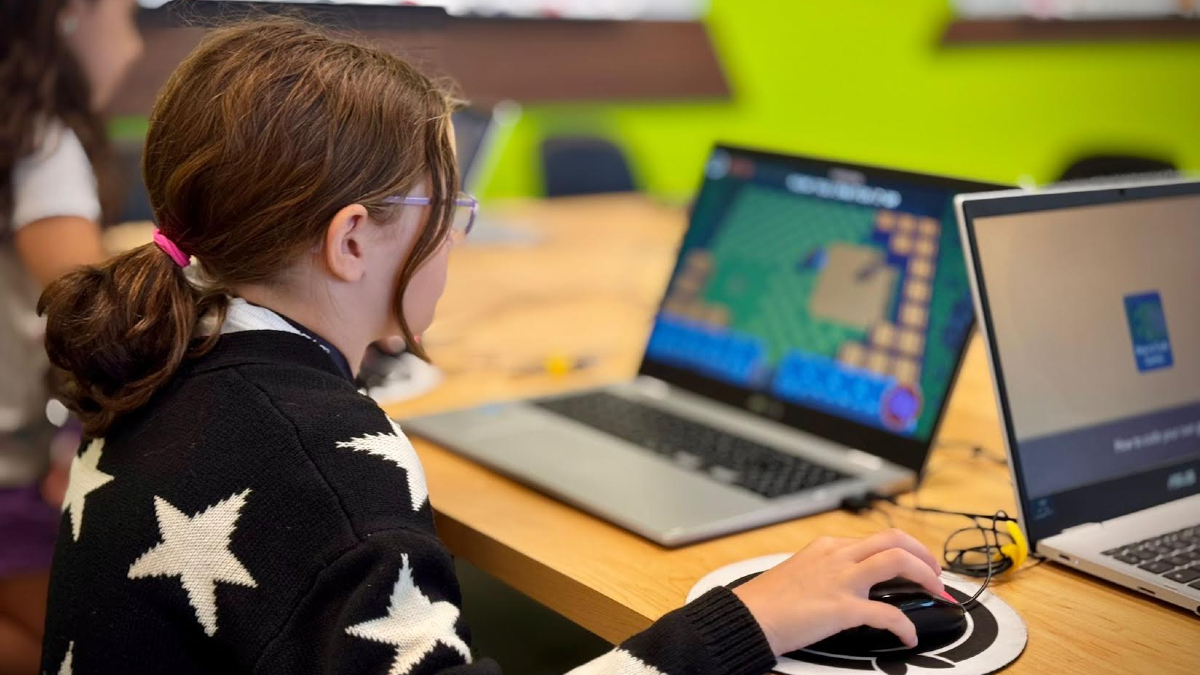
For many children, an interest in game development begins with playing Roblox or Minecraft. What starts as a way to spend time with friends can become an interest in building games themselves.
Platforms like Roblox and Minecraft are important gateways into game creation for children, according to Ed Kim, the vice president of education and training at Code Ninjas.
“They tend to be in that area of where it’s the first exposure a kid has to any kind of game or any discovery of their passion,” Kim said. “They’re going to meet their first friends. They’re going to get together on Roblox, on Minecraft, things like that.”
Kim says children use that early interest to explore programming languages, customize assets, and create mods. He has also seen their gaming interests broaden into other titles, but the creative step comes when they begin looking beyond playing and experimenting with the platforms themselves. Some move into Unity and Godot, learning C# and experimenting with game-making tools.
“It’s now, ‘I’ve learned how to play around and I’ve been a player in these kid games. I want to now build my own,’” he said.
Learning to create, not just code
Kim believes the benefits of game development extend beyond technical knowledge. Making a game teaches children to organize ideas and work through failure. They start with something they want to build, then work backwards to identify what they need.
“They’ll learn how to plan. They’ll learn how to storyboard. They’ll learn how to do things in order to fail, to go back and try different pieces,” he explained.
The fundamentals can be introduced early, Kim says five-to-seven-year-olds can develop computer skills and encounter loops and if-then conditionals through playful activities. By seven or eight, some are ready for formal coding; a few progress to JavaScript because they find block-based coding too boring.
He stresses that the foundations involve more than programming. Mathematics, counting, colour recognition, spelling and written language all contribute, alongside engineering and creativity.
Parents have a role to play
Parents also have an important role in encouraging children to explore technology, although Kim suggests they don’t need to be experts themselves. Instead, he encourages them to show curiosity about what their children are creating and be willing to admit when they don’t understand something.
“Be curious in a very open way about what your kid’s doing, and also be very blatantly obvious about what you don’t know how to do,” he said.
He suggests asking children: “Hey, I have no idea how to do this. I think you do. Can you show me?” That lets the child take the lead and brings parents into the conversation about their online activities.
Kim acknowledges that parental controls have improved, but says they aren’t perfect. Protecting children online remains difficult, making parental involvement important for both encouraging creativity and guiding their experiences.
AI won’t make coding skills irrelevant
Artificial intelligence is changing who can create software and how much technical knowledge is required. Kim believes programming skills will remain important, although the number of people needed to perform certain technical tasks might decrease.
People who understand the inner workings of systems will still be necessary. Kim says AI tools have allowed him to start building code himself.
“I’m now able to build code on my own, and I just need maybe one software engineer to check my final product because I have Claude,” he said.
He is clear that using AI doesn’t make him an expert. He would still want an experienced engineer to review his work before it goes into production. People still need to assess what AI produces, not simply ask it to produce something.
The future could belong to independent creators
Kim expects AI to lower the barriers to entering game development, creating more opportunities for independent creators who previously lacked the resources to compete with established studios. Creators will have more tools and fewer of the restrictions associated with a large studio.
But he also raises a question he feels deserves more attention: if AI reduces employment opportunities while allowing more people to create content, who will have the money to support those creators?
“What happens to wealth generation when everyone’s creating and they don’t have jobs?” he asked. “Everyone’s doing their own job, what money are they going to use to buy what other people are creating?”
But easier production won’t guarantee an audience or a sustainable business; funding creative work matters just as much.
Preparing children for a different future
Kim’s biggest concern is whether education is keeping pace with the technological changes shaping the next generation’s lives. Children need to be prepared for a world increasingly shaped by AI, requiring schools to rethink how they teach.
“We as a society have to get back to educating kids, because now that AI, I think, is a game changer,” he said. He believes preparing the next generation will also support adults as society adjusts to the technology. He also argues that education needs to regain its place in public priorities, rather than allowing the wider turmoil of the moment to distract from the needs of children.
One of the things Kim finds most encouraging is that children maintain their enthusiasm for learning and creating, filtering out much of the noise and negativity around them.
“It’s a blessing to be able to see that kids are able to ignore all that noise,” he said. Their interests remain important enough that they can “organically” filter it out.
For Kim, preserving that curiosity is an important part of preparing children for the future. Whether their first experience comes through Roblox, Minecraft or a platform yet to be invented, the opportunity is to help them move beyond playing games and discover the possibilities of creating them.