

General Intuition raised $320 million at $2.3 billion valuation to use gameplay data to build more robust AI frontier models.
A sister company of the game social media firm Medal, General Intuition mines Medal‘s clips data — which gamers post as video clips to share their gaming prowess — to provide insights for building game worlds with cool AI technology, and it also provides data so AI models can be smarter and more realistic in helping robots understand the real world.
Ultimately, General Intuition also wants to create AI agents that inhabit imaginary worlds, and as it does so, the company promises it will not replace human workers with AI. I heard it first hand in an exclusive interview with Pim de Witte, CEO of General Intuition.
That may sound esoteric to gamers, but clearly some of the biggest AI investors, AI model companies and others see the value that General Intuition is generating, even with a team as small as 25 people.
The funding round

The funding, which was completed in January 2026, comes on the heels of a $133.7 million round that General Intuition announced a little more than a year ago.
Khosla Ventures led the latest January round of $320 million, just as it had with the $133.7 million round. It took around six to eight weeks to close the round.
Others investors include General Catalyst, Hedosophia, Jeff Bezos, Eric Schmidt and Nico Rosberg. And more investors include cofounders of Remote, Cradle, as well as researchers at Google Deepmind and MIT.
Based on research progress since January, General Intuition is currently in conversations for an additional Series B round beyond the $320 million investment, de Witte said.
“The context is GPUs are expensive,” said de Witte.
He was half joking, but he noted that General Intuition needs a lot of GPUs and it makes most sense to rent them and lock them in for long periods of time. The good news is that there is a reason that the company needs more GPUs — because it’s making progress.
“For us, the reality is the progress was really good. It was much faster than expected. We managed to transfer into real-world robots much faster than we realized that we could,” he said.
The company created its own frontier model for AI that could be used to train robots how to operate in the real world. To do that, it taps the data of games, such as actions where a player has to make fast decisions with a gaming character in motion.
“We don’t build models that predict pixels or compete with game developers. We build models that predict actions — the actions people take inside video games, as opposed to the art or anything like that,” de Witte said.
The company said it focuses on building a new class of frontier models that can perceive, predict, and act in any environment. General Intuition believes that world models are just one part of the journey toward the ultimate goal: building agents that can solve any problem in simulation or the real world.
General Intuition was not spun out of Medal; the two companies operate under a shared parent company.
“Most AI today has learned to see the world. The harder and more valuable problem is teaching it to predict what happens when someone acts in it, both the physics of the world and human intuition,” said Vinod Khosla, founding partner of Khosla Ventures, in a statement. “We’ve had LLM’s, multi-modal models, World Models, but what comes next? Large action models are the next big leap. This category will produce several of the most valuable companies in AI, and General Intuition is built to lead them.”
De Witte said he was grateful to have the investors supporting him.
“A lot of doors open when you get to work with these people,” he said. “I think building a company is in many ways about building optionality on possible features. And so when you, when you get to work with people that can open doors, it generally is very good for business.”
Unlocking machine intelligence for the real world
General Intuition is the frontier lab for acting in space and time. This spans virtual environments like video games and the physical world. It’s not unlike what Arkadium recently announced, where it will contribute data from gamers who play its puzzle games to make AI models more intelligent when it comes to human reasoning.
De Witte said the company is raising the funding in part to acquire graphics processing units (GPUs) for AI computing that can in turn be used to build a new class of frontier models which enable agents or physical robots to perceive, predict, and act in any environment.
To accomplish this, General Intuition is distilling the ability to navigate space and time from millions of human gamers into a single AI model; one model for many different embodiments and environments, both virtual and physical.
The company already has a lot of player data uploaded from Medal, but it has also onboarded its first partners across games, simulation, and robotics to its commercial API and will be selectively working with a few companies ahead of the release of the model.
“We are expanding our team and looking for the world’s top research scientists and engineers,” the company said.
Generating worlds and actions
World models predict how environments evolve, given actions. Action models do the opposite: they generate optimal actions, given observations of an environment.
It’s what humans do every day when acting in the real world. We take in our surroundings, consider our goals, predict the future, and decide what to do next. In real time.
Human activities in video games, on a large scale and with diversity, provide strong pre-training data for real-time human intuition. General Intuition builds action models and world models.
I asked how gaming was useful for robots.
De Witte replied, “Gaming has a lot of just spatial reasoning information, and the real world doesn’t really have that information. Think about, for example, when you’re moving your mouse. You’re actually simulating eye movement, and how would you get that from, like, real world information, right? You wouldn’t be able to get it, even if you had a camera on your forehead. So, there’s just a lot of information that is very obvious when you play video games that is incredibly useful for spatial world reasoning. And so our models, as a result, are just incredibly good at specifically spatial temporal reasoning.”
How much data do the frontier models need? It’s about an order of magnitude or two less than is required for the largest AI foundational models, like Claude or ChatGPT, he said. And the models are more efficient because the data is useful, he said.
I asked why Medal’s data is more useful. De Witte said the model needs a very diverse set and horizontal and broad data set. That works well for spatial reasoning. I asked how some of the things that Jensen Huang, CEO of Nvidia, is saying relate to what General Intuition is doing, in terms of the evolution of AI toward reasoning.
“I think what he’s saying is that if you’ve ingested a lot of data, then search is the next interesting thing. How do you search that data? That is, reasoning for the most optimal answer? He’s mainly just saying that things are shifting from pre-training to inference time compute or searching the possible options in the space. We’re still very much in the pre-training stage, because we have a new data set. So it’s applicable in the sense that we can implement a lot of those methods, and I think it’s broadly where the industry is going.”
Pushing the frontier, on unique training grounds
As far as what AI can do for games, de Witte told me last year that visual knowledge was extremely useful. You could have AI characters that could look at a door in a world and realize it was something they could open, based on their reasoning capability. Such characters could be so much more realistic.
“When you’re playing, say, PUBG, do you want to play against bots that already know your location and know where you’re hiding, because they have access to the state information of the game? You don’t want that, right? You want to play against things that have the same constraints as you. Otherwise, the game developers have to nerf the capabilities of those bots,” he said. “You get this state where the bots suck. You get this really weird middle ground where they’re really good at some things, and the other things they are so good at that you have to nerf them because otherwise they would just be running around the map, shooting everyone.”
He added, “The design space for for intelligence inside video games today is just deeply broken, and I think we can fix that.”
An ethical approach to AI
“To me, it’s been quite obvious for a few years that the game industry has a really good chance to have a winning hand here, but in many ways we’re holding ourselves back by being overly critical of technology that is going to happen [at fast pace],” he said.
I noted that in the past year, the resistance to AI has gotten worse, both inside the game developer community and among general gamers.
“To a certain degree, it’s rightfully so, because AI hasn’t really done anything for games yet,” De Witte said. “Two things are true. Gamers are rightfully upset because AI has only taken from us, right? It hasn’t yet enabled new things. It hasn’t enabled what it’s promised. At the same time, that doesn’t mean that you shoot new ideas in the foot. In my opinion, both of those things are true.”
He said game developers need to build things that are great for gamers.
“That is what we intend to do, and then also it’s true that we should embrace new technologies, because if we don’t, then we’re not going to economically be able to compete with the AI industry, and therefore have access to the memory, and the things like that,” he said.
He added, “You’re part of a global system. You have to be in the fire. Otherwise, you get chewed up.”
I noted that we should not wait for Nvidia’s Huang to take his foot off the gas pedal. It’s more like the game industry needs to step on the gas instead.
De Witte nodded at that.
“Here’s the question that I would pose: Do you really want multi-trillion dollar companies to own that, or do you want a bunch of cool game developers who currently are being criticized to have a shot at this, and I would argue the latter is much better,” he said.
A sidetrack that isn’t a sidetrack on the memory chip shortage
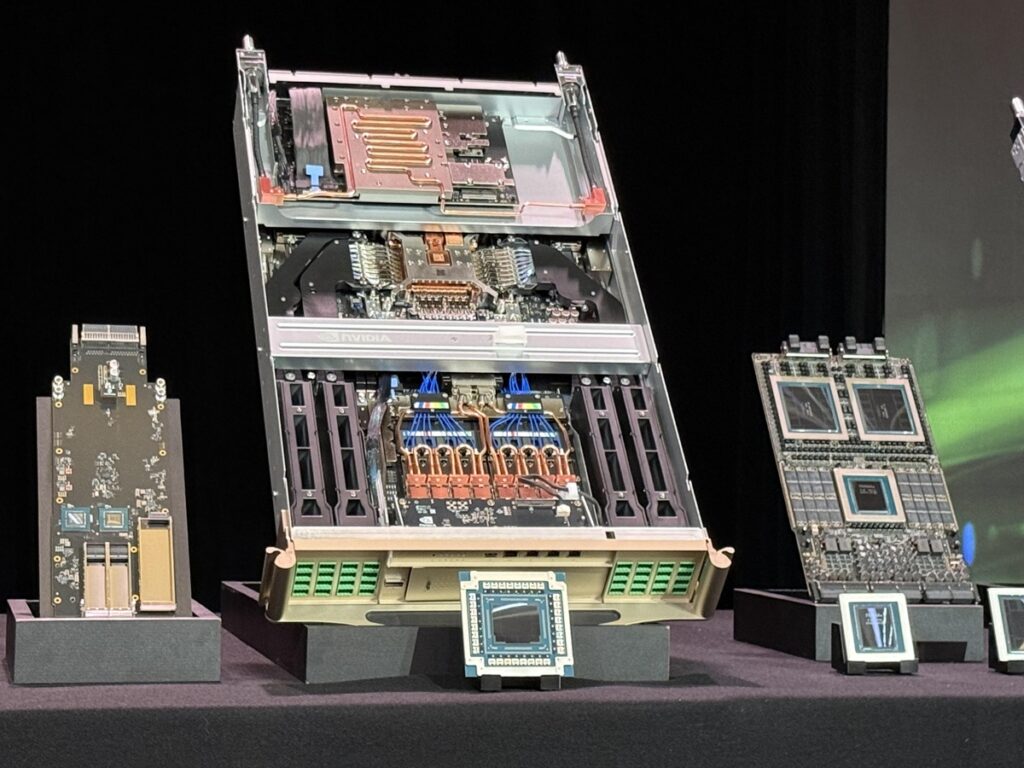
De Witte said he is very concerned that gamers are suffering from higher prices for gaming PCs and game consoles, thanks to the shortage of memory that is resulting from the huge demand for AI chips. He noted that the best investment chip makers can still make right now is pouring their money into making chip factories that churn out AI processors or AI memory.
No one among the chip makers is incentivized to pour capital into making factories for lower-priced memory chips that go into game machines. They’re going to make chips for the highest bidder, and that’s always going to be the AI companies. It’s not clear when this problem will get fixed.
But he had a novel idea on how gaming can climb out of this problem.
“The way that you fix this is build such good video games that everybody all of a sudden wants to pay more for them [or for the hardware],” he said. “If you think about it, the way you fix this is to give the gaming industry more economic buying power and give gamers more economic power, and obviously unblock the supply chain bottlenecks.”
On top of that, General Intuition should make the best AI models possible that can benefit games. As the efficiency of the processing gets better, so do the models, and so do the games that rely upon those models, De Witte said.
“Then the games get better, and then the value of video games go up. It’s like a loop. The way you fix it is economically,” De Witte said.
The state of gaming and the big opportunity: It’s the data, stupid

The upshot of this is that people are going to both create and play more video games, De Witte said.
“What that means is that you definitely want to be in the games industry, and you definitely want to weather the storm in the game industry. So, Medal is still a really big priority for us, but next to that, the foundation models are much more relevant today economically,” he said. “So they reinforce each other in a good way. I feel very strongly that the games industry is going to grow a lot. I’d rather solidify our position in the games industry.”
I asked him how things can get better in the game industry. He said games have a barrier in trying to access the broader market. Distribution is a problem, he said, and discovery is bad. Some categories like Roblox games are still going viral, but quality needs to get better. He noted that Medal is really trying to nail discoverability.
“We need more games with like really good core mechanics, like Valorant, right? People will download games that really nail a specific mechanic,” de Witte said. “They do really, really well where a core audience loves that type of game. I think we also need new genres, and I hope that that AI and our models are going to actually enable new genres. We, we basically need to expand the definition of the games industry and the types of games we build.”
I asked if Medal’s data was skewed because players only upload their victories in gameplay, not their worst matches. But de Witte said that is a shallow knock on Medal and his company has access to all sorts of data, including the action data from games.
“The reality is just that no data exists here, and it’s better to start with a very large data sets and work your way forward from there than it is to start with a small data set and try to solve the same problems,” de Witte said.
As far as de Witte knows, no other parties are collecting as much useful data, and that’s why General Intuition is valuable.
“We were so public about [saying that data is valuable] because we wanted the games industry to rise up. We purposely put all cards to the table around what the capability of data was because we knew that it was going to take an entire industry in order to compete in AI,” de Witte said. “In many ways, this data was the motivation for starting to research this as a problem space. You solve economic problems by creating more opportunities, and so we made the choice that we were going to openly share these opportunities, so that other gaming companies could get out of situations that may be unfavorable for them.”
He added, “I did all the interviews and podcasts. The reason why I did that is because I knew that if the games industry collaborates and moves towards this, then we can actually rival the AI industry in terms of economic impact. And that, so all that was on purpose.”
Hiring
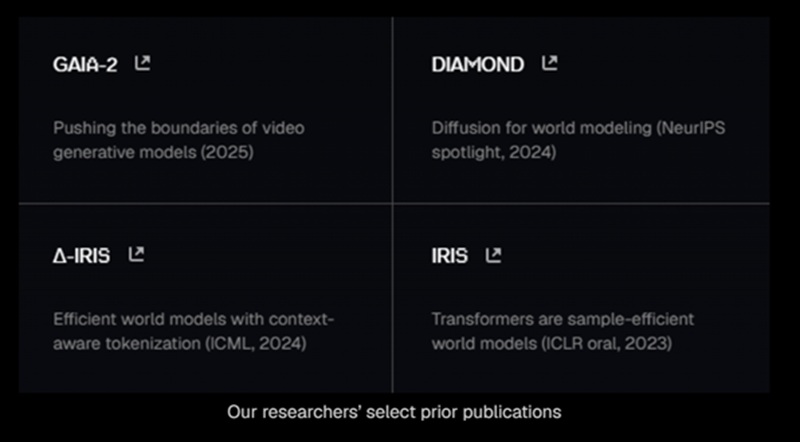
The company’s researchers are the research team behind the Diamond diffusion world model, IRIS and Δ-IRIS world models, and GAIA-2 generative models for automated driving.
“We’re hiring the best engineers and researchers in the world, but we’re not in a rush,” de Witte said.
The company is specifically hiring ambitious researchers and engineers with experience in games, consumer, mobile, social, video, and large-scale model training and data processing, the company said. De Witte said he wants people who can help figure out the problems that he has pointed out and who can take the game industry to where it needs to be to grow.
The company is inviting folks to meet the team and see our models and research results in person at ICML in Seoul, July 6–11, or visit the company at its offices in New York, Geneva, London, or Paris.