
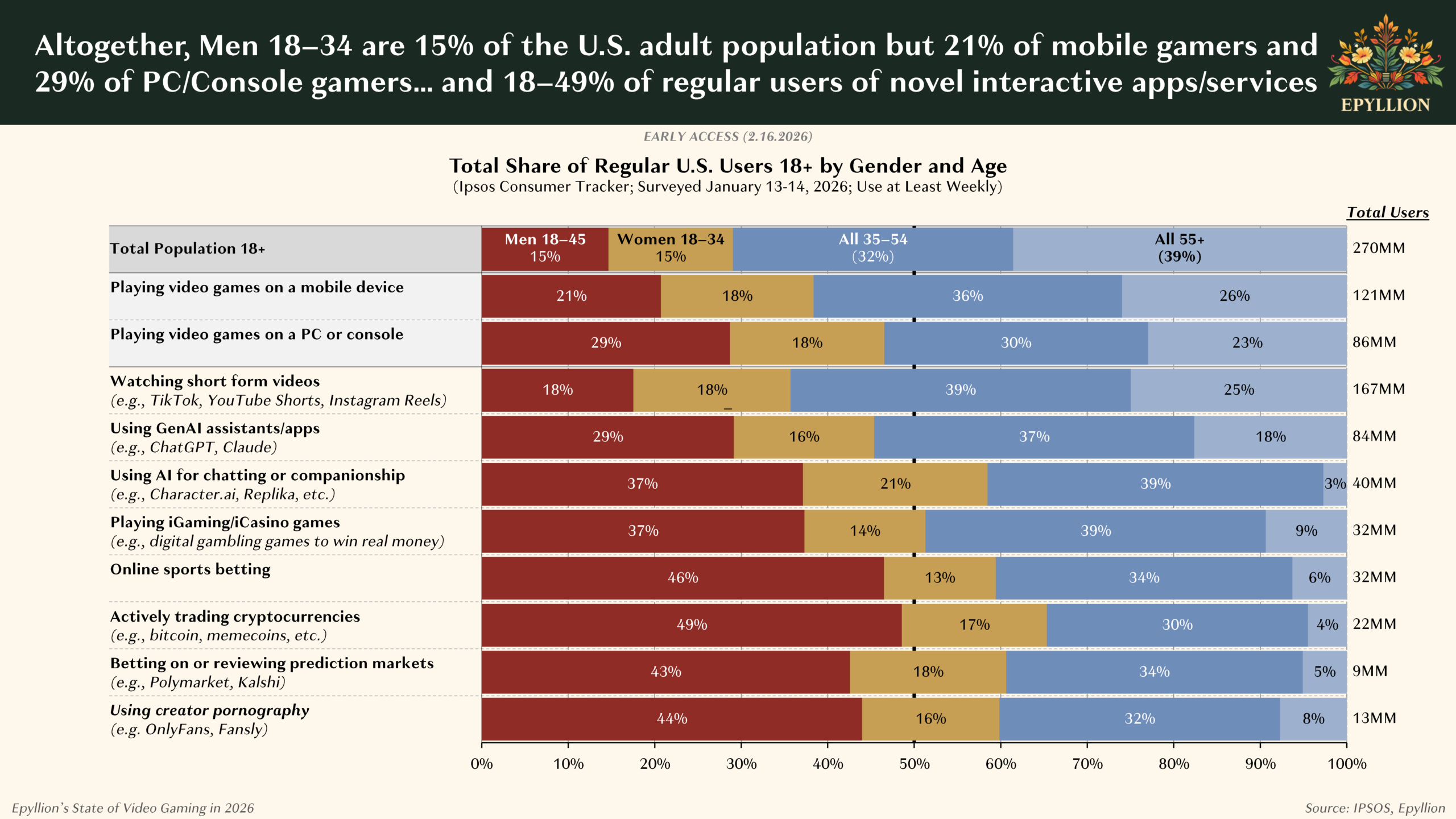
A new report from gaming industry observer and analyst Matthew Ball highlights how the industry has splintered over the past year.
Ball, the CEO of Epyllion and Amazon Studios’ former head of strategy, has observed the gaming industry with clear eyes since 2018, self-publishing reports, essays and even books on topics from gaming to the metaverse and the broader attention economy.
In January 2025, Ball published his first State of Video Gaming presentation, which charted the industry’s post-pandemic slump. Today, February 17, Ball released his second annual State of Video Gaming presentation. This time around, he is taking the analysis a step further by looking to reframe how observers, analysts, and other stakeholders view the structure of the industry itself.
To Ball, gaming is no longer a cohesive industry in 2026. Instead, the space has evolved into an interwoven ecosystem of interactive entertainment, with some sectors stagnating and others greatly benefiting from changing user behaviors and other industry dynamics.
GamesBeat received an advance copy of the new presentation and spoke to Ball about some of the findings. Here are the key takeaways.
Roblox is additive to the industry — and crucial for its growth
Ball’s 2026 State of Video Gaming presentation flagged that Roblox accounted for an eye-popping 67 percent of net industry growth and over 4.5 percent of non-China spend in 2025. The narrative that gaming is a growing industry is significantly propped up by the rise of Roblox. Ball’s report lists five specific growth areas as the biggest for gaming in 2026: growth in non-core markets, advertising, webshops and D2C payments, external development — and Roblox. At the moment, average quarterly Roblox engagement is equivalent to the combined engagement on Steam, PlayStation and Fortnite, per the report.
“Roblox has taken some players, play hours, and dollars from other games, but I suspect the majority of the revenues that Roblox collects would not have existed without it,” Ball said in a written interview with GamesBeat.
China’s rise is an existential issue for Western game companies
In recent years, a significant amount of non-Chinese spending in the gaming market actually came from Chinese gamers who used VPNs to access and purchase games on Steam through foreign markets — a phenomenon highlighted by Ball’s report. Although this is not inherently bad news for Western game makers, the report flagged that the market is headed for a potential reckoning in 2026, with Chinese users disengaging from Steam in favor of local alternatives at an unprecedented level. By the end of 2025, Chinese-language PC gamers accounted for their lowest share of Steam users since May 2022.
“I suspect the strength of the Chinese development ecosystem — and a general domestic preference for homegrown/home-targeted titles — is making imports less lucrative, and thus attractive to Chinese publishers,” Ball said.
Despite growing revenue, industry profits are decreasing
Global video game content sales reached an all-time high of $195.6 billion in 2025, representing 5.3 percent year-over-year growth. Yet in spite of this growth, total operating profits for the industry are lower than they were in 2019, according to Ball’s report. As game makers scramble to fix their business models and make up some of this lost ground, workers in the gaming industry are taking the brunt of the hit, with a total of 44,000 industry layoffs over the past four years. Private funding for new game studios continues to shrink, too.
Roblox dominates the user-generated content space — for now
Although other players like Fortnite and Minecraft have a significant hand in the growing user-generated content market, no other UGC platform holds a candle to the user base and skyrocketing engagement of Roblox in 2026. However, Ball cautioned that Roblox is not yet dominant within the broader gaming market, in part because it skews to younger players who tend to age out of the platform.
“Roblox has an extraordinary two-sided marketplace, massive economy and a suite of easy-to-use and fast-to-deploy tools,” Ball said. “These are hard to overcome, but I think it’s flawed to assume the company cannot be beaten or surpassed. Indeed, Roblox’s annual R&D of $1.6 billion suggests the company is working very hard to keep its crown.”
Broader societal effects are impacting the gaming industry
In his 2026 State of Video Gaming presentation, Ball dedicates an entire section to the broader societal effects that are having an increasingly significant downstream impact on gaming. More than ever before, gaming companies are finding themselves in direct competition with other forms of interactive entertainment, from gambling and iGaming to prediction markets and short-form social video.
In the past, some observers have viewed gaming as relatively recession-proof because video games provide consumers with an extensive amount of entertainment for a fixed cost. But as cost of living increases soak up more of consumers’ free time and spending money, and consumers cut back on all forms of leisure spending, gaming is increasingly competing against other forms of media that provide extended entertainment for a relatively low price.
“These alternatives, though not ‘games,’ do offer varying degrees of skill mastery and social play,” Ball said “They are also, in many cases, far more addictive than video games — and also highly effective at postponing and interrupting game time. They also accumulate hundreds of billions of hours and spend that has to come from somewhere.”