
Jam City and WikiGameJam are looking to leverage the considerable social impact of gaming for the greater good.
Media isn’t just a moneymaker. It has long been a powerful tool to educate and sway large groups of people, from Upton Sinclair’s “The Jungle” to Donald Glover’s “This Is America.” Games have arguably lagged behind other forms of media as a driver of social change — but Jam City and WikiGameJam are out to change that by hosting game jams intended to both educate a diverse range of new game developers and drive players back to Wikipedia as both readers and contributors.
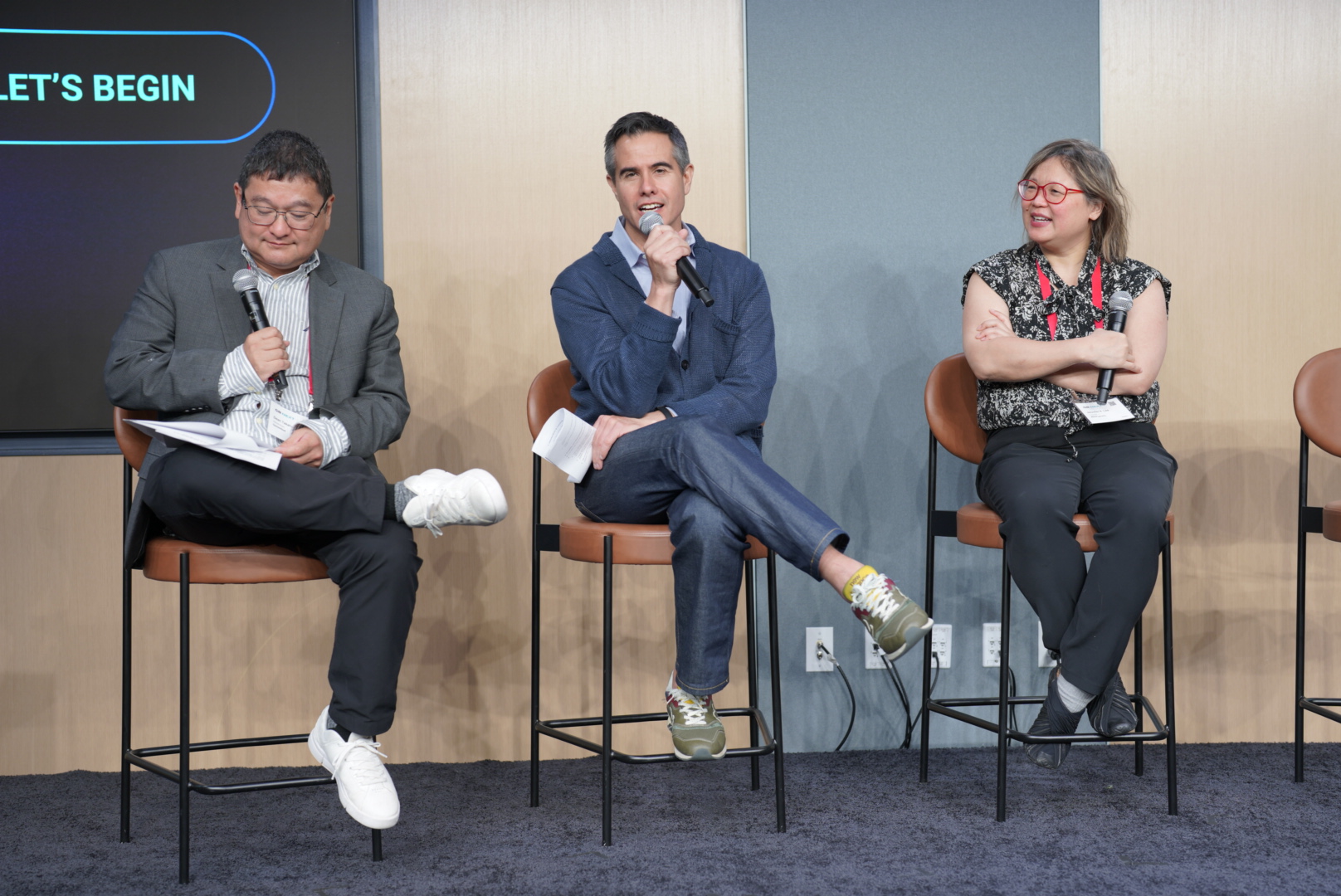
At GamesBeat Next 2025 last week, Jam City CEO and co-founder Josh Yguado and WikiGameJam co-founder Jennifer 8. Lee sat down with GamesBeat’s Dean Takahashi to discuss the vision and goals behind their game jam initiative. Here are some of the key takeaways.
Games are a powerful gateway to civic participation
Yguado and Lee agreed that games can help people engage with civic issues in a relatively low-friction, low-pressure way. Registrations of new editors on Wikipedia have decreased by 35 percent since 2019, per Lee, and the purpose of Wikipedia’s game jams is explicitly to help increase these numbers. Instead of doing a standard registration or recruitment drive, the organization decided to take a different approach for its first-ever game jam — which took place in Brooklyn last month — encouraging game developers to use Wikipedia content to make games with the goal of introducing them to the platform and making them feel more comfortable using it down the line.
“There are game jams in many different places all the time, but the fact that it was a WikiGameJam, I think, brought out a new population,” Lee said during the panel discussion.
Wikipedia’s mission aligns naturally with game design
As unlikely as an alignment between Wikipedia and gaming might seem, Lee flagged a number of similarities between gaming and wiki activity that explained why Wikipedia is hopeful that game jams could eventually bring new blood into its editor community. She flagged numerous gamification elements present on the platform — like the badges and so-called “barn stars” editors can earn for their contributions — and drew parallels between ascending Wikipedia’s org structure and leveling up in games.
“I’ve heard from many people that it feels like you’re in a video game — but you’re kind of in the video game of knowledge,” she said.
Collaboration between tech, non-profits and creators works
Jam City provided key support for both the initial WikiGameJam in Brooklyn last month and a second WikiGameJam event in San Francisco on November 15, both by helping fund the event and by sending some of its own engineering staff to join the participating teams. Jam City engineers worked directly alongside Wikipedians, indie developers and students to raise the overall technical quality of the prototypes and provide feedback on participants’ ideas. In addition to strengthening Jam City’s reputation as a purpose-driven studio and building goodwill with the Wikipedia community, participating in the game jam exposed Jam City to a wealth of new ideas and design spaces, according to Yguado.
“The idea of being able to work with Wikipedia to support this cause was aligned with Jam City’s goal of not just bringing joy and connection to the world, but also civic engagement and involvement,” Yguado said during the panel.
Younger audiences need new forms of civic engagement
As younger audiences’ media consumption behavior shifts away from other formats and toward gaming, anyone looking to drive social change among younger demographics needs to be following this behavior and adjusting their messaging strategy accordingly, per Yguado, who said that the medium has inherent benefits to help build empathy and understanding.
“Everyone plays games; it’s a form of media that reaches billions of people, and I think with that comes a little bit of responsibility and a little bit of opportunity,” he said. “At jam city, and also through some of my personal endeavors, we’ve been trying to find different ways to use that medium in an interesting way. And I think games, in particular, are first-person — they tend to put you in a position where you can be a little bit more empathetic, and understand the position of the characters of the world that you’re in.”