

Later this year, Epic Games will start giving Fortnite creators new ways to earn money, expanding the platform’s creator economy to rival ecosystems like Roblox.
Starting in December, developers will be able to sell digital items (both durable and consumable) directly from their Fortnite games, otherwise known as islands. This is limited to digital items only, and all sales must follow the Island Creator Rules. It’s the first time Fortnite has opened up this type of revenue stream, signaling a major shift in how players and creators interact with content.
The plan, reportedly, is to first offer higher percentage payouts on sales until the end of 2026, at which point the percentage of revenue distributed to creators will decrease.
From December 2025 through the end of 2026, developers will keep 100% of the V-Bucks value from in-game transactions, which is equivalent to roughly 74% of retail spend after subtracting platform and store fees, and dividing it by the total V-Bucks spent by players.
That represents a meaningful new revenue stream on top of existing engagement payouts, which have already helped Fortnite creators earn more than $722 million to date across 260,000 live islands since Unreal Editor for Fortnite (UEFN) launched, according to Epic Games.
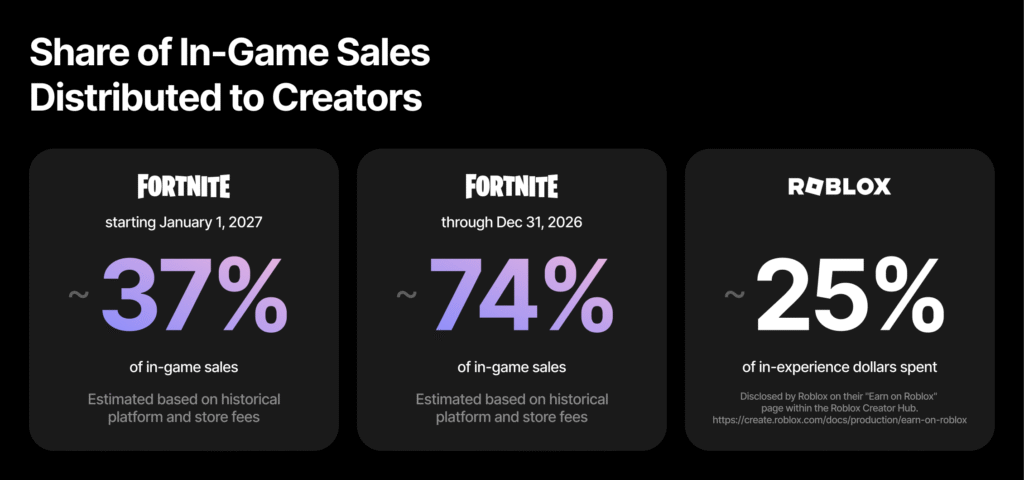
Notably, Epic Games specifically compares its payout structure to that of competitor Roblox. According to the Earn on Roblox webpage, approximately 25% of in-experience purchases are distributed to creators, compared to approximately 74% for Fortnite once the feature launches. As stated, that payout will decrease to approximately 37% starting in 2027.
Speaking of existing engagement payouts, that formula is getting updated to offer higher payouts as well. Starting November 1, 2025, creators who bring in new or lapsed
players will receive 75% of those players’ contributions to the engagement payout pool for their first six months. And when calculating player retention, the engagement payouts will now attribute island-specific retention bonuses. This formula will now cover minutes played, new user acquisition, lapsed user acquisition, playtime around V-Bucks spent, and island retention.
Additionally, in November, Epic is also adding a new “Sponsored Row” in the Discover tab on Fortnite so that creators can choose to spend money to increase visibility for their islands using transparent market data. Until the end of 2026, all sponsorship revenue generated by the new “Sponsored Row” will go into the engagement payout pool, at which point it will drop to 50% of all sponsorship revenue.
According to a press release provided by Epic Games, the company continues to invest in and operate the business at a loss. The goal of these new revenue streams is to use those funds to help “cover the costs of servicing the Fortnite ecosystem,” as it continues to grow and evolve.
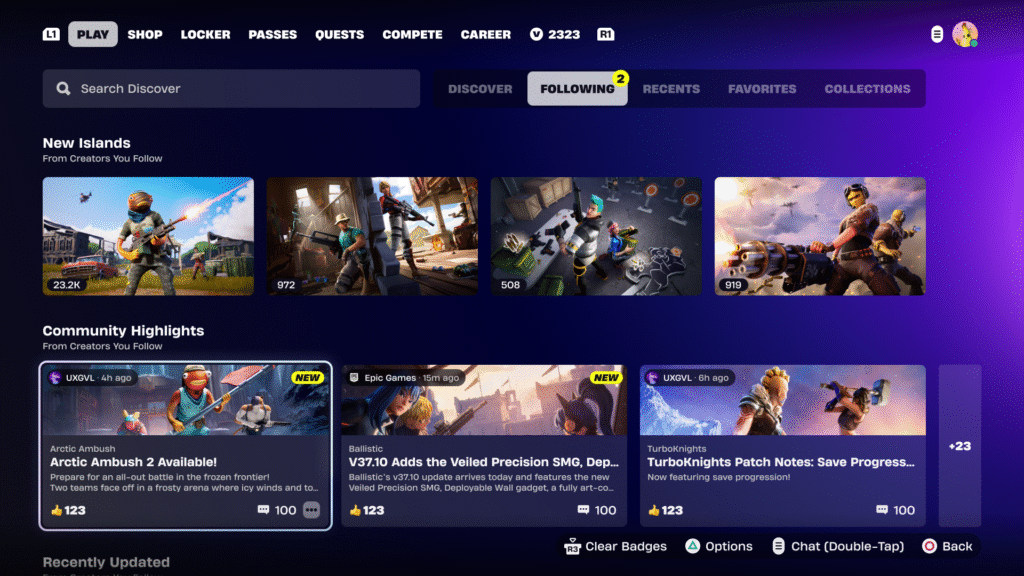
Beyond monetization, Epic is rolling out new ways for creators to connect with their communities. A feature called Creator Communities will allow developers to share updates, post event announcements, and gather feedback directly from players inside Fortnite and on the web. Posts will appear in island lobbies, creator pages, and even a new Discover row, with players able to react and engage with updates.
Taken together, these updates deepen Fortnite’s evolution from a battle royale game into a full-fledged creator economy. Epic is clearly positioning Fortnite as a direct competitor to platforms like Roblox, which already allow developers to monetize their creations at scale. By giving creators not just payouts for engagement but now direct sales, advertising options, and dedicated community tools, Epic is broadening the scope of what it means to build inside Fortnite.
The added context that Epic continues to operate the game at a loss highlights the gamble Epic is making: it’s investing heavily in creators now in hopes of driving long-term growth, retention, and cultural relevance beyond even what it’s already achieved.