

Lenovo today announced it is delivering a near real-time AI-powered infrastructure platform for the FIFA World Cup 2026 to enable ultra-low-latency IPTV (Internet Protocol Television) video distribution for World Cup games this summer.
Lenovo and FIFA are also working on the traditional cable and satellite broadcast, intelligent content delivery, and mission-critical decision-making across the event ecosystem and operations.
As the world’s largest sporting event prepares for an unprecedented scale—spanning three host countries, featuring 48 teams, and engaging an estimated 6 billion fans—FIFA, broadcasters, and event operators will benefit from a live, always-on environment designed to perform at the highest level.
As FIFA’s Official Technology Partner, Lenovo will deploy servers at the International Broadcast Center in Dallas, Texas, to help deliver the computing power, devices, and AI-driven solutions needed to bring every moment of every match to global audiences and support the most expansive broadcast operation in FIFA World Cup history. More than 17,000 Lenovo and Motorola devices and 200+ engineers deployed across venues and Team Base Camp training sites will help ensure professional execution.
Lenovo’s technology solutions have reduced latency within IPTV infrastructure for the global showpiece, with IPTV delays now under five seconds, enabling near real-time access to live match action and more synchronized viewing experiences.
Lenovo ThinkSystem SR635 V3 servers and technology will help manage massive volumes of live video data coming in from stadiums across North America and power FIFA’s IPTV live feed by ingesting, processing, and distributing all match content in close to real-time via ten channels to over 1,000 screens throughout FIFA venues. Fans, media, VIPs and officials will quickly be able to access every match from anywhere within the event ecosystem, from fan zones to media tribunes.
An AI Nerve Center for the World’s Biggest Sporting Event
Beyond broadcast, Lenovo’s technology will be deployed at FIFA’s Technology Command Center in Miami and the Tournament Operation Center for the duration of FIFA World Cup 2026.
This hub serves as the central “mission control” for the World Cup, where all the technology powering the games is monitored and managed in near real-time by experienced engineers and FIFA management. With the help of Lenovo’s enterprise solutions, FIFA’s Technology Command Center and Tournament Operation Center will ensure tournament organizers are able to swiftly observe, and if needed, address operational matters across the tournament footprint.
“Lenovo’s AI infrastructure is redefining the FIFA World Cup experience, delivering near real-time highlights, multi-angle views, and insights at unprecedented global scale,” said Ashley Gorakhpurwalla, president of Infrastructure Solutions at Lenovo, in a statement. “Together with FIFA, we are running AI under the world’s most demanding conditions—solving latency concerns and bringing billions of fans closer to the action than ever before, setting a new standard for live sports.”
“The FIFA World Cup is one of the largest and most complex sporting event in the world,” said Nacho Fresco, director of technology at FIFA, in a statement. “With this edition set to be the biggest in history, delivering exceptional operational efficiency and cutting-edge technology is critical. Lenovo is a key partner in helping us meet the stringent low-latency requirements essential for live production environments.”
Powering the World’s Biggest Stage
FIFA World Cup 2026 showcases the real-world AI advancements Lenovo is making possible. Lenovo will manage complex on-premise edge computing, significantly reducing latency, where cloud-only solutions failed to meet broadcast requirements. During the World Cup, technologies powered by Lenovo ThinkSystem servers, engineered for high-density, mission critical environments requiring massive throughput, and near real-time operational performance will support:
- Near real-time monitoring of stadium and tournament wide tech systems
- Live broadcast, streaming, and IPTV delivery
- Rapid incident detection and issue resolution to minimize disruption and downtime
Enhancing the Fan Experience with Real-Time Insight and Transparency
Lenovo is enabling a more immersive and understandable viewing experience through AI-driven innovations. AI-enabled 3D player avatars provide clearer, real-time visualization of complex decisions such as offside calls. Built using advanced GenAI and real-world player data, these avatars are designed to help fans better understand the game as it happens. These avatars will also be an additional value input to support FIFA’s Match Officials in their offside decision-making during matches. The tech for offsides calls was tested at youth tournaments.
To improve the in-venue experience across three countries, Lenovo is deploying solutions designed to enhance safety, efficiency, and engagement:
- AI-driven navigation systems reduce congestion and improve movement across venues.
- AI-driven stabilized “Referee Views” deliver first-person perspectives with up to 50% less motion distortion.
- Immersive digital and holographic experiences create new ways for fans to engage with the game.
Leveling the Playing Field Through Smarter Football for All
Lenovo is actively transforming the sports industry and remains committed to democratizing football through its “Smarter AI for All” vision. With the FIFA World Cup 2026, Lenovo will deploy the FIFA AI Pro platform, a next-generation AI-powered knowledge assistant delivering tactical insights to coaches, players, and analysts. Built using Lenovo’s AI Factory, the platform will be provided to all 48 teams competing in the tournament, democratizing access to elite-level analytics and helping level the competitive playing field.
Bringing the Tournament Home with Special Edition Collections
For fans of the game, Lenovo is offering a unique way to showcase their passion through a collection of FIFA Special Edition devices across its commercial, consumer, and gaming portfolios. Featuring exclusive FIFA World Cup 2026™ branding and packaging, the lineup includes the Motorola Razr FIFA World Cup 26th Edition, ThinkPad X9-14 Gen 1, ThinkPad X1 Carbon Gen 13 and 14, Yoga Slim 7i ultra Aura Edition (14”, 11), Idea Tab, and the Lenovo Legion Pro 7i (16”, 10). These limited-edition models allow fans to carry a piece of the world’s largest sporting event with them, long after the final whistle.
The scale and complexity of these operations reflect Lenovo’s broader investment in sports technology. In March, Lenovo launched a dedicated sports vertical designed to support organizations operating live, global, and mission-critical environments. By integrating AI infrastructure, edge computing, devices, and services into a unified model, Lenovo is enabling sports organizations to move from fragmented systems to real-time, end-to-end operational control.
As the Official Technology Partner of FIFA, Lenovo is powering the biggest event in the history of humanity. FIFA trusts Lenovo to deliver the tournament’s end-to-end technology backbone from AI devices to infrastructure and solutions, to provide immersive and unique fan experiences and provide unprecedented access to data and analytics for the 48 competing teams. Visit the FIFA page on Lenovo.com to see Lenovo in action at the World Cup.
Press briefing on the details
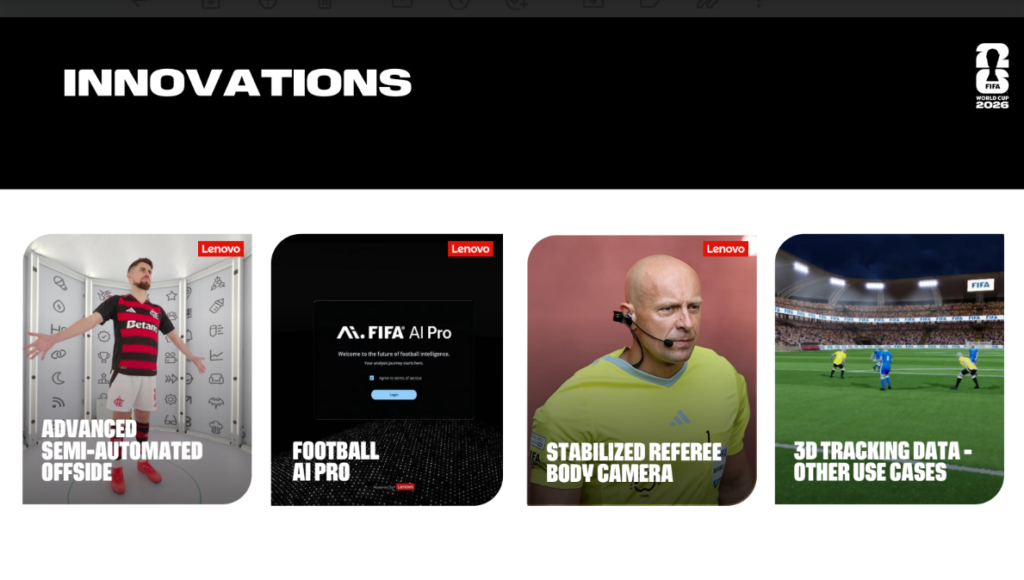
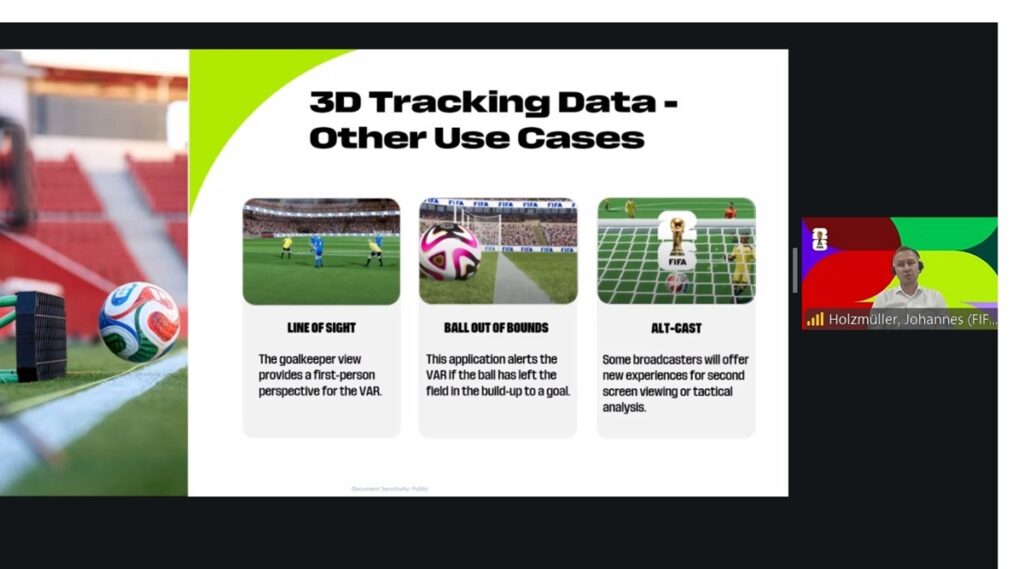
Johannes Holzmüller, director of innovation at FIFA, said in a press briefing that the World Cup will offer new technologies for fans to appreciate the matches. Those include Football AI Pro, for match analysis — something that also helps the teams. There’s also a Referee Body Camera that has been improved since it was used last year in the U.S. for FIFA Club matches.
Holzmüller said the referee body camera is stabilized and it debuted during the FIFA Club World Cup last year.
“It was a great success. It went beyond our expectations at this tournament, especially since we got the feedback that people really like the way this adds another layer, another perspective,” Holzmüller said. “In the world feed that we are providing to the broadcasters, this gives this first person view. You can realize the difficult job a referee has making decisions in milliseconds on the field of play.”
Holzmüller said Lenovo has worked to reduce the shaking of the camera for the referee body cam. That tech, which includes AI, will make more of the video usable for the audience to see.
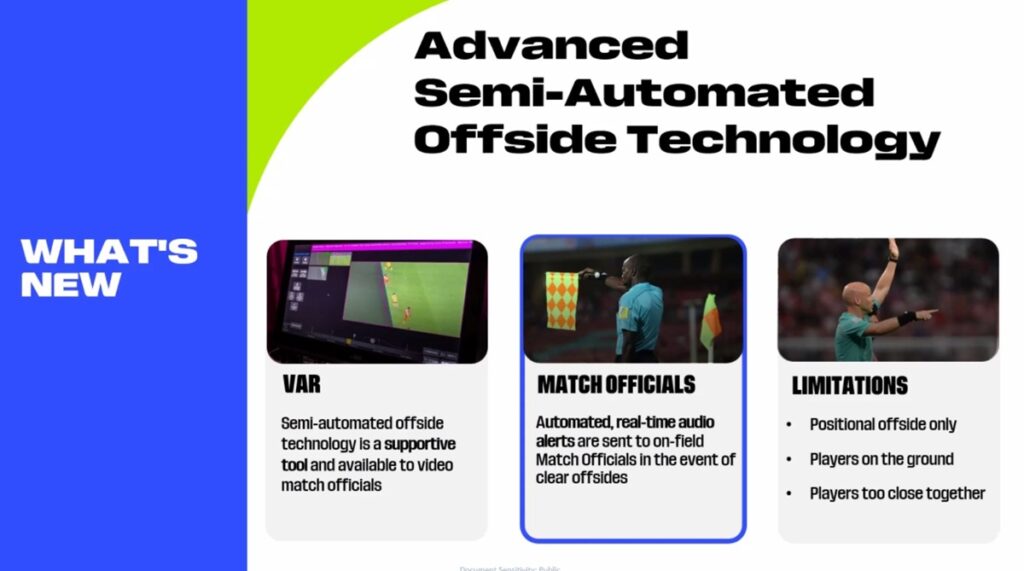
The Semi Automated Offsides technology was used at the last World Cup in 2022 in Qatar. Now it’s called the Advanced Semi Automated Offsides, and it’s used to determine of players are offsides during a play. Akin to an instant replay for refs, it can help speed up official decisions about offsides calls. The aim is also to reduce the risk of injury if play continues during an offsides call, Holzmüller said.
Since the last World Cup, the data on positional offsides tech analysis can be transmitted directly to the referees on the field on their wrist-bound devices. If cameras aren’t positioned in exactly the right locations, then the value of the tech is limited.
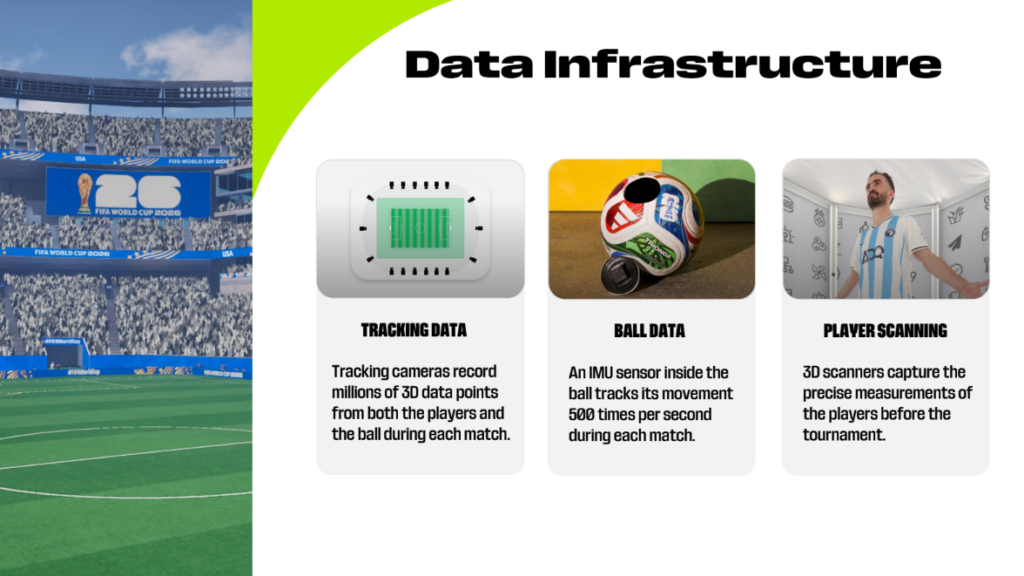
Holzmüller said that the tech for all 16 stadiums (or stadia, I guess) is centralized in Dallas where the data infrastructure is based. There are 16 optical tracking cameras installed in each of the stadiums and they track 29 data points at 50 times per second.
The optical tracking cameras installed in all the stadiums are collecting over 150 million tracking data points per match, Holzmüller said. He noted in the last World Cup in the match between Japan and Spain, a ball was either on a line or had crossed a line. Now the data points should be able to measure when a ball has crossed a line.
“We have millions of data points per match that we are collecting,” Holzmüller said. “In addition to that, we have also the sensor inside the ball, which gives us IMU (internal measure unit for movement) data.”
The combined info can help focus in on the correct video frame to make the final decision. The same kind of data can be used for hand ball violations as well.
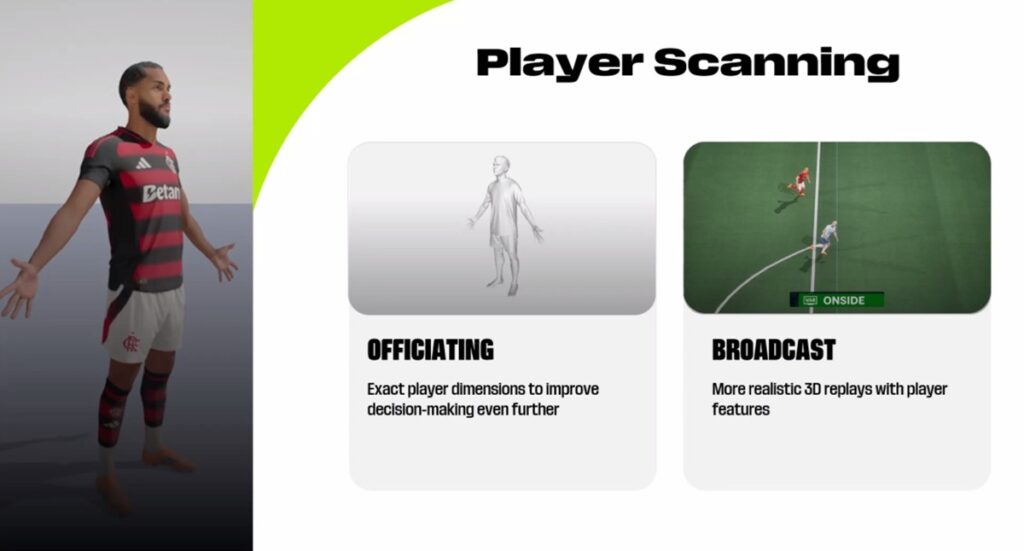
One of the things that will help with the tech and tracking is that every player will have a full body scan as part of the media activity for the day. This scanning takes only one second and it delivers an accurate image of an athlete that can be used in the data processing during referee calls.
Holzmüller said that the data is then ingested in the system and is helping to be even more accurate than it was in the past and helping to make referee decisions faster, more consistent, and reliable.
“This is helpful for officiating, but at the end it’s also helpful for football fans, since we can also improve the replays where the players really look like the players, and it’s immediately obvious which are the players involved in the offside position,” Holzmüller said.
Art Hu, global CIO at Lenovo, said in the press briefing that the collaboration on technology can improve multiple aspects of the game to advance the sport.
“As we look at player scanning, I think this is really about how can we bring the latest technology to increase the fidelity and the resolution of what multiple stakeholders are able to see,” Hu said.
More than 1,200 players will wind up with digital avatars, which will lead to more realistic replays and better raw data for officiating.
“We want to help the game go more smoothly without delays by actually bringing more real time data that enhances these particular use cases,” Hu said. “It’s a great tribute to I think the vision of FIFA, but also the flexibility of the technology that we bring. We’re talking about accuracy down to the millimeter level from a scan perspective.”
Regarding Football AI Pro, Holzmüller said AI is playing a more important role in everyone’s life and that’s true for soccer as well. The Football AI Pro tech is meant to give coaches useful analytics information about the game in enormous levels of detail. That helps democratize the coaching process so every team can make use of the data.
Hu said that in the past, teams were swimming in a sea of data, but it took time to sift through it. Now it’s available in real time and accessible via natural language queries when it comes to asking for insights about game performance, such as key actions like attempts on goal and visual patterns in the play. Holzmüller said FIFA is looking fr feedback from the teams.
One journalist asked in the press briefing if the tech would give an advantage to wealthier nations. But Holzmüller said that the goal was to reduce that effect by sharing the data in a democratic way and making it much easier to understand and more accessible.
“At the end of the day, and this is the beauty of our sport, it always depends on how you use this information and if it can really be an advantage or not,” Holzmüller said.
Disclosure: I have family working at FIFA.