
China’s video game market reached a new milestone in 2025, generating $51.8 billion in revenue, up 5.4% year-over-year and surpassing the $50 billion mark for the first time.
Niko Partners forecasts the market will slow somewhat this year, growing another 4.0% in 2026 to $53.9 billion, before reaching $59.8 billion by 2030, representing a five-year CAGR of 2.9%. The growth is slowing compared to past years, but it seems likely that China will grow faster than many other parts of the world when it comes to gaming.
Player spending continues to strengthen, with annual average revenue per user (ARPU) exceeding $70 for the first time in 2025 and projected to reach $77.68 by 2030. This solidifies China’s position as the world’s largest video games market by players, with the total player base forecasted to reach 769 million players by 2030, Niko Partners said. (For more color on the Chinese games market, check out our recent Gamescom interview with Tencent).
Niko Partners holds a more positive outlook for China’s gaming market than in the previous November 2025 forecast, driven primarily by stronger-than-expected performance from both newly launched titles and legacy evergreen games.
Five key trends
Looking ahead, here are five key trends are expected to shape the market over the next five years:
- Integration of Generative AI into game development and player-facing experiences,
- Continued growth in niche and boutique genres that cater to underserved audiences,
- Increased out-of-app monetization that improves publisher margins, alongside direct to fan monetization of game IP,
- Rising consumer spending on both domestic and international premium PC and console titles,
- A more favorable regulatory environment for domestic game companies and continued access to the China market for international game companies via platforms like Steam.
A supportive environment for innovation and growth
Niko Partners noted that China’s 15th Five-Year Plan (2026-2030) provides a supportive framework for the country’s gaming industry as part of broader efforts to strengthen digital innovation and cultural industries.
This policy environment is creating new opportunities for both domestic and international companies while reinforcing the strategic role of gaming within China’s digital economy. Domestic game approvals are running ahead of 2025 levels, providing developers with greater visibility and supporting a larger pipeline of commercially launched titles.
At the same time, Chinese game companies are rapidly embracing Generative AI across development pipelines and player-facing features. AI tools are being used to enhance content creation, improve operational efficiency, and deliver more dynamic player experiences.
This trend is converging with a broader boom in user-generated content (UGC), as many of China’s most successful live-service games increasingly evolve into creation platforms that allow players to build, share, and participate in content ecosystems.
However, the market is not without challenges. The rapid expansion of AI infrastructure has increased demand for memory and semiconductor components, constraining supply for consumer hardware and contributing to higher device prices. Despite these pressures, ongoing innovation, regulatory clarity, and robust player engagement continue to support long-term market growth.
Some of the key takeaways from China Player Behavior & Market Insights Report:
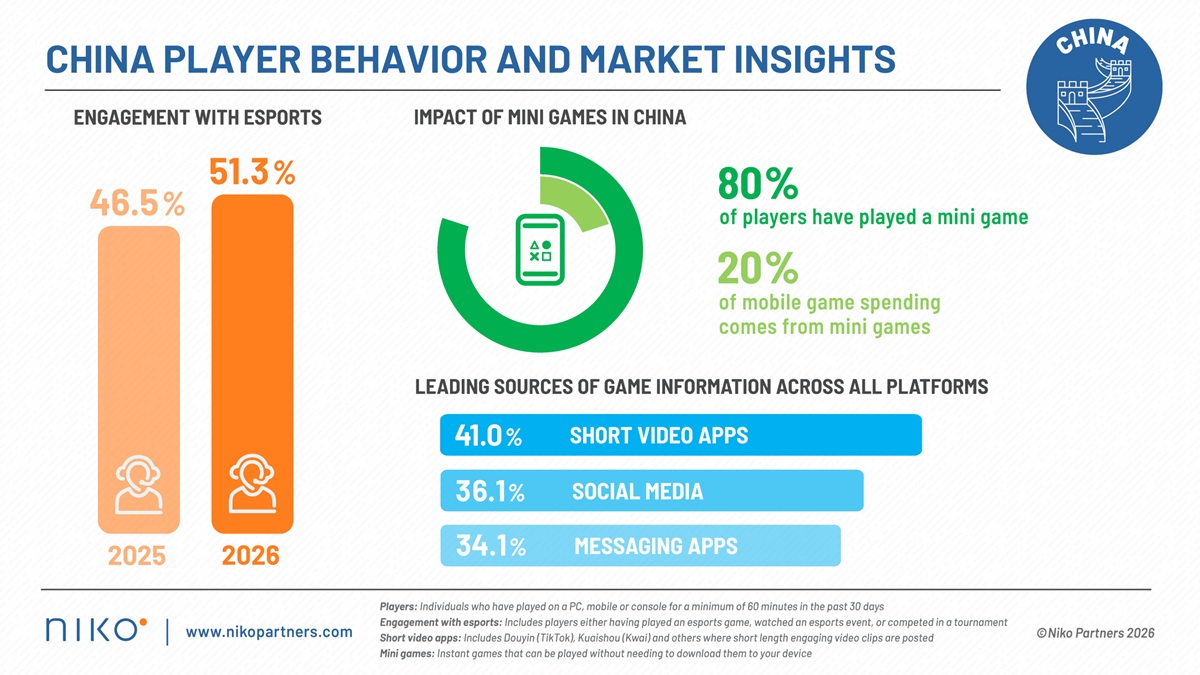
- Short video is the leading discovery channel. 41% of players use short video apps to discover new games and game information, making it the #1 discovery method across PC, mobile, and console.
- Esports engagement continues to grow. 51.3% of players have engaged with esports, up from 46.5% in 2025. Niko Partners defines esports engagement as having played an esports game, watched an esports event, or competed in a tournament.
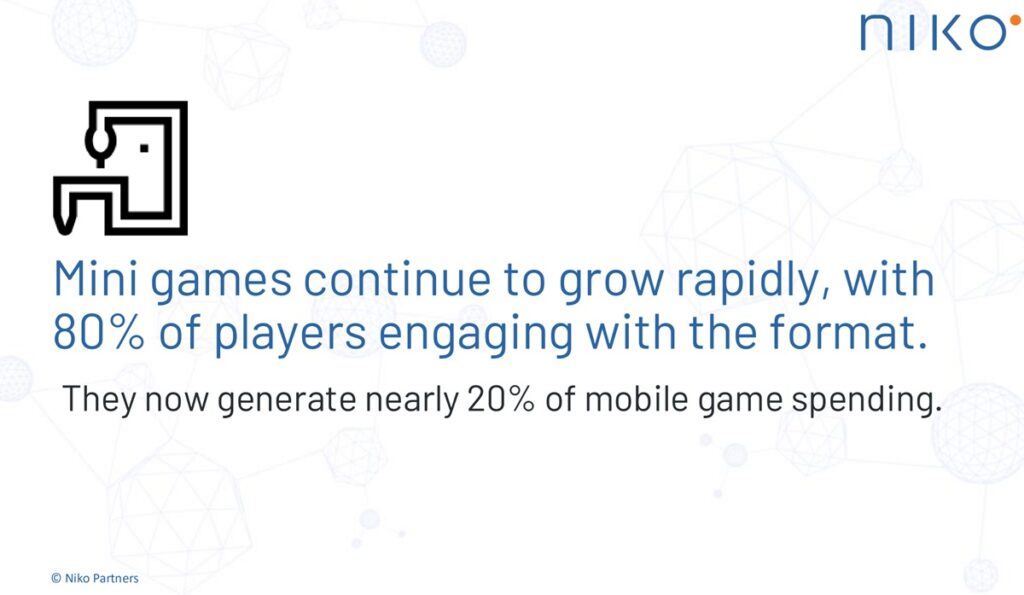
- Mini games are becoming a major growth segment. 80% of Chinese players have engaged with mini games, which now account for nearly 20% of mobile game spending. Their growing reach and monetization potential make mini games an increasingly important part of China’s mobile gaming ecosystem.
I sent some questions over to Niko Partners to get more exclusive details on the report. The answers to the questions came from Xiaofeng Zeng, vice president of Niko Partners, and Daniel Ahmad, director of research & insights at Niko Partners.
Here’s an edited transcript of our interview.
GamesBeat: Is China now growing faster or slower than the whole world when it comes to game growth by year?
Niko Partners: China’s video game market growth is ahead of annual GDP growth and is generally in-line with global video game market growth figures. However, it is not the fastest growing markets in Asia & MENA, which are India, Saudi Arabia and Thailand.
GamesBeat: Is there a cause that suggests why Chinese players are playing more per week?
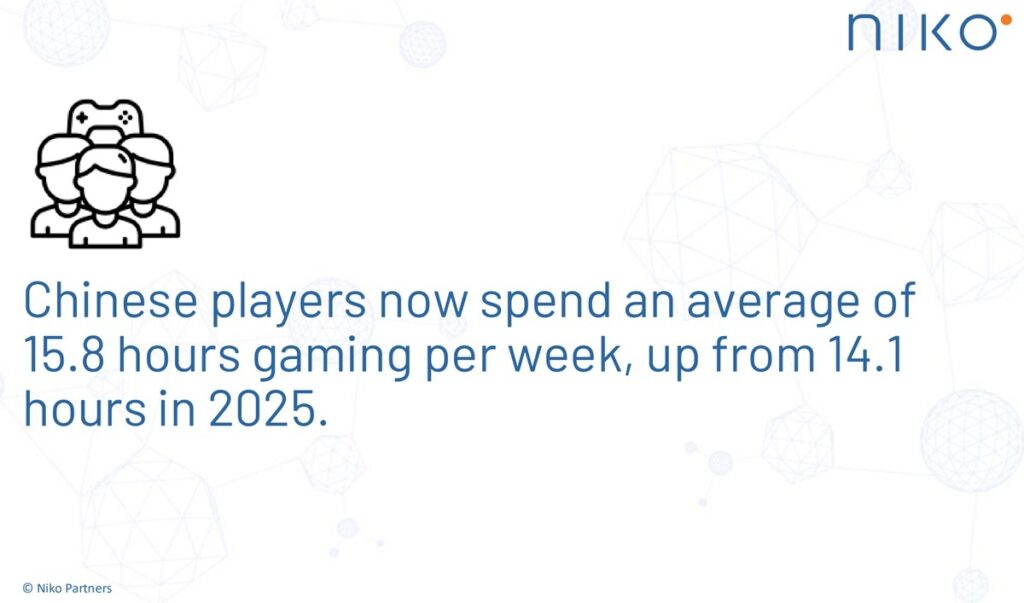
Niko Partners: The rise of evergreen games that continually provide new content via live service updates, and fixes / adjustments to existing content, are keeping players engaged for longer. We also see extension of gameplay to additional platforms through cross platform releases and mini games that allow players to pick up and continue their session across devices.
Video games are also a low cost form of entertainment and continue to see strong engagement even during periods where the economy is weak.
GamesBeat: Do Chinese players seem more engaged with games than players in other regions?
Niko Partners: When looking directly at hours per week spent gaming, China emerges near the top of the markets we track. However, players in India, Thailand, Vietnam and Indonesia do play for longer on average.
When looking across different metrics, and to sum up, they are generally more engaged than not, but they are rarely the most engaged in any one specific thing.
GamesBeat: Is the esports engagement in China greater than in the rest of the world?
Niko Partners: Based on sheer size alone, esports engagement in absolute terms is extremely high. Relatively speaking, they are not the most engaged, but definitely near the top. China and the MENA-3 countries tend to be highly engaged when it comes to esports, relative to other countries.
GamesBeat: How do you define mini games?
Niko Partners: A mini game is an instantly playable game that does not need to be downloaded. These are often called HTML5 games as well. Examples in China include the WeChat Mini Games platform or Douyin Mini Games platform that offer smaller game experiences within the super app.
GamesBeat: Are there particular game categories doing better?
Niko Partners: 2025 was an extremely strong year for shooters with the genre entering the top 3 most played genres across all three platforms (PC, Mobile, Console). While titles like CrossFire and Peacekeeper Elite have long been popular, newer titles including Delta Force and Valorant Mobile.
The PC games market has seen a surge in the popularity of new genres including live action games such as Return to Empress, friendcore titles such as REPO, and extraction games such as Return to Duckov.
Also, the rise of premium games should not be understated. Black Myth Wukong acted as proof of concept and this year is set to see the release of titles like Phantom Blade Zero and Grand Theft Auto VI which are expected to be major hits.
GamesBeat: Are there any AI-native games that are growing fast in China yet? Or AI slop?
Niko Partners: While there are certainly some smaller or more experimental AI native titles, the larger story is how nearly 90% of game developers in China are using generative AI tools across various aspects of the game development cycle.
This includes integration of third party tools as well as companies that are developing their own models. One notable example is NetEase partnering with Tripo AI to enable user-generated environments in Eggy Party.
Right now, game developers are now looking to shift focus from generating individual assets or code snippets toward agentic workflows, where AI can understand requirements, manipulate development environments, generate and modify code, test outputs, and iterate autonomously.
The tech doesn’t have the same stigma as in the West. But this shouldn’t be interpreted as unconditional support for the tech. Poor uses of GenAI are still called out all the same.
At the same time, we’ve also seen some game developers say they will not use GenAI tools. This primarily applies to AAA game developers in China who have a more global audience and are balancing both the need to create a title with high production values and a large overseas audience that is less receptive to GenAI usage (Black Myth Zhong Kui and Phantom Blade Zero).
GamesBeat: How big is the mobile category? is it growing at different rates vs PC/console?
Niko Partners: Mobile games will account for 68% of player spending in 2030 compared to 28% for PC games and 3.9% for console games. While it continues to grow at a faster rate than PC, we do expect console to grow faster. Although this is primarily due to console starting from a lower base and a new console generation cycle underway starting with the Switch 2 last year.
GamesBeat: Are there still challenges with discovery of games? How so? How is it getting solved?
Niko Partners: Short video platforms such as Douyin (TikTok) have emerged as key marketing channels for video games in China, and a lot of promotion for new games is now entirely online. Even games that are not officially released in China can promote on video platforms like Bilibili without many restrictions these days. Steam is also still available in China, despite operating in a grey market environment, which allows Chinese players to discover global games easier.
GamesBeat: How does using a gaming accelerator enable access for a player?
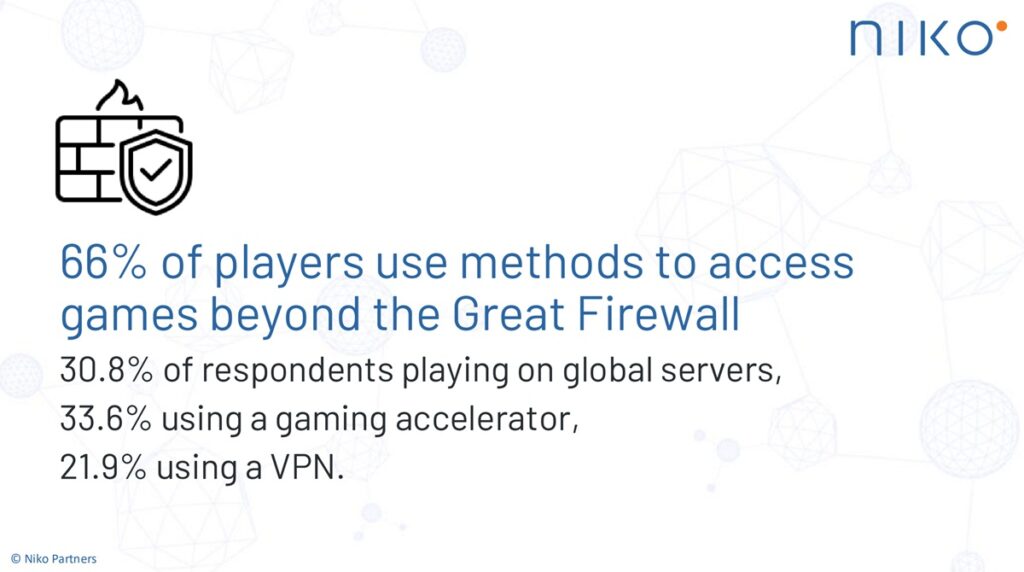
Niko Partners: Gaming Accelerators are primarily software tools that can reroute internet traffic through optimized servers to create a more stable connection, faster downloads, lower ping etc. It’s extremely useful for global or Steam games that do not have a server in China. NetEase UU is a popular accelerator for example.
GamesBeat: Can you add more explanation on the use of global servers or other means of playing games outside the firewall?
Niko Partners: China’s strict regulatory environment means not every game is available to players in the country, or there is a separate China and International version of a game. Some games may not have servers in China either, or suffer from connectivity issues in general due to the Great Firewall.
Tools like VPNs and gaming accelerators are how players get around these issues to play on global servers or have a smoother connection. Some gamers may even prefer playing on the global server of a game like World of Warcraft or CS2 where they can access a different in-game experience, economy, players etc.