
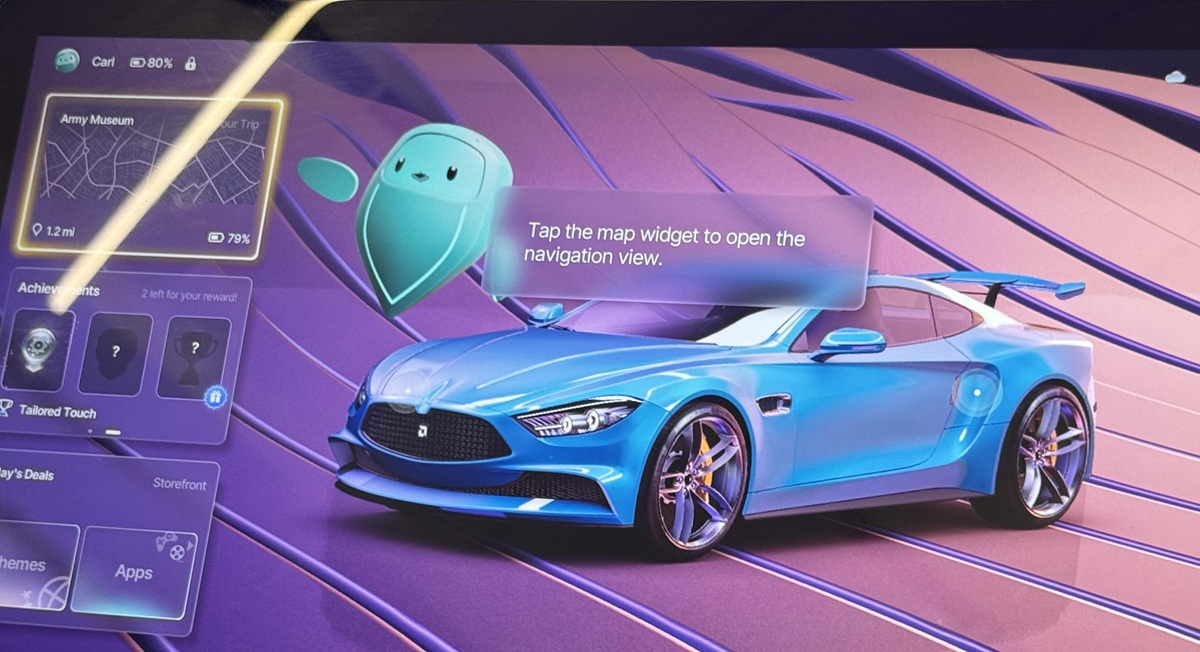
Revealed at CES 2026, the Unreal Engine 5 Next-Gen HMI Experience demonstrates the game engine running all pixels inside a digital car cockpit.
I saw the demo behind closed doors at CES, where Epic Games teamed up with AMD to show off a 100% UE-based human-machine interface (HMI) running on a version of the AMD Ryzen™ AI Embedded P100 Series.
“This is our vision for the future of a digital cockpit,” said Dana Cowley, marketing director for Unreal Engine 5 at Epic Games, in an interview at CES.
Joe Andresen, technical product director for Unreal Engine 5 HMI at Epic Games, said in an interview with GamesBeat that it took about three months to pull together the project.
“This is a full next-generation Unreal Engine 5 HMI experience, with either an 8K display or a 1080p display,” said Andresen. “When we started HMI five years ago at Epic, we were using Unreal Engine. It was being adopted by OEMs and used as part of the experience. And this is the next phase of our initiative, where we’re pushing to use Unreal Engine for the entire experience.”
It started as an internal Epic project designed to be the gold standard for visual fidelity, performance, and interactivity in automotive HMI development.
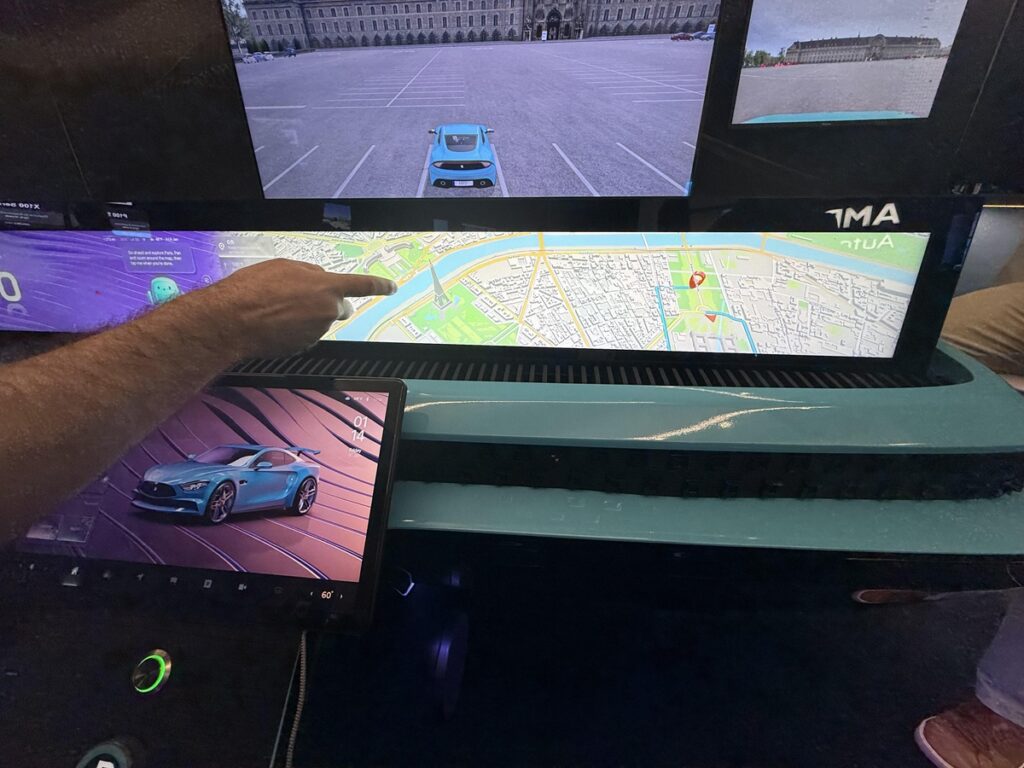
The project uses one UE5 instance to simultaneously run the digital cockpit experience including the instrument cluster, maps, mini map, control panel, and 3D backgrounds on high-resolution displays at 60 FPS.
This includes:
- Customizable visuals and interactive themes like Fall Guys with controllable Beans, demonstrating game mechanics within the HMII
- Native maps with 2D aerial views and 3D street-level navigation featuring points of interest and iconic landmarks like the Eiffel Tower and Notre Dame
- ADAS features that use photorealistic Unreal Engine environments to train AI systems using synthetic data – and are integrated with an AMD workstation-based driving simulator from rFpro
- Ability to launch third-party applications, including games and Chromium-based applications such as audio and video streaming platforms
- Functionality to play games such as Rocket League and Shadow Complex on the passenger window within the digital cockpit
- Plus, a lighthearted narrator guides the user through the experience, from choosing themes to using auto-parking assist
This project has enabled Epic to test and improve new HMI functionality in a production-quality environment, develop a clearer view into the future of automotive, and forge stronger industry partnerships.
The live demo
In the demo, a digital copilot character narrates the experience. That character is powered entirely by Unreal Engine 5 and tuned for the AMD automotive qualified embedded processor portfolio for ADAS (advanced driver assistance system).
“Every pixel on these displays, including me, is rendered live in Unreal Engine, thanks to multi-view and multi-world, which lets a single Unreal Engine instance drive multiple windows and displays. It saves vehicle resources, streamlines the HMI architecture and speeds up design,” the character said.
The first window where the HMI is used is the instrument cluster on the multi-world window. There’s also a minimap widget, an 8K display that showed where the car was driving, and a full HD display on a tablet in the middle of the dashboard. The demo also activated the car’s 3D touch control on the tablet, where you can drag and rotate a 3D image of a car and tap the touch points to interact with its doors or spin it around.
The demo also showed customization, so a driver could remake the experience in the cockpit to be personalized for favorite music and imagery. You can create a visual theme on the dashboard screens that visualizes the music. The themes are rendered in 3D in real time and they can dynamically influence lighting, materials and reflections.
The ambient lighting in the car can also pulse to the music. A tech dubbed API Gear can interface with hardware and easily communicate with it and Unreal Engine. You can hit the Apply button and the characters switch to Fall Guys characters and scenery.
“Unreal Engine empowers designers to create rewarding experiences that keep drivers engaged long after delivery,” Andresen said.
He showed a map of Paris stretching across most of the dashboard, powered by the Unreal Engine 5 through a map provider API. Designers can render the maps any way they want.
The safety system makes use of the Unreal Engine as well. The vision-based AI can perceive dangerous situations inside a virtual world simulation. The ADAS domain controller reeceives data in real time from the camera, the navigation system and feed the data to the AMD Versal AI edge series processor, an Arm-based processor,for real-time rendering. The entire simulation environment ran on an AMD Ryzen Threadripper CPU and Radeon workstation GPU.
Managing the system
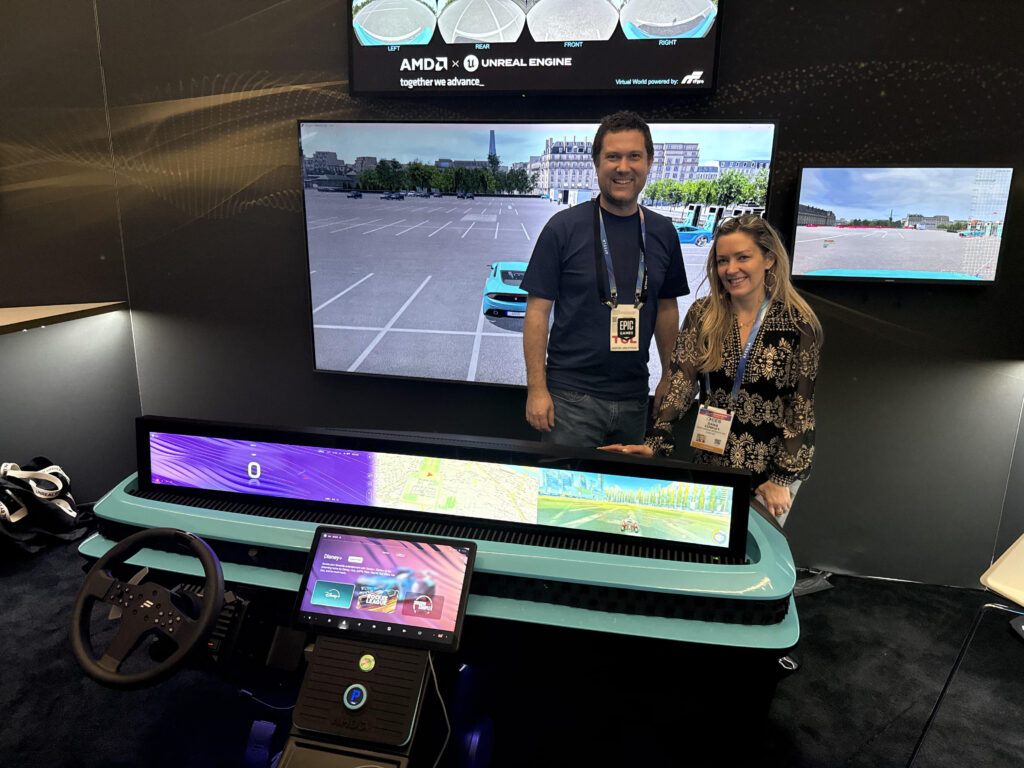
The Unreal Engine manages system resources efficiently so that third party apps run smoothly right alongside the HMI. You can tap the Apps button to turn your dashboard into an entertainment hub. We tried out some streaming services and you could see how they could easily play on the displays.
You can also get a surround view based on calculations that the computing in the car can do, based on what the cameras can see. That’s useful for creating 3D models so that the auto-parking feature can work and be more useful.
“With auto park, we can detect parking spots. And the AI board is communicating to the simulator, telling it how to drive, and then we’re getting an Unreal surround video feedback for it,” Andresen said. “While driving, we get data about the speed, and we actually also get the steering angle in Unreal Engine. We can really get a good view of what the car is doing the simulator.”
The Unreal Engine has shipped in more than two million cars already, but having the engine handle the processing and display of information across so many screens is the next phase of the initiative, Andresen said.
“So being at CES, we have this over-the-top experience and fun. But what’s really important is we’re showing the technical feasibility, and that OEMs can take these different features and design them and implement them,” Andresen said.
OEMs are also willing to put screens in the rear seat, though the Epic Games demo did not show this. Those screens offer more privacy for passengers and the ability to play games.
Epic Games didn’t have a similar demo with Intel or Nvidia, but it likely isn’t hard to do a demo with x86-based processor technology.