
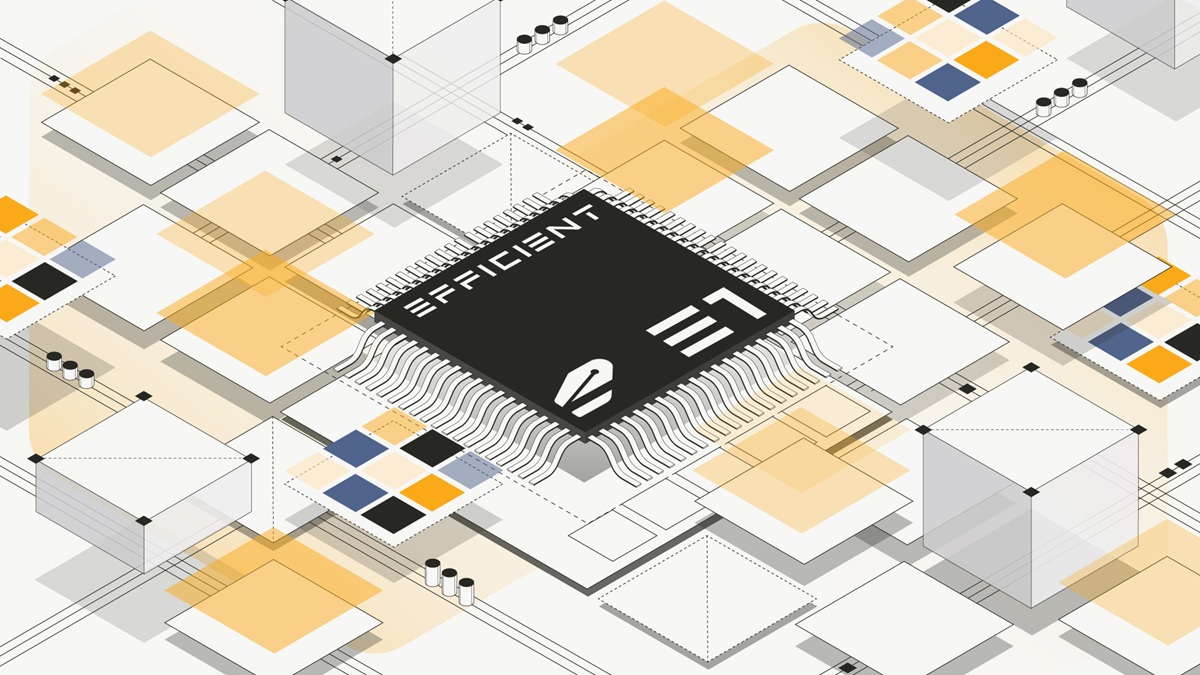
Efficient Computer, a startup aiming to build the world’s most energy-efficient general-purpose processors, has raised $60 million.
Triatomic Capital led the Series A funding round, with participation from Eclipse, Overlap Holdings, Union Square Ventures, RTX Ventures, Toyota Ventures, Overmatch Ventures,
and others. The round brings the total amount raised to $76 million.
“We’re super excited about bringing in the $60 million Series A. We love having Triatomic Capital in the lead seat,” said Brandon Lucia, CEO of Efficient Computer, in an interview with GamesBeat. “With these resources, the sky’s the limit for us. We’re going to be scaling Electron E1 silicon, the Electron IP business, and we have lots of very interesting things happening in the future.”
The new capital will be used to accelerate Efficient Computer’s product roadmap and expand its engineering and developer teams, bringing its ultra-efficient architecture to a wide range of use cases.
Energy efficiency
Energy is the primary constraint on all modern computing hardware. As AI and advanced
software move out of the cloud and into the physical world, existing processor architectures struggle to deliver intelligence within power, thermal, battery lifetime, and
form-factor limits.
Fixed-function accelerators entering the market lack the flexibility required to keep pace with rapidly evolving workloads, and the next iteration of inefficient CPUs or GPUs does nothing to address the energy demands of the world’s most important applications of intelligence and computing.
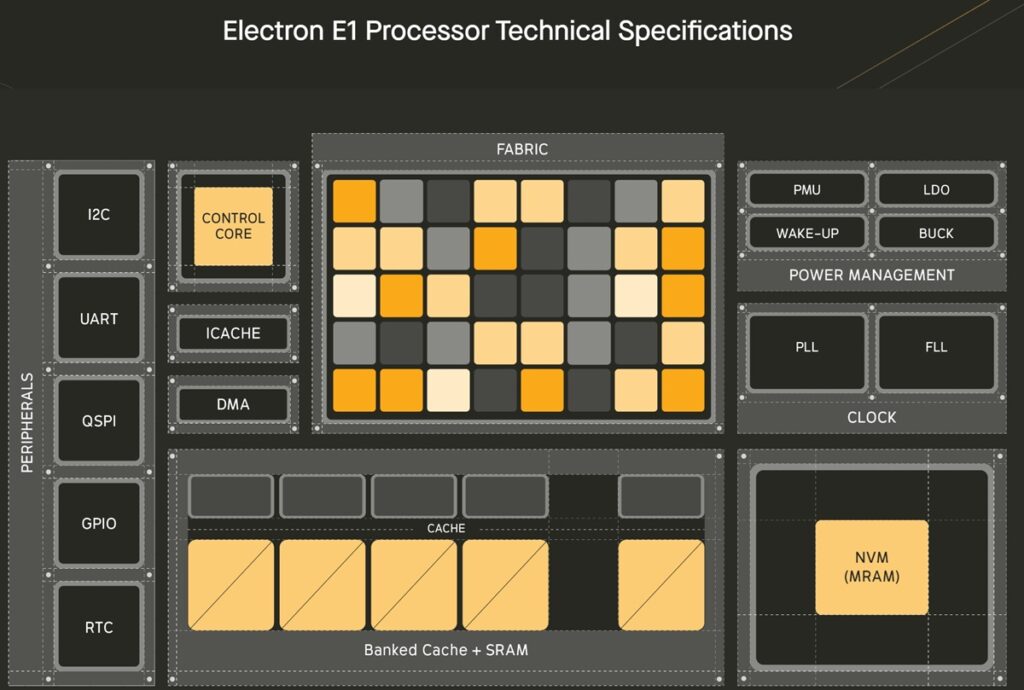
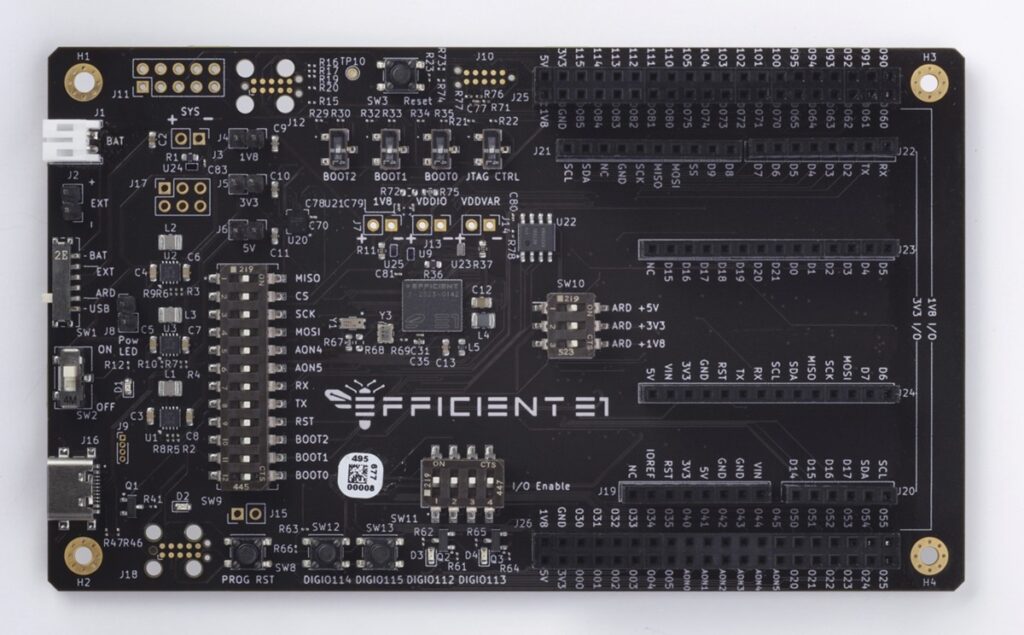
Efficient Computer is addressing this challenge with the Electron E1, the world’s most energy-efficient general-purpose processor, built on Efficient Computer’s Fabric architecture. The Efficient Fabric architecture is a spatial dataflow architecture designed
from the ground up to minimize energy use while executing real, general-purpose programs — including critically important AI, signal processing, and controls workloads — efficiently on a single programmable platform.
By eliminating unnecessary data movement and architectural overheads intrinsic to CPU and GPU architectures, the Efficient Fabric architecture delivers dramatic gains in performance per watt The Fabric achieves hardware-accelerator-like efficiency and performance, without sacrificing programmability, like many recent over-specialized hardware products that do not support the full breadth of computation needed for critical applications such as physical AI.
“The industry has responded to rising energy costs by layering many fixed-function
accelerators into a typical SoC,” said Lucia. “The specialized hardware approach works to support a narrow slice of today’s workloads, but it breaks down as software, models, and applications continue to change. Efficient was built around a different idea: that the most durable path forward is a truly general-purpose architecture that can evolve with software over time, while providing market-leading energy efficiency for a range of critical intelligence use cases.”
This funding round will enable Efficient Computer to advance its vertically integrated
hardware and software platform into embedded high-performance applications and
further develop its Efficient Fabric architecture IP across edge, infrastructure, and
emerging AI-driven markets.
A better way to do computing
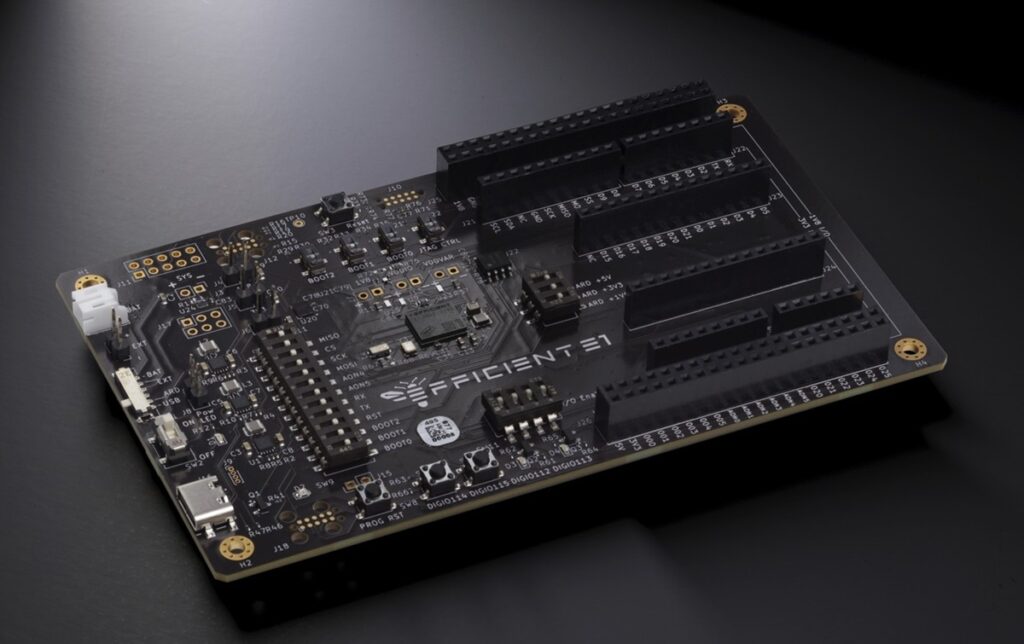
Lucia said the company is shipping electron E1 evaluation kits to the lead customers, and it is ramping production to supply into general availability as soon as possible.
“Right now, we’re working with early lead customers. We’re taking orders and E1 is ready for the market. So as soon as a new customer comes in, we work with them to understand the alignment of their application with this product. And we’re very excited to see the things that we’re able to bring to life in areas like infrastructure, observability, industrial innovation and more.”
As for energy-efficiency comparisons, Lucia said it is best to compare to the best available general-purpose parts that are on the market.
“When we do that, we see a difference of 10 times, depending on which application and which application profile you’re looking at.”
There are other entrants in the market that are less optimized for efficiency, and Lucia said his tech can achieve 10 times or 100 times improvement in energy efficiency.
“When we compare to those parts, it’s night and day. And the reason is that we’ve redefined the architecture. So we’ve eliminated a lot of the overhead of the typical CPU, von Neumann processor loop that you find in embedded CPUs and embedded GPUs,” Lucia said. “What we’ve built in Electron E1 and its fabric architecture looks more like a fixed function accelerator, and all of the efficiency that that brings along with it. But because of our architectural innovation, we retain the ability to do general-purpose source code, so C and C source code.”
The net results is high efficiency like in an accelerator chip and programmability like in a CPU.
“That’s our big advantage,” he said.
A wide range of applications
Among the applications, Lucia said its collaboration with Bright AI means it will bring
intelligence to physical infrastructure devices, where Efficient Computer will power a physical AI device that monitors the health of physical infrastructure.
These are things that are a bit “unglamorous but extremely important,” he said.
That includes power poles and water and gas infrastructure — “things you can’t live without, but ideally you don’t want to think about very often.”
This kind of edge computing, where the AI is placed in the field in devices instead of centralized in data centers, is the kind of computing that requires energy efficiency. This edge computing allows devices to process sensor data on the device and send along only what is important to send over the network.
“We provide a new way by bringing our efficiency into the use cases for this wide range of different computational subroutines that are important for those applications. We make it possible for a deployment like Bright’s deployment of physical AI infrastructure observability devices to support new capabilities that are not possible,” he said.
The aim is to replace a lot of general-purpose CPUs that are energy inefficient.
He added, “Our fundamental rewriting of the architectural rules means that we can get that level of efficiency, meet the performance and yet retain the general purpose software for it. That’s a way of showing our core value proposition.”
The company has internal tech that allows easy porting of code so Efficient Computer’s software stack and be up and running in five minutes. The company can also ingest existing c, c++ code that is aging. The company compiled Doom, the first person shooter from the 1990s. The hardware is also compatible with AI tools, he said.
Dealing with memory and chip shortages
I asked Lucia if the main memory chip shortage is going to have an impact on his company, as memory prices were up 90% so far in Q1 according to Counterpoint Research.
“One thing to one thing to one thing to keep in mind about what we’re doing is we have a fully integrated SoC solution with E1 and so our technology is not reliant on scarce, expensive, off-chain memories,” Lucia said. “And that owes to the target market that we’ve been pursuing.”
As an example, infrastructure devices don’t require hundreds of gigabytes of memory to support the types of applications that Efficient Computer’s customers want to bring to life in that area,” he said.
The same is true with robotics applications.
“We don’t need mountains of data in each of the near-actuator computer systems that we would be building in a robotic system,” he said. “Those are just a couple of examples. And so the consequence of that is that we avoid the need for fighting in the mud for the last few sticks of DRAM.”
Lucia said the company has a partnership with chip manufacturer Global Foundries to create its chips, and will allow the Electron E1 processo to scale to volume production. And the company is using a manufacturing node that is not in high demand from AI chip designs.
“The long and short of it is we don’t anticipate, and we don’t have, currently, a capacity problem. We plan to scale across 2026.”
The company has about 50 people split between its San Jose, California office and its headquarters in Pittsburgh, Pennsylvania.
Investor comments
“As we continue to see AI embedded across the physical world, Efficient’s processors enable intelligence in applications that were previously inaccessible,” said Peter Zhou,
general partner at Triatomic Capital, in a statement. “We see Efficient’s architecture as the missing link in AI’s last-mile distribution problem. We are proud to support the team as they tackle AI’s energy problem from the edge to the data center.”
“Efficient is taking a fundamentally new approach to compute architecture, delivering dramatically greater efficiency and significantly lower power consumption than traditional
general-purpose compute,” said Greg Reichow, partner at Eclipse, in a statement “As energy becomes the defining constraint for everything from edge devices to data centers, Efficient’s breakthrough enables far more compute within the same energy footprint. We’re excited to support the team as they translate this clean-sheet innovation into real products that can reshape the future of computing.”
“Efficient Computer truly lives up to its name in more ways than one. The company has
built a unique, energy-efficient computing architecture and has also done it in a highly
capital-efficient manner,” said Justin Stevens, founder and CEO at Overlap Holdings, in a statement. “To reach this stage of development and commercialization with so little expenditure to date sets them up for unparalleled growth and success going forward.”
“We are excited to partner with Efficient Computer as they build a new class of highly
energy-efficient chips. The team’s technical depth and market insight position them to
enable new applications that have long been constrained by power,” said Rebecca Kaden,
general partner at Union Square Ventures, in a statement. “The proliferation of sensors and the emergence of an intelligent physical world represent one of the most exciting opportunities in front of us, and Efficient Computer is well positioned to help power what is possible.”
“Efficient’s Electron E1 processor fundamentally changes what’s possible at the edge,”
said Alex Hawkinson, founder and CEO of BrightAI, in a statement. “Efficient has delivered a true leap in energy-efficient computation, and integrating E1 into BrightAI’s Stateful platform allows us to unlock a new sphere of physical AI, bringing real-time observability to the world’s most critical infrastructure.”