
As brands flow into user-generated content platforms like Fortnite and Roblox, the creators and developer studios competing for advertising dollars are using increasingly divergent strategies.
The data platform GEEIQ has published annual reports about advertiser activity inside UGC platforms since 2023. For the 2026 edition of its State of Brands in Virtual Worlds report — which GEEIQ plans to publish later this week — the company polled 51 Roblox and Fortnite creators and developer studios to better understand how their approach to branded UGC content has evolved over the past year.
In this year’s report, GEEIQ deliberately broke down respondents’ answers into two categories: responses from developer studios, which GEEIQ defines as companies that specifically build branded worlds and integrations, and creators, which GEEIQ defines as individuals or companies that own and operate their own non-branded experiences, which may or may not include brand integrations.
GEEIQ’s report overindexes somewhat on responses from developer studios, with 38 of the survey’s 51 responses coming from studios, rather than creators. However, the report includes insights from prominent entities on both sides of the aisle — Wonderworks and Bullseye on the creator side, for example, and Sawhorse and The Gang on the studio side — and uncovered several key differences between these entities’ approaches to working with brands.
GamesBeat has exclusive early access to GEEIQ’s 2026 State of Brands in Virtual Worlds report. Here are some of the key takeaways.
Developers are overwhelmingly multi-platform, while creators are focused on one platform
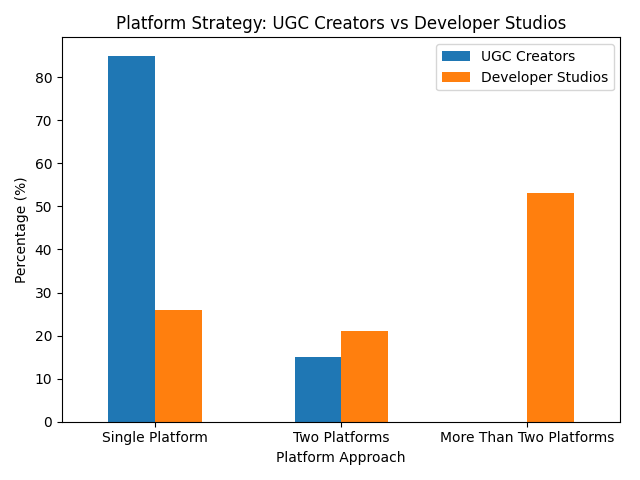
GEEIQ polled creators and developer studios on the number of platforms they regularly use to build brand activations, giving respondents the choice between identifying as using one, two, or more than two platforms regularly. The survey found that roughly 85 percent of creators followed the single-platform approach, with the remaining 15 percent using two platforms. In contrast, roughly 53 percent of developer studios said they followed the multi-platform approach, with the remaining responses from this group relatively evenly split between single-platform and two platforms (26 percent single-platform, 21 percent two platforms).
The striking difference between developer studios’ multi-platform approach and creators’ single-platform focus reflects the endemic versus non-endemic nature of these different types of UGC businesses. Many developer studios have their origins outside the UGC space, with prominent studios like Sawhorse Productions employing a full payroll of 3D artists who are able and willing to apply their work to whichever platform a brand desires. On the other hand, UGC creators often came up within the communities of their specific platform of choice and typically have no interest or passion in branching out to alternative platforms.
Developers are more likely than creators to work on long-term campaigns and activations
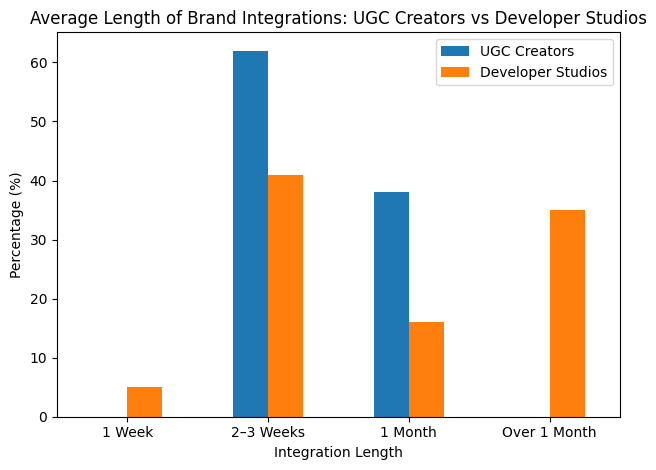
GEEIQ’s survey asked both creators and developer studios about the average length of their branded experiences or integrations, finding that 35 percent of developer studios’ integrations lasted for over one month, compared to zero percent of responding creators. A larger proportion of creators’ experiences were on the shorter end: Roughly 62 percent of creators’ experiences were between two and three weeks long, compared to roughly 41 percent of developer studios’ experiences.
Developer studios’ longer integration time reflects how a larger proportion of these companies’ branded work takes the form of fully owned and operated branded worlds, rather than integrations into pre-existing popular experiences. But branded worlds are on the downswing, while integrations are rising, according to GEEIQ’s data — meaning developer studios may have to change their approach to the business or risk falling behind.
“With integrations being the new standard, brands should try to work closely with creators or at least ensure they’re included in the conversations early on: they’re not just a distribution channel, but they need to be a core part of the infrastructure,” said GEEIQ CEO Charles Hambro in an interview with GamesBeat. “They are the experts on their own platforms, they know what their players like and what they don’t.”
Direct relationships with brands remain uncommon
UGC creators and developer studios are united by one core element of their businesses: their ongoing reliance on third-party agencies and intermediaries to sign most of their brand deals. GEEIQ’s survey found that roughly 85 percent of creators and 87 percent of developers had worked with intermediaries to sign brand deals in 2026, compared to only 8 percent and 13 percent respectively relying on direct relationships with brands.
As more advertisers take the UGC opportunity seriously, there is a pervasive sense among creators on both Roblox and Fortnite that intermediaries are soaking up more than their fair share of brands’ marketing budgets. Hambro told GamesBeat that this finding was one motivation behind his company’s decision to launch an Integration Network product intended to connect interested advertisers with fitting creators and developer studios using data from GEEIQ’s platform.
“Creators join our Network to gain insights into their audience to understand their competitive advantage, and brands can find the most relevant experience to integrate into through GEEIQ based on their target audience. This matching process means that brands can contact creators directly, and creators keep their full deals,” Hambro said. “We want the market to work better together instead of being another intermediary that gatekeeps brands or creators from one another.”