
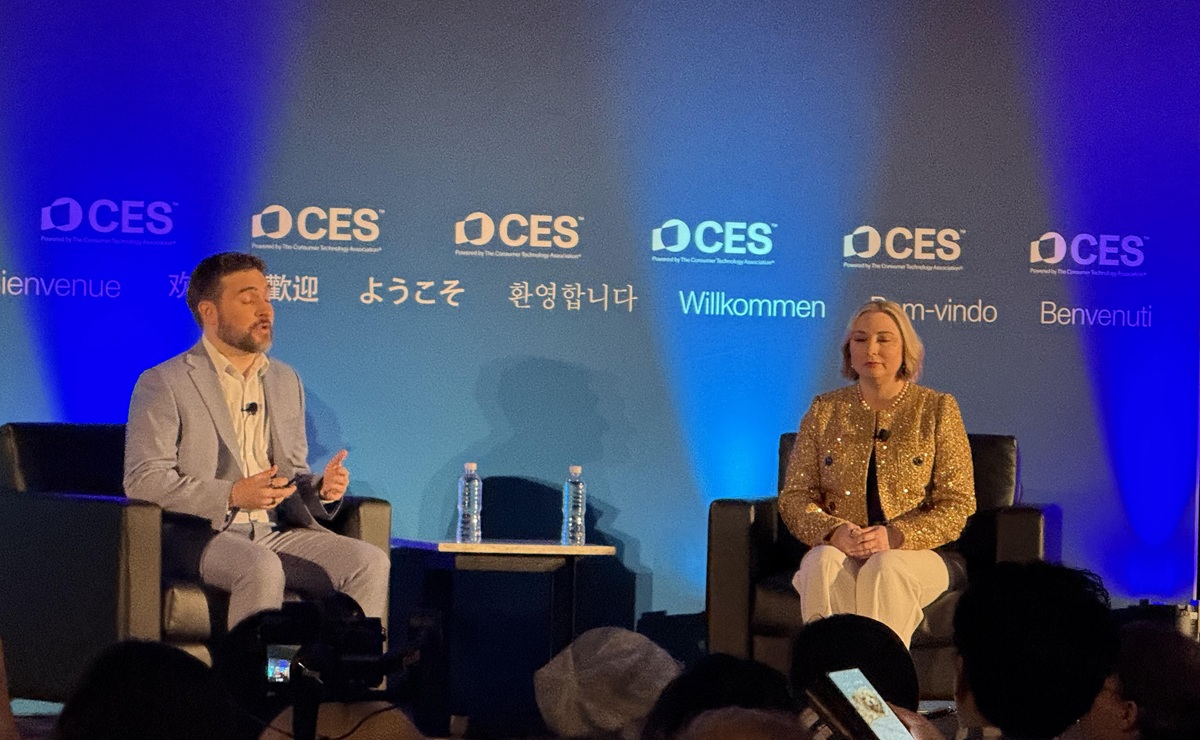
Brian Comiskey, senior director, innovation & trends and futurist for the Consumer Technology Association, kicked off CES 2026 for the press today with a talk about the tech trends to watch.
The sessions is the first of hundreds of speaking events at CES 2026, the big tech trade show in Las Vegas this week.
Intelligent transformation
He said that the CTA predicts that 2026 consumer electronics sales will grow 3.7% to $565 billion, driven by trends like AI and intelligent transformation — the first megatrend of the show. Some 63% of U.S. workers have used AI at work and saved 8.7 hours of time per week.
“AI isn’t static,” he said, noting the shift from AI prompts to agentic AI, where the shift is from something like helping us write an email to helping us manage an inbox for an entire day.
He said vertical AI is emerging in specific industries and industrial AI is also helping with manufacturing goods for the tech industry. Siemens will talk at its keynote on Tuesday on how it is using AI to drive manufacturing with digital twins.
You’ll see SoundHound AI will provide AI assistants. Physical AI going to get a lot of attention, with a focus on humanoid roots, advanced AI models and autonomous vehicles. We’ll see new smart glasses and XR headsets from companies like Xreal.
We’ll see a shift from devices to platforms, with the platforms including smartphones, laptops, TVs, vehicles and smart glasses, Comiskey said.
“The phone is evolving into an intelligent personal assistant,” he said.
Longevity
That’s one example of the trend. The second mega trend is longevity. One of the most profound measures of progress is improved quality of life, Comiskey said.
Withings will show up with its Body Scan 2 system, which can assess your heart rhythm and your precise body fat calculation, based on a scale-and-camera system. It’s all aimed at creating healthier living. You can remotely manage elders and reduce hospitalizations. Vivoo will show up with tests to show vital health measurements for your body.
The notion is to improve the quality of living for people based on tech like exoskeletons, earbuds that can help deal with hearing loss, and other tech that helps people with accessibility. For mental health, startups are trying to detect signs of early depression. Startups like Neuroverse are focused on this space.
“Those conversations are incredibly important,” Comiskey said.
Smart homes and smart living trends are stronger now, based on a real tech and enhanced by improvements in AI. Your security system can alert you to the moment in your security camera footage where an intruder is spotted on your property.
Non-tech companies like L’Oreal and Kolmar Korea are coming to use tech in non-tech products. Video is evolving as the primary driver of culture. The Oscars will move to YouTube in 2029. Ad-supported growth engines are emerging, and short form content is determining what people will notice from long-form content.
“And AI is transforming how video is produced,” with the line blurring between professional and user-generated content, Comiskey said.
Audio is AI is coming on strong with audiobooks and podcasts that drive longer listening sessions. For gaming, live service models are taking off, and brands supporting free content are also important trends to watch, Comiskey said.
Engineering tomorrow
This mega trend is about how we move, structure, feed, and power our world. This takes planning among platforms, personalization experts and partnerships to tackle huge problems like evolving mobility, protecting systems in real time. Bosch Defender provides continuous security awareness through cars moving on the road 24/7.
These kinds of advances are possible through technologies like software-defined vehicles. Qualcomm is developing platforms that enable things like cloud-enabled services, and these technologies are leading to autonomous driving.
To feed more people, John Deere is using robotic autonomous tractors to fill the jobs gap and enable more food production around the world. Oskosh is developing new kinds of fire trucks to prepare first responders to deal with more challenges.
There’s a shift from one-way power delivery to a new energy ecosystem based on electrification, grid infrastructure and energy efficiency.