

California is the land of Hollywood and Silicon Valley, two of the most natural allies of the game industry. But in 2025, the Golden State accounted for 47% of all of the global game industry layoffs, according to game jobs champion Amir Satvat.
Satvat has brought transparency to game jobs and layoffs, as he tracks openings and layoffs at more than 5,000 game companies around the world. His data, produced in his spare time without fees, has given us unprecedented visibility into the gaming labor market. He forecast recently that the global gaming layoffs would subside in 2026.
But this one hurts, as I’m smack in the middle of the Bay Area in California.
“It is a difficult dataset. A grim one. But it is also an important piece of the broader story,” said Satvat, who shared the data with game industry expert Matthew Ball, who has amassed a lot of data and analysis on the broader gaming business.
“California is one of the clearest signal stories inside this dataset, as long as we frame it correctly,” he said. He noted, for instance, that California added 5,000 gaming jobs at the same time that it lost 18,838 jobs from 2022 to 2025.
Satvat noted that California still has the most game jobs in the United States (and the world), based on his own data. There are also other sources of California’s massive number of game jobs such as the Entertainment Software Association. (The ESA reported in 2024 that California had 44,205 direct video game industry jobs and 27,568 jobs for a total of 71,773 total jobs supported).
California has suffered through the layoffs in gaming from 2022 through 2025 like no other region in the world.
California’s share of layoffs from 2022 to 2025 was 43%, or 18,838 jobs lost. In 2024, California accounted for 54% of global gaming layoffs, while North America in 2024.
Amir satvat
Worse for the U.S. and Canada, North America accounted for 62% of all game industry layoffs in 2025. And from 2022 to 2025, North America’s share of gaming layoffs was 61%.
Here’s the data on what Satvat knows about important regions in the world when it comes to gaming jobs.
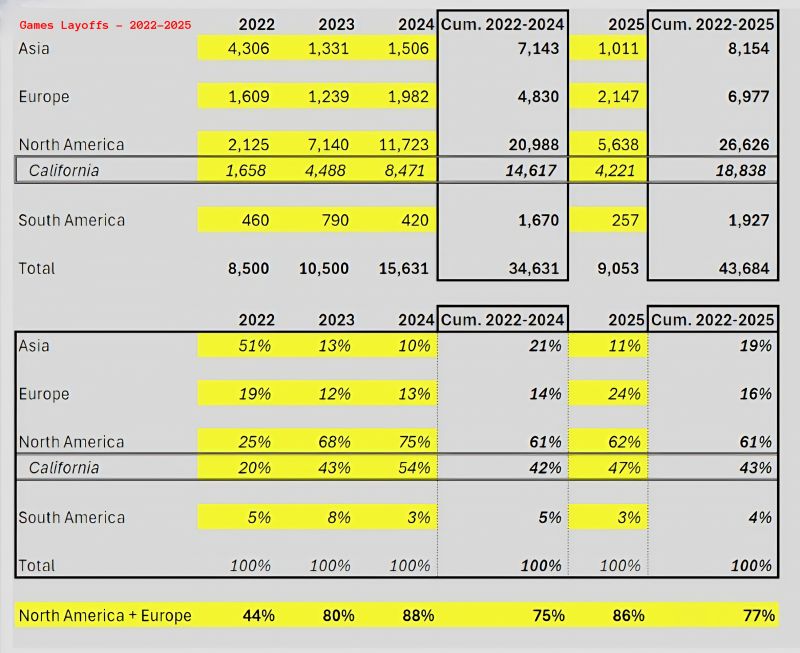
Satvat emphasized the key nuance in an message to GamesBeat.
“California is still the most important hub for games in North America, and it certainly still has the single largest concentration of games employment. So the storyline should not be that California is collapsing or no longer the center. That is not accurate,” Satvat said. “The storyline is that California’s rate of change is materially outpacing other places, meaning the marginal movement of jobs away from California is happening much faster than the marginal movement of jobs away from other hubs.”
Satvat said that what is most striking is that California is not just a North America story. It shows up as a global outlier.
As noted, he said, “Across 2022 through 2025 year to date, California represents about 18,838 of roughly 43,684 tracked games layoffs globally, which is about 43% of the entire global total across that period. That is an extraordinary share for a single state.”
He added, “And it is not stable year to year. California’s portion of layoffs actually accelerated as the cycle worsened, rising from about 20% of global layoffs in 2022 to about 43% in 2023 to about 54% in 2024, and still around 47% in 2025 year to date. So it is not only that California is big. It is that California increasingly became the epicenter of the contraction.”
Satvat also made an important point for interpreting these numbers as it can be easy to misinterpret any single statistic.
“This number is tracking games industry layoffs, not total workforce churn. Games has always had meaningful movement in and out of roles, and it is absolutely true that over a three-year span, some percentage of the workforce would have moved anyway through normal transitions, contract cycles, studio closures, and personal career changes,” Satvat said.
Gaming is also an industry with a relatively young workforce where many people have fewer than seven years of total experience, and that naturally increases general mobility.
” So I would not want anyone interpreting this as 18,838 unique individuals permanently exiting games, or as a direct proxy for long-term career attrition. The correct reading is narrower and more useful: this tracks the scale and concentration of layoff-driven displacement events during the contraction cycle, and where the shock was absorbed geographically,” Satvat said. “It is not a claim about the entire labor market, but it is a strong signal about where the restructuring pressure landed.”
And Satvat has a second interpretation to emphasize. He said any layoffs dataset can include the reality that the same individual may be laid off more than once across the period, especially during a volatile cycle where people move quickly between studios, projects, and contracts.
“So while the aggregate count is directionally very meaningful, we have to be careful not to treat it as a clean measure of distinct, non-overlapping people. In plain terms, some portion of this number may represent repeat displacement of the same people, which makes the human impact even harsher, but also means you cannot translate the number directly into unique heads without further work,” Satvat said. “And to add one more crucial framing point, this all occurred alongside significant hiring as well. In that same 2022 through 2025 year to date period, we estimate total hiring into games roles in California was at least 5,000 people, which helps contextualize this as a turbulent labor cycle rather than a one-way narrative.”
Satvat also said that what matters in California specifically is the mix of the layoffs. A meaningful subset of California displacement has come from FAANG (Facebook/Meta, Amazon, Apple Netflix and Google) and other large conglomerates with games adjacent organizations, platform orgs, and cross functional product teams.
He said that in those platform-related environments, a portion of impacted people do not leave the ecosystem at all. They often move into internal recruiting, adjacent consumer product roles, or other areas within the same parent company or peer conglomerates. So the layoff events are real and disruptive, but the downstream outcome is not always a straightforward exit from games or from the broader technology labor market, he said.
“The other nuance that matters is that layoffs alone cannot cleanly answer what percentage of California game jobs disappeared without a strong baseline of total employment by year, and that baseline is hard to measure precisely enough with public data,” Satvat said.
This is where he said there is more research to do. For instance, Satvat does not know the split of layoffs between Northern California or Southern California, or how the layoffs in gaming compare to layoffs in platform tech companies (FAANG).
“But even without perfect baseline employment, the incremental impact is unmistakable. In our ongoing open roles tracking, California has represented only about 9% to 12% of open roles in recent snapshots. So no matter what the true base employment number is, the directional story remains very clear,” said Satvat.
Put differently, even if California started from a very large installed base, the marginal change is significant, he said.
“California is shedding roles at roughly a five-times-plus pace relative to its current share of hiring back into the state. That does not mean California is not still the biggest hub. It is. But it does mean the center of gravity is shifting in a measurable way. California remains the largest and most important hub, but it may also be changing faster than anywhere else,” Satvat said.
He added, “And the reason I am going into this level of detail is simple. These figures have received outsized attention, and we want the interpretation to be as responsible as possible. The point is not to inflame a narrative. The point is to give as much accuracy and context as we can, while still protecting community level data, so people understand what the numbers do and do not say.”