
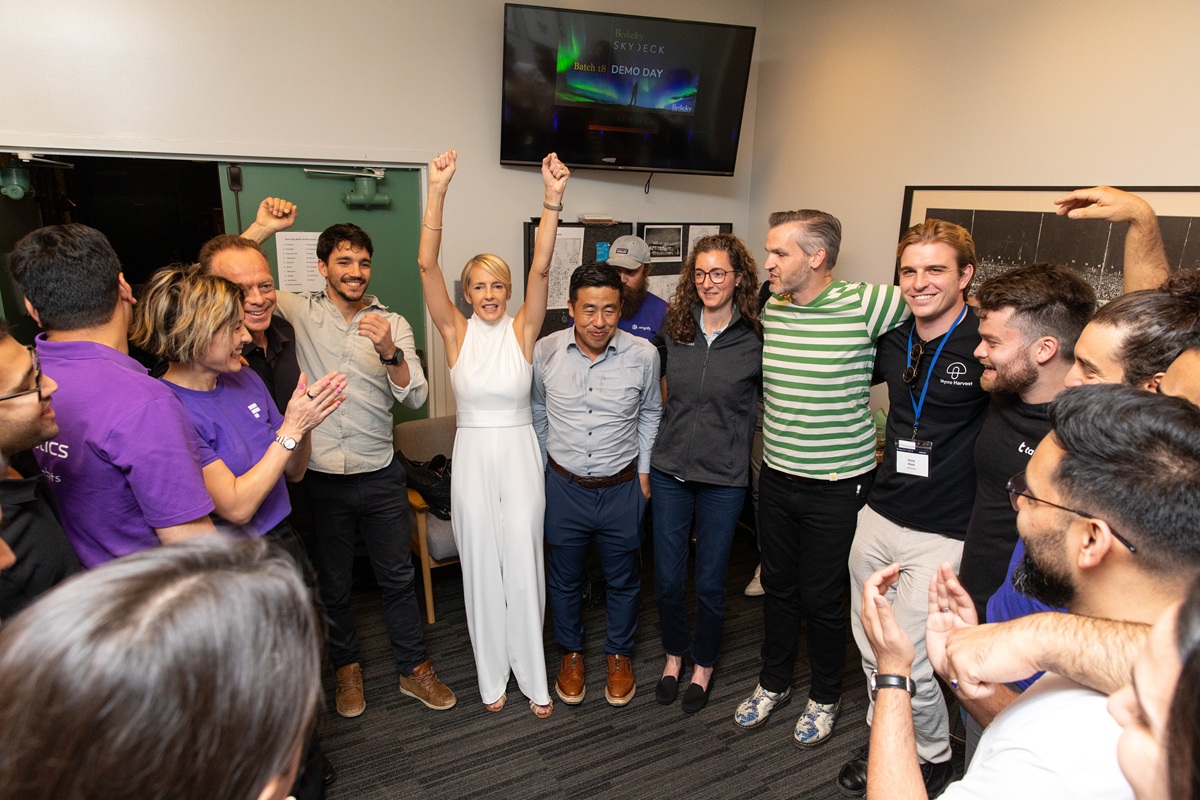
As artificial intelligence and robotics rapidly reshape industries, a new cohort of global startups will take the stage at Berkeley SkyDeck’s Demo Day to present technologies aimed at solving complex real-world problems.
In the class of 17 companies in Berkeley’s accelerator class (Batch 21), the majority of companies are focused on agentic AI, or AI that can act as its own agent, setting goals or make plans with minimal human supervision.
“The companies are pitching agentic AI. We’re also in the middle of interviews for batch 22 and I’d say it’s similar to this batch. With the exception of a pure therapeutics company, there isn’t anybody who isn’t making AI or strictly AI agents front and center for the platform. That’s where it’s at in startups right now,” said Caroline Winnett, executive director of Berkeley SkyDeck, in an interview with GamesBeat.
More than 1,000 investors, founders and industry leaders are expected to attend the event on April 2, featuring startups tackling challenges across AI, healthcare, enterprise software and climate technology.
This year’s Batch 21 cohort represents founders from 13 countries, reflecting SkyDeck’s continued role as a gateway for global entrepreneurs seeking to leverage the strengths of the UC Berkeley ecosystem.
Startups debuting at Demo Day are developing technologies ranging from autonomous robotics for hospital logistics to AI platforms designed to improve industrial operations, enterprise decision making, and healthcare diagnostics. See the full list of participating startups here.
These companies show promise but they haven’t yet raised a ton of money. The accelerator can provide funds through the Berkeley Skydeck Fund.
“What we’re seeing right now is a new generation of founders building incredibly ambitious companies with very small teams,” said Chon Tang, founding partner of Berkeley SkyDeck Fund, in a statement. “AI is dramatically increasing what early-stage startups can accomplish, allowing founders to move faster from idea to product and from research to real companies. Demo Day is often where investors first see teams that could scale into major companies far faster than was possible just a few years ago.”
This latest Demo Day reflects the growing scale of UC Berkeley’s innovation ecosystem. Startups emerging from Berkeley programs have contributed to significant growth in the Bay Area, including supporting more than 1,000 jobs across Alameda County and generating an estimated $450 million to $550 million in annual economic impact.
Skydeck said Berkeley continues to rank as the No. 1 university for producing venture-backed founders, according to PitchBook, underscoring its role as one of the world’s most prolific sources of startup creation.
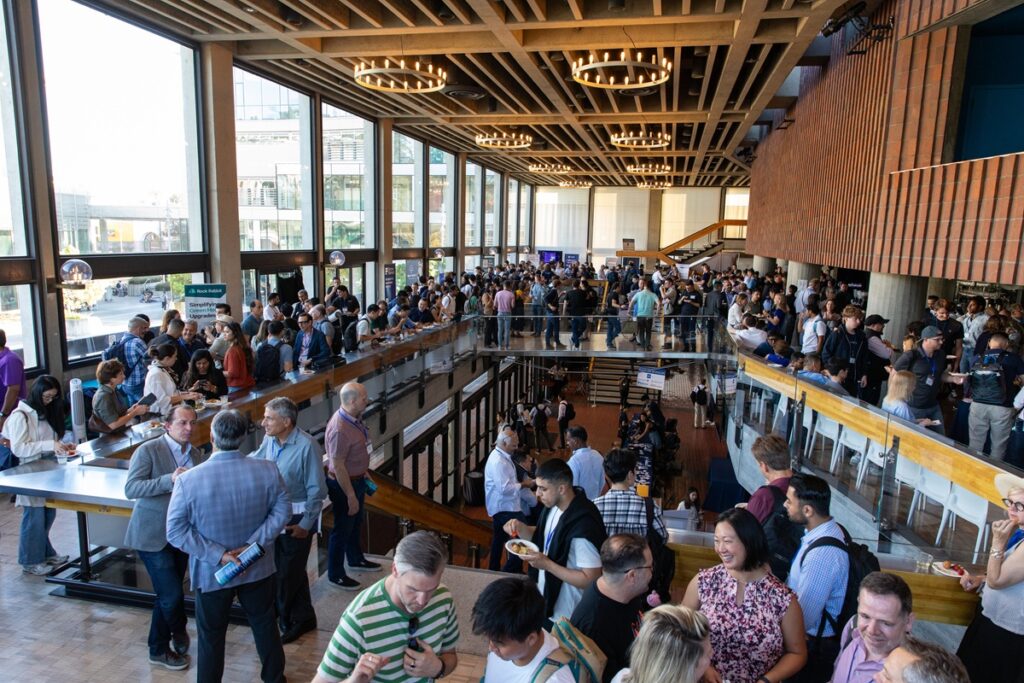
As UC Berkeley’s largest accelerator, SkyDeck plays a central role within that ecosystem. Since launching its first Demo Day in 2016, the program has attracted thousands of applications from founders worldwide each year, while accepting fewer than 30 startups per batch. SkyDeck startups have collectively raised more than $2.7 billion in aggregate funding.
“Berkeley has built one of the most dynamic environments in the world for founders turning bold ideas into companies,” said Winnett. “The strength of the Berkeley ecosystem lies in its openness. Entrepreneurs from across the globe come here because they can access world-class research, experienced advisors, and a deeply engaged investor community.”
Demo Day marks the culmination of SkyDeck’s six-month accelerator program, where founders refine their products, business models and investor pitches before presenting to the venture community. Many of the program’s most successful startups secured their first major funding commitments immediately following the event.
The program will begin with registration at 2:00 pm at UC Berkeley, followed by startup pitches starting at 2:30 pm. An expo and reception will follow from 4:30-6:00 pm, leading into Demo Night events that bring together investors, founders, and members of the Berkeley innovation community.
As UC Berkeley’s largest and most prominent accelerator, SkyDeck combines hands-on mentorship with the vast resources of its research university. SkyDeck is the only accelerator of its kind that offers the value of a dedicated investment fund alongside the resources and network of a top university.
Participating startups have access to SkyDeck’s 980 advisors, 70 industry partners, and a network of more than 613,000 UC Berkeley alumni. For more information, see skydeck.berkeley.edu.
The AI impact
“People are starting to get good at building agents right. It’s still TBD about where they’re going to live. But they are going to be a massive part of our lives for sure. The question is how do we assess these new startups that have zero legacy software,” Winnett said. “Are they builders who can build really fast, iterate quickly, take coaching, use the resources we have, and really think about the customer problem from the customer’s point of view?”
But Winnett said there is a lot of uncertainty around agentic AI. “What are the picks and shovels? Where’s the dirt? Where’s the gold? It feels very untethered right now,” she said. “My view is that agentic AI will bring great benefits, but there’s going to be some big harms. We’re already seeing, those in social media.”
She said the possible layoffs that result from AI are the most tangible and immediate impact coming.
Only one of the companies is focused purely on therapeutics, and another is making software for prosthetics.
The quantum track
Winnett also said the accelerator is launching a quantum track, which means it will have an official track with advisers who supports the admission of such companies into the accelerator. That sounded early for me in terms of timing for getting into the market.
“We’re okay with a pretty long view. We’re not naive, but we’re optimistic that maybe one of the foundational technologies will pay off sooner rather than later. And if anybody can make that happen, it would be the academic talent that we have here,” said Winnett.
What are the possible early uses for quantum? Winnett said cracking the encryption on lost Bitcoin or cryptocurrency accounts might be one. But dealing with the security threats from quantum’s ability to circumvent just about any kind of security is another.
“We launch a track because we’re interested in that technology, and we know it needs very specific expertise,” Winnett said. “Our tracks are biotech, climate, FinTech and blockchain. We’ve had some quantum applications, and we’ve had a few quantum companies come through. It requires a whole different level of expertise to assess the technology. So what we do is we collect a group of advisoes for those tracks.”
The robots are coming
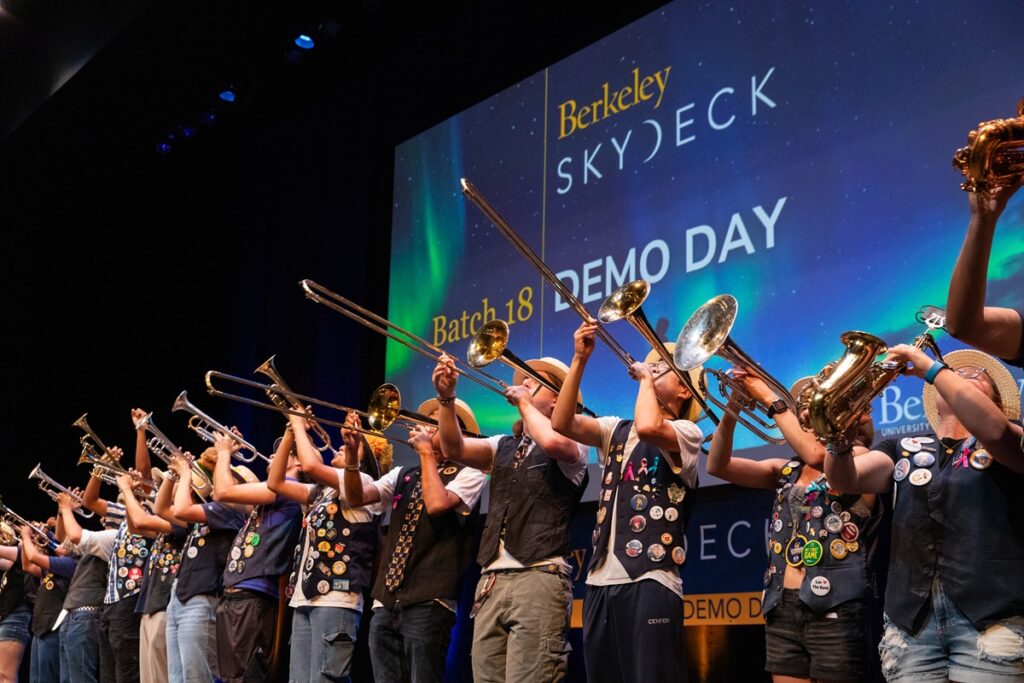
She said there are more “hard tech” companies focused on chips or robotics. Two of the companies in the current batch are making robots, and one is making a platform for robot testing.
One of the companies in the batch handles robot testing.
“The industry’s becoming more sophisticated. We’re all looking at the Boston Dynamics videos of the robot dogs chasing the balls and everything like that. That’s super cool, and I watched them every time. But it’s not a business. Who knows how long away from being a business that is?”
She noted there will be some humans replaced by robots and some humans who will be made a lot better by robots, like those that could push carts around through a hospital.
Beyond the purview of Skydeck, Winnett said, “Governments around the world should be talking about this every day and thinking about it, [regarding human displacement]. I would love to see a company that had a venture scalable business model for that. I would love to see that. That’s more of a social program or social impact.”
In the larger picture, Winnett said AI “is an arms race between the US and China. On the one hand, you want to regulate AI in some way, shape or form. On the other hand, you don’t want a kneecap the talent.”