
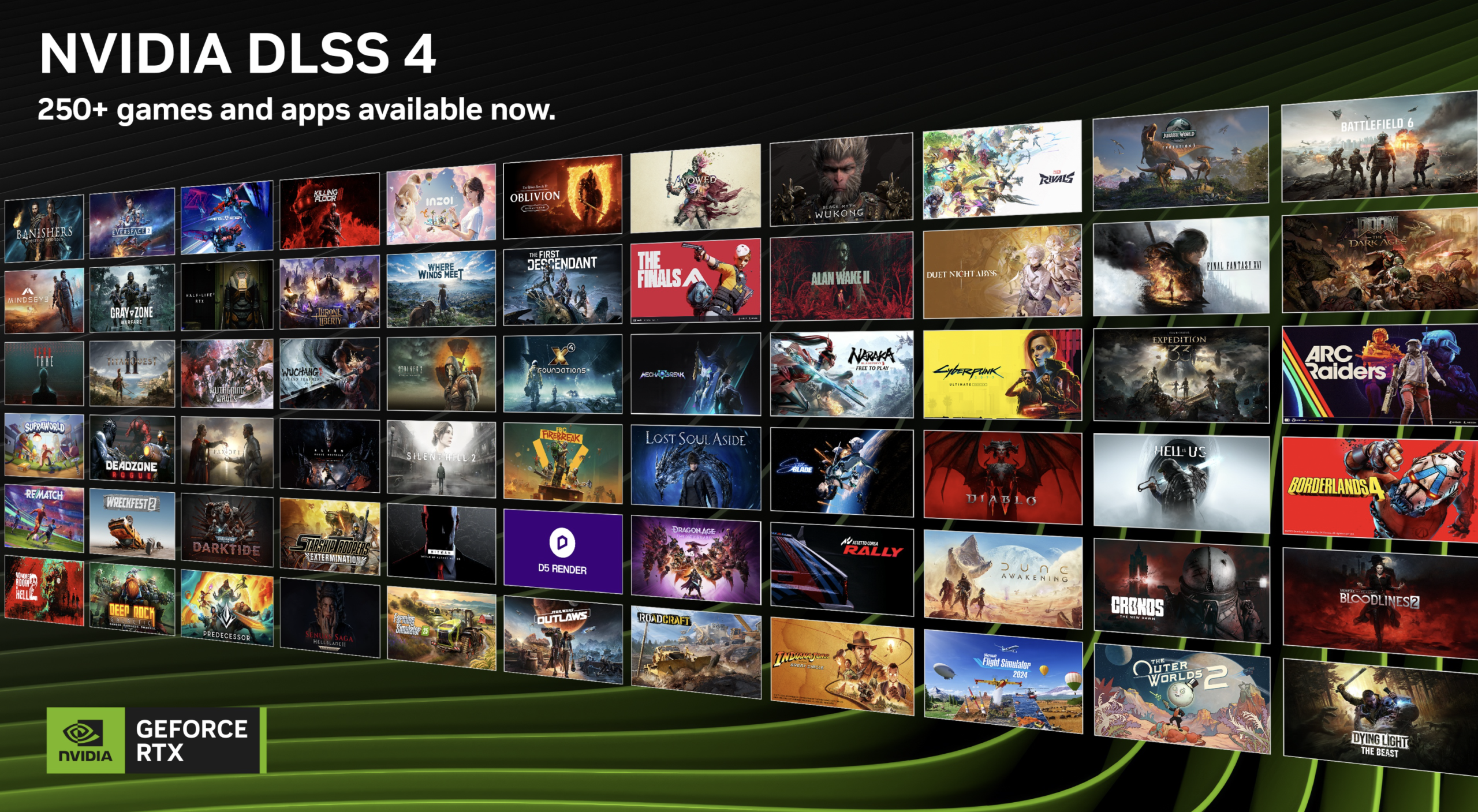
As Nvidia continues to roll out updates to DLSS, 2026 is shaping up to be the year of AI upscaling in gaming.
On Tuesday, January 6, Nvidia revealed a range of announcements covering updates to both the company’s hardware and digital products. But it was one announcement in particular that turned heads among the conference’s gaming industry attendees: the rollout of DLSS 4.5, the latest iteration of Nvidia’s powerful Deep Learning Super Sampling artificial intelligence upscaling technology.
“The model has greater context awareness of every scene, and more intelligent use of pixel sampling and motion vectors,” said Nvidia vice president of applied deep learning research Bryan Catanzaro during Nvidia’s GeForce On community update presentation at CES 2026. “These improvements make Super Resolution Performance and Ultra Performance Mode so much better.”
As AI upscaling technology pervades gaming in 2026, it’s no longer just an option for players to improve graphics — it’s shaping how games are designed and creating a new baseline for graphical fidelity in the player experience.
The rise of AI upscaling
AI upscaling is the practice of using machine-learning models to reconstruct a low-resolution image into a higher-resolution image that looks close to, or better than, native rendering. Using an AI upscaling tool like DLSS, a GPU might render a game at 1080p or 1440p resolution, then use an AI model to analyze the low-resolution image and reconstruct it into a sharper, high-resolution version. Unlike traditional upscaling, AI upscaling uses trained neural networks to predict how images should look, rather than simply stretching out pixels and smoothing edges.
“We always anchor to the ground truth of, what can you render natively without any of our technologies? We’re always comparing to that to make sure that we’re not compromising image quality for performance,” said Nvidia director of product management Henry Lin in an interview with GamesBeat. “Because that’s really easy, right? You could generate more frames, but if it doesn’t look good, then you’re making a trade-off — and we don’t want to make trade-offs.”
In 2026, AI is the buzzword of all buzzwords in gaming, dominating industry conversations at events like CES and beyond. So far, though, most applications of the tech in game development have remained relatively experimental — with the exception of AI upscaling. Thanks in large part to Nvidia’s development of DLSS, AI upscaling has gone mainstream in gaming over the past year, with triple-A and indie developers alike embracing AI upscaling tech — and developing titles under the assumption that their players will use it.
“The thing we’ve proven out is AI upscaling — so Nvidia DLSS, or you’ve got AMD’s FidelityFX,” said Tommy Thompson, the founder of the AI and Games website and conference series. “Sure, there are still a lot of gripes about that, but it has become mass-market and commercialized in games in a way that is quite interesting.”
Thompson pointed out that DLSS is not the only AI upscaling tool on the market, flagging other examples like AMD’s FidelityFX and Intel’s Xe Super Sampling product. But DLSS was the first prominent, machine-learning-based upscaling tool to achieve broad commercial deployment, evolving through multiple iterations since the 2018 launch of DLSS 1.0, including the most recent full version launch of DLSS 4.0 on January 30, 2025.
“The secret sauce is the models and the technology and our super-computer — and this continuous, iterative cycle that we’ve honed and continue to improve, that allows us to create even better models,” Lin said. “It’s like a virtuous cycle, and we’ve done it for eight-plus years.”
Developer concerns
Nvidia’s announcement of DLSS 4.5 at CES earlier this week shows that the tech giant has no plans to give up its lead in the AI upscaling arms race. But in spite of the mainstreaming of AI upscaling in 2026, not all game developers are sold on the technology. Although DLSS runs smoothly on devices powered by Nvidia RTX GPUs, it is not available on the majority of gaming consoles, sparking concerns among developers that games optimized for AI upscaling will not run properly for players using older-generation devices.
“In a world where we can make games run on platforms such as the base model PS5 and Xbox Series X/S, developing with lower-power hardware in mind — such as Nintendo Switch, lower-end PCs, et cetera — it benefits us on a cost and production angle to disregard DLSS as a way to side-step doing the necessary work to optimize games,” said game developer Wolfgang Wozniak in an interview with GamesBeat.
As newer-generation consoles like the Nintendo Switch 2 start using Nvidia GPUs — and thus supporting DLSS — developers’ concerns about AI upscaling foisting hardware challenges onto players could simply fade away over time.
“I’m on the penultimate boss right now of ‘Metroid Prime 4,’ and that game looks absolutely stunning on the Switch 2 — really high framerate, gorgeous visuals, even in handheld,” Thompson said. “The game just looks so good, because it’s running on an Nvidia system that has the ability to then run DLSS on it.”
But for the millions of gamers still using older-generation systems as their primary consoles, it will take years to be able to take advantage of AI upscaling — and Wozniak, Thompson and other industry observers believe the product’s ongoing development could bring diminishing returns as graphics get better and better.
“Fundamentally, the rise of neural rendering — of actually using AI to enhance aspects of traditional rendering — is a really interesting idea to me,” Thompson said. “But, equally, isn’t it a bit of a joke that we’ve found ourselves in this situation? Go back and look at a game from 2016 onwards; it still looks great.”
Nvidia does not view DLSS as a crutch intended to replace traditional optimization, with Nvidia’s GeForce evangelist Jacob Freeman pointing out that developers are still strongly incentivized to make their games run on as wide a range of hardware as possible. Instead of putting forward DLSS as a tool to help developers avoid doing core performance work, Nvidia wants developers to use it to make advanced rendering techniques more accessible, reducing the costs associated with techniques like path tracing and advanced lighting.
“Without DLSS, there’s no Ray Reconstruction, so that significantly improves visuals,” Freeman said in an interview with GamesBeat.
Nvidia’s long-term vision for AI upscaling is for the technology to act as foundational infrastructure for game developers, rather than an easy workaround for higher graphics. As more gaming devices support this technology, the company is increasingly positioning DLSS as a product that just makes sense to turn on, rather than a technical compromise of any sort.
“It’s probably been there already, where it’s almost a no-brainer to use it, because the image quality is so good, especially with DLSS Super Resolution,” Freeman said. “I think some people have reservations about frame generation — but speaking purely on Super Resolution, the image quality is, in many cases, better than the ‘native resolution’ or ‘native rendering’ of the game.”