
Presented by Meshy AI
The pressure on game studios has increased in 2026. Teams are leaner, budgets remain tight, and players continue to expect richer worlds delivered faster. As AI moves deeper into production pipelines, studios are moving past the question of whether the technology works and toward a more important business challenge: whether it can deliver quality at scale.
The question is no longer whether AI can generate a 3D model in seconds. It can. The real challenge is whether those assets are consistent enough to reduce production time instead of creating more work.
For studios, the relevant metric is time-to-usable-asset: the time required to generate, refine, optimize and validate an asset in its target production environment. Meshy 3D Agent is designed around that workflow, maintaining creative context across multiple turns and converting selected concepts into exportable 3D assets.
From faster assets to better workflows
The latest GDC State of the Game Industry survey shows AI adoption continues to grow, particularly in early-stage development. Among more than 2,300 industry professionals surveyed, 36% said they personally use generative AI tools in their work, with research and brainstorming (81%), daily tasks (47%), coding assistance (47%), and prototyping (35%) among the most common uses. Asset generation remains a smaller application, cited by 19% of respondents.
However, concerns around quality and creative standards remain widespread. More than half of respondents said generative AI is having a negative impact on the game industry, with developers citing risks around job displacement, data sourcing, and the quality of AI-generated content. BCG’s 2026 Global Gaming Report similarly found that AI adoption is expanding across the industry, with roughly half of studios using AI somewhere in their pipeline.
Consistency at scale
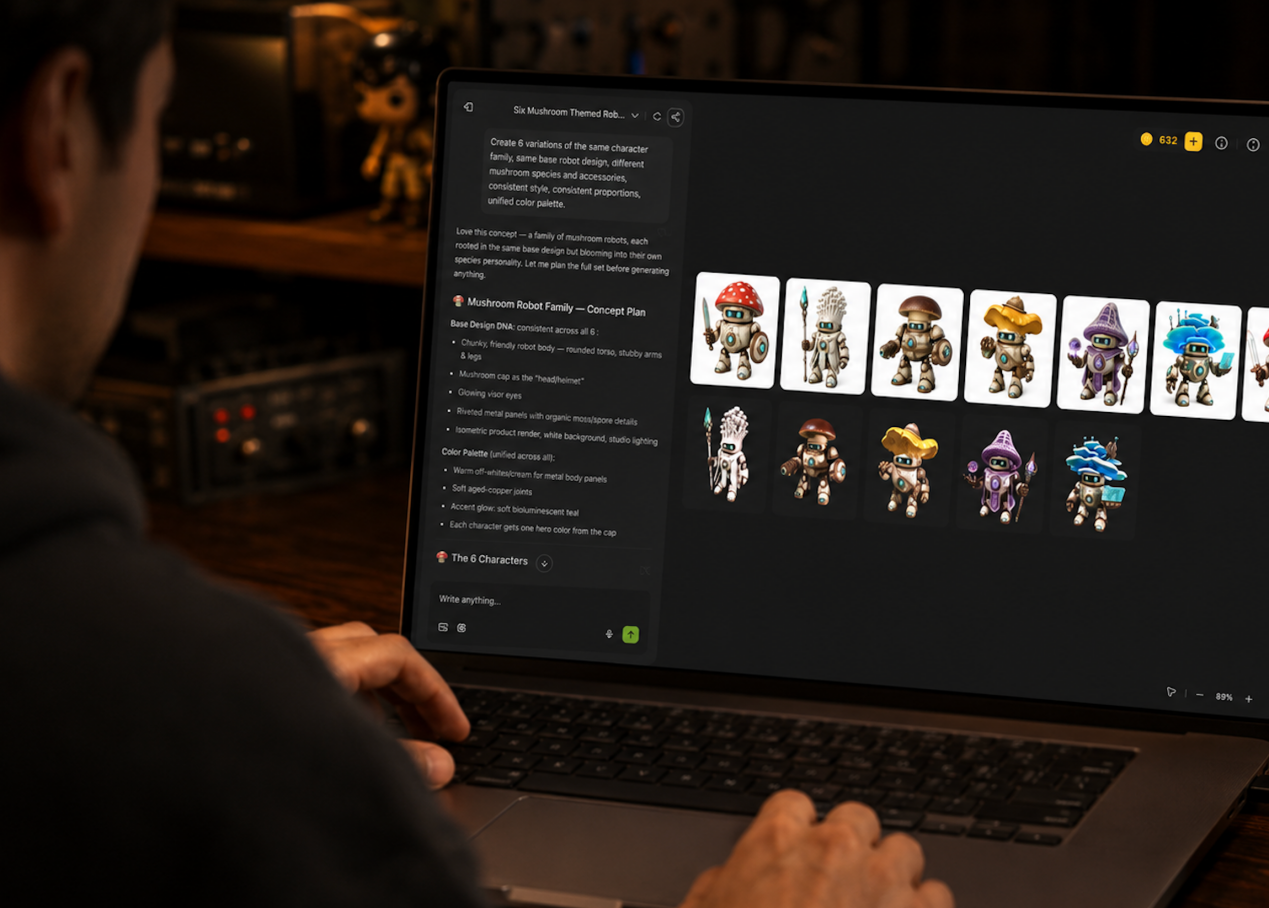
Meshy says its 3D Agent lets developers establish an art direction once, refine it through conversation and generate related assets without restarting the creative brief for every object. Rather than treating each model as a separate prompt, the workflow is designed to keep an entire asset set visually coherent.
Demo: Generating a Consistent 3D Game Asset Set
For a game studio, consistency operates on three levels. The first is creative: assets need to share a recognizable visual language, with matching proportions, material treatment and level of detail. The second is technical — assets have to follow compatible polygon budgets, scale conventions, texture requirements and export formats. The third is workflow, meaning art direction and production context carry through from concept generation to refinement, rigging, animation and engine handoff.
Meshy’s strongest product claim sits on the first level: creative consistency across an asset set. The broader platform extends that workflow into remeshing, PBR texturing, rigging, animation and export, reducing friction between concept development and downstream production.
From Text Prompt to Game Engine: Meshy’s AI 3D Workflow
Rather than replacing artists, conversational AI is finding its place earlier in production. Concept exploration, blockouts, secondary props, and prototyping can move faster, while hero assets and final creative decisions remain with development teams.
Meshy’s product pitch extends beyond generating a visually consistent batch. Within its broader game-asset workflow, teams can start from a text prompt, reference image, sketch or rough idea, then establish and refine a shared art direction through conversation. From there, the agent generates a batch of related concepts, and selected ones can be converted into 3D game assets.
The workflow continues past generation: assets can be prepared to meet target polygon, topology and texture requirements, characters can be rigged and animated, and everything exports in standard formats for game engines and digital content creation tools.
Meshy 3D Agent supports exports including FBX, OBJ, GLB, USDZ, STL, BLEND, 3MF and DXF. Those formats allow generated assets to move into workflows involving Unity, Unreal Engine, Godot, Blender, Maya, 3ds Max and Roblox.
Demo: Moving an AI-Generated Character Further Into Production
As of July 2026, Meshy says more than 12 million registered users have generated over 100 million 3D models through its platform, which SimilarWeb ranks as the top platform in its category by web traffic. The company has just closed a $400 million Series B round from a group of leading global investors, valuing it at $1.5 billion. Meshy has also recently added in-chat rigging and animation for generated characters, expanding its role further into the game asset pipeline.
Consistency is the starting point, not the whole story
For game studios, consistent AI-generated 3D game assets are only the first proof point. Meshy 3D Agent connects that first step to the rest of the production pipeline.
That broader workflow matters because speed at the first step has little value if teams lose the time again in cleanup and handoff. The more useful benchmark is whether AI shortens the distance between an initial brief and a usable in-engine asset.
Meshy is betting that a conversational, human-in-the-loop workflow can do exactly that: automate repetitive generation and iteration while leaving final creative and technical control with artists.