

The Alliance for OpenUSD (AOUSD) today announced the completion of the Core Specification 1.0 deliverable, a critical milestone in establishing Universal Scene Description (OpenUSD) as an international standard for 3D content creation and interchange.
If you’re not sure what this means, you could say that we’re one step closer to the metaverse, or at least the industrial version of the metaverse.
The more popular term for the metaverse is probably virtual worlds, or the industrial metaverse, which refers more to digital twins, or simulations of work environments that are useful for engineers or designers. Some stakeholders use the industrial metaverse to distinguish between worlds that respect the laws of physics versus entertainment, where defying the laws of physics is commonplace.
“I think they all fall under the umbrella of virtual worlds, right? And traditionally [it refers to] virtual worlds at scale. Not just in terms of the complexity of of the world and in the physics, but also the types of data that it takes to describe that world,” said Aaron Luk, director of product management (OpenUSD Standards), Nvidia Omniverse Libraries, and Core Specification Working Group Chair, in an interview with GamesBeat.
This is true particularly in the industrial world, where you have lots of non-3D data that that will flow through a typical facility that needs to be replicated In the virtual version of that facility. There is plenty of non-3D data in augmented reality experiences.
A lot of work

This achievement represents more than two years of intensive collaboration across the industry and lays the foundation for unprecedented interoperability in 3D workflows.
Formed in 2023, AOUSD is an organization dedicated to fostering the standardization, development, evolution, and growth of OpenUSD, an extensible framework for describing, composing, simulating, and collaboratively navigating and constructing 3D scenes.
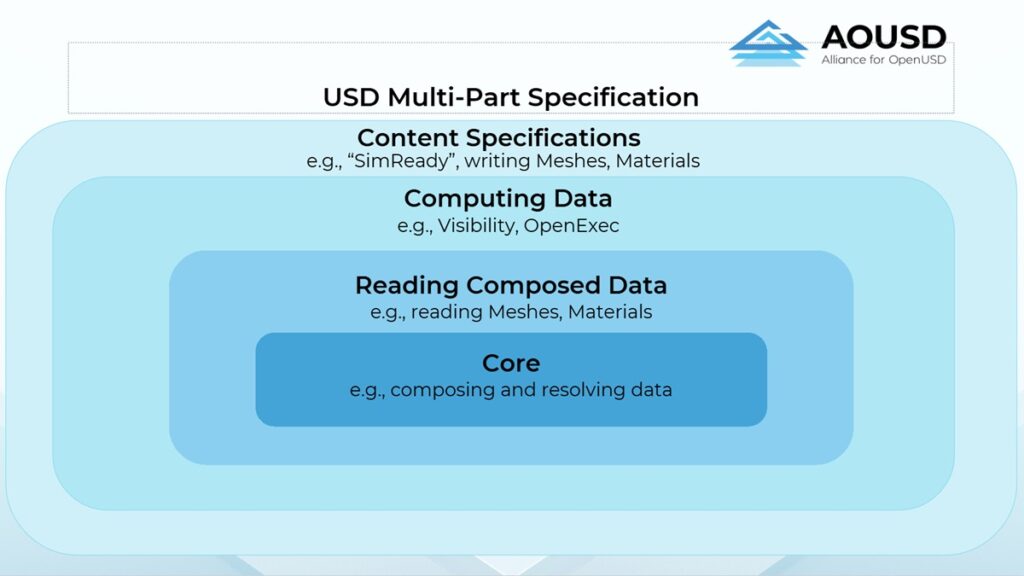
The Core Specification 1.0 provides the first normative definition of OpenUSD’s foundational data models, composition algorithm, and value resolution system.
Building on the work that began with the working group’s formation in 2023, this specification ensures that developers can rely on consistent, predictable behavior when working with OpenUSD across any compliant implementation.
“The Core Specification represents the bedrock that enables an entire ecosystem to build with confidence,” said Luk, in a statement. “By formalizing how OpenUSD data is structured, composed, and resolved, we’re enabling independent implementations while ensuring they all speak the same language.”
How it all came together

In an interview with GamesBeat, Luk said the work on the spec officially launched at Siggraph 2023, and then this working group launched a couple months later in November 2025.
“It’s about a two year journey bringing this specification to life. Of course, before that, there were many years of development in OpenUSD code base that we’ve now put into normative language as a true standard,” said Luk.
Luk said the work involved coordinating18 voting eligible member companies who unanimously approved the 1.0 spec.
“This is my first time working with this many companies at once on a standardization. It was a lot of work and a challenge for me to really put together enough guidance and leadership to keep things moving along,” Luk said. “Often, standardization work is seen as a side hustle. Ideally, it’s like the day job and the standardization work really converge.”
He added, “I would say the challenges are around like cross-organizational communication and keeping the momentum going, in terms of the technical challenges. We were at an advantage in that we’re standardizing something that already has an existing implementation right in the OpenUSD code case.”
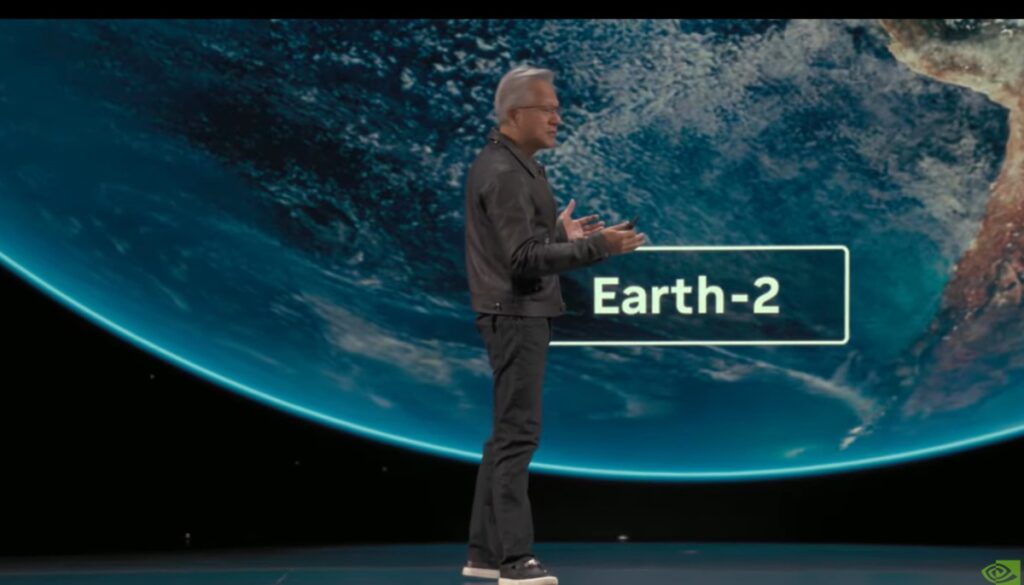
Pixar created the Universal Scene Description technology to have a standard way of handling 3D graphics data, which was useful across its different movies. It offered the tech up as a standard to make it not only easier to make animated movies but to do any kind of digital simulation work, whether it was making 3D games or building Earth-size supercomputer weather simulations or creating digital twins of factories or creating the lingua franca of the metaverse.
Key components of Core Specification 1.0
The Core Spec 1.0 comprehensively defines grammar and data types, document
data model, composition algorithm, value resolution, file formats, and compliance
framework.
“This specification enables stakeholders to implement independently compliant
importers and exporters, opening the door to entities that will only engage with
published and ratified standards,” said Steve May, AOUSD chairperson and chief
technology officer at Pixar, in a statement. “It’s the critical first step toward ISO standardization and broader international recognition.”
The specification development and validation process itself uncovered and resolved ambiguities in the OpenUSD codebase, demonstrating the value of rigorous standardization.
The Core Specification 1.0 serves multiple critical functions:
● Provides canonical documentation for all higher-level specifications being
developed by AOUSD working groups
● Establishes baseline compliance and testing frameworks
● Enables compliance in alternative USD implementations, such as the
TinyUSDZ project
● Creates a foundation for domain-specific specifications, such as those in the Geometry, Materials, and Physics Working Groups
Two of the competing technologies have kind of made their peace. OpenUSD favored complex 3D graphics like those in movies or games. But the glTF standard focused on 3D data on mobile devices. And lately a new tech that has emerged is the Gaussian Spatt, which uses point cloud data and imagery to capture complex objects like trees in 3D.
“The bottom line is, no one wants to fracture the content ecosystem. And so there’s continual good progress towards alignment for common data modeling that is not just with USD and glTF, but with the whole content ecosystem,” he said.
Momentum and roadmap: Predictable evolution
Having successfully completed two IP review periods and Technical Advisory Committee review, the Core Specification 1.0 represents the culmination of AOUSD’s initial two-year roadmap announced in 2023. The working group is already advancing Core Specification 1.1 for 2026, which will include:
● Enhanced animation spline support reaching feature parity with OpenUSD 25.08
● Variable expressions and path expressions
● Refined compliance rubric to clarify core and domain-specific distinctions
Beyond technical achievement
This specification fundamentally changes how we approach 3D content longevity. For the first time, creative and industrial organizations can invest in 3D assets knowing they’re building on a foundation that no single vendor controls. It’s about democratizing 3D content creation while ensuring professional-grade reliability.
The Core Specification also serves as the foundation for domain-specific specifications currently in development by the Geometry, Materials, and Physics Working Groups, creating a comprehensive ecosystem for 3D content interchange that scales from indie developers to major studios and industrial applications.
The specification has already informed improvements to the OpenUSD codebase itself, uncovering ambiguities and bugs through the rigorous standardization process.
Early access to the Working Group’s sample implementations and compliance testing in development that supplement Core Specification is available here.
Feedback to sample implementations for compliance testing are welcome on forum.aousd.org. The working group actively encourages feedback from early implementers to inform the 1.1 release.
While the promised metaverse hasn’t arrived yet, Luk said, “We definitely live in a world where everything that’s manufactured has been simulated in any number of scenarios for the manufacturer to have confidence in that product. We certainly believe in that at Nvidia. That’s certainly super important for autonomous vehicles, right? Anything that moves right needs to be simulated, and a vast number of scenarios.”