
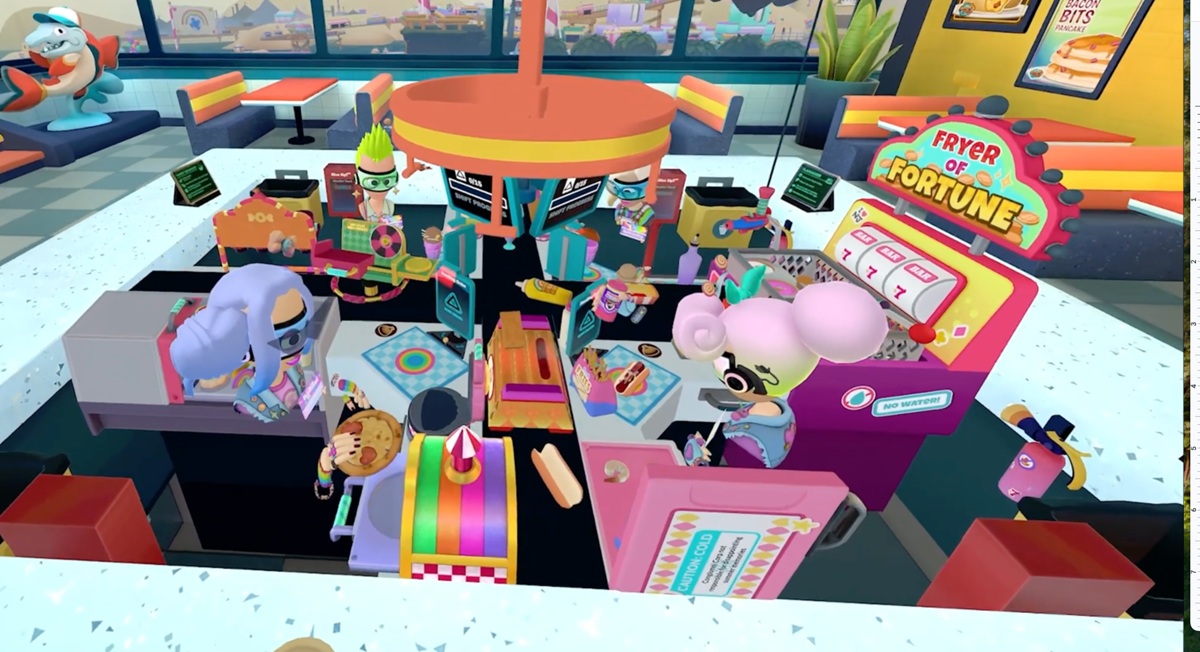
Artificial Agency announced that it has integrated its agentic AI Behavior Engine into Owlchemy Labs’ Dimensional Double Shift.
Artificial Agency’s AI tech — designed to make games and characters feel more alive — will power the smart non-player characters (NPCs), making possible a new single player mode for the XR game. I was able to demo the tech at the Gamescom expo in Germany, the the single-player mode itself won’t ship until the first half of 2027.
The mode brings the game’s signature collaborative multiplayer experience to solo players with a full AI crew of Totally Expendable Multi-dimensional Personnel (T.E.M.P.s), or robotic coworkers, each filling a distinct cooperative gameplay role.
This is the world’s first commercial game mode built around moment-to-moment collaboration between one human player and multiple AI agents that interpret player intent, coordinate with one another, and adapt as the game unfolds. Artificial Agency’s technology and game-specific models provide the behavioral layer for these interactions and decisions, bringing Owlchemy Labs’ creative vision and gameplay design to life.
Distinct from classic “bot” implementations in previous single player game modes which respond to a pre-mapped sequence of actions, the T.E.M.P.s interact with the player in a complex, open-ended way that creates more room for player expression and individual choice.
The player can speak naturally, and the T.E.M.P.s interpret requests, coordinate with the player and one another, decide how to help, and invoke approved actions within Owlchemy’s defined roles and boundaries to keep the shift moving in a busy setting like a diner.
The T.E.M.P.s can also draw on relevant earlier moments, improvise within their roles, and express humor, skepticism, and other human-like personality traits authored by Owlchemy and powered by Artificial Agency’s technology.
“For years, cooperative games have relied on human teammates for communication, coordination, and role fulfillment to provide the most entertaining experience. Artificial Agency’s advances in agentic behavior have shown it’s possible to create rich experiences without compromise,” said Andrew Eiche, CEO at Owlchemy, in a statement. “By integrating the Behavior Engine into Dimensional Double Shift’s new Single Player Mode, we can preserve the teamwork at the heart of game and make the experience accessible to solo players when real-life friends are not around or in off-hours of the day—all without changing the core mechanics or dynamics of multiplayer.” We were able to keep our current pipeline unmodified and use agents to turn your voice into action. Everything else is traditional Owlchemy Labs. That’s a big deal for us from a development perspective and for our players.”
Eiche added, “With this integration, Artificial Agency has made significant advancements in its training and model architecture which has unlocked commercial viability for cost-effective deployment at scale in game titles and other applications.”
The video game industry is bigger than ever as global revenues are expected to reach $300 billion by 2029, but competition to capture player attention is fierce, with more than 225,000 new games released in 2025 alone. Agentic AI presents one of the most significant emerging opportunities for studios to innovate gameplay and captivate player attention, but high recurring inference costs tied to persistent agents has served an economic challenge to game studios already under budget pressure. At the same time, developers face hurdles ensuring agents are fast and responsive in game settings.
Artificial Agency trained a small, optimized model specifically for Dimensional Double Shift, in combination with its reflex architecture to separate fast, immediate reactions from decisions that benefit from deeper model reasoning and help behavior stay responsive as gameplay changes. The result is dynamic behavior with lower latency and inference costs, making agentic gameplay commercially viable at scale and practical across a broad range of platforms including PCs, mobile, VR, and consoles.
“Three years ago, we founded Artificial Agency on a clear thesis: commercially viable agentic behavior in games requires a game-native approach,” said Brian Tanner, CEO of Artificial Agency, in a statement. “Our work with Owlchemy Labs on Dimensional Double Shift’s Single Player Mode proves it. At the heart of that approach is what we call agent empathy: designing from the agent’s point of view so it can perceive, understand, and act reliably inside the game. By closing the reality gap between what the agent believes and what is actually happening, we can train very small, game-specific models that deliver responsive, adaptive gameplay beyond what scripting can achieve, at a cost developers can ship.”
I also spoke with both Tanner and Eiche at Gamescom.
Artificial Agency’s partnership with Owlchemy Labs is a significant milestone for the company. As the first shipped game built with the Behavior Engine, Dimensional Double Shift’s Single Player Mode offers a category-defining experience, serving as powerful proof of the company’s founding vision for how agentic behavior can rethink the way games are designed and experienced.
To learn more about the Behavior Engine and partnering with Artificial Agency, click here.
The playtest at Gamescom
I’ll be the first to note that the playtest at Gamescom at the Owlchemy booth didn’t go so well. The culprit was too much traffic on the WiFi network in the vast hall at the B2B expo. So I tried to look past that problem and I intend to do another test in better conditions later.
The test started out on Google and Xreal’s new headset, Project Aura. Normally, Dimensional Double Shift is a four-player multiplayer game. But in this case, I was working a shift in a coffee shop with three AI characters, each serving at a food production station. I was also one of the food workers, and my job was to get coffee orders and other food orders going so we could serve large numbers of customers with our production crew.
My job was to speak in a natural way and their job was to understand what I needed and then provide it to me. Now, normally, if we didn’t have such bad WiFi, they would have gotten the requests and then tapped their AI to understand what I had requested.
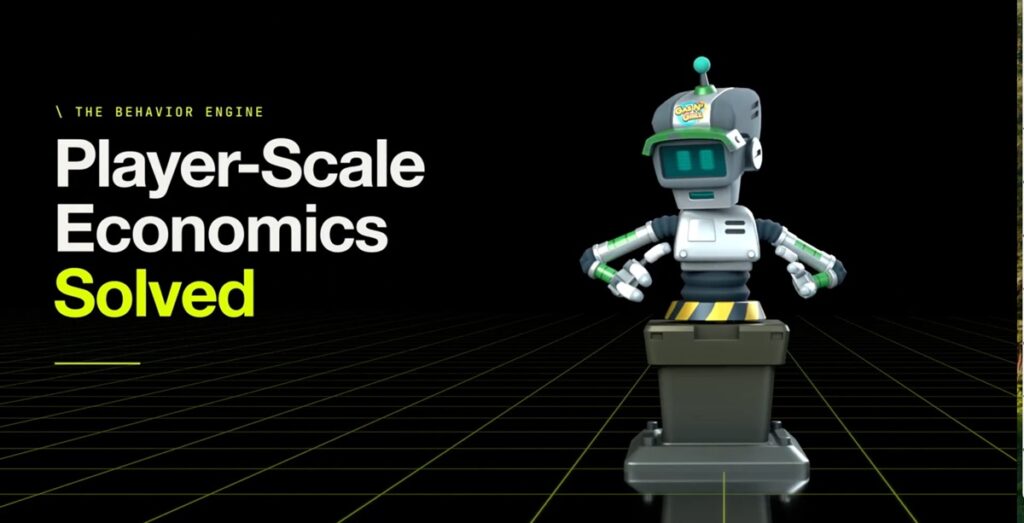
My three coworkers were robots, with no real attempt to make them look like humans. Their ability to reasoning goes like this. I can ask for a carrot. Then the bot’s AI will go through a processing, “I know what a carrot is. There is a carrot in this scene. I can go to the carrot, grab it, throw it to the player, and then perhaps say something.”
At any given moment, there will be three AI agents running in the cloud, Tanner told me in our interview. They understand their current state, their name state, and they recognize they have work to do. When the player asks them for something, they will combine their understanding of the world with what needs to get done, and then come up in action and get executed in the game to do it.
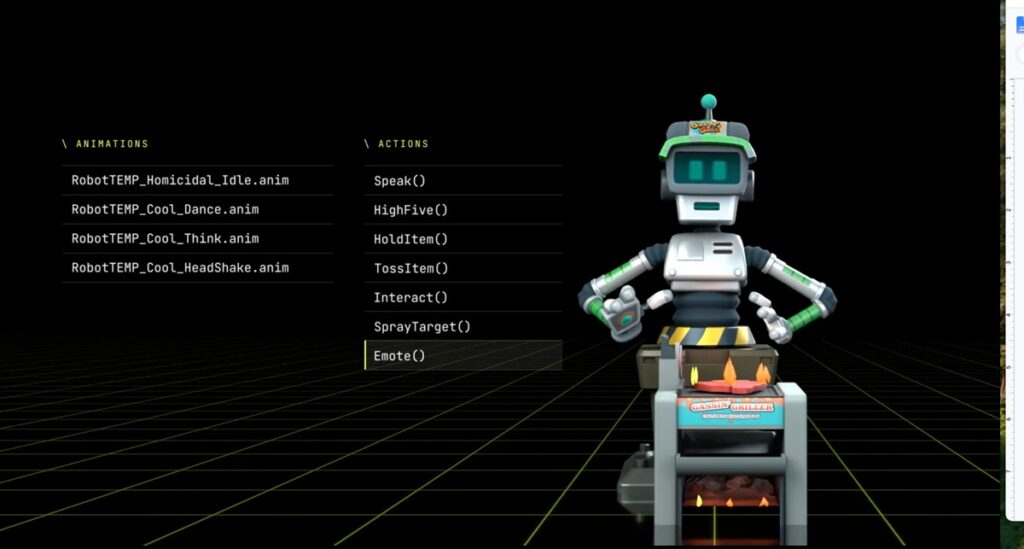
“If you ask them to pass you stuff, they will do it. Also, if you ask Stan to shoot Debbie with the water hose, the robot will do that too. Like they have a wide ability to understand all the affordances. They’re in-game agents,” Tanner said. “One of the key use cases we’re going after is basically human-like conversations that are not scripted bots that you can play with.”
Eiche said that the AI is not tapping a foundational model (like ChatGPT or Claude) because those models aren’t cheap to run. But the smaller, game-focused model create for this game is a lot cheaper to run. (Over time, such costs are expected to fall further).
“We’re going to potentially run them on device,” Eiche said, which would pretty much eliminate a lot of the AI processing cost.
In the demo, you stand in one part of a circulation station that includes all four workers in the coffee shop. I pick up a scanner and look at an order that has come in. (At this point, I had to switch to a different headset with a better connection).
I had to sit back a bit to better see everything in the scene. The order said I needed to make a coffee. I had to grab some coffee beans, put them in the blender, grind them, and then put it in a cup. Then I had to get hot water and put it in the cup and then pass it over to a robot. There were variations like putting more sugar into the cup, and I had to ask for the sugar. The comedy came in as I dropped cups and broke them and the robots threw me things I had to catch. I also made a hot coffee when they asked for an iced one. Eventually, the various requests I had were answered and the robots tossed what I needed over. It just took time.
The finished product was not particularly easy for me to find, but things weren’t happening in real time. But under better internet circumstances, the latency would likely go away when the game actually ships, the parties said.
Eiche said that there will be some game functions like sound that would help make the latency of the AI seem less awkward. A robot could say, “I will give you that in a second.” Also, when the demo shifts from cloud to local processing, the latency will pretty much go away, Eiche said.
“We’ve crossed some of the hardest things we can do, and I am confident that it will work,” Eiche said.
How Owlchemy Labs warmed up to AI in gaming
Eiche said that a year ago Owlchemy came up with a “crazy idea.” What if the company made an “uncompromising version” with single player mode that plays exactly like multiplayer with your voice and everything else.
They figured that AI was changing so fast that it would grow into what Owlchemy needed. Eiche met the folks at Artificial Agency and began talks.
“We realized we were both talking about solving the exact same problem, and so we partnered,” Eiche said.
Dimensional Double Shift first came out on the Meta Quest XR device in September 2024 and it came out on the Samsung Galaxy XR in December 2025. The game reached a million players — a great result for a VR game.
The game got its Hexas Dimension expansion in April 2025, the New Joysey expansion in October 2025, and it got its Sporelando expansion in April 2026. Those expansions sell for $5 each.
Artificial Agency origins

The company was founded in 2023 by Brian Tanner and Alex Kearney. Tanner has 25 years of experience in reinforcement learning and AI, including research with Rich Sutton and leadership at DeepMind. He now leads Artificial Agency to bring agent-driven intelligence to the world of video games.
Kearney is an AI researcher and entrepreneur with experience at DeepMind, Twitter, and the University of Alberta, specializing in generative behavior and reinforcement learning. Previously, she was a research scientist at DeepMind, PhD under Rich Sutton.
Tanner told me in 2025 that he has wanted to make AI games since he was 10 years old.
“I remember like doing HyperCard animations in the 90s and wishing I could find a way to actually make the game intelligent. And so I spent so many years doing AI research and reinforcement learning, always wishing there was a way to bring it over to games,” Tanner said. “But it was so hard previously because you needed so much data and training. When we were at Deepmind, we saw all of these amazing things.”
Like beating world-class human players at Starcraft and Atari games. But they needed to train using an enormous amount of computing time for the models.
“Then, when generative AI finally hit the mainstream, we saw what ChatGPT could do, and we saw actually had a system now that had common sense knowledge built into it, which was always the big gap,” Tanner said. “And ever since we basically started playing with ChatGPT, to harnessing this core idea and bringing it into video games.”
In 2024, Artificial Agency raised $16 million in funding. The money came from Radical Ventures, Toyota Ventures, Flying Fish, Kaya, BDC Deep Tech, TIRTA Ventures, and others.
The company is based in Edmonton, Canada, with a lot of people from the University of Alberta.