
 Activision’s long striptease for Call of Duty: Ghosts began last month, and now IGN has pulled off a few more veils with additional details about the single-player campaign that will make fans salivate.
These revelations will continue until the game debuts in November, but they’re critical to shaping the buying decision for the Call of Duty consumer and building buzz about the game. Nobody does this better than Activision. Last year’s Call of Duty: Black Ops II generated $1 billion in sales within 16 days of its launch.
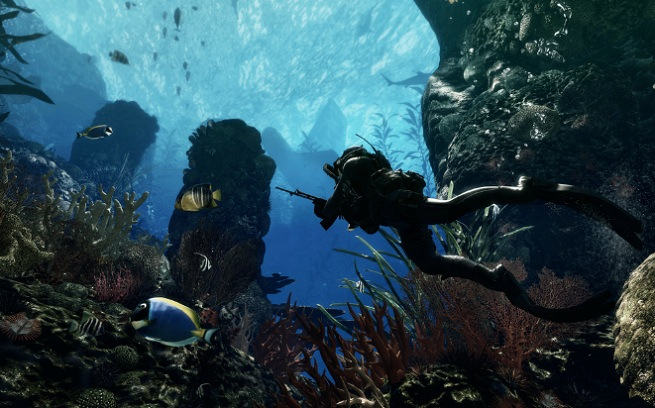
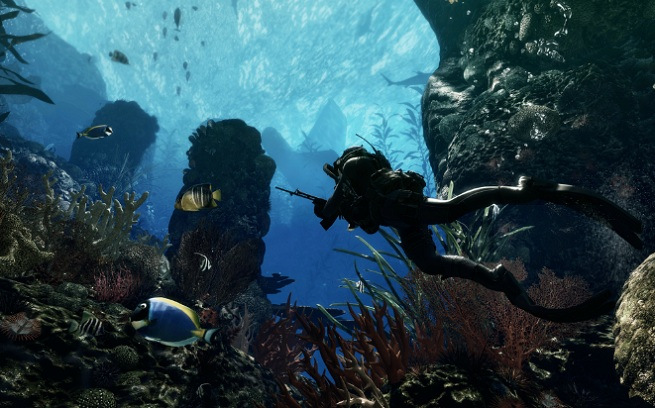
Activision, a division of Activision Blizzard, announced Call of Duty: Ghosts earlier this year and then showed off a full level and description of the game during Microsoft’s Xbox One reveal. That level demonstrated how the stealthy U.S. soldiers could swim underwater, fight with their enemies using underwater guns, and then sink a submarine with a detonation charge. Touting the “best Call of Duty ever,” Activision also revealed that it will have a dog as one of the main characters in the game.
More story details
Today, we’re learning more about the playable main character Simon “Ghost” Riley, a soldier who, along with his brother and fellow soldier, grew up in the U.S. after it had been nearly wiped out by a calamity. The cause of the disaster hasn’t been revealed yet, but it happened 10 years ago. The story is a brand new one set in the Call of Duty universe, but it has no other narrative connection to the Black Ops or Modern Warfare stories.
The Russians aren’t the threat anymore. Instead, the U.S. is facing off against “resource rich” states that include the oil states of South America. One of the battles takes place in a no-man’s-land about 10 miles north of San Diego, Calif. — now a wasteland full of wreckage and collapsed interstates. The area is now contested between the U.S. and an unnamed faction. During the mission, players come upon a mile-wide crater and have to send scouts with hazmat suits and gas masks into the area. The dog participates in this mission as a remote recon scout. Players can track where it is through a tablet-screen viewfinder.
The dog carries a periscope-like camera and an ear piece. The team can tell the dog what to do through the ear piece. The soldiers can also give nonverbal vibration commands to the dog to send it in the right direction. You steer the dog as you would a soldier. When the dog comes upon an enemy, the player taps a shoulder button and gets the dog to attack the enemy’s throat. It can also bark to distract an enemy and lure him into view. A soldier with a silencer rifle can then dispatch the enemy. IGN says the dog is like a drone in the Black Ops games.
IGN also saw more of the underwater combat, where enemies can take cover behind rocks and reefs. They can use elevation to get an advantage over a rival. Sonar blasts from a submarine can cause havoc with divers. The player has to swim to cover to avoid them.
Livestream coming
Activision will show more about Call of Duty: Ghosts in a livestream tomorrow at 11 a.m. Pacific time. The game is being developed by Infinity Ward, and it will debut on Nov. 5. It will come out on the Xbox 360, the Xbox One, the PlayStation 3, the PlayStation 4, and the Windows PC. Activision says later announcements will include new multiplayer features.
Call of Duty is one of the five most valuable game franchises in the industry. About 40 million gamers are awaiting this title, which is not just a single game but a whole new sub-brand, much like Call of Duty: Modern Warfare and Call of Duty: Blacks Ops. Like those sub-brands, Call of Duty: Ghosts is expected to spawn multiple titles in a new modern combat universe.
As you might expect, Ghosts represents another huge investment of time and money in a modern combat game. The title suggests that the game is about ghost-like elite soldiers who perform secret and controversial missions, always operating in stealth. The scenes showed the signature Call of Duty style: intense action, a gripping narrative, pulse-pounding music, and stellar graphics.
At an event last month, Eric Hirshberg, the head of Activision Publishing, said, “From time to time, I have read stories about how long Call of Duty can last. They are about whether this franchise is ever going to crest. And I know that it seems that it should be. There is just one problem. It’s not. By every measurement you care to look at, Call of Duty has never been stronger. It’s not only thriving. It’s still growing. Sales of the game, sales of downloadable content, the number of people who play every month, the number of daily users, the number of hours played, the engagement with social media, the video views — [with] just about any measurement you care to look at, this is still a franchise that is on the rise. After all this time, that’s pretty remarkable.”
Infinity Ward hired Stephen Gaghan, the screenwriter for the Oscar-winning Traffic film, to create more fleshed out, emotion-driven characters. Gaghan, who’s a gamer himself, also directed Syriana. The bet is that Gaghan’s fleshed-out characters will make full use of the enhanced graphics technology in the new game consoles for rendering human faces.
Players will be able to customize their characters more than ever, choosing faces, heads, body types, and more. The idea is to make players connect with who they are onscreen. The new consoles have a technique called Sub D (developed by Pixar for animated movies) that pushes up the number of polygons (the basic building blocks of 3D images) in real time. High-resolution textures enable much better details. When a beam of light hits a character’s skin, the mathematical models behind the animation cause the light to bounce around under the surface and produce a faint glow to its texture. The engine quickly determines how many polygons should be included in a given animated image so that it looks better. That makes images more realistic.
Characters’ arms, one of the few body parts you see a lot in a first-person shooter game, will be far more realistic than in past games with an “exponentially higher polygon count.” The arm animations will show cuts, bruises, and even the dirt underneath fingernails. The weapons will also look a lot more detailed. Jungles in Ghosts will be far more detailed and populated with plants than in Call of Duty: Modern Warfare 3, which came out in 2011.
The multiplayer combat will also be more dynamic, including events such as earthquakes and floods that will affect the battlefield. There are also player-driven actions such as doors with explosives and other player-created traps. And the developers promise that those changes won’t slow down the game. Suarez said that the multiplayer animation quality has typically lagged behind single-player versions in first-person shooters. But Activision is aiming to reproduce the same graphics fidelity in multiplayer as it has in single-player mode.
Activision previously showed how a technique called Displacement Mapping enables much higher fidelity for the animation of water rushing over rocks in a river bed. Without this, the rocks look flat. But with the Displacement Mapping turned on, the scene looks fully three-dimensional. The engine adds those effects on the fly.