
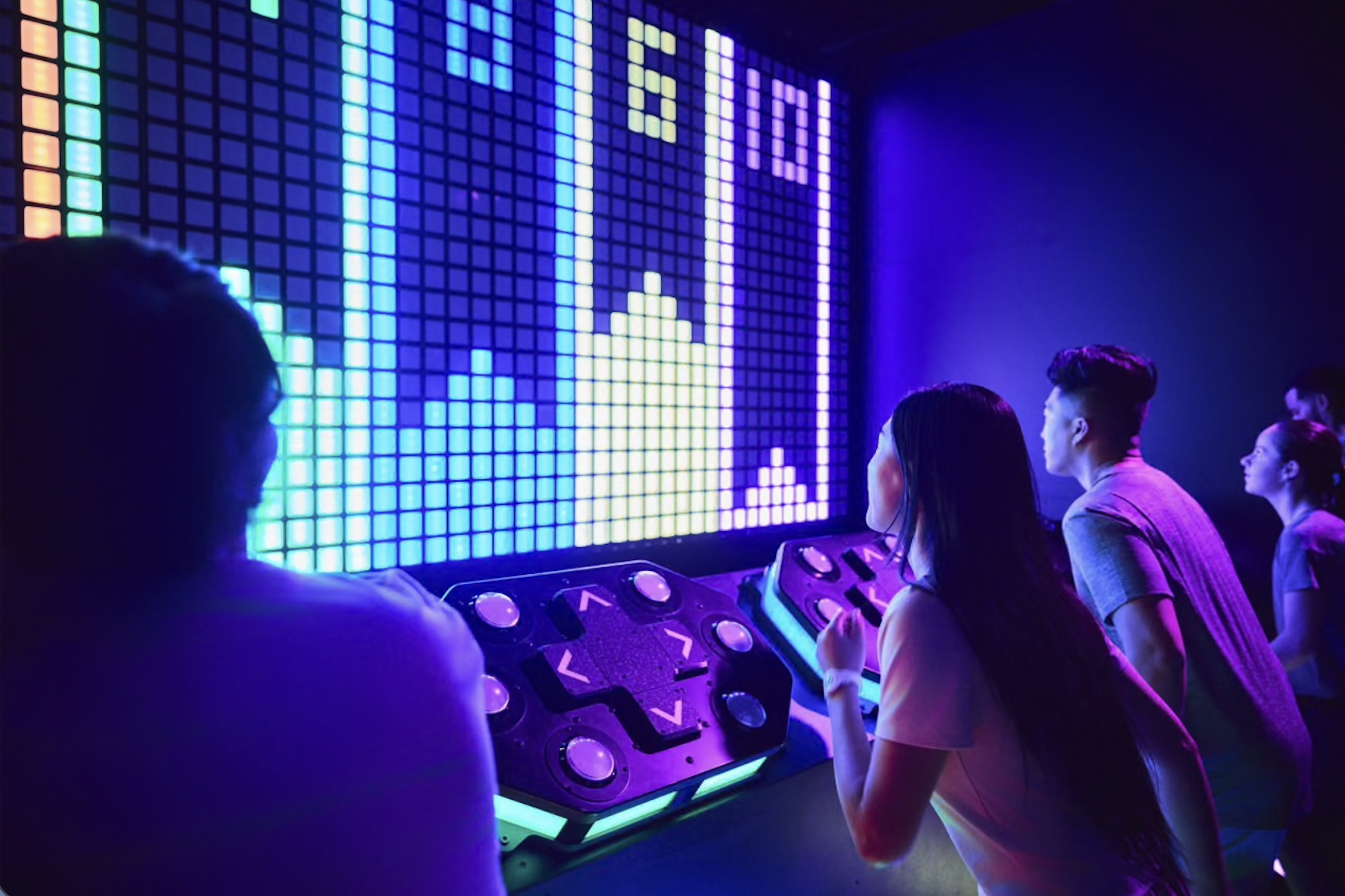
The gaming industry has spent the past few years worrying about flat engagement and rising development costs. Meanwhile, one of Canada’s fastest-growing tech companies was growing exponentially by sending people out to play in a physical room.
Activate, the Winnipeg-founded “active gaming” chain, ranked No. 26 on Deloitte’s 2026 Technology Fast 50 with 958% revenue growth from 2022 to 2025, a reminder that some of gaming’s fastest growth is happening away from the console.
Activate’s 958% revenue growth, which earned it the 26th spot on Deloitte’s 2026 Technology Fast 50 list, points to a part of gaming that rarely makes industry headlines. Location-based, social play is scaling on proprietary tech rather than on game sales or subscriptions. Rapid franchise-style expansion, leagues that link venues worldwide and the appeal of play that’s physical and social could tell the broader industry something about where players now want to spend their time and money.
The Canadian in-person gaming company opened the doors of its first location in Winnipeg, back in 2019. Today, the company holds more than 85 locations across Canada, the U.S., Denmark, Germany, France, Finland, Malaysia, Mexico, Norway, Sweden, the U.K. and the U.A.E, claiming that it has now welcomed over 14 million players.
“Being recognized by Deloitte’s Technology Fast 50 program is an incredible milestone for Activate and a reflection of how far we’ve come since our opening in 2019,” said Adam Schmidt, CEO and co-founder of Activate, in a press statement. “We always strive to push the boundaries of what entertainment looks like by bringing together technology and physical activity in a new way.”
Activate says its revenue has grown up to 958% between 2022 and 2025, a figure Deloitte used to rank the company No. 26 among Canada’s fastest-growing tech firms. However, Activate hasn’t disclosed actual revenue numbers, so it’s unclear exactly how big the business has become. Deloitte’s ranking rules do set some parameters for these figures: to qualify for the list, companies needed at least $50,000 in revenue in 2022 and $5 million in 2025. Qualifying companies also had to be headquartered in Canada, own proprietary technology, and spend at least 5% of gross revenue on R&D conducted in Canada.
When Activate first launched in 2019, they introduced their concept with a relatively simple premise at the core of their game model: players play against the room, or against each other.
Activate’s players move through the venue’s interactive game rooms, in which they compete in a series of games that combine physical movement with digital gameplay, including laser mazes, interactive climbing walls, and hide-and-seek style games. This fusion of physical gameplay with digital features is the company’s proprietary technology and lives at the heart of Activate’s growth. The technology uses RFID wristbands for players to integrate into the interactive game spaces, as well as real-time scoring to track each player’s achievements and performance.
More recently, Activate has also launched features aimed at getting players to return to their locations. Activate’s Team Mode allows larger groups to compete against one another, for parties larger than six players. Additionally, Activate Global League connects teams around the world through competitive play, in which each team can compete from its local Activate location. The structure of the Global League is reminiscent of esports leagues, but this version is played in real rooms rather than on PCs or consoles.
For game makers, Activate’s growth is a reminder that not every gamer is looking for just another download. Over the past couple of years, the industry has been shrinking its workforce: the ASGC Games Industry Layoffs Tracker, maintained by Tencent Games executive Amir Satvat, projects about 14,259 game job losses in 2026, up 78% from its January forecast. Against that backdrop, a gaming company built on the premise of physical rooms, wristbands and in-person competition is scaling on an entirely different set of economics, with leases and build-outs instead of live-service updates and user acquisition.
Whether that model competes with traditional games or complements them is an open question. Location-based play like Activate’s could pull time and spending away from console and PC sessions, or it could work as a social on-ramp that brings in audiences who don’t play video games in other contexts.
“The 2026 Technology Fast 50 winners exemplify the ingenuity, resilience and ambition that continue to define Canada’s technology sector,” said Brendan Cooper, national Technology Fast 50 program co-leader at Deloitte. “We are proud to celebrate their achievements and recognize the meaningful impact they are making in communities and markets across the country.”
Amanda Perran, the program’s other national co-leader, specified that this year’s winners “are tackling complex challenges, unlocking new opportunities, and fueling growth across Canada’s technology ecosystem.” Perran also added that “their success is inspiring the next generation of entrepreneurs and helping to build a more connected, competitive, and innovative future for Canada.”
The Technology Fast 50 program runs alongside Deloitte’s North American Technology Fast 500, and winners are automatically eligible for that broader ranking. Activate is calling itself North America’s fastest-growing entertainment experience, a claim the company makes in its own boilerplate.
Activate hasn’t publicly shared any plans for how quickly it hopes to grow from here, but the company seems to be courting further expansion in the coming year.
“As we continue to grow, we’re excited to continue innovating our experience and sharing it with new communities around the world,” Schmidt said.