
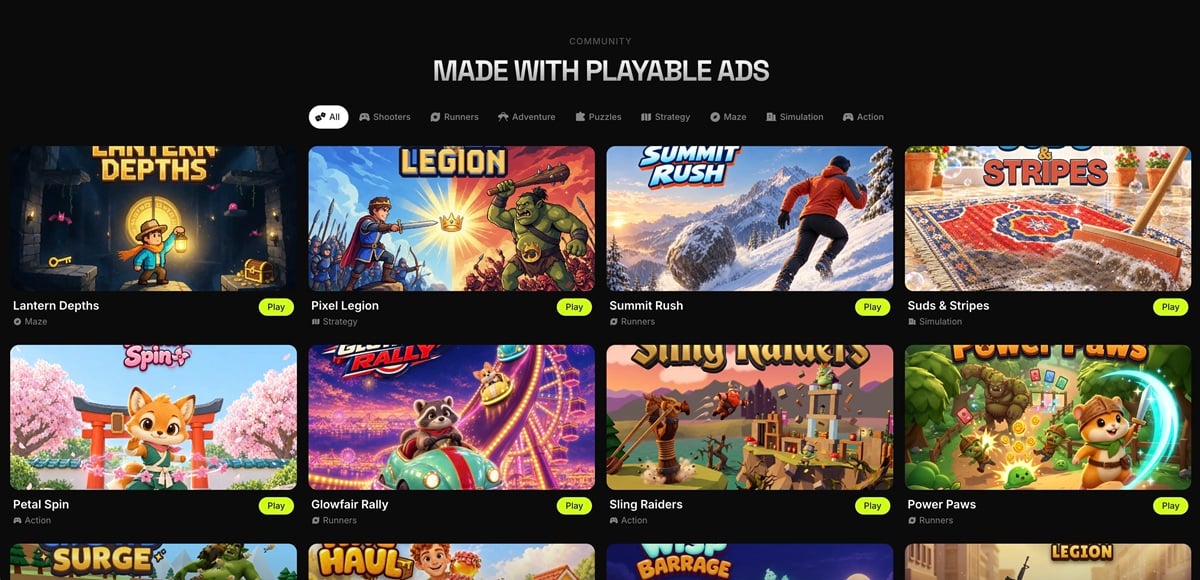
Higgsfield has launched playable ads, a new enterprise-only workflow for creating interactive ads with AI.
The company said it will lead to lower costs, faster production and better user acquisition — the latter being a perennial problem for mobile games. Playable ads have been a staple of mobile games for years, but AI startup Higgsfield said it is bringing near-instant generative AI creation to the process of making the playable ads.
The game developers can use the tech by describing a game mechanic, choosing a genre and dimension, adding creative assets, and generating a playable experience in manual or auto mode. They can upload up to 100 assets, including sprites, textures, and sound effects. They can also start without assets or modify an existing playable ad.
Higgsfield also offers playable games, a tool for creating mobile games available on all Higgsfield payment plans. Creators can generate games directly on Higgsfield or through Claude using Higgsfield MCP.
Others have used cloud technology to stream playable ads to devices. But in this case, you download the playable ad, which is essentially just an HTML file, which users can then upload to ad networks like AppLovin, Meta, Google, TikTok, and etc. You can play the ad because it’s using HTML and you can export it to ad networks, said Zhangir Yergaliyev, member of technical staff at Higgsfield, in an interview with GamesBeat.
The game isn’t slow in part because of the requirements for the playable ad, which is limited to five megabytes of data. The playable ads are lightweight, using small amounts of memory, so they can play on a mobile device easily, Yergaliyev said.
The most important part here is the editing functionality and the control. You can edit and ask an agent to change anything about the game. With performance marketing, it becomes easy to test hundreds of variants of the game, said Yergaliyev said.
And so you can customize it based on feedback, without regenerating the game from scratch. You can customize multiple versions of a game. If you don’t like the camera angle, you can edit it and save it and it creates a new version. You can make the game harder or easier by clicking a button, Yergaliyev said. After creating the playable ad, you can add a call to action link too, said Nuray Omarkhan, spokesperson for Higgsfield, in an interview with GamesBeat.
Yergaliyev said gaming studios can now create playable ads and games at the same time and iterate on them in house.
Using AI to make playable games and ads
Higgsfield Playable Ads applies interactive gameplay to advertising. Instead of watching a video, viewers can try a game mechanic as part of the ad experience. The enterprise workflow includes additional generation controls and options for supplying existing creative assets.
Playable Games lets you describe a game, choose a genre, add references, and generate a 2D or 3D experience. You can start with a simple concept, such as a cat jumping across rooftops, then define the controls, obstacles, and objective.
Both are part of Higgsfield, the generative platform for creative production, with 35+ models and tools.
Playable Ads are available exclusively on Higgsfield Enterprise plans. Its workflow starts with a game description and supports optional creative assets, genre selection, dimension settings, and stage approvals.
Manual mode lets you review and approve each stage before proceeding. Auto mode generates without intermediate approvals.
All uploads are optional. Start from a description alone or supply assets to guide the look, sound, and game concept.
Upload limits describe the Playable Ads workflow. They should not be treated as confirmed limits for Playable Games.
Higgsfield launched Pixel Games, a tool that enables the creation of brand new games with generative AI. That product came out earlier this year. While you can games on Higgsfield, there’s more approval for creating the ads and marketing materials with AI. This tool for creating games is available only for enterprise customers.
Yergaliyev said said the major use cases for playable ads come from game studios that focus on mobile games. Higgsfield cannot talk about them due to NDAs, but the company said that it works with the top five major game companies in places like Turkey, Israel and Cyprus.
For almost every product Higgsfield works on, it collaborates closely with the people who actually use the product. It’s working with game studios now for playable ads.
“We listened to their feedback and built this product so they can actually implement it,” said Yergaliyev. “And for our other products, we also work with actual creatives, creative directors, filmmakers to come to define our product roadmap.”
Creating Your First Playable Ad
Developers can describe a short interaction that introduces the game mechanic quickly. They can choose a genre and dimension, upload any relevant assets, then select manual or auto.
They can test the result for clear controls, readable visuals, and an understandable objective.
Playable Ads exports your finished ad as a single .html file up to 5 MB, formatted for your selected advertising network. Choose the destination network and enter the Destination URL, the page users should reach when they click the ad’s call to action, before downloading.
Nine export options are available: Generic MRAID, Moloco, AppLovin, Google App Campaigns, Unity Ads, Meta, Pangle (TikTok), Mintegral, and Liftoff. Once downloaded, upload the file to your advertising platform to set up the campaign.
The genre selector offers eight categories include shooter, runner, adventure, action, strategy, maze, puzzle and simulation.
You can choose the genre that best matches the main action. Your description should explain what the player does, how they control it, and what counts as success or failure.
Playable Games is available on all plans. Playable Ads requires an Enterprise plan. Access and generation costs are separate: availability on a plan does not establish a fixed price per game or ad.
Tips for a better first playable game or ad
You can start with one mechanic. Give players one clear action to learn before introducing more complexity. Describe the controls. Specify tapping, swiping, dragging, or keyboard input rather than leaving the interaction undefined. Define the ending. Explain how the player wins, loses, or restarts. Give references a purpose. Identify which image should guide the character, object, or environment.
Test the full interaction. Check the opening, gameplay, scoring, failure state, and restart.
Use assets you have permission to use. This includes images, music, footage, and existing game files.
Higgsfield has created an enterprise tool for creating and iterating on mobile-game playable ads, emphasizing faster and lower-cost production.
Studios can describe a game, choose a genre and 2D or 3D format, and upload up to 100 assets, including sprites, textures, and sound effects. They can also start without assets or modify an existing playable ad.
Higgsfield is being cautious. It removed App Store and Google Play link import after studios raised copying and legal concerns, as game companies don’t want their games inside somebody else’s LLM. Manual mode lets users approve each stage, including mechanics and generated assets.
Playables are lightweight HTML packages, designed to stay under 5 MB and work on mobile devices, including older phones. Users can download them for major ad networks such as AppLovin, Meta, Google, and TikTok.
Cost and iteration
Higgsfield is looking to get more endorsements from enterprise clients such as game publishers. And Higgsfield is constantly improving its product.
The company reported an average manual production process of five days and about $5,000 to create a playable ad. But its tool takes about 40 minutes for a first version, or roughly one to one and a half hours with edits, at an estimated $30 to $40 per playable ad — around 600 credits in tokens.
The playable-ad team has fewer than 10 people; a backend engineer runs about 10 AI agents in parallel. That team built the first version of playable ads in two weeks.
Higgsfield said it ships frequently and integrates new models quickly. Higgsfield open sources a lot of its own work.
The Chinese AI games market is taking off, but the company hasn’t yet focused on that market. Higgsfield itself has more than 40 million users around the world, with much of the audience in the U.S., followed by Europe and then South Korea, Japan and Singapore. AI adoption is steadily improving said Omarkhan. Higgsfield has also moved into AI films, launching a short drama product made with AI at the recent Web Summit in Portugal. You can create a drama around an e-commerce brand and help that brand take off on social media, Yergaliyev said.