
Artificial intelligence could help game developers build faster, reduce costs, and take creative risks that were previously out of reach. But industry leaders say its benefits will depend on human judgment, reliable data and stronger software security.
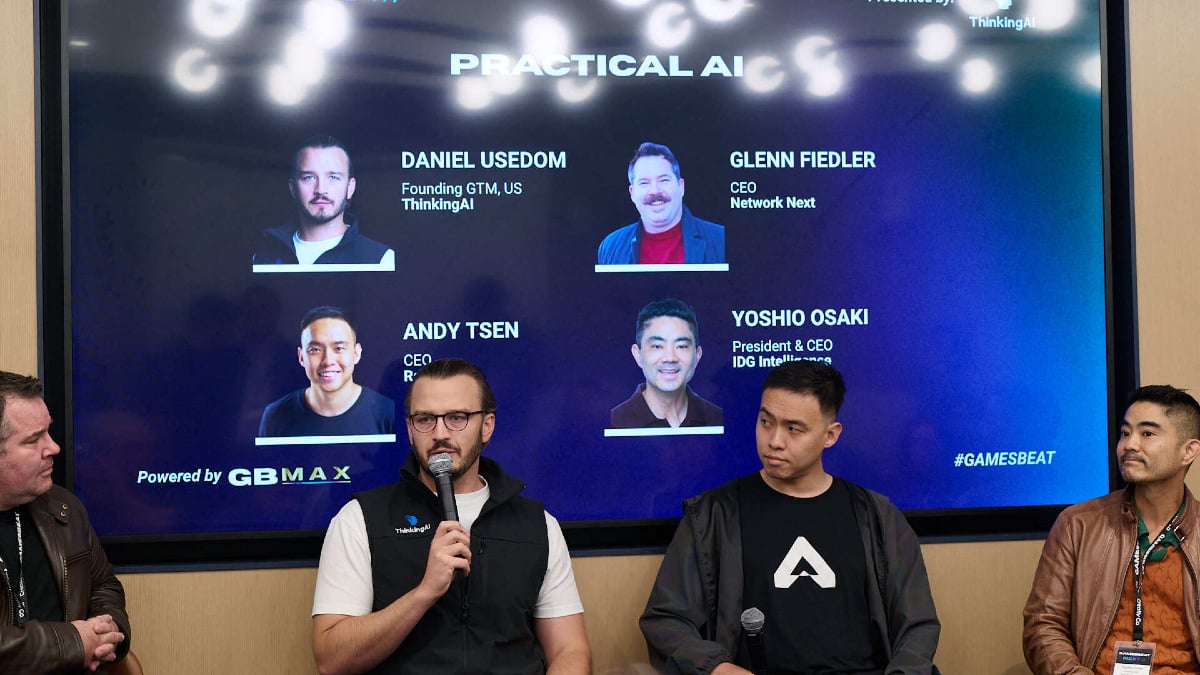
That was the message from a practical AI panel at GamesBeat Next, moderated by Yoshio Osaki, president of IDG Intelligence. The discussion featured Andy Sen, the chief executive officer and co-founder of Ramen; Dan Newsom, who works on the go-to-market team at Thinking AI; and Glenn Fiedler, the chief executive officer of Network Next and a veteran network programmer.
AI is accelerating development and exposing bottlenecks
AI coding has already changed how Fiedler works. After decades as a programmer, he said he recently used an AI model to examine open-source networking libraries and uncover bugs he had not previously identified.
“I’ve never had as much fun sitting down as I’ve had for the last four months,” Fielder said during the panel discussion. He urged studios to use AI to audit their own codebases and identify problems.
Sen added that AI is also helping studios accelerate prototyping and the creation of gameplay systems and content. It can allow artists to build systems without deep engineering skills, while programmers with artistic instincts can bring more of their ideas to life.
But faster development does not eliminate every bottleneck. Sen noted that playtesting and verifying features still take time.
“Whatever AI can accelerate means that the bottleneck becomes the thing AI can’t accelerate,” he said.
Human creativity and taste still matter
The panelists agreed that AI’s ability to generate content does not guarantee that the result will be good. Fiedler argued that developers need strong creative judgment to make meaningful work with the technology.
“You really want to be Rick Rubin with AI these days,” he said, comparing the role of a developer to that of a producer who guides creative work. “If you have good taste, you can make something good. If you don’t have good taste, God help you.”
Fiedler said he was particularly excited about using AI coding to build tools that help artists work more effectively, rather than relying on AI-generated art alone. In large studios, he said, teams often have to build tools while simultaneously making a game. AI could speed up that process and give artists more ways to realize their ideas.
Better data can make AI agents more useful
Newsom described how Thinking AI uses agents to help studios understand player behavior and run personalized engagement campaigns. The technology can take on repetitive tasks, allowing smaller teams to operate more like larger organizations.
But he cautioned that agents are only as useful as the data they can access. Studios need a clean, governed data layer before deploying agents across analytics and player engagement.
The goal, he said, is not simply to send more notifications. It is to identify where players are struggling or losing interest and respond in a relevant way.
Smaller teams could take bigger creative risks
The panelists also saw AI as a way to reduce the financial barriers to making games. Sen said smaller studios could pursue ambitious projects without needing enormous budgets, potentially bringing more experimentation and new genres to the market.
“I’m really excited to see the new types of games that people will be making as a result of AI,” he said, pointing to cross-genre and multimodal ideas that may not have been practical before.
Fiedler put the challenge simply: “The games are too expensive to make. It’s that simple.”
Security and over-automation remain concerns
The panelists warned against using AI without restraint. Newsom said studios should avoid overwhelming players with notifications and campaigns simply because automation makes them easier to produce.
Fiedler raised a more immediate concern: software vulnerabilities. He urged studios to use AI to audit their matchmaking systems, backends, client-server architecture and network code before focusing on new features.
Ultimately, the panel’s message was that AI could give developers more room to create, help smaller teams pursue ambitious ideas and make studios more efficient. But those gains will depend on keeping human creativity, responsible player engagement and technical oversight at the center of development.