
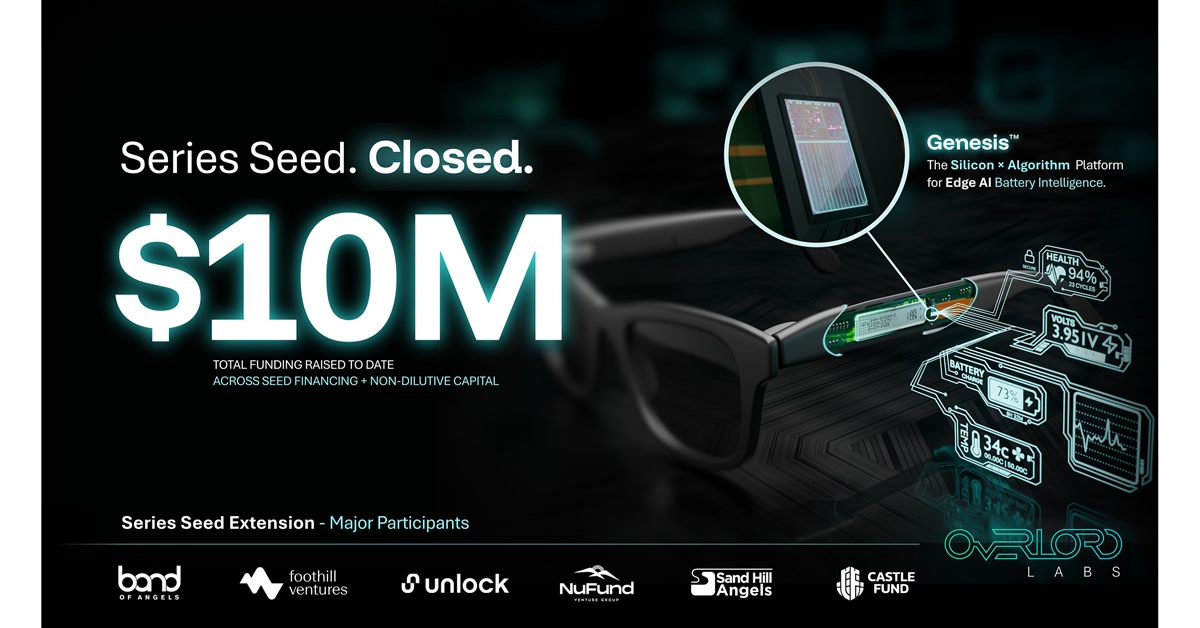
The future can’t run on yesterday’s systems. That’s the thinking behind Overlord Labs, which has raised $10 million to revolutionize the art of battery management.
The San Jose, California-based company is solving the problem of battery management with a battery-intelligence platform combining custom silicon, embedded software, and algorithms. And it’s doing so with an energy efficient chip that is the size of a grain of rice, said Carlos Rodriguez, COO of the company, in an interview with GamesBeat.
Overlord Labs is a San Jose fabless semiconductor company building battery-intelligence
infrastructure for compute-intensive, battery-powered devices. The team is working on ways to precisely measure and improve the battery life of AI smart glasses and other small devices.
Its Genesis platform uses the company’s proprietary Silicon × Algorithm Architecture to
combine precision sensing, programmable processors, software, and battery algorithms. The
platform gives manufacturers more flexibility around charging, power management, and device
design.
Support for firmware updates allows battery models and control strategies to evolve as
manufacturers introduce new workloads or adopt emerging battery chemistries.
Smart glasses are the initial market, with broader applications across wearables, hearables,
drones, and other compact devices.
The company has working silicon and customer sampling underway with a leading U.S. AI glasses manufacturer. Customer identities are not being disclosed. The chip is about 2.6 millimeters by 1.6 millimeters, with an indicative price of about $1.
The firm is making the chips at South Korea-based DB HiTek on a mature 130-nanometer process, Rodriguez said. And the team has about 15 full-time staff and another 10 contractors. It has filed for nearly 20 patents.
The topic of battery management may seem arcane, but it will help lighten the weight of wearable devices like AI smart glasses and increase comfort for wearers. Battery placement matters for the devices, as do thermal conditions, power-management choices and more.
They said the battery constraints behind AI glasses are tough. They note that cameras, audio, sensors, displays, and AI workloads affect power delivery, runtime, and manufacturers’ design choices. To address the challenge, silicon and software need to work together to deliver precision sensing, programmable processing, and more.
“Overlord Labs is dealing with the next generation of consumer devices and the battery management problems they have,” said Richard Nicholson, CEO of Overlord Labs, in an interview with GamesBeat.
He noted that devices like the new Snap glasses, which are still larger than ordinary glasses and have to handle complex augmented reality graphics on the optical lenses of the device, are a good example of the challenge.
“Everybody is struggling to get features and runtime into the devices,” Nicholson said. “It’s hard to see people wearing some of the devices all day long.”
The customers need to solve runtime, integration, and design challenges driving early interest, and how customer feedback shapes the platform. Firmware updates can adapt battery-management behavior s workloads and cell characteristics change.
With the funding, the team can use the capital to support validation, qualification, customer integration, and production infrastructure.
Origins

Richard Nicholson, CEO, and COO Carlos Rodriguez have decades of experience across semiconductors, consumer electronics and venture-backed tech companies. They started the company 16 months ago and are sampling their chip designs with tier one companies. The firm had its first silicon of its chip designs in July 2026.
Nicholson holds a doctorate in microelectronics from Lancaster University and he has held engineering and business leadership roles at chip makers Texas Instruments and Fairchild.
At Overlord Labs, he leads the development of the battery intelligence platform and the engineering effort, including testing, qualification, and customer collaboration required to bring semiconductor products to market.

Rodriguez was part of the executive staff and leadership group at Maxim Integrated, where he supported product development, new product introductions, and strategic customer engagement.
He later led global business development at Sevenhugs, acquired by Qorvo, and helped define
and bring to market a CES Innovation Award-winning cloud-edge device at LatticeWork. His
exposure to battery technology began with a 1997 internship at PolyStor, which developed early lithium-ion prismatic cells for mobile phones.
The company said in September that it raised $10 million in funding to date, including a $7.25 million seed round and $2.75 million in non-dilutive strategic development funding. The company raised a $4.35 million seed extension that was led by Band of Angels, with participation from Foothill Ventures, Unlock Pacific Ventures, NuFund Venture Group, Sand Hill Angels, Castle Fund, and returning strategic angel investors.
Now that it has its first chips in samples, it is focusing on product validation, qualification, firmware development, customer integration, and production readiness.
Board members include Chris Allexandre, CEO of Navitas Semiconductor; Dave Heacock, former Texas Instruments SVP and General Manager; and the Robert M. Speer, former Acting Secretary of the U.S. Army.
Nicholson said that battery management largely slowed down its progress around 2012, as smartphones stabilized on the design with a big screen and a giant battery. And the companies in that space moved on to designing other things. But battery chemistries have evolved, and Nicholson said the company makes a small chip that can determine how much energy is left in a battery.
But many smartphones aren’t very precise, and they don’t really have an accurate way to tell you how much battery life is left. And now many wearables are moving beyond smartphones to devices that have even more battery constraints, like smart rings, smart glasses and pendants.
If you look at the market-leading Meta AI smart glasses, the largest physical element in the device is the battery. It governs just how big the glasses have to be.
Making a new kind of chip
The team designs the silicon chips as gauges that sit next to the battery and measure the energy in the device. Many other factors can influence the battery life, like dropping the device and damaging it, and the temperature. If you don’t know when the battery will run out, the engineers of the system will leave a 30% power margin just to be sure the device won’t run out of battery quickly. That’s inefficient.
“It’s a tiny little chip that tells you what percentage battery life is really left in the device,” Rodriguez said. “It’s a really complex problem that gets overlooked. One of the worst things is when the device shuts down and you think you have 16% battery left.”
Rodriguez wears the Meta glasses and notes that they can make it about four hours of operation, and then he pulls out a second pair to get through the day. But AI brings challenges to these devices because the AI function is needed all the time.
This isn’t a commodity chip, despite its small size, because it’s difficult to measure the activity of the crystals and other materials inside a battery.
The company plans to raised another $15 million to $20 million and scale up to about 60 people as it gets closer to launch.
“We’re a piece of technology that the customer will never see, but we will impact them on a daily basis. We’re the hidden layer, and that’s a great and sad place to be.”
Rodriguez said, “You may never see it, but it could impact your life.”