

C Festival of Gaming at Informa released a new 15th State of the Game Industry survey, based on surveys of more than 2,600 game industry professsionals.
The report delves into developer attitudes about changes in gaming such as AI adoption, the evolving attitudes about labor, game development tools, the rise and fall of game platforms, the evolution of outsourcing into co-development, and mental health of game makers.
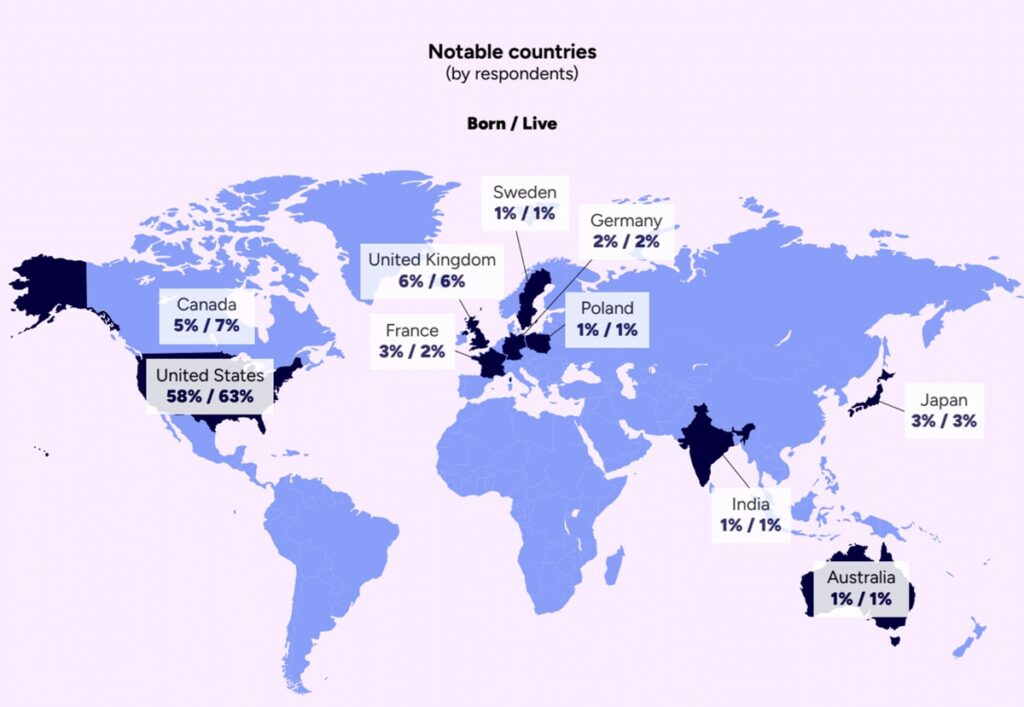
The 15th State of the Game Industry Report is based on 12% more respondents (from 69 total countries) in an attempt to get a more global representation of views, considering those in Asia have different views from those in North America and Europe, said Beth Elderkin, content marketing manager at GDC Festival of Gaming, in an interview with GamesBeat.
“We covered (topics including) labor experiences, generative AI, layoffs in the job market, game development trends, next-gen consoles,” Elderkin said. “This is the 15th iteration this year. It’s been going on for over a decade, and every single year we look to take a pulse on what is going on in the game community and whatw they need and what they want and what they’re advocating for.”
The report shows an an industry that continues to face tremendous adversity even as the love that game makers feel for their craft endures. While the report is typically released at the beginning of each year, this edition and reports going forward have been adjusted to release near year’s end, befitting the report’s reflections on the current state of the industry and a snapshot of the year.
The complete report, which captures insights across labor realities, generative AI, development trends, and more, can be accessed at this link.
This year, the company established a new state of the game industry committee, which is a group of eight game industry professionals from all different walks of life, whether they’re in research, development, media, and other areas.
They included people Morgan Brodskiy of Blizzard, Bob De Schutter of Northeastern University, Laine Nooney of New York University, Amari Doshi of the University of St. Andrews, Veronica Peshterianu of System Era Softworks, game journalist David Jagneaux, Elizabeth Kilmer at Take This, and Amir Satvat, the game jobs quantifier and champion.
Now let’s get to the survey results.
More game pros are using generative AI, but it’s still polarizing
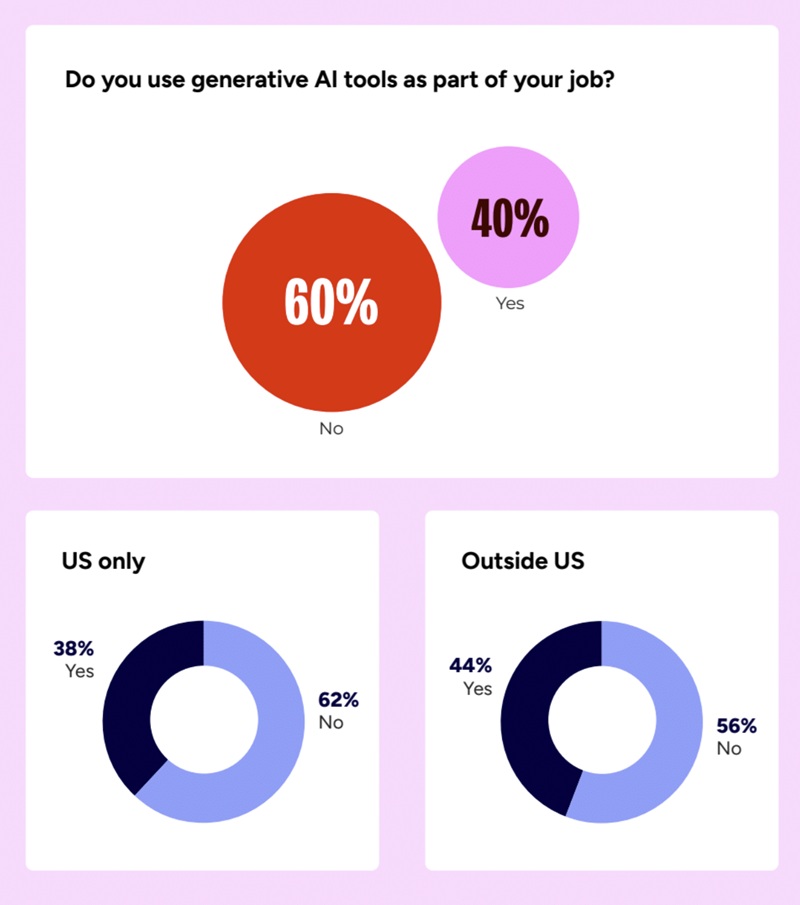
Elderkin said 40% of game industry professionals report using generative AI tools as part of their job, up four points from the previous survey. And 57% of AI adopters use it daily. Usage is highest among those working in business operations and services (71%), at mobile-only studios (70%), and those working on free-to-play games (58%).
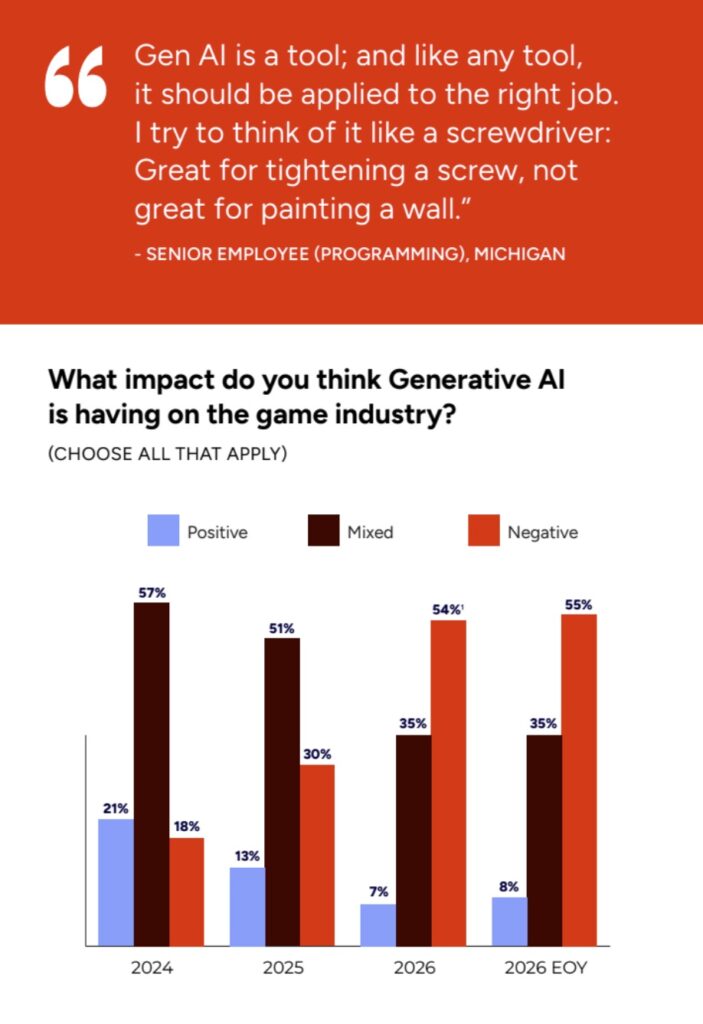
Company policy tends to vary significantly by company size, with 27% of triple-A workers feeling encouraged or pressured to use generative AI, compared to only 9% of indie studio workers. Despite the industry’s increased adoption of generative AI, its use remains polarizing; 55% of respondents felt that it has a negative impact on games, which is consistent with 54% from the previous survey.
The report includes room for respondents to make their own comments, and the responses suggest that game industry professionals are forming nuanced stances on generative AI. For instance, some respondents wrote that they see value in using generative AI tools for repetitive tasks, research, and prototyping, but others cited environmental, psychological, and societal concerns for their hesitation to use such tools.
Others pondered whether generative AI could be an equalizer for marginalized and excluded groups struggling with cost, geography, or access, Elderkin said.
In our interview, Elderkin said this is the fourth time that the survey has delved into game professionals and their attitudes about generative AI. It makes sense to have that focus as it moves from a theoretical conversation to something that is part of everyday life.
“We found 40% of our respondents say they use the (generative AI) tools as part of their job, which was a up four points from 36% last year. I was expecting it to be a little bit higher, but we did see more respondents in business services, mobile-only workers, free-to-play games. They’re more apt to use to use generative AI tools,” Elderkin said.
The real surprise was when it came to sentiment around generative AI.
“For the past few years, ever since we started asking about this, we have been asking what impact it is having on the industry. And every single year, we have seen a growing divide, a growing increase in negative impact, and a growing decrease in positive impact,” Elderkin said. “This was the first year where it did not change. It went from 54% last year to 55% this year, which indicates to us that, at least for the time being, sentiment around generative AI has settled, and people know enough about the technology and its uses to have already established what their opinion is and what the impact is on the industry.”
For AI adopters, 57% said they use it daily. They use largely use text-generation like LLMs, also code generation. They use it on PowerPoint presentations, and some of the biggest uses are for research, brainstorming, conceptual work, early work.
“When we looked at the open responses from our community about what impact generative AI is having and what value it can bring and what ethics they take into account, we got very nuanced conversation. We had over 2,000 open responses, and I read through every single one of them. And what we found were the same similar concerns over environmental impact, the impact on on job security, privacy, IP protection,” Elderkin said.
But she added, “We also saw a new one this year about. Fears of skill atrophy, in which some some respondents were saying that they fear that the over-reliance on generative AI tools will permit or even encourage some to not develop the skills on their own, which could impact junior developers in particular moving forward. That said, we saw a lot of nuance this year, even people who said it’s having a negative impact on the industry largely — they said there are still uses for this technology.”
About 10% of open responses indicated full opposition to use of generative AI tools, but a large majority expressed that for things like repetitive tasks, things that can happen in the background, and things that take a really long time but don’t take a lot of effort.
“Those are the kinds of things that a lot of our respondents see value in these tools for. But there is still more widespread opposition to using it for player-facing content, more creative content, and front-facing content,” Elderkin said.
There were also some respondents who said they didn’t like generative AI but were forced to use it at work.
With ongoing layoffs, a tough job market awaits
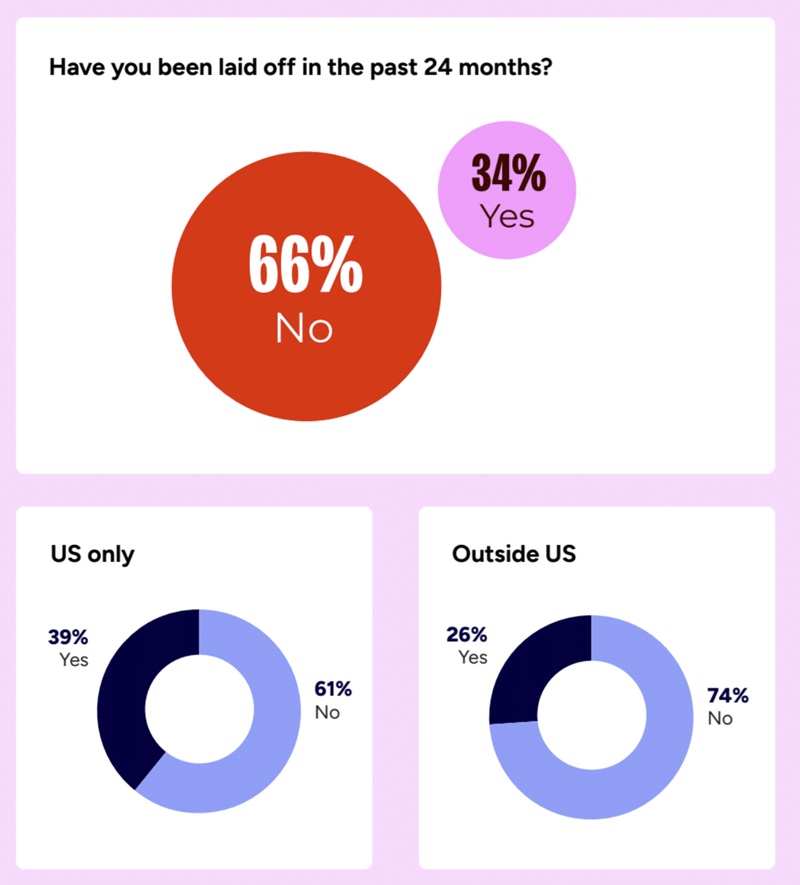
One in three (34%) respondents have been laid off in the last 24 months, up from 28% in the previous report, and the number rises to 39% for U.S.-based respondents. That’s an incredibly high number for something that was more rare in past eras.
Of the one-in-three, 68% were laid off in the past 12 months. Nearly half (49%) said their companies have conducted some form of layoffs in the past 12 months: 68% at triple-A studios, 35% at older indie studios, and 14% at younger indie studios.
The percentages in this year’s survey are higher than in other recent publications; for example, Always Supporting the Games Community estimates that only 14% of U.S.-based game industry professionals have been laid off in the past 24 months. This suggests that the survey reflects higher participation from people most affected by layoffs, which gave GDC the opportunity to dive deeper into their lived experiences.
Over half (54%) of those laid off have not found new employment. 62% have applied for 20 or more jobs, while 25% have applied for 100 or more. About 21% of overall respondents are unemployed, up 8 points from the last report (13%). And 9% of re-employed respondents have left the game industry, while 4% have started their own companies or studios.
“For layoffs, this has been something we’ve been going over for years, and it has been tough every single year,” Elderkin said. “You can see the first number you see is one in three of our respondents said they’ve been laid off in the past two years. That is a huge number. It goes up to 39% for those in the United States.”
She added, “However, we do not believe that this is a one to one representation that one in three people have been laid off in this industry.”
Amir Satvat, for instanced, has noted that 14% of U.S. developers have said they were laid off in the past 12 months. So this survey is weighted more heavily toward people who have been laid off, possibly because those people might be more willing to respond to a survey.
This time, the survey covered how many times respondents had been laid off, when was their most recent layoff, how many jobs they have applied for, and if they use generative AI tools in their job searches. Layoffs were higher in triple-A games compared to older indies and younger indie studios.
Over half of those who had been laid off said they have not found a new job. Some have felt discouraged by this, but others are resilient and try to create their own opportunities. And one i particular wrote a long response about the impact of layoffs and said companies are short-sighted because they are losing talent, they are losing industry knowledge, they are losing years of experience.
Co-development rises as teams shrink and funding tightens
Outsourcing, where game companies offloaded work to contractors, has come a long way. Now co-development is more popular, with external development companies now playing a role in many projects at the incdeption.
Open responses from those surveyed show a funding landscape that is reluctant and shrinking, forcing more studios to be entirely self-funded. Some 50% of respondents say their company uses self-funding as the predominant source of operational funding, compared to only 15% through publishing deals.
Coupled with layoffs and studios seeking operational stability, contract work and co-development is on the rise. Nearly half (45%) of studios utilize co-development on their games, and 16% of studio workers said their companies have offered or provided co-development services in the past 12 months. Reasons range from needing additional income streams to enjoying the challenge of working within other teams’ constraints.
“Co-development has been a big conversation this past year, so we really wanted to see how many people are utilizing it. We found that almost half of our respondents say their studios have utilized co-development services at some point in the past 12 months, higher among triple-A studios in particular,” Elderkin said.
Asked why they were doing more co-development, respondents often said it was for extra income or to diversify their portfolio.
“We also asked co-development studios if they’re working on their own projects, and a majority of them said that they were. So we are seeing more interaction, more interplay between these studios, which kind of goes back into the taking matters into your own hands situation,” Elderkin said. “And then for funding, half of our respondents said they are turning to self-funding. We did also get lots of open responses regarding the challenges of funding in 2026, and they are pretty similar to what we saw last year as well. We found you know publishers are saying they want games with a big wish list. They want games that have a large following on social media. They want games that are have a strong prototype already set, if not already in alpha, before they put their money in.”
Next-gen development is underway as Switch 2 interest surges and VR declines
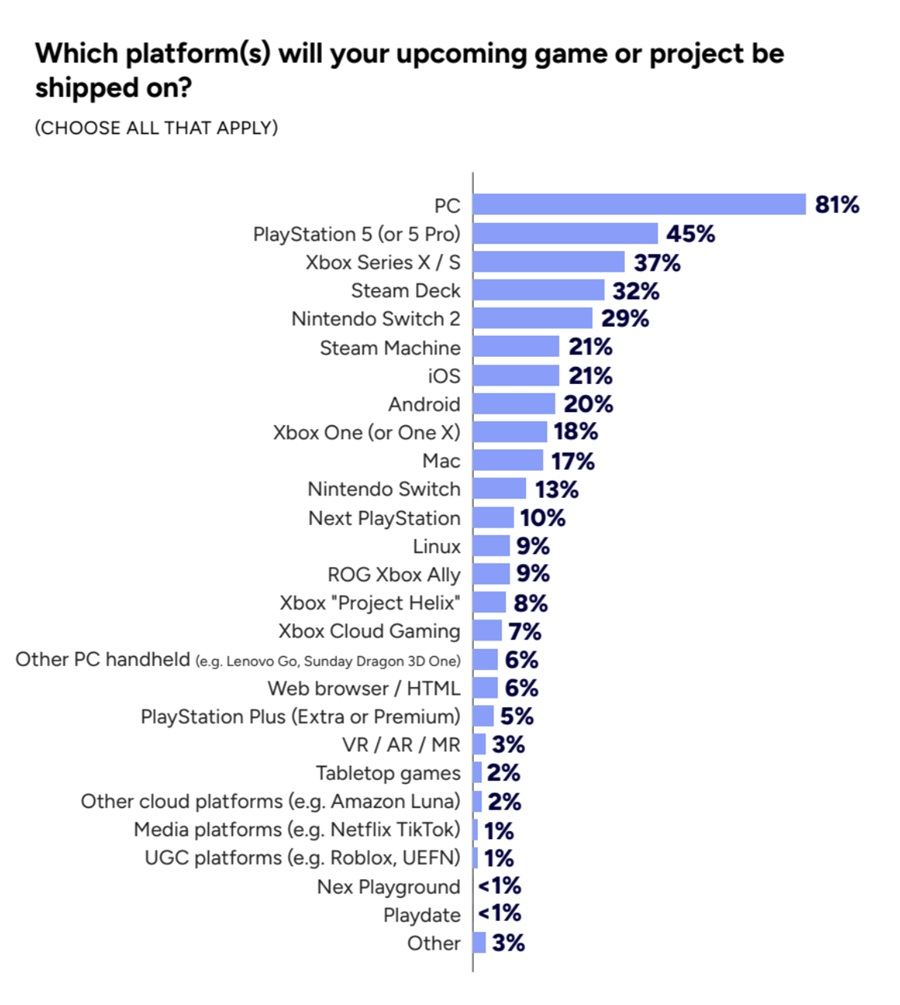
About 10% of respondents are developing for the next PlayStation and 8% for Xbox’s “Project Helix.” PC (83%) remains the dominant development platform, and the figures for PlayStation 5 (47%) and Xbox Series X/S (40%) are consistent with the previous survey.
Only 3% of developers reported working on a virtual, augmented or mixed reality game, down from 8% in the previous survey, but interest in developing for Nintendo Switch 2 has increased nearly 10 points to 47% since the last survey, with Steam Deck interest consistent at 38% (vs. 40% interested a year ago).
Regarding platforms, developers are targeting the PC most, perhaps because the consoles on the PlayStation and Xbox side are getting old. Elderkin noted that mobile respondents were underrepresented in the survey. International devs are more likely to be developing on mobile. And only 3% of devs said there were working on VR games and only 8% said they were interested in that. By contrast, interest is growing for the Nintendo Switch 2 and Steam Deck.
Unreal Engine remains the most popular engine for survey respondents at 35%, which is down from 42%. While it still leads Unity (at 28%, down from 30% in the last report), the gap has closed somewhat, and proprietary and in-house engines have climbed four points to 23% usage.
“For platform engines, one thing that we saw was a higher rate of respondents saying their studios are using proprietary internal engines, and that there is less use of Unreal and Unity. We thought this could be related to the fact that we have more triple-A respondents, so we actually segmented and looked at those responses based on the studio type where they work, and we found it was actually pretty consistent across the board,” Elderkin said. “So we are seeing overall a change from you know a slight shift away from Unreal and Unity, and a slight shift toward more proprietary engines.”
Support for the open source Godot game engine rose from one year to the next, but it is still relatively small at 6% of the respondents. But newer studios were more likely to use it.
Though passion endures, layoffs and overtime take toll on mental health
Love for games and the craft of making them remains crucial and prevalent in the industry. About 86% of respondents report more fulfillment working in games than in other industries, and 66% tie their identity and self-worth to working in games.
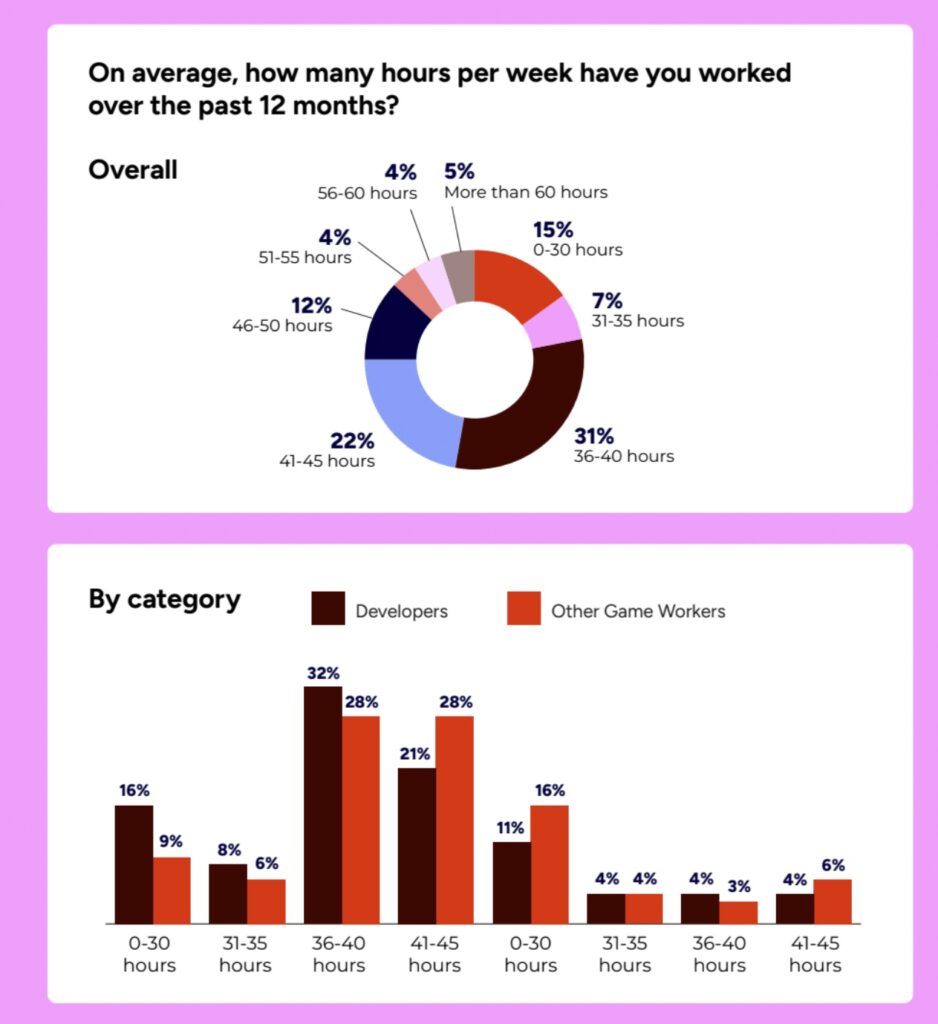
However, industry members are working long hours. 86% of developers said they’ve worked more than 40 hours in a single week over the past year, and 46% reported working over 40 hours a week on average. 8% report experiencing mandatory overtime, otherwise known as crunch. 63% of them feel this could have been avoided; respondents commonly blame poor planning, project changes, and leadership.
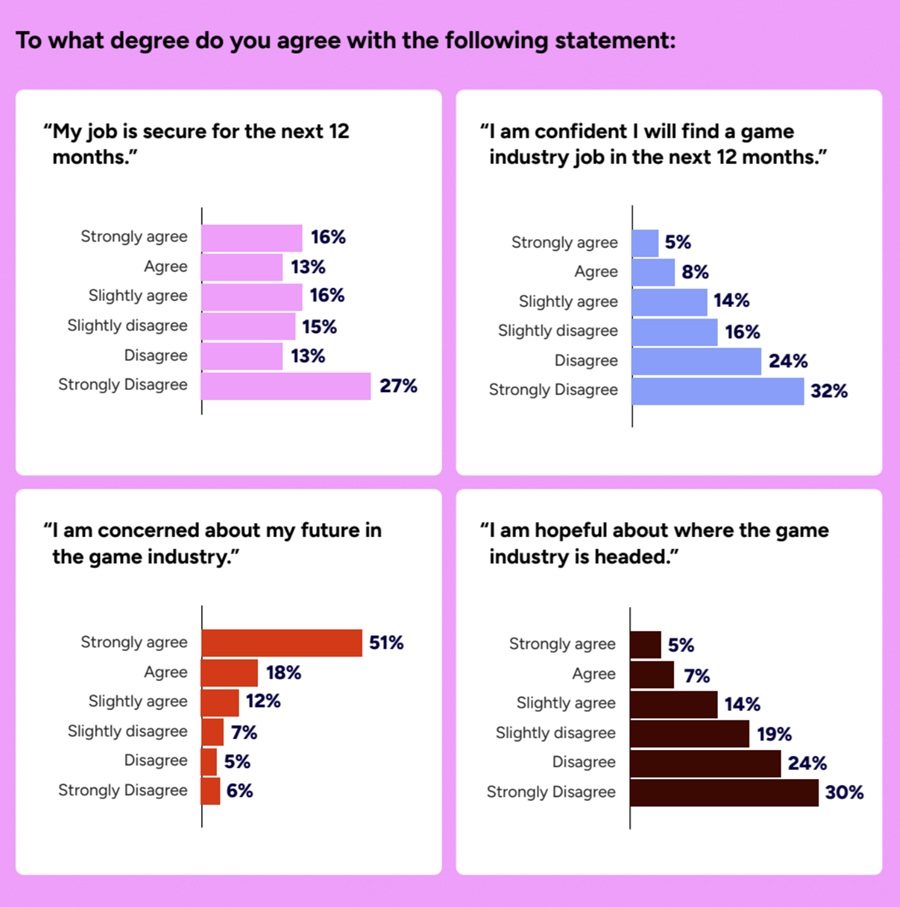
These hours and job instability are taking a toll on mental health. Two-thirds (65%) say their mental health has suffered because of their job; this proportion increases when looking at those who are currently unemployed (81%) and currently employed respondents who were laid off at some point over the past two years (71%).
The survey looked into mental health in terms of crunch, or working longer hours, and how many people are being forced to crunch, or work mandatory overtime. That percentage was 8%, and the majority of those 8% believed crunch could have been avoided.
One out of three said their mental health has suffered in some way, with one third strongly agreeing with that — whether the cause was overtime, layoffs or job insecurity. But the developers had a higher sense of purpose as well, with 86% of respondents getting more fulfillment working in games than in another industry, and two thirds tie their sense of identity and self worth to their work in games. That sentiment signaled resilience, pride, and love for the industry and its community.
“Over 2000 people responded to that question, and they and I again I read through every single one of them, and I was tearing up at times because it was so beautiful how much love and passion and drive and dedication the game industry has. People in this community help it succeed and thrive. There were some respondents who said, “You know, I used to love working in games, but I don’t anymore.”
She added, “But you know, one takeaway this year is we’re seeing resilience coming up out of challenging times. And while there still are challenging times, and I don’t expect that to go away anytime soon, it does present a path forward, and that’s very inspiring to see.”
More respondents are in unions. For the rest, interest is falling
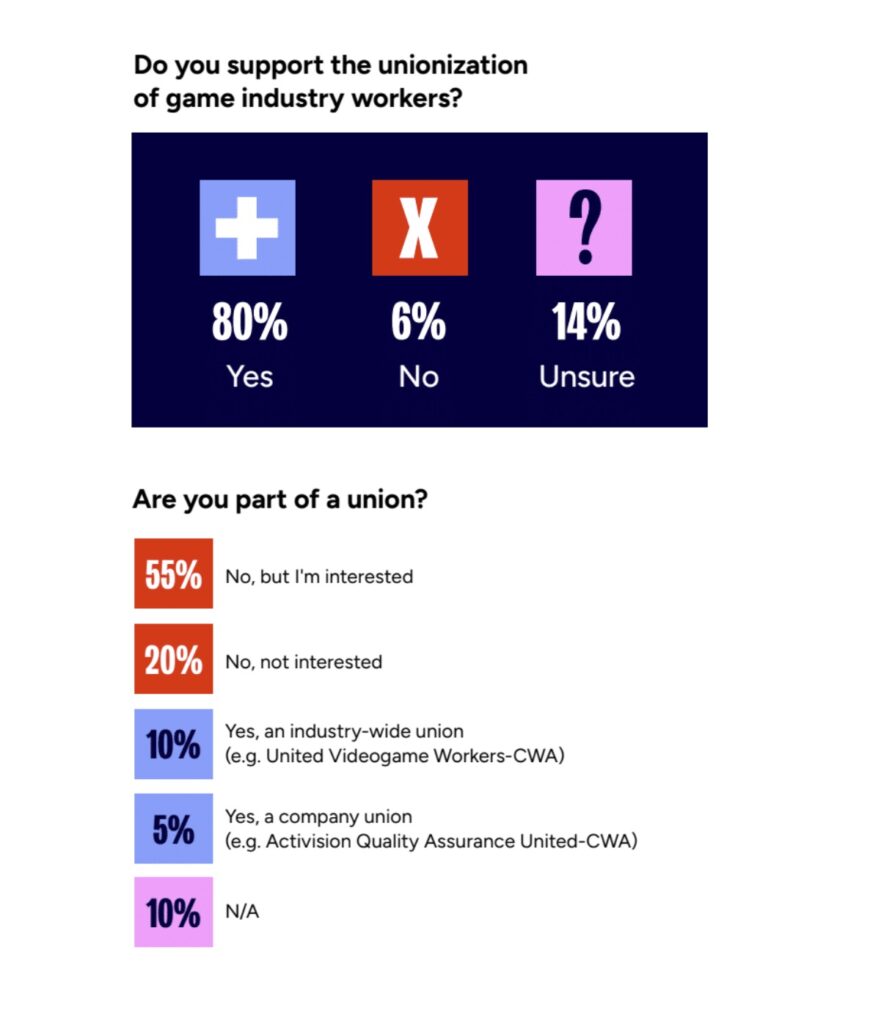
The report said 15% of respondents are part of a union, up from 12% in the last report. While union membership is up and a large majority of the industry supports unionization, interest in actually joining one may be falling. While membership grew, overall sentiment and interest in unionization showed slight decreases:
- Overall Support: 80% support the unionization of game industry workers (down from 82%).
- Interest in Joining: 55% are interested in joining a union, down seven points (from 62%).
- Non-Participation: 20% of respondents are not in a union and aren’t looking to join one.
GDC just started asking about the interest in joining a union a couple of years ago. That answer can be different from the answer about support in general for a union. Some of the respondents said their support for unionization comes from their concerns about the use of generative AI.
For a complete look at the 15th State of the Game Industry Report’s findings, including additional statistics, quotes from respondents, and visual representations of the data, see the full report, available here.
In light of these learnings, GDC Festival of Gaming sad its role in gathering the global industry for dialogue, learning, support, and inspiration is more important than ever. The conversation will continue at San Francisco’s Moscone Center from March 1-4, 2027. For a deeper look at the event, visit gdconf.com.
GDC is organized by Informa PLC, a leading B2B information services group and one of the leading B2B Events organizers in the world. To learn more and for the latest news and information visit www.informa.com.
The annual State of the Game Industry survey is published by Informa and the organizers of GDC Festival of Gaming, the world’s largest gathering of games industry professionals and the premier source of knowledge, learning, and expertise within the industry. Every year, across hundreds of lectures, panels, roundtable discussions, workshops, fireside chats, and more, GDC attendees engage with the latest challenges, opportunities, and innovations shaping the game industry, including topics and themes explored in the State of the Game Industry report.
This is the second State of the Game Industry report in 2026, but Elderkin said that in the past the report came out in January and was set up to predict what the year would be like. But the surveys are more like a slice of the industry at a given point in time, and that can change fast. So the report now, debuting in November, is more of a reflection of the industry and where it is now, and it’s not necessarily trying to predict where it will be for the next year.
“This also gives our attendees and speakers and advisors an opportunity to really look at the data before making decisions for the following quarter and the following year,” Elderkin said, as it matches budget cycles.
The team used AI in research and editing phases, such as sentiment analysis of the responses. But the team did not use AI in the writing.
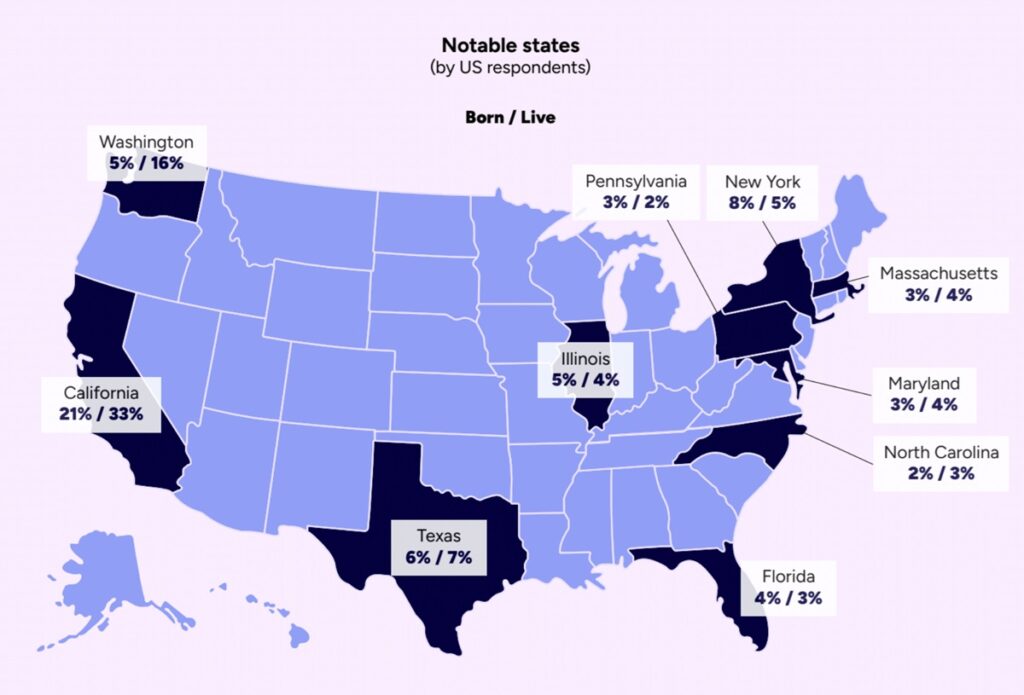
The survey included people in all regions of North Ameria, as well as those in Asia such as Southeast Asia, Central Asia, and also South America. The North Americans were about 63% of those surveyed, more than the 58% from last year. But going forward, the team will work to include more international representation as those markets are growing more. There are also more triple-A studio respondents, and the percentage of LGBTQ+ respondents is higher than expected.
Elderkin said that GDC Festival of Gaming in March 2027 will focus on the issues attendees care about.
“The game industry deserves a chance to have its voices heard, and I’m very proud that GDC gets to be the place where that happens,” Elderkin said.