
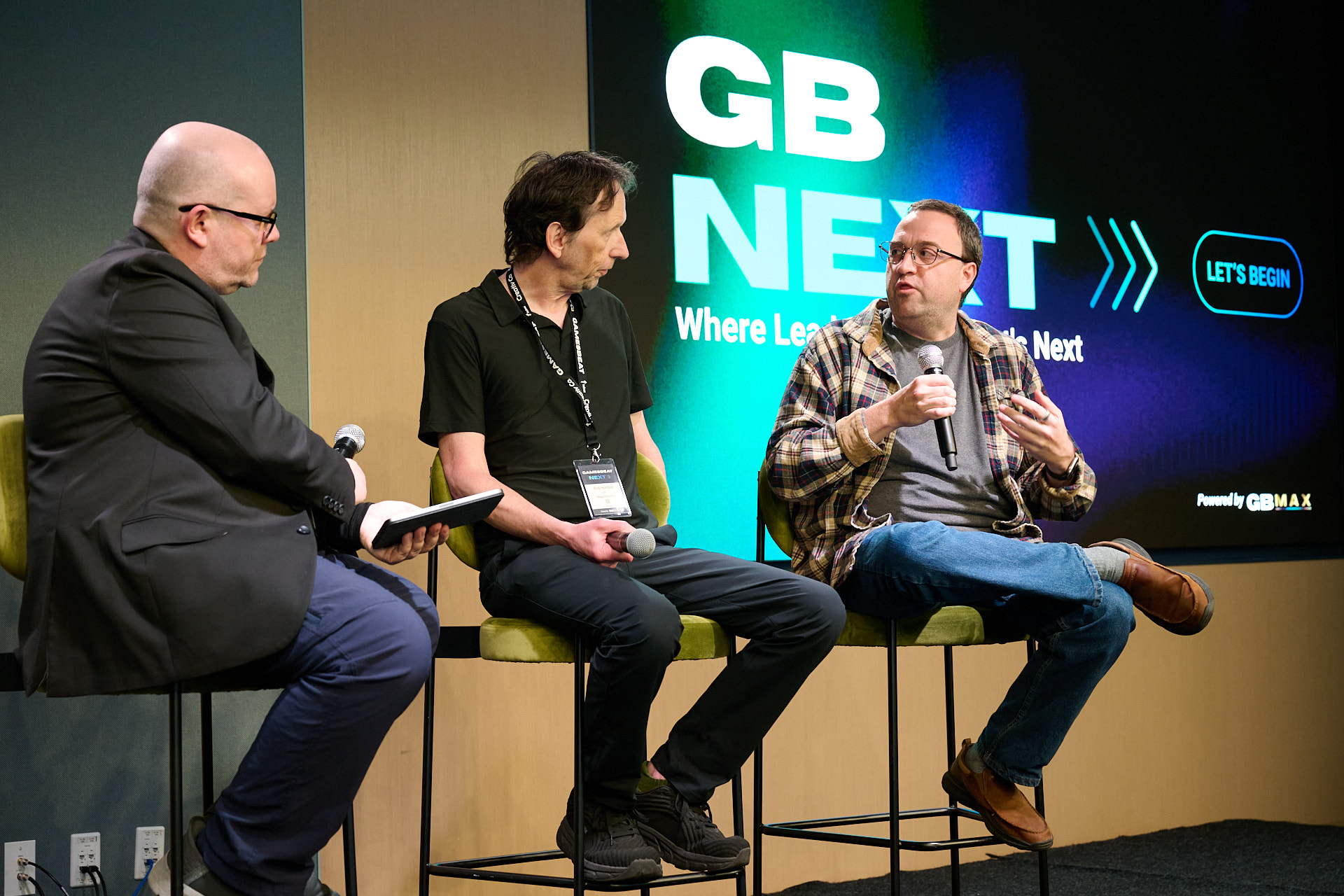
At GamesBeat Next 2026 in San Francisco, Megastructure CEO Rod Humble and Luke Dicken, former head of AI at Take-Two Interactive, took the stage in an intellectual debate around how AI has moved from hype to everyday tooling. TK Game Design game consultant Tadhg Kelly moderated.
Dicken opened by addressing a common line that he keeps hearing: “AI raises the bar without raising the ceiling.” According to Dicken, AI makes it easier to be less bad, such as catching gaps in a design doc, but developing new ideas remains within human territory. “Originality and new ways of doing things remains a very human thing,” he said.
Humble, a game developer since 1990, was more confident in his AI-related optimism. “This is the greatest time I’ve ever seen to be a game developer, like period, like no ifs ands or buts,” he said. He argued that left alone, AI tools “revert to the mean,” so developers need to use them in subversive ways, as the industry has done with past technologies.
Humble described a workflow in which agents write features, a swarm of agents handles QA, and an automated pipeline pushes builds live. He said building the orchestration software took six months of full-time agent coding and was “the hardest thing I’ve ever done.” He advised developers not to do the same, and applied the same rule to code: “Keep your filthy monkey hands out of the codebase.”
Dicken pushed back against the notion of the arms race. He said studios are burning through money as they chase after every new tool, and that a consensus toolchain will likely emerge in the next three to five years. “Shut up and ship” was Dicken’s overall advice. Kelly shared an example of a team that let agents do so much playtesting that nobody on it had looked at the game in months. Dicken’s response: “If you’re making something and you don’t want to touch it, why are you making it?”
Dicken also mentioned that until recently he had seen few examples of AI enabling new player experiences. He pointed to the Steam demo Teach My Little Sister to Drive, in which players verbally coach an AI driver. It reportedly ran up $1,000 in AI bills from about 400 demo downloads. Following this, Humble stated that he is in the process of building a virtual world where every inhabitant has its own intelligence and memory, and he thinks local models could provide “fake multiplayer” so games never launch empty.
Asked for their most contrarian takes, Humble made a prediction: within 12 months, major AI providers will restrict game development. He said politicians in both parties have long been hostile to games, pointing to the “murder simulators” label. That, he argued, is why developers will move toward local and uncensored models, using frontier models only for certain kinds of code. He added that the big labs have much larger targets than game studios. His biggest fear for the industry, he said, is censorship rather than AI itself, and he urged developers to push back on rules such as agent-identification requirements. Dicken acknowledged those rules create real compliance headaches.
Dicken joked that he was the conformist on the panel. His takeaway was that “AI is just math,” and that it feels foreboding mostly because it is attached to a massive capitalist machine. Once the hype around AI fades, he said, the industry can talk about real opportunities.