
Celia Hodent, a veteran game user experience strategist and a neuroscientist who wrote The Gamer’s Brain, is one of the thinkers of the game industry.
She’s leading an effort to get the game industry to adopt a code of ethics, and she believes it will be good for the game industry to address warranted concerns around potential addiction problems around games while avoiding “moral panic.”
Hodent spoke on a panel at the GamesBeat Summit 2026 event in May. And I asked her to take a closer look at the issues related to fun vs. addiction in games, partly because Matthew Ball’s slide deck on the industry pointed to how the fun of games was losing ground to other addictive industries such as short videos, social media, Only Fans, AI companions, sports betting, online gambling and prediction markets. Those industries are growing so fast that it could prompt game companies to improve monetization by veering toward addictive features in games such as loot boxes, salacious themes and more.
How does gaming win the “attention war” against those industries, while still staying on the side of fun? In her own work, Hodent emphasizes user experience strategies as a mindset based on four pillars: human-centered, grounded in science, collaborative process and benevolent (based on ethics, accessibility and inclusion).
Hodent noted media coverage of games often leads with sensational moral panics such as creating fears that games can cause addiction, violence and mental disorders. While Hodent doesn’t dismiss these fears, she approaches them from both a scientific and ethical point of view.
She said the science on video game violence, which was litigated in decades past, shows there’s insufficient and contradictory evidence about whether games are linked to aggressive behavior. In fact, during the pandemic, games were praised for bringing joy to lonely people under harsh circumstances, improving their social lives and giving them escapes.
The World Health Organization included “gaming disorder” as a possible addiction before the pandemic, but that issue is still heavily debated in academic circles. Some people suffer from “pathological gaming,” but specific addiction to games is still disputed.
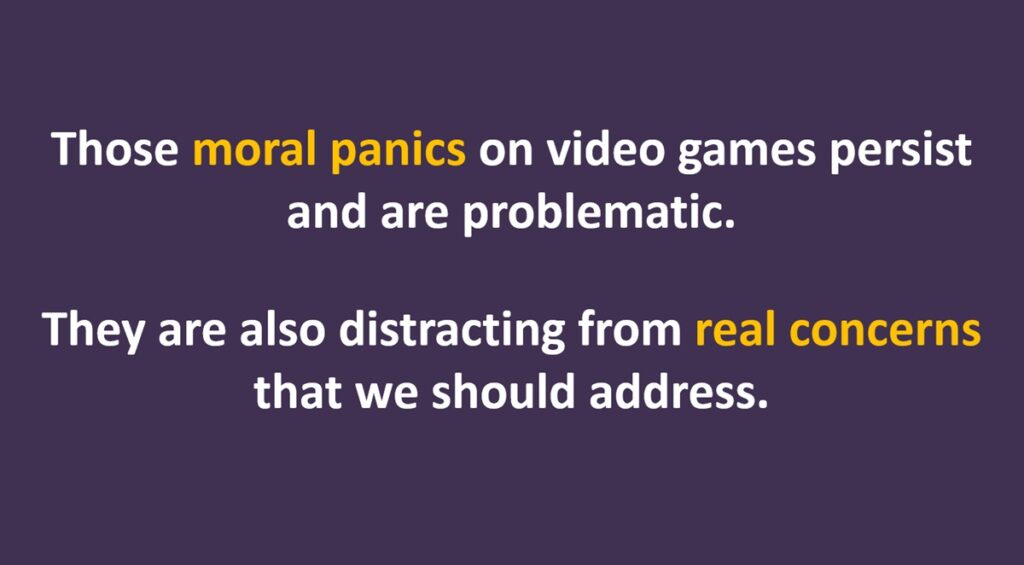
“Those moral panics on video games persist and are problematic,” Hodent said. “They are also distracting from real concerns we should address.”
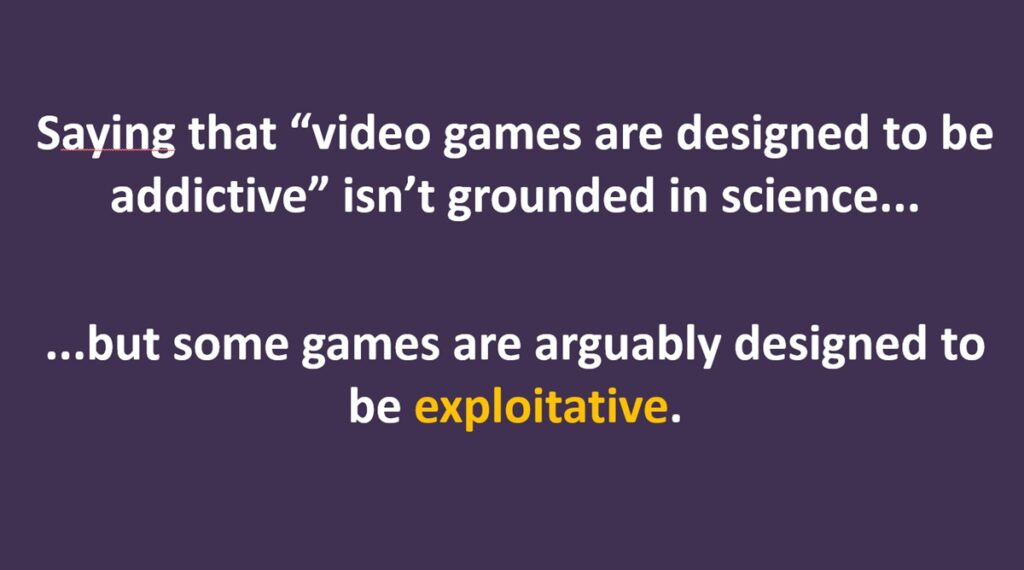
Hodent prefers to focus on “exploitative patterns” rather than outright deception, since it’s common to deceive a player to serve gameplay, just as a movie maker may deceive an audience to serve the story or elicit emotions.
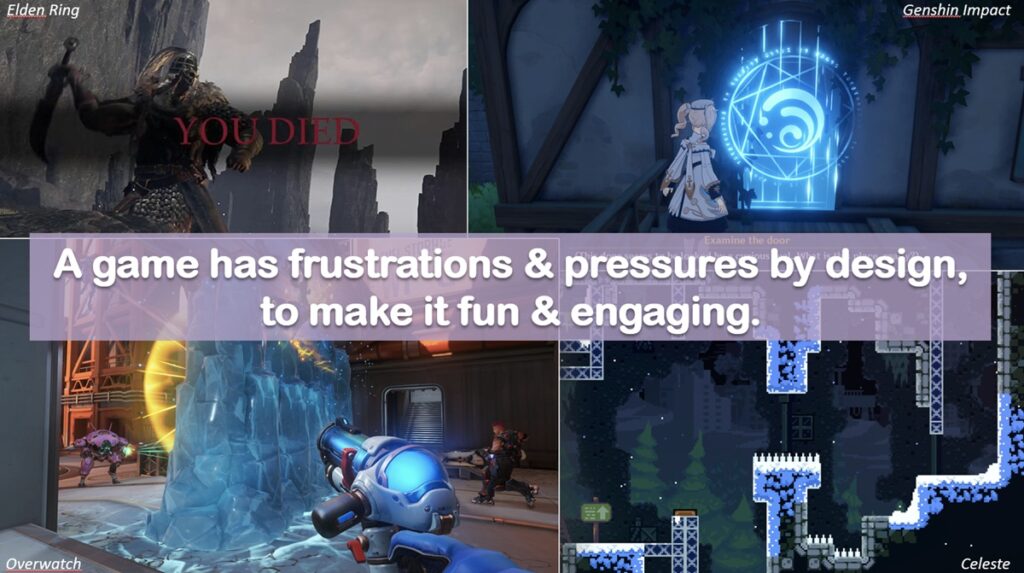
She noted a game has frustrations and pressures by design to make it fun and engaging. But she noted that manipulation of emotions and human biases can also be used to exploit users.
In her own book and another, — Deceptive Patterns: Exposing the tricks that tech companies use to deceive you by Harry Brignull — Hodent said dark patterns use exploitative design to benefit a company at the expense of users. An example from Amazon was cited in a complaint by the Federal Trade Commission where it used a dark pattern, such as a message that said, “No thanks, I do not want to save $18.95.” Amazon paid $2.5 billion in fines and compensation in 2025.
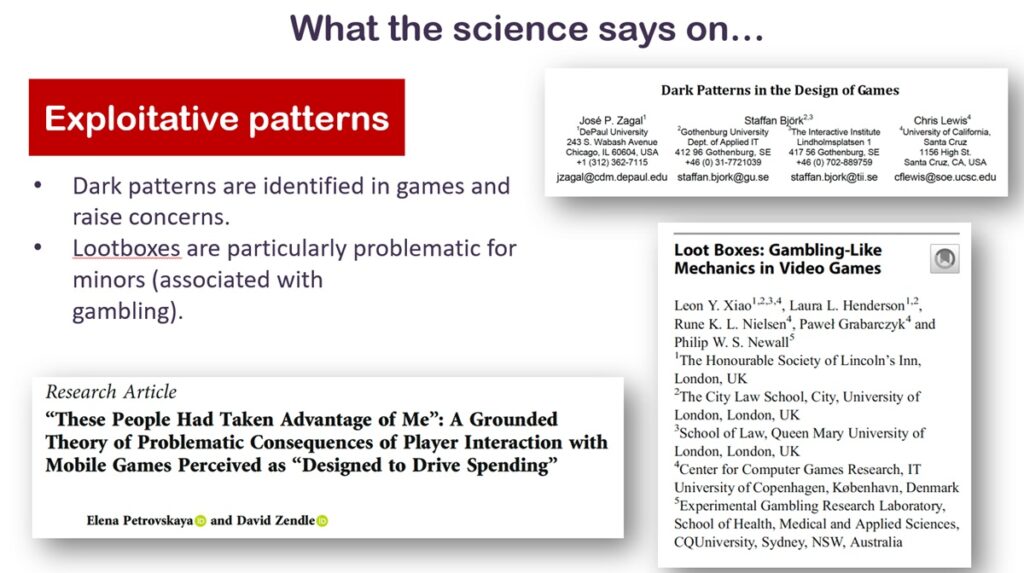
Hodent said that scientific research has show that exploitative patterns or dark patterns are present in games and raise concerns. Loot boxes are a good example that can be problematic for minors.
Examples of exploitative patterns in the game industry include “guilt tripping,” paying to remove discomfort, loot boxes that serve monetization, loss aversion and punishing disengagement, capitalizing on fear of missing out (FOMO), auto play and more.
Hodent said that the brain’s prefrontal cortex is fully mature only at 25 years of age. This makes children and teens particularly vulnerable to these pressures. Loot boxes can particularly be hard to handle by minors: children and teenagers don’t have yet the brain maturity needed to be able to resist the temptation (i.e. self control).
Development of self-control (needed to resist loot boxes, loss aversion, FOMO, etc.) takes time. Even adolescent brains are too immature to exert control over impulsive drives.
Hodent noted that minors are not allowed to gamble in casinos. But can we regulate loot boxes for kids? One problem is that it’s hard to reliably identify someone over the internet. That’s why The Netherlands and Belgium made loot boxes illegal. And the FTC announced that they will conduct a public workshop on lootboxes later this year.
“I prefer to talk about exploitative patterns rather than deceiving because we may deceive the player to serve the gameplay, just like a moviemaker may deceive this audience to serve the story or elicit emotions,” Hodent said.
To weigh the issues, Hodent said game devs should ask themselves if the pressures designed in the game are serving gameplay and players’ interests or are they primarily serving business goals.
When it comes science, some social harms have been measured. About 76% of adults say they have experienced harassment in games. Online spaces and games were actively being exploited by extremist movements. Bullying, grooming, pedophile crimes can be experienced online. Other “disruptive behaviors” can disrupt the spirit of a game or its intended experience, or interfere with the ability for others to enjoy a game.
This is why Hodent started the Ethical Games movement, which is aimed at creating a code of ethics for the game industry. It’s aimed at improving ethics in games, communities and workplaces.
She said that there is some resistance to this idea, as it’s supposedly costly, too complicated, could create a PR/legal nightmare, and it could encourage censorship.
“Many artists and designers are worried it would restrict what they can talk about in a game, especially regarding violent topics,” Hodent said. “But the conversation usually ends up highlighting more benefits than costs.”

She said the industry should consider the cost to the business from things like the state of New York suing Valve because its loot boxes are gambling. Toxicity in games can drive players away. There’s a crackdown on dark patterns, or trickery charges, with lawsuits around addiction, regulation of loot boxes and social media restrictions.
Ignoring the issues raised by “moral panics” won’t make the issues go away.
“So let’s acknowledge it and tackle it in the best way we can, with benevolence and transparency,” Hodent said. “Games are an art form. We don’t want to censor them. But, if you address violence in your game, for example, the code of ethics will challenge you (not force you) to think outside of the trope box, which can be a great creativity enabler.”
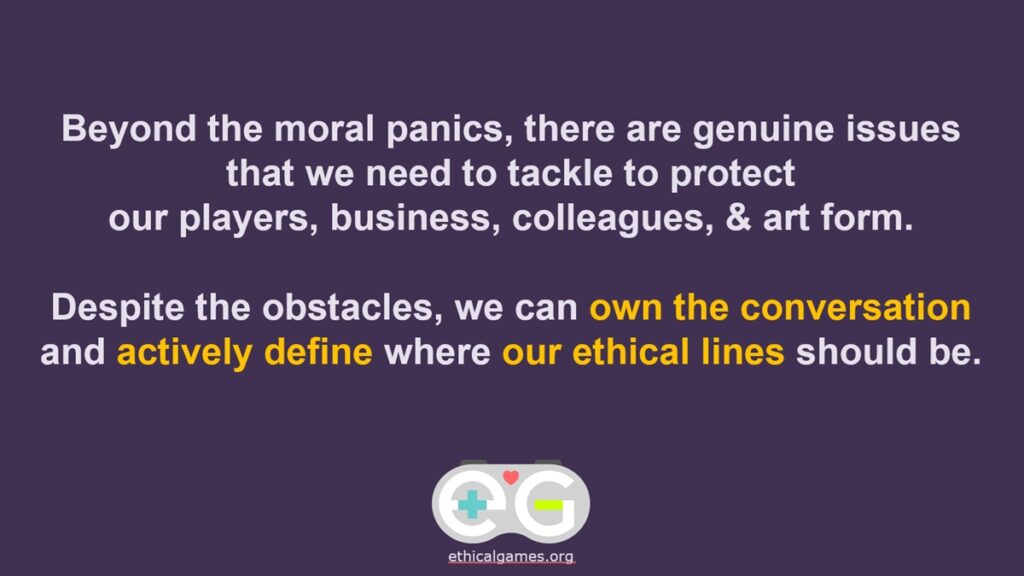
The code of ethics could ultimately be an investment, become an interative proces, prevent PR and legal nightmares, and encourage creativity. Hodent believes the tide is likely to change on this issue soon.