
One of the topics that consistently arises in my work at GamesBeat is the crossover between Hollywood and games — or rather, the cross-pollination between more “traditional” non-interactive media and interactive media. The two forms of entertainment have always been tied closely, even if they’ve historically not had the best relationship. However, in recent years that relationship has become very close indeed.
How do you better understand the relationship between the games industry and the film industry? What role do performers — and the managers of performers — play in the creation of new work? How can external companies provide what studios need while sustaining themselves?
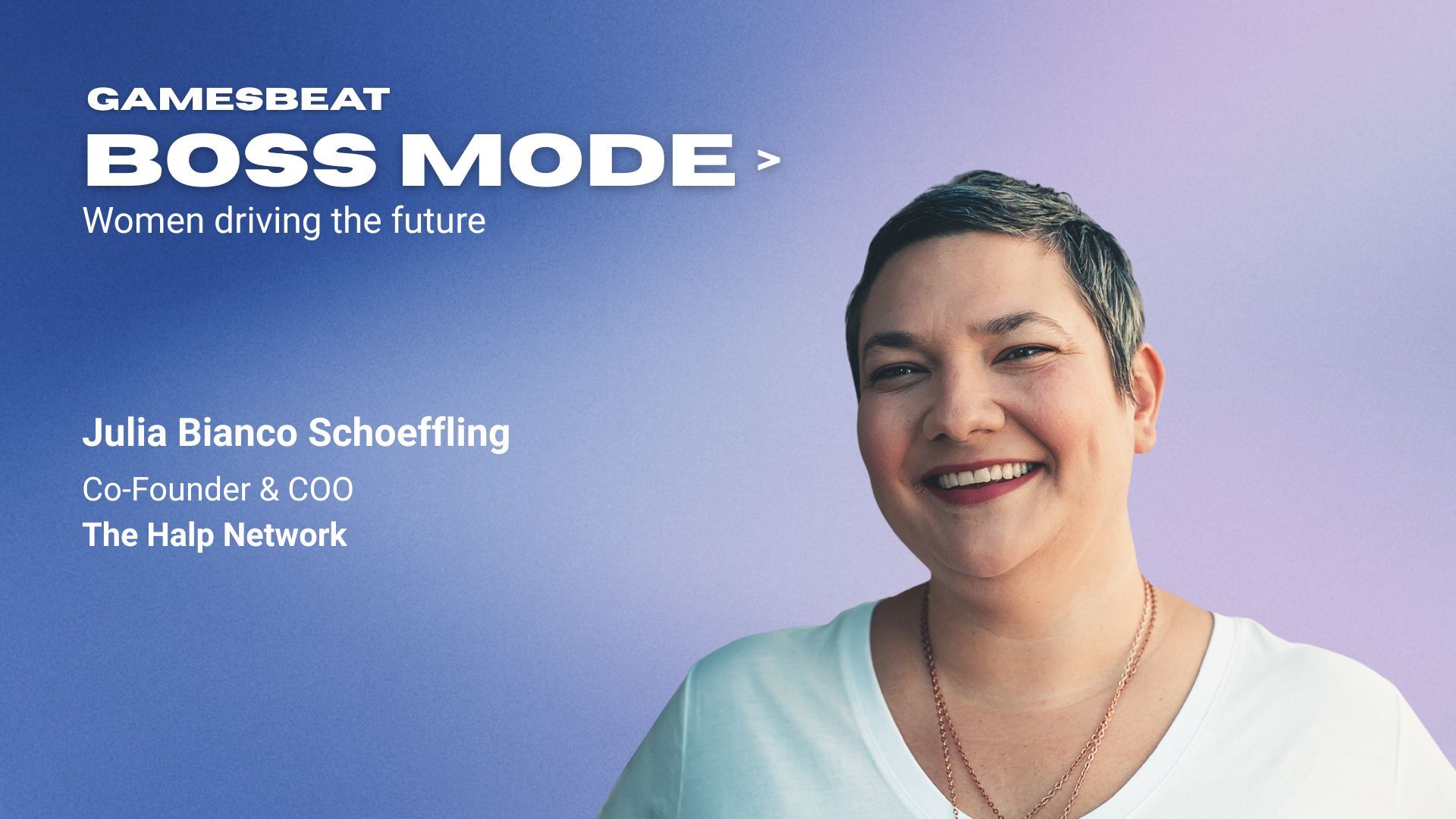
To answer these questions, I turned to our latest BOSS Mode interviewee, Julia Bianco Schoeffling. As co-founder and COO of The Halp Network, a creative services and production company, Schoeffling’s primary involvement in the games industry is via her extensive work as a casting agent. But, as I quickly learned when talking to her, that is far from a singular position, and she’s often the go-between for the games industry and Hollywood.
I spoke with Schoeffling about her work on the creative side of gaming, and where she sees the future relationship between the industries developing. Below is an edited transcript of our interview.
GamesBeat: I’m curious, what exactly does your job look like on the daily? It sounds like you’re an ambassador between two different sides of the industry, and I’d honestly love to hear more about that.
Schoeffling: It’s almost this gateway to Hollywood on both sides, translating film to games and games to the film world. I’m thinking about [Simon Pulman’s] talk at GamesBeat, where he talked about what was important and required for people on the game side to understand when they’re entering into a film contract.
We’ve been doing that since the very beginning, well before any kind of interest in games… the language of agents and casting had to be crafted around games because it didn’t exist. Even explaining to an agent deal points you would have on a game versus a film — every piece of it had to be translated. There is a lot of ambassadorship and translation.
I’m very bullish on games and the future of transmedia. I don’t believe that the future is segmented into TV, film, music. All of the industries are so cross-pollinated already and they will continue to be so. Those boxes around them will dissolve, and us in games and tech are always suited to lead these conversations. Because of that, a lot of what we do is educating our clients.
Okay, you want to work with celebrities on your game? That’s great. Know that the questions they’re going to ask are very different than the ones an actor (or their agent) who’s used to games is going to ask. Balancing the client’s needs and expectations with what’s realistic in the games industry, bridging the conversation between writers who’ve been in film or TV who are interested in games –every game team is different, and the needs can vastly change.
GamesBeat: Can you tell me where you come into the process when you work on a game?
Schoeffling: Yes, it depends. In general, my company provides creative services. I can be there very early — sometimes a client comes to me with a game idea, but it’s set in an area for which they have no experts. They can ask us to find some in order to make sure that they’re rooting in authenticity.
For casting, we try to get involved as early as possible, but typically casting happens before a script is fully written, because as we know, scripts for games are very fluid and they change quite a bit. So they will have an idea of their characters and they will write character descriptions for these characters, and they will typically write lines for the characters that are specifically for the casting sides. It’s dependent on the developer, in what phase they’re willing to start playing around with story. Sometimes it’s early, sometimes they wait until there’s a lot done.
I don’t believe that the future is segmented into TV, film, music. All of the industries are so cross-pollinated already and they will continue to be so. Those boxes around them will dissolve.
Once we get the casting sides, depending on if it’s performance capture or voiceover, we’ll review the materials. We’ll make sure there is authenticity in the pipeline. My general focus for casting is very much with consideration of representation, authenticity and respect, as well as having a very open door. Casting is the biggest gatekeep, right? I’m an official gatekeeper — that’s my job. In order to do that ethically, I have to keep the gate open at all times. You’re always allowed into my door.
When we start reviewing these auditions, it’s my job to make sure I’m providing a rainbow, a variety of options. One of the misconceptions people have about casting is that we know what we’re looking for. Very rarely does the client have something specifically that they’re looking for. We’re listening for quality of performance, but most of what we want is somebody’s unique approach.
Your brain cannot be replaced by somebody else’s brain. Your lived experiences, your ideas, your comedy, any of that stuff. We’re looking for someone who brought themselves to it. No one else could have done it that way because you’re a unique being. That’s the approach on our side. It’s also a personality match — if I’m casting for this client, maybe they really love this performer and want to hear what they did. I’ll give them that, but I’ll also sprinkle in these other people.
99% of the time, I don’t do the actual choosing. I just provide the selections and they make the choice. Then we do all of the other pieces at my company as well — recording, editing, implementing it back into the game, any of that stuff.
GamesBeat: I think there’s a certain misconception on both the consumer and business side of just how much a game company does in-house for this sort of thing. How likely is it that a triple-A developer will have their own casting director?
Schoeffling: Again, it depends. Take-Two typically has casting, but Activision and Microsoft typically outsource casting. They have talent people and business managers for contracts and to make sure everything is tracked. But they’ll hire casting directors or studios.
My company broke the mold of dialogue services several years ago. My business partner Chip [Beaman, CEO of the Halp Network] and I wanted to start our own thing. We wanted to be remote and not have any facility because we felt that there are already so many recording studios that it wasn’t a service we felt we needed to provide.
We start with the dialogue pipeline, and manage everything from casting, recording, editing — and you know it’ll be under-budget because we’re not actually paying for all these days we’re not using the studio.
We were providing all of the management and production around that service, and we could teach studios and place people in those studios to execute that work best, but it wasn’t something that we’d have to have in-house. Basically, we didn’t want to have a $10,000-a-month recording studio that we were trying to pay for while we’re managing these services. We’re actually a fully remote company, which we thought was financially prudent.
This was in 2018, before the pandemic. We had no idea that it would be advantageous for us to not have a facility to shut down. We’ve been very successful as a remote company, and it allows us to have amazing partners all around the world. We’re vendor-agnostic. It’s community, not competition.
GamesBeat: When you say you broke the mold, do you mean that you’re more remote and flexible?
Schoeffling: Yeah, because all of these other companies were basically recording studios with those services attached. We flipped it and said, “We’re not a studio, we’re just those services.” We start with the dialogue pipeline, and manage everything from casting, recording, editing — and you know it’ll be under-budget because we’re not actually paying for all these days we’re not using the studio.
GamesBeat: I’m curious, do you think casting services and creative services could provide a model for how the games industry could work with dedicated external partners on other parts of development?
Schoeffling: Absolutely. When I say “vendor-agnostic,” what I’m really saying is that you should let the experts do their work. If this PR/marketing firm is the best at doing this, it makes senses to only have a small in-house team that deals with the day-to-day, and outsource to this expert, right? Not everybody is an expert. Hiring experts is important.
I think we can take that from film more so than the other way around. In general, I think game companies have not quite learned how to interact with these kind of external development resources in order to get the best work out of them. Sometimes they outsource everything and don’t get what they want because they didn’t communicate what that was.
GamesBeat: What do you think is the biggest impact you’ve made in the industry? What do you consider a win?
Schoeffling: I’ve hired a lot of people, and I’ve gotten a lot of people hired — probably over 100 at this point, not counting actors. I’m really proud of the fact that a lot of these people are people of color or underrepresented people. When I started at Treyarch, I was one of seven women in a company of about 200 people. It feels nice for it not to be that way, and to feel like I had a little bit of a part in bringing more women and underrepresented folks into the industry.
GamesBeat: Was Treyarch the first game studio you worked for?
Schoeffling: Yeah! I got denied a job at Starbucks the same week I got my job as a receptionist at Treyarch. I worked there until I graduated from college, and then I moved into the sound department. At that time, in 2005, dialogue was not something the sound people wanted to focus on. They wanted to make the big booms and not deal with the script and all of the organization work.
I was handed an Excel doc and basically managed the dialogue-recording process for Spider-Man 3 and Call of Duty 3, and had started on Call of Duty: World at War when I left because I was burnt out. I worked for a bunch of sound-service providers, dialogue service houses, most of which don’t exist anymore. Then I started at Formosa Interactive (which is now Arrival), where current business partner Chip and I were employees five and six. We grew it to about 25 people before we left to start the Halp Network, which we’ve been running since 2018.
GamesBeat: How do you measure success in your position? How do you create success as a creative in a business-oriented space?
Schoeffling: Empowering others to do their amazing work. It goes back to what we were talking about: Let the people who are excellent do the things they’re excellent at. I’ve trained a lot of people and let them go — whether that’s let them go off and run within my company, or let them go run wherever they want and help them get those jobs.
Hiring experts is important… Let the people who are excellent do the things they’re excellent at.
I think I measure my success by all of the amazing people in the industry that I helped shepherd into careers in one way, shape or form. I can’t go to an industry event without running into someone whose career I’ve impacted, and that, to me, is everything.
GamesBeat: What do you consider to be your Boss Move, the career move or decision that defined your trajectory?
Schoeffling: In 2017, around when I had my kid, I decided that I wanted a billable career. I wanted something that, if everything fell apart, I could go bill hourly. “Producer” was too vague a word, so I decided I would be a casting director. I felt I had enough experience in the industry that I understood what casting for games meant.
At that time, there wasn’t really anyone who cast for games, it wasn’t a big enough think. I saw it would be bigger, and I wanted to be able to bill as a casting director. I wanted a daily rate taht i can be as so that, if everything else fell apart, I could still find casting jobs. I think that was really smart and important for me.
Over the pandemic, I wrote a book called “The Art and Business of Acting for Video Games.” It’s the only book on the subject, and I think as much as that was like having another child, it was very important in kind of establishing my credibility as someone with knowledge about this subject.
GamesBeat: And what about your boss music? What’s your kickass music selection?
[Editor’s note: She said this was the hardest question of the whole interview.]
Schoeffling: You can put “Hot to Go” by Chappell Roan.