

Astromech has raised $20 million to advance its evolutionary biology AI predictive models of biological change.
The Dallas startup created by the founders of Colossal Biosciences uses evolutionary and multispecies genomic data, today announced a $20 million funding round led by biotech investor Bob Nelsen, with participation from Peak 6, NeoGenesis Capital, Builders VC, and CAZ Investments.
The financing brings the company’s total capital raised to $60 million and values Astromech at $3.8 billion. Cofounded by Ben Lamm and George Church (founders of Colossal Biosciences, the company trying to bring back the Wooly Mammoth), Astromech will use the funding to expand its research team, increase the number of species represented in its functional genomic datasets, and scale the comparative genomic infrastructure used to train its models.
Much as a weather forecast uses current conditions and historical patterns predicting what comes next, Astromech aims to bring forecasting capabilities to biology. The company’s prediction models are designed to help researchers move beyond reacting to biological change—such as genetic bottlenecks, responses to changing environments, drug resistance and disease progression—and toward anticipating it.
Astromech develops AI-driven predictive models designed to anticipate how living systems change, identify where they are most vulnerable and uncover the regulatory mechanisms driving those changes. The company combines genomic, evolutionary and functional data to learn from 3.8 billion years of biological history. Astromech is currently in a deep research and development phase, with its platform and initial research pipelines operational.
Gestated at Colossal Biosciences, Astromech has access to the genomic data resources Colossal has spent five years assembling: a broad genome bank of extinct and living species, tooling battle-tested on massive biological datasets, ancient-DNA capability that reads old genomes and compares them to living ones to see exactly what changed and when, and a scientific team trained across evolutionary systems and computational biology.
“Biology runs the world and historically, we have only reacted to it,” said Lamm, co-founder of Astromech, in a statement. “We can describe biology in extraordinary detail, yet we still struggle to anticipate what comes next. Astromech is building the AI system predicting how living systems will change and where they are most likely to break. Every genome carries a record of what changed, when it changed, and the tradeoffs that followed —but almost none of that history is readable at scale today. Astromech was built to close that gap, and this funding allows us to further expand that work far more across the tree of life.”
While most computational biology models analyze organisms as they exist today, Astromech studios how biological traits developed over time. Traits including longevity, cancer resistance and tolerance to environmental stress have evolved independently across many species, creating naturally tested examples of biological resilience.
By reconstructing when those traits emerged and the genomic and regulatory changes associated with them, Astromech seeks to address a central challenge in biology: understanding not only which sequences differ, but what those differences do and how they influence biological function.
How it works
Astromech’s architecture takes three layers of data and produces three kinds of forecasts. The inputs are genomic – living and extinct genomes; evolutionary – deep-time ancestry and divergence, and functional – expression, traits, and response. From those, one system of models predicts where a genome or population is headed, where that biological system is most likely to break, and which regulatory circuits are driving the change.
Two engines sit underneath. The first is a suite of deep learning models that find patterns across species and systems: how genes are expressed, how organisms respond to their environment, how vulnerabilities develop over time. The second works backward through evolutionary history, reconstructing how a system reached its current state, then runs the same mathematics forward to project where it goes next. Fused, they form a single model system trained on the history of biological change across deep time.
The technical core is ancestral state reconstruction extended beyond sequence. Rather than inferring only the ancestral protein at each node of a phylogeny, Astromech reconstructs ancestral regulatory state: chromatin accessibility, gene expression, and functional annotation. It integrates that evidence across multiple data modalities into a Bayesian framework that returns calibrated confidence rather than point predictions. The same engine runs against different traits by changing the evidence overlay, not the architecture.
For many complex traits, important variation occurs outside protein-coding regions and affects how genes are regulated, Reconstructing ancestral proteins alone misses the majority of the signal for polygenic, heavily regulatory traits like those that impact longevity. Reconstructing the ancestral regulatory state is what turns a comparison between two species into a mechanistic account: when a change arose, on which lineage, under what pressure, and what it did.
What makes this possible is not only the model architecture, but the breadth of the training data. Models that predict regulatory function from sequence are typically trained on one or two reference genomes, where most functional genomic data has historically been concentrated. Astromech trains its models across species, supplementing public datasets with functional data generated in-house for species where coverage is limited. This broader comparative foundation allows the models to examine regulatory changes between lineages, rather than variation within a single species.
What the platform produces
Astromech’s platform is designed to generate three types of biological insight: where a genome, pathogen or population may be headed; where a biological system may be most vulnerable, including potential susceptibility to disease or drug resistance; and which regulatory mechanisms may be driving those changes.
To make this analysis possible at genome scale, Astromech developed a learned tree-inference method that, in internal benchmarks, reconstructed phylogenies approximately 100 times faster than conventional maximum-likelihood methods while maintaining comparable topology accuracy.
In retrospective validation, the broader pipeline recovered trait-associated genes previously established in published research while identifying additional candidates for further study. These results provide the foundation for prospective validation through future partner pilots.
Core Technology
Astromech’s core model framework is designed to work across species and biological systems. By identifying patterns of vulnerability and resilience, the platform could support applications in human health, biosecurity, agriculture and conservation. Potential uses include:
- Flagging susceptibility across species to different pathogens before they reach humans
- Predicting drug resistance before it becomes a treatment failure
- Mapping disease risk and the drivers of healthspan
- Modeling herd vulnerability under disease and climate stress
- Identifying which species and ecosystems are most at risk
- Anticipating food security and supply-chain threats before they spread
This positions Astromech upstream of industries that depend on understanding biological change rather than developing a separate model for each market. The company aims to adapt the same underlying framework to different biological traits, species and applications. By identifying biological risks and their underlying mechanisms earlier in the research process, Astromech aims to provide predictive insights that can inform downstream drug discovery, public-health planning and conservation research.
Longevity as the first proving ground
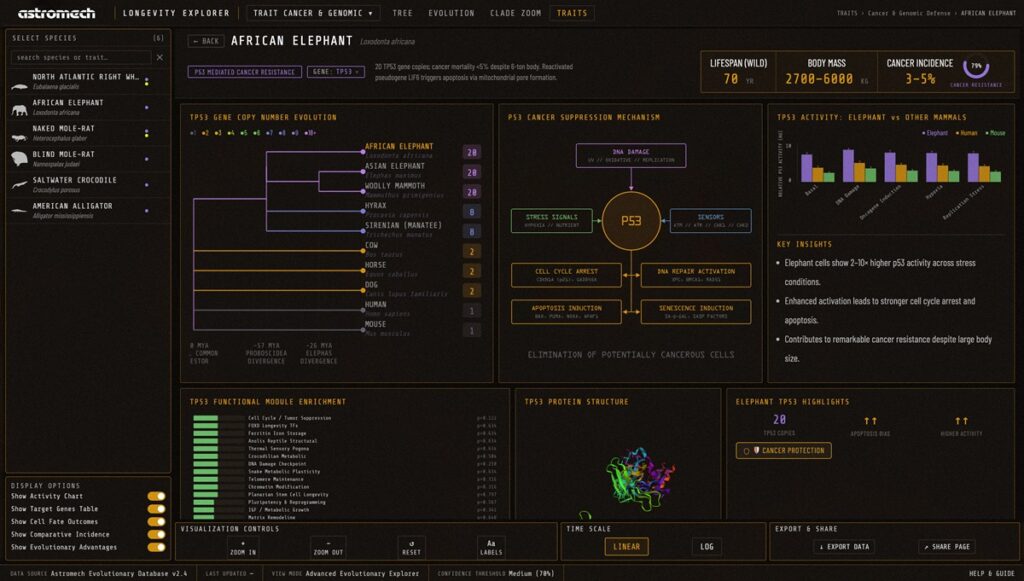
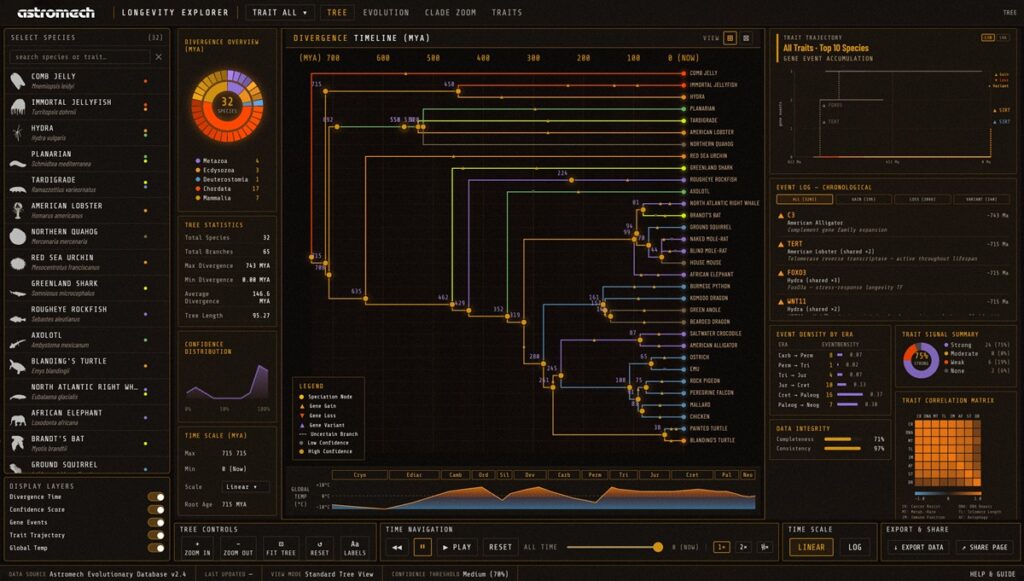
Astromech’s first demonstration of its core model maps 46 longevity-associated genes across a time-calibrated tree of life. Rather than studying a single gene or species in isolation studied in isolation on timelines measured in years, the platform allows researchers to examine how genes linked to longevity, cancer resistance, and cellular and genomic maintenance have been conserved or changed across evolutionary history—from entire groups of species down to individual proteins.
The platform draws on genomic resources developed by Colossal as well as other proprietary datasets, to compare how different species have evolved distinct responses to aging and disease. Asian elephants, for example, have evolved notable cancer-suppression mechanisms despite their large size and long lifespans. Tasmanian devils, by contrast, are vulnerable to a rare transmissible cancer that has devastated wild populations. Examining such divergent outcomes is precisely the kind of comparative question Astromech is designed to address.
Other long-lived species offer independent biological solutions to the same broad challenge. Bowhead whales can live for more than two centuries despite a body mass associated with elevated cancer risk. Brandt’s bats weigh only a few grams yet can live for more than forty years. Birds routinely outlive mammals of comparable size despite higher metabolic rates. By comparing these evolutionary outliers, Astromech aims to identify the genomic and regulatory changes associated with resilience, vulnerability, and healthy aging—and generate more precise hypotheses for the biological mechanisms involved.
“Comparing living species by their genomes can fail to assign DNA differences to functional impacts,” said George Church, co-founder of Astromech. “Most of the variations that matter for complex traits, for example, morphology and longevity are regulatory rather than coding, so reconstructing the ancestral regulatory state, not just the ancestral protein, has the crucial explanatory power. That takes functional data across many species rather than sequence alone, and AI reconstruction cheap enough to run genome-wide. Neither was true ten years ago.”
Moving from Prediction to Application
Today, Astromech’s unified modeling engine and longevity explorer are operational across genomes, traits, genes and clades. The company’s next phase will include forecasting pilots with partners in health and biosecurity, applying its vulnerability and trajectory models to real-world biological challenges. Over time, Astromech aims to prospectively validate its forecasts and integrate confirmed predictions into early-warning systems and therapeutic research programs. Its long-term vision is to build a global platform capable of anticipating biological change before it occurs.
Astromech is hiring across ancestral modeling, regulatory genomics, genomic inference, sequence reconstruction, metabolic modeling and protein folding.