
AMD had a great quarter with $11.5 billion in revenue, up 50% over a year ago. And its stock price promptly fell 7% in after-hours trading.
But Lisa Su, CEO of AMD, was optimistic in a call with analysts. She said sales were driven by significantly higher sales of Epyc, Instinct, Ryzen and embedded processors.
Data Center revenue more than doubled year-over-year and now represents 58% of total revenue, up from 42% a year ago, reflecting the rapidly expanding scale of server and data center AI businesses.
Su repeated her prediction on July 23 at AMD’s AI event that the data center AI accelerator market to grow more than 45% annually to approximately $1.4 trillion by 2030. And she expects the server CPU market to grow more than 50% annually to approximately $220 billion by 2030. This is why AMD’s market value is $845.5 billion.
Of course, a constraint on the business is the shortage of memory. Asked if AMD could get enough allocation of HBM, or high-bandwidth memory chip supplies, Su said she has worked with memory chip partners for multiple years to have a strong ramp for what the company expects to deliver in 2027.
She said AMD has an advantage as larger bandwidth matches large memory footprint and it helps with total cost of ownership for a system. The benefit of the memory is workload dependent, she said. Taking a step back, the overall data center market opportunity is expanding far more rapidly than AMD projected just six months ago, she said.
“We are still in the early stages of a multi-year AI adoption cycle as deployments grow across
a broad set of markets and workloads, driving demand for more compute and creating a clear
path to significant revenue growth and earnings power in the years ahead,” Su said.
In server, she said AMD delivered its fifth consecutive quarter of record server CPU revenue, with cloud and enterprise sales each growing more than 70% year-over-year, exceeding the
outlook AMD provided last quarter.
In a jab at Intel, she noted AMD gained x86 server revenue share year-over-year, as customers expanded deployments of both 5th Gen Epyc “Turin” and 4th Gen Epyc “Genoa” families.
In cloud, hyperscalers continued expanding Epyc across their internal infrastructure and
public-cloud offerings, including AWS, Microsoft, Google, Oracle and others.
Su said 5th Gen Epyc “Turin” now powers nearly one-third of the more than 1,600 Epyc public-cloud instance types available globally, as providers broaden their offerings with new database, storage and AI workloads.
That expanding footprint is translating into growing adoption of Epyc in the cloud, with
healthcare, financial services, media and technology companies adding tens of millions of
instances in the last quarter, Su said.
Su said more than 230 5th Gen Epyc platforms are now in market from HPE, Dell, Lenovo,
Supermicro and others, our broadest enterprise portfolio to date. Su said she remains optimistic about the health of the PC market as it grows to help meet AI demand.
Agentic AI growth
Looking ahead, agentic AI is creating a new growth vector for server CPUs, spanning high-
frequency AI host nodes, high-density agentic servers, and general-purpose cloud and enterprise workloads. Agentic AI is the largest piece of the TAM, she said.
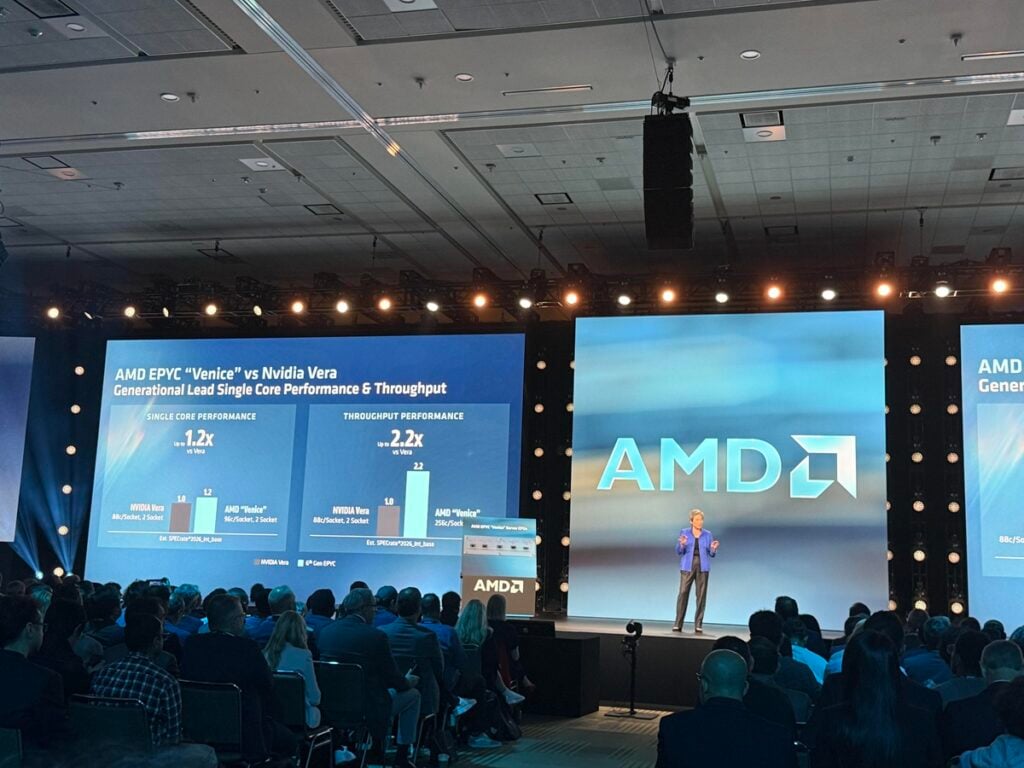
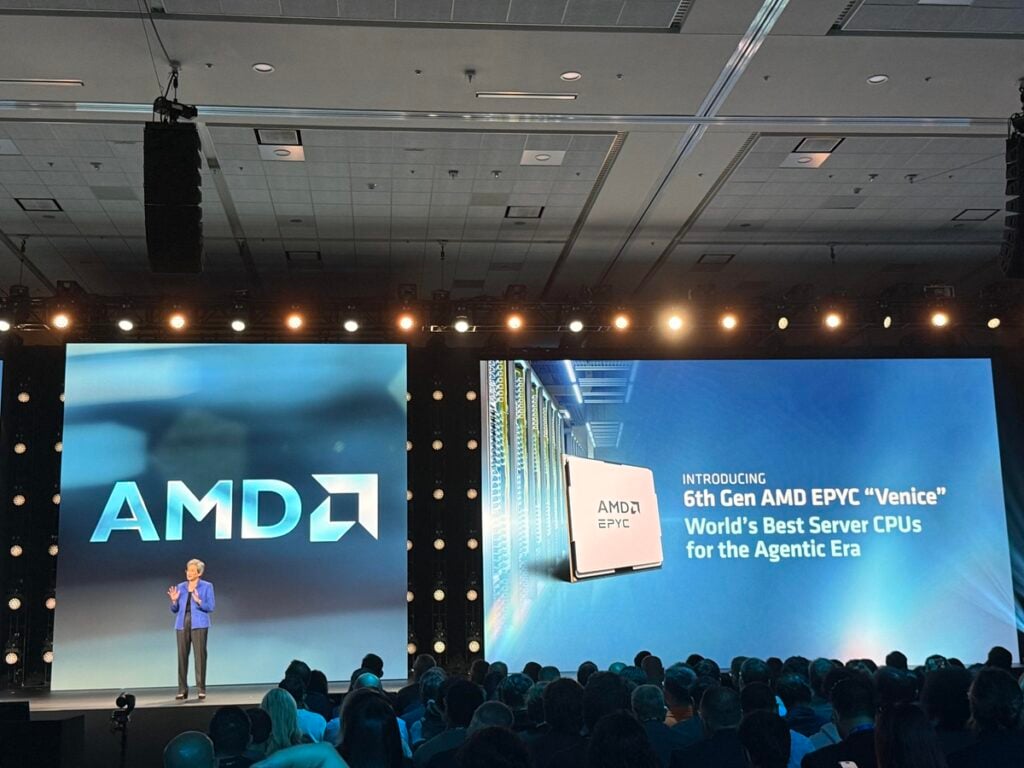
AMD’s 6th Gen Epyc “Venice” family is purpose-built for this expanding range of workloads
and delivers one of the largest generational performance gains in Epyc history.
Built on the new “Zen 6” core and 2-nanometer technology, “Venice” extends Epyc
leadership in performance and efficiency, delivering more than twice the performance per watt
of leading x86 CPUs and up to 3.3 times the performance per watt of leading Arm-based CPUs.
The “Venice” family includes more than 30 processors that combine leadership per-core and
per-socket performance with a broad range of memory and I/O configurations, giving customers greater flexibility to optimize performance, efficiency and TCO across the most widely used cloud, enterprise and HPC workloads.
“Venice” is in production now, with every major OEM on track to launch platforms and the
leading cloud providers planning deployments beginning later this year.
Customer demand for Venice is stronger than for any prior EPYC generation, and Su expects
to continue growing market share across cloud and enterprise in the coming quarters.
Data Center AI Business
Dean Takahashi
Revenue more than doubled year-over-year in Data Center AI, driven by strong demand for Instinct accelerators, AMD’s graphics processing units (GPUs) for the data center.
MI355X adoption continued to broaden, as leading AI companies scaled deployments across a growing range of inferencing and training workloads and cloud providers expanded MI350-series availability.
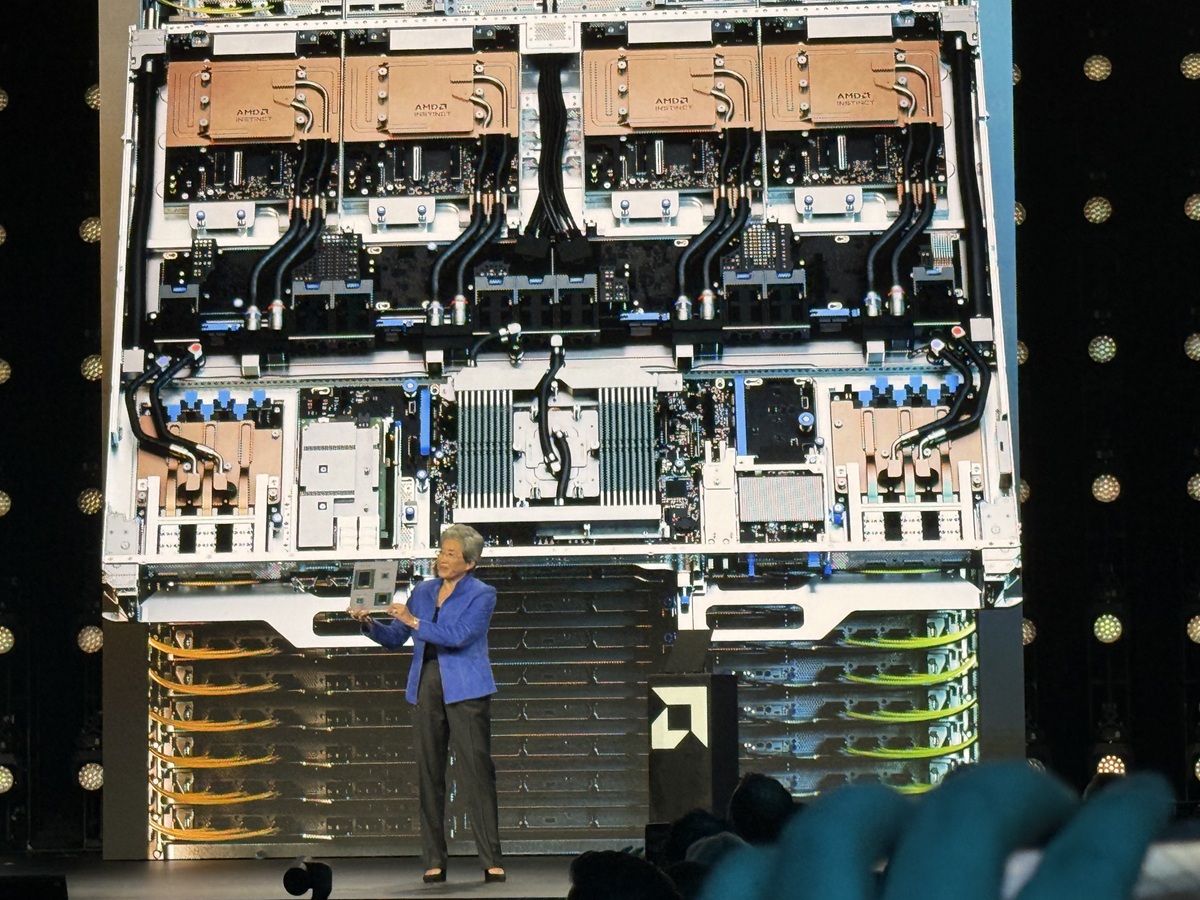
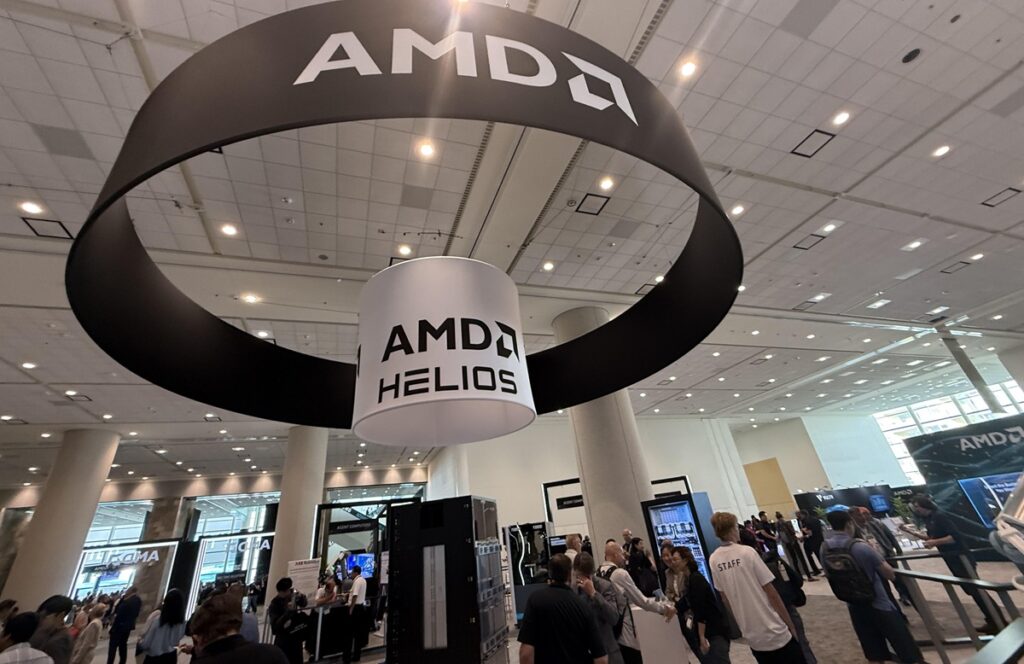
At the Advancing AI event, AMD launched Helios, our rack-scale AI platform combining Epyc
“Venice” CPUs, MI450-series GPUs, Pensando networking and ROCm software.
Across a broad range of inferencing workloads, Helios delivers up to 15% more throughput at the same rack power, and up to 30 percent more tokens per dollar than the competition.
Customer pull for Helios is very strong and tracking ahead of initial forecasts, Su said. In addition to the multi-generation, gigawatt-scale deployments with OpenAI and Meta, AMD
announced a new strategic partnership with Anthropic.
Anthropic will deploy up to two gigawatts of MI450 series GPUs in Helios, with deployment
of the first gigawatt beginning in the first half of 2027.
The partnership includes a multi-year joint engineering collaboration, using Claude to optimize workloads for Instinct GPUs and accelerate ROCm software development.
AMD also expanded a long-standing partnership with Microsoft, which also reported stellar Q2 earnings due to AI revenues. Microsoft will deploy “Helios” at scale on Azure for frontier-model inferencing across Microsoft, its AI customers and Azure AI services.
Together, these commitments broaden the group of leading AI companies and cloud
providers building their next-generation infrastructure on AMD, Su said.
Helios is now in production, with initial shipments on track to begin later this quarter and
ramp through the fourth quarter and into 2027 to meet very strong customer demand.
Looking beyond Helios, AMD plans to launch a new rack-scale AI platform every year, with
each generation delivering significant performance, efficiency and TCO gains.
In 2027, AMD’s next-generation platform combines MI500 series GPUs, “Verano” CPUs, and
Pensando networking with expanded scale-up domains and both copper and optical-based
interconnects, Su said.
Customer engagement on MI500 is very strong with multiple customers working closely with
AMD as they plan their next-generation AI infrastructure.
AMD expects MI500 to deliver the largest generational leap in Instinct history, putting it on-
track to increase inferencing performance more than 2,000 times in just four years.
Turning to AMD’s AI software stack, Su said ROCm has reached an important inflection point, with the performance, capabilities and developer experience customers need to deploy AI in production at scale.
The breadth of the ecosystem also continues to expand. More than three million models now run out of the box on AMD, the leading open models launch with Day-0 support for Instinct and
open-source contributions to ROCm have increased more than tenfold over the past year.
AMD introduced ROCm.AI, a new AI-assisted development platform for AMD GPUs last
month. ROCm.AI lets developers use today’s leading coding agents, including Claude, Codex and Cursor, to create, port and optimize code for Instinct, making it significantly faster and easier to bring new models and workloads to AMD, she said.
ROCm.AI delivers more than twice the training performance and more than three times the
inferencing performance of ROCm 7 across a broad range of models.
We are also working closely with the leading AI labs, including OpenAI, Anthropic, Meta, and others to co-optimize ROCm for their models…with the improvements benefitting the entire
AMD ecosystem.
As AI moves into production across a broader range of applications and workloads, demand
for both accelerators and CPUs is growing well above our prior expectations.
For AMD, this larger opportunity, combined with the strength of its portfolio and growing
customer visibility, is creating a steeper growth trajectory for the Data Center business.
In data center AI, the growing number and scale of Helios and MI450 Series Instinct
deployments position the business for significant growth in the second half of the year with
growth accelerating in 2027.
In server CPUs, with very strong customer demand and improved supply, AMD now expects
server revenue to grow more than 80% year-over-year in the second half of 2026 and
more than 70% for the full year 2027, off a much higher base. She said supply is short now because much of the demand growth was not anticipated.
“We feel good about what we talked about, which is 70% year over year growth,” she said.
Taken together, AMD now expects Data Center segment revenue to more than double year-
over-year in 2027.
Client and Gaming Segment
Segment revenue grew 6% year-over-year to $3.8 billion. In client, revenue increased 23 percent year-over-year to $3.1 billion, driven by record mobile processor revenue and continued share gains.
Commercial adoption continued to expand in the quarter, with Ryzen PRO sales growing
more than 50% year-over-year as we closed new wins with large healthcare, technology,
automotive and financial services companies.
To build on this momentum, Dell, HP, Lenovo, Asus and others launched a broad portfolio of
new commercial PCs powered by our latest-generation Ryzen AI PRO 400 Series processors.
Demand was also strong for our Ryzen AI Halo developer systems, which went on sale in
the quarter.
In July, AMD introduced next-generation Ryzen AI Halo platform, powered by new “Gorgon Halo” processor, featuring an industry-leading 192 gigabytes of unified memory and can run models with up to 300 billion parameters.
And to make it even easier for developers to build and test large AI models locally, AMD Is partnering with Hugging Face to include one year of Hugging Face PRO with every Ryzen AI
Halo system beginning later this year.
Looking to the second half of the year, Su said AMD is planning for a softer PC market, as higher memory and component costs weigh on demand.
Against this backdrop, she expects the client business to perform better than the market,
driven by the strength of the Ryzen portfolio and growing commercial adoption.
In gaming, revenue declined 31% year-over-year to $779 million, primarily due to
lower semi-custom sales at this stage of the console cycle.
Gaming graphics revenue also declined year-over-year…as higher industry-wide component
costs contributed to higher graphics card prices and weighed on overall demand.
Embedded Segment
Revenue increased 19% year-over-year to $977 million, our strongest growth in more
than three years.
Demand was broad-based, with strength across networking, aerospace and defense, test,
measurement and emulation, and communications customers. The embedded x86 business grew significantly in the quarter, as hyperscalers and networking customers increasingly adopted AMD CPUs to power critical networking and control plane functions in the data center.
AMD also continued to expand our portfolio, introducing Ryzen AI Embedded X100
processors for demanding real-time edge AI workloads and the Kria AI Robotics platform for
physical AI.
Looking more broadly, the strategy AMD has been executing over the last few years is now
delivering strong results, Su said.
Embedded x86 is becoming a significant growth driver for the segment. The overall embedded portfolio is outgrowing the market and gaining share and our embedded semi-custom engagements are expanding.
Design-win momentum also remains very strong. AMD is tracking toward another record
year, with more than $18 billion of new design wins, led by major wins with networking, data
center, communications, test, and aerospace and defense customers, Su said.
In closing, she said, “We delivered record revenue and profitability in the second quarter, reflecting our strong execution and the growing adoption of our leadership products.”
And she said, “We enter the second half with strong momentum across our businesses, with ‘Venice’ and MI455X now in production, initial Helios shipments set to begin this quarter, Ryzen ProCPUs driving continued commercial share gains, and our embedded segment returning to strong year-over-year growth.”
More than a decade of focused investment has given AMD the strongest and broadest product
portfolio in the industry, deep strategic relationships with the companies driving the future of
computing, and a proven ability to deliver multi-generation roadmaps and ramp complex
products at scale, Su said.
“At the same time, AI is driving demand for dramatically more compute across all of our
markets,” Su said. “We now see the overall market for high-performance and AI computing growing approximately 40% annually over the next several years, approaching $2 trillion by 2030. And we expect to grow well above the market.”
AMD said it is tracking materially ahead of the long-term financial model Su shared at
the Financial Analyst Day last November.
“We now expect revenue to grow substantially above our prior target of greater than 35%,” Su said. “And we expect to significantly exceed our $20 annual EPS target within our strategic timeframe. We are still in the early innings of a multi-year AI adoption cycle and the opportunity ahead is enormous. We are exceptionally well positioned to capitalize on this opportunity and deliver significant growth in the coming years.”