
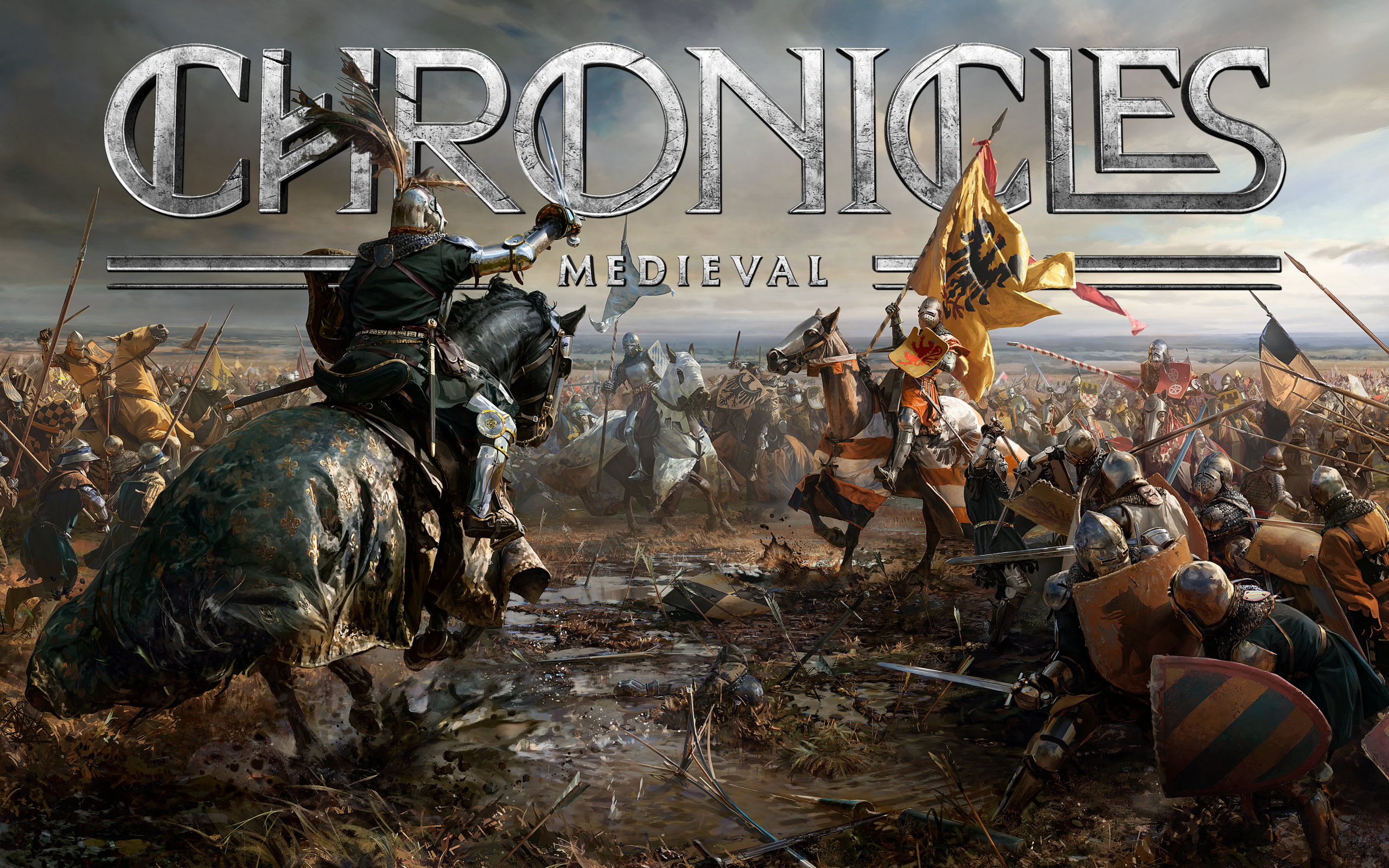
Raw Power Games unveiled its gameplay for Chronicles Medieval at the Summer Game Fest broadcast in Los Angeles.
The Copenhagen, Denmark-based game studio showed off its debut title, Chronicles: Medieval, scheduled to release in early access later this year. Step into a vast, dynamic medieval sandbox set in the age of the Hundred Years’ War.
Explore a brutal but beautiful, historically grounded Europe, command armies in massive battles, leave a mark the chroniclers can’t ignore as you make your name one fight at a time.
The trailer, narrated by (award-winning) Danish actor Lars Mikkelsen (The Witcher, House of Cards, Frankenstein), shows the intensity of the large-scale battles and is captured directly from the game.
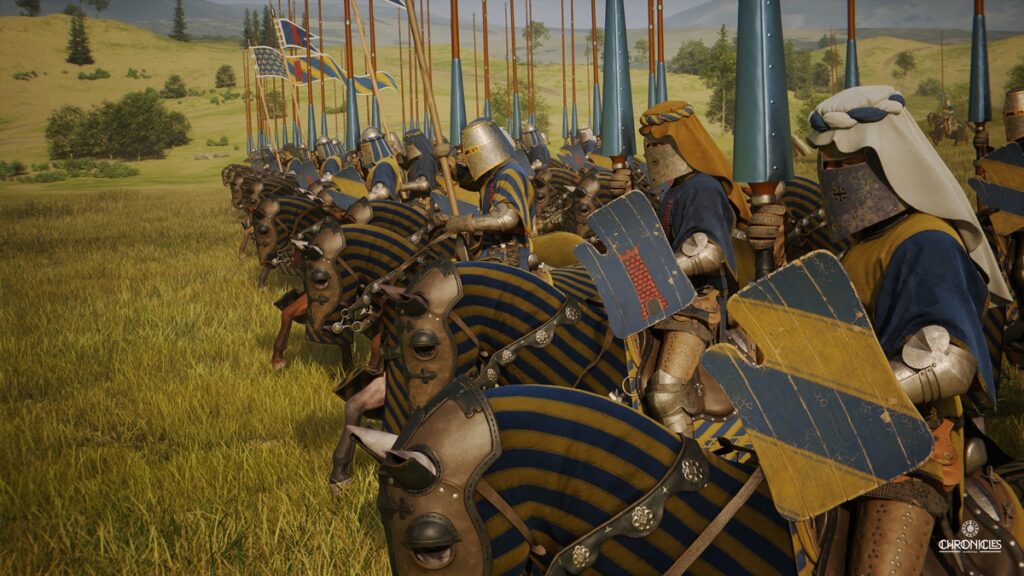
Raw Power Games also confirmed that the Holy Roman Empire joins England and France as the third fully playable faction in Chronicles: Medieval. The three factions represent the primary powers and will each bring distinct units, strategic options, and a different perspective as you adventure through medieval Europe.
“This time last year, we revealed Chronicles: Medieval to the world, unveiling our ambitious debut title,” said Gareth Bourn, senior game designer at Raw Power Games, in a statement. “Now we’re providing a closer look at the exhilarating and brutal combat, which fuels the heart of our game. Chronicles: Medieval is all about player agency as they step into a medieval world defined by war, and the only way to survive is to rule the battlefield with cunning strategy and vicious drive.”
At the center of the game is a combat system in which the player serves as both the commander and the fighter. Players issue orders to Longbowmen, cavalry, crossbowmen, and men-at-arms without ever stepping out of the fight themselves. Position a flank, direct a charge, then draw a sword and enter the melee personally. Each unit type carries a distinct battlefield role and responds to orders in real time, making every engagement a layered tactical decision.
Beyond the battlefield, Chronicles: Medieval is a historically grounded open-world sandbox set across the British Isles, France, and the Holy Roman Empire. Players build a character from nothing, recruit and train an army, forge alliances, and accumulate a reputation that echoes through the world.
Chronicles: Medieval enters Early Access on PC via Steam in 2026. The Early Access release represents a substantial foundation, with Raw Power Games committed to expanding the world, deepening the systems, and integrating community feedback on the road to the 1.0 release, including a deeper focus on modding support. The game is powered by Unreal Engine 5 and Raw Power Games’ proprietary Asgard technology.
The game will launch first on the PC and then on consoles.
Set in the brutal and beautiful European world of the 14th and 15th centuries, Chronicles: Medieval throws players into a sprawling, dynamic sandbox blending action and RPG depth on a strategic scale. Set in the Hundred Years War, players will write their story and forge their destiny in a living, breathing realm where every decision echoes through history and every sword swing could change their fate. Players can engage in intense combat, fight for land, glory, and legacy, and lead massive armies into intense battles.
“Whether players dream of carving out a kingdom, leading armies into battle, or becoming the most prosperous trader, history is written by their hand in Chronicles: Medieval,” said Andrzej Zawadzki, senior designer at Raw Power Games, in a statement. “As we unveil the game and move towards an early access release, we plan to listen and work with our community to make our first game a truly epic adventure.”
Clemens Koch, senior community manager, said in a statement “We believe the best ideas often come from players themselves, and we look forward to building the game with our community, offering early playtests and feedback sessions. To learn more about Chronicles: Medieval and engage, we encourage players to join our dedicated Discord channel.”
Raw Power Games
Powered by Unreal Engine 5 and Raw Power Games’ proprietary Asgard technology, Chronicles: Medieval is coming to early access on PC via Steam in 2026. The world premiere announcement trailer at Summer Game Fest features narration by none other than award-winning actor Tom Hardy (Mobland, The Revenant, The Dark Knight Rises, Inception).
Raw Power Games is a new studio of more than 100 veterans who have worked on notable titles such as The Witcher 3, Assassin’s Creed series, the Hitman series, Red Dead Redemption 2, Cyberpunk 2077 and the Grand Theft Auto series.
Gareth Bourn, senior game designer at Raw Power Games, said in a press briefing that the company has 100 passionate gamers with many self-proclaimed historians. The Copenhagen company is “fully funded and fully focused on building our first game,” he said.
“We are a group of seasoned developers from all over the world, and we’ve worked on some pretty incredible titles. Now we are all under one roof, working together to bring our first game as a studio to life,” Bourn said.
A year ago, the company showed off its game trailer at Summer Game Fest, and now it is showing off gameplay for the first time.
At its heart, Chronicles Medieval is a player-driven sandbox RPG set in medieval Europe during the 14th and 15th centuries amid the Hundred Years War.
“We are aiming to build a world of war, trade, diplomacy, politics, ambition, and player-driven narrative – a world that functions and breathes regardless of what you do, where kings fall and rise, where reputation built over years can unravel in an afternoon, from rags to riches, from obscurity to power,” Bourn said. “Your journey is yours to forge. You are not the center of the world in Chronicles Medieval. You’re part of it, and what you do within it is all up to you.”
Watching gamelay
Clemens Koch, senior community manager proceeded to show what the gameplay looks like, with a trailer that showed off formations of soldiers as well as movement and combat.
“One of our core pillars is large-scale battles, and as you so saw, we are bringing hundreds of soldiers together in brutal clashes with steel meeting steel across amazing battlefields. We take warfare seriously,” Koch said.
Bourn said that one thing about the Hundred Years War is that not every battle had historical significance.
“For every Crecy or Bannockburn, there were 100 smaller affairs fighting over small scraps of land all the way through to enormous clashes that decided the fate of entire kingdoms,” Bourn said. “All of these possibilities exist within our game. You can be in the rolling hills of Burgundy, facing down a handful of brigands, or staring across the muddy field at the very King of England himself, where you are on the map, and who you’re choosing to battle against matters when it comes to the field you’re fighting in.”
He added, “Each field supports battles of every scale. It’s a big part of what makes Chronicles Medieval feel like a proper sandbox. The world decides the battlefield, the armies decide the stakes, and you decide how to shape the outcome.”
Once armies come together on a battlefield, the clash begins and participants have to “settle their accounts in iron and in blood.”
No armies fight the same
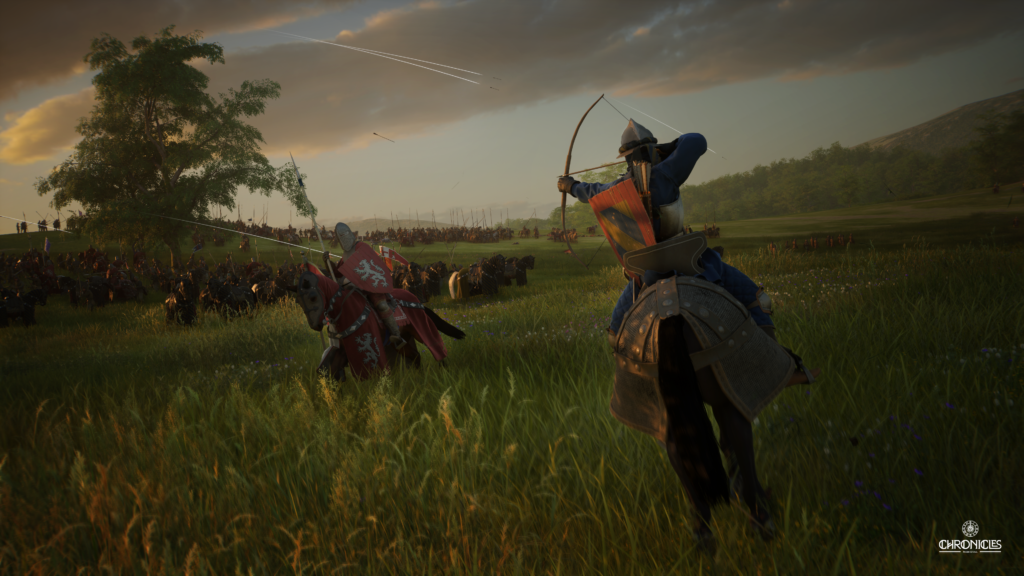
No two armies fight the same, and no two will deploy the same way either, Bourn said.
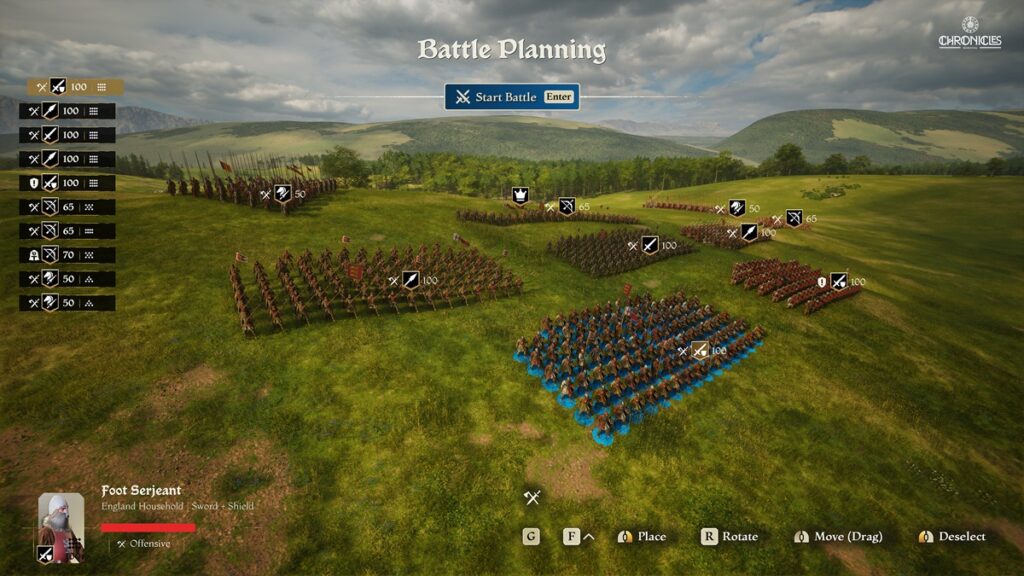
. This is because how the units that compromise, sorry, comprise any army like to fight dictates where they stand and the overall layout on the field. So once you’ve initiated a battle on the exploration map, the command layer kicks in. You’re on the precipice of battle in what we call battle planning, inside your deployment zone, laying out your plans and brewing your tactics. This will be very familiar to fans of the genre, with a key point of difference.
In games like Total War, you issue commands to your troops in regimental formations. They execute your commands and you see the tactical results of your strategy. But in the case of Chronicles Medieval, the army doesn’t have a prescribed shape.
“Each unit carries its own preferences based on type and on culture, and our deployment system reads that to place your units where they fit best, across the vanguard, the main battle, the rear guard, and the flanks,” Bourn said.
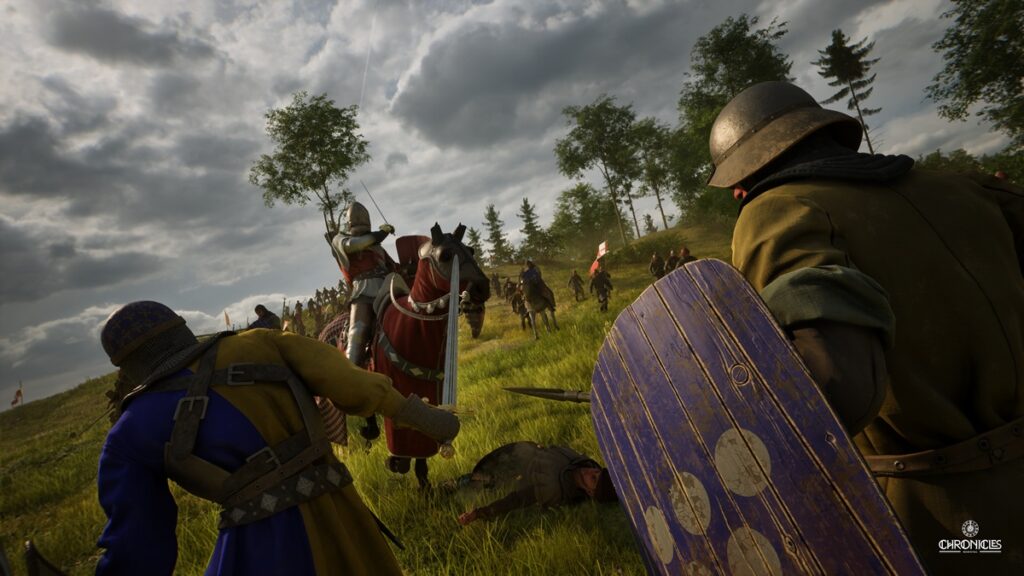
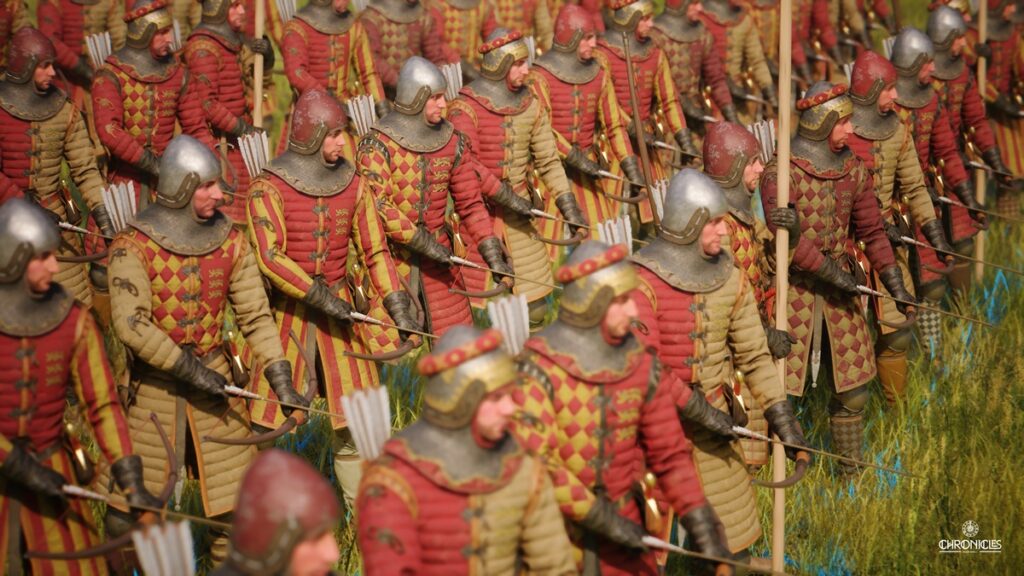
He noted, “For example, French heavy cavalry, true to their reputation, gravitate to the vanguard, eager to lead the charge. English longbowmen prefer the flanks, where they have clear lines of sight and room to bring their legendary longbows to bear. The forces of the Holy Roman Empire, they favor a dense vanguard and a dense main battle, presenting war of well-drilled, well-armored men for the enemy to break themselves against.”
With your army, you can deploy them as you wish and you can reshape and reposition your army however you see fit, and however you want to plan your battle.
“And in the future, we plan to allow you to decide how you want your army to deploy through an army management UI. If you’re not a fan of the game deciding for you, or if you have a way you like them to deploy, and you just want to get straight into the thick of it, and you don’t want to do any of this at runtime. So before the first horn sounds, your army already knows how to fight with or without you due to orders you give them,” Bourn said.
Chaos of war versus planning
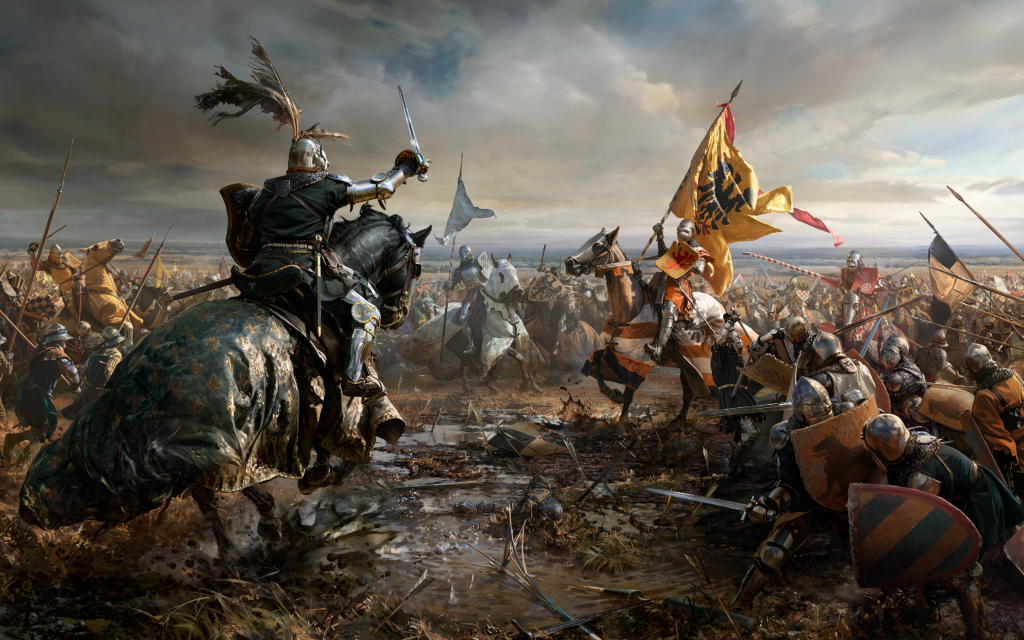
If you die in battle, will your soldiers still do your bidding as trained? That depends on how your unit thinks, the shape they fight in , and what you told them to do. Units have standing orders until they get fresh commands. If they’re aggressive, they will seek out and engage anything that moves. Defensive units will hold ground and wait for the enemy to come to them.
“Adaptive is where the system begins to show its depth. The AI is essentially told to do what you think is best,” Bourn said. “So, a cavalry unit set to adaptive that is facing a unit in the shield wall formation might switch to a wedge formation on its own to drive a gap into that line.”
On top of that, units have initial orders.
“These let you script each unit’s opening move. It’s the first action the moment the battle begins, after which the unit will fall back to its standing order,” he said.
He added, “For example, you could take a cavalry unit and send them round on the right flank, and once they’ve finished that initial order, they will fall back to their standing order. So, perhaps they’re in adaptive, and they decide what’s to do, what’s best to do once they reach that destination.”
Battle formations
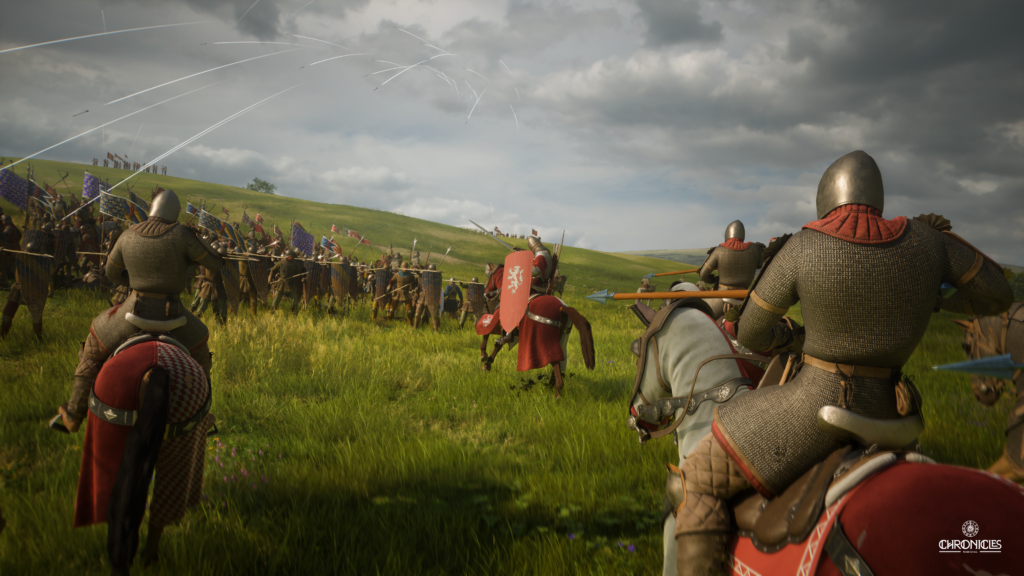
There are base formations, which are line, block, and loose. They are the resting state. These are easier to move. Then there are advanced formations like a shield wall or shock cavalry lining up for a charge in a wedge formation. Or squares of infantry that are hard to flank.
“Each one is brutally good at its job and meaningfully quite bad at most others. So a spear wall can barely walk, squares can’t really maneuver. [Cavalry] give you great charges before your mounts are spread out,” he said. “The system rewards the reading the field rather than micromanaging it. Your upfront choices matter, and you can alter your plans and react to the evolving field, but you also need to get stuck in as well, and not spend all of your time fiddling with how all of your men are standing.”
When you are done with plans and can start the battle, you drop into third-person and can see the battle and what it looks like on the ground. You can direct them closely and risk your life or give them courage. But if you falter, so will your army.
“When you commit, your initial orders fire, and units fall into their standing orders. From here, the game is about reading the fight, spotting the moment a flank bends or a standing order stops making any sense, wrangling the chaos of war in real time,” Bourn said.
The pace of command
You can step into command mode to issue orders. The world doesn’t necessarily stop, but it slows enough to let you think.
“It’s a brief moment to collect your thoughts and influence the battle around you. Issue commands, shape the battle before driving back in,” he said.
The game has global commands with army-wide intent, like advance, hold, fall back, engage, charge, or retreat.
“A very classical list. They go out as horn calls, and the AI figures out how each unit carries them out. You’re shaping the battle, you’re not micromanaging it, and then we have our local commands. These are more precise. You can select a unit, you can get direct control over it, move it, send it at a new target, set its facing, change its standing order, change its formation,” Bourn said.
Unit morale has a variety of settings, like fighting above a baseline, confident, which is normal, or concerned, and wavering.
“These are your warning lights, your window to act at the bottom,” he said. “If it hits broken. which triggers a route, the unit turns and runs, and it’s counted as loss, regardless of however many men survive that route,” he said. “That’s an army-wide morale system. But two units standing side by side can be in completely different states: casualties, charges, flanks, friendly unit breaking nearby. All of these things, they can drop morale down, and this is where you can really earn your keep. Your presence affects the men around you.”
Size of battles
Bourn said the team is aiming for a maximum of 2,000 soldiers on the map at any given time, but that depends on how what your hardware can support. The maps will be procedurally generated as armies meet on the field, and they will reflect the battleground and what can be generated.
There’s an economy that supports your troops and resupplies them between battles. You start with recruiting peasants and eventually work up to training French cavalry. There will be no siege battles in this game at the moment. But they will eventually come, but not for early access. The team is trying to balance historical accuracy and fun gameplay.
It’s the same question that the Total War team has wrestled with for 25 years. But there are some big differences between the games. There is a larger exploration map, though it’s not necessarily a campaign. This is inspired by both Total War and Crusader Kings.
“Obviously, a very big difference between us and Total War is that we are a third-person game as well as a strategy game, then there’s some really interesting blending going on,.” Bourn said. “There is quite a quite a big difference between us and Total War. Trying to bring a battle to life in third person is very different from essentially being God and directing it from a distance. It’s quite a different paradigm and a very different problem space.”
The team is deep in development and the work of different disciplines is coming together. Another developer diary is coming up after Summer Game Fest.
Koch said that early access is the beginning, not the end, of shipping the game.