
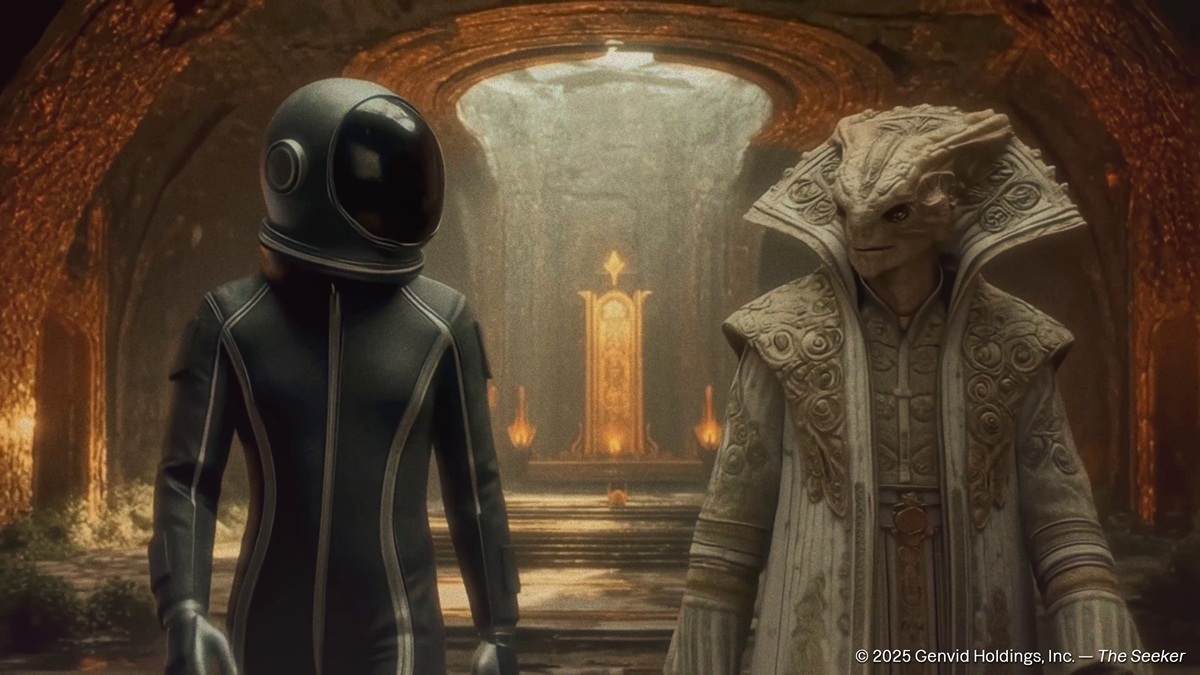
Stephan Bugaj, chief creative officer at Genvid, announced the commercial release of The Seeker, an emotionally compelling sci-fi film created using generative AI.
Bugaj was the winner of last year’s Emmy Award for Outstanding Innovation in Emerging Media. He used GenAI for all visuals and music, and all but two of the voices in the film. It’s a pioneering work, but it’s also the kind of thing that will cause conversations, given the controversy around the use of gen AI in gaming.
This is the first time an Emmy Award-winner has created an entirely generative AI film, and it is also the first time that a film made with generative AI has been made commercially available.
The Seeker Overview

In the film, a deep space “Seeker” who retrieves and sells the last artifacts of dead civilizations is visited by a mysterious Stranger, leading The Seeker on a path to discover the most valuable thing in the universe.
“I made The Seeker because I love philosophical sci-fi stories,” said Bugaj. “And Generative AI gave me a chance to make a movie, almost entirely by myself, on a budget I could afford without any outside financing, in that genre that otherwise almost never gets
greenlit by studios.”
Stephan continues, “By lowering the cost and therefore risk of making credible-looking films, the great opportunity AI provides for filmmakers is to take filmmaking power back into their own hands and tell stories beyond the over-broad blockbusters that become necessary when a huge budget needs to be recouped.”
The Seeker will be available soon through Amazon and Apple platforms. For those looking for immediate availability, The Seeker is available for sale today at $20 through Genvid’s direct channels at genvid.com.
Genvid launches Genvid Studio-Grade AI Platform and partners with Massive Studios

Genvid, which released last year’s hit title with Warner Brothers Discovery, DC Heroes United, and 2023’s Emmy Winning Silent Hill: Ascension with Sony Pictures Core, is also
announcing general availability of its new Studio-Grade AI Platform. The platform was built from the ground up for professional studios to build long-form content with AI video and is the first of its kind.
Massive Studios—an AI-native production and production-services company—is partnering with Genvid to deploy a customized Studio-Grade platform, advancing the next generation of AI-driven film, television, and commercial production.
“Similar to CG studios in the late 80s and early 90s,” adds Genvid CEO Jacob Navok. “Those
who experiment and build with AI technology now are poised to take the creative lead like Pixar, with Massive Studio’s Alex Patrascu resembling John Lasseter in his work with the burgeoning craft.”
“At Massive, we believe AI is a powerful engine,” said cofounder Reza Sixo Safai, in a statement. “But it still needs human hands on the wheel. Creative judgment, ethical discernment, and thoughtful refinement remain essential to shaping work that truly resonates.”
Using Higgsfield AI with the Genvid Studio-Grade Platform

“Genvid has selected Higgsfield as its Generative AI platform not only for their market-leading position, but because of their ability to innovate on top of all the important 3rd party models and best-in-class pricing strategy,” said Navok. “Users of the Genvid
Studio-Grade Platform are encouraged to bring their Higgsfield accounts to Genvid to power their content generation.”
“We are pleased to partner with Genvid on their journey to bring the power of GenAI to build next-generation gaming content,” said Alex Mashrabov, CEO of Higgsfield, in a statement.
Higgsfield is an advanced AI-powered platform for creators, marketers, and businesses to
generate high-quality, cinematic images and videos from text, images, or sketches, featuring tools for text-to-video, image editing, lip-syncing avatars, and advanced camera/VFX controls, making it easier to create ad-ready clips and social media content with cinematic motion and consistency. It integrates multiple leading AI models (like Sora 2, Veo3..) and offers creator-focused features such as character consistency (Higsfield Soul), inpainting (Higsfield Canvas), and lip-sync studios.
Building The Seeker with the Genvid Studio-Grade Platform

Compared to the equivalent cost of animation in past Genvid productions such as Silent Hill, using the Genvid Studio-Grade platform, The Seeker took about 1/500th the cost to produce the equivalent animation within a game engine or standard animation workflow.
The Seeker also took less than 1/10th the number of iterations of most other AI short films and was produced for less than $2,000 worth of AI usage credits.
“There’s going to be an Oscar-winning GenAI film by 2029,” adds Stephan. “And creatives need to master working with these tools, or get left behind like all those who refused to learn CGI thirty years ago. GenAI isn’t going to eliminate jobs in film, TV, and games in the future– it already is doing so today. The workflows in the Genvid tool will make learning the craft and doing Oscar-worthy work a lot easier for filmmakers.”
Studios from five to 5,000 staff who expect pro-grade management processes for AI will find that the Genvid Studio-Grade platform provides substantial efficiency + cost savings.
Solo artists and small teams also benefit from an integrated, managed workflow that reduces frictional costs and wasted generations.
Studios can assign roles so artists can create while supervisors manage approvals and costs across all popular AI systems (including Kling, Google, Runway, and many more) in a single dashboard.
Full end-to-end control takes you from scriptwriting to timeline editing, with asset-managed image generation for location and prop assets, and shot management with asset referencing when building scenes with keyframe editors, video generators and dialog integration all in one system that provides status visibility across the entire production.
Genvid’s design incorporates Stephan Bugaj’s experience with visual storytelling and developing effective production systems at Pixar and Telltale, and Genvid CIO Jerry Heinz’s
experience building and operating scalable platforms at Amazon and Nvidia, implementing world-class filmmaking workflows through a scalable, extensible agentic architecture.
We last heard from Genvid when it launched DC Heroes United in November 2024, and it’s still working on that game.
The evolution of generative AI

Generative AI has been very expensive to produce assets for and has been very costly to develop cinematics in. And we started experimenting earlier this year with AI video and found that it wasn’t able to accomplish consistency or long form, but the potential is there,” said Jacob Navok, CEO of Genvid, in an interview with GamesBeat. “We began to build a workflow that we’re using for our next set of games.”
Bugaj added in an interview with GamesBeat, “We were looking at the volume of content that we need to produce to do these interactive experiences, like branching narratives.”
He said the team explored various AI models for building film content for The Seeker. He concluded that no one was building anything anywhere near the quality of the films that come from Pixar or the games that Telltale has made.
“We built this tool that you can use to start with a script. You can start by just creating shots. But once you start creating shots, it starts populating the script with information about the shots. The AI breaks that down into assets and shots,” Bugaj said. “And then you can make your corrections and additions as you need, as the creator. You can generate packets for your assets, which include models and images that define the model and its components. You can reference those in your shot frames.”
In the tool that Bugaj showed, he could figure out how much a particular shot is costing, depending on how it goes out to AI resources for answers. The platform helps people make AI content on a budget. You can take a script for a show and import it into the platform. You can control all the assets needed for the film, and you can storyboard the script. You can see who is working on different parts of a film.
“You can go into specific shots that you’ve generated and see how much those shots cost in terms of your budget,” Bugaj said. “You can see every rejected shot. You can see what was created by every model. You can assign and generate new shots. You can see what was approved versus what was rejected.”
Building a platform by eating your own dog food

“We used The Seeker as our test bed for building this AI platform tool,” Bugaj said. “I was making The Seeker. I was describing problems I was running into and features and fixes I wanted, and the team would go and build those. We used it to eat our own dog food, using our own tool, and to figure out what problems I wanted solved.”
Massive Studios is the AI native studio that Genvid partnered with to make the platform.
“The platform is being used by a series of AI video game, television and ad studios right now that we have already signed up through our various processes. Massive is one partner who’s using it for several of their upcoming AI short films and commercials,” Navok said.
The company is still making games as its primary business. And it is making the tool available to the public because it believes that the more users it has, the better the software gets, Navok said.
“It just improves everything for the ecosystem as a whole,” he said.
The company is selling the platform on a per-seat basis to cover Genvid’s costs for server infrastructure. But it’s not trying to generate a lot of revenue from it.
“Most of the companies that are providing tools in AI are trying to charge you for credits and make money off of the arbitrage of the credit cost for the underlying model. We don’t do that at all. You bring whatever model you want to it. So if you’re using Higgsfield AI or Google, you plug your API key into our system,” Navok said.
Making The Seeker

Bugaj started The Seeker because he wanted to try out the tools and make something that the team wanted to make. And I love science fiction, so we actually started off making a different science fiction film and a different visual style that the models at the time in August weren’t ready to make,” Bugaj said. “I wanted to do something that was philosophical sci-fi, that was character and dialog driven, that had big science fiction ideas around it — about the nature of humanity and love and relationships.”
It took about six weeks to make the film. All of the imagery uses Gen AI. Most of the voices use Gen AI. The film cost about $2,000 worth of credits for AI server use, as well as the time of the filmmakers. It’s a 25-minute film that will debut on Genvid.com for now and on Amazon and iTunes in January. Bugaj thinks it would have cost a lot more and taken four times as long if he had used traditional means to make the film.
“It’s going to be the first purely AI-generated film ever sold. What we’ve found is that too many people just give these films away for free because they’re trying to prove out the tech. I’m not looking to prove out the tech. I’m actually looking to prove out that you can sell this stuff, because I’m using it in my upcoming games, and I plan to sell my upcoming games,” Bugaj said. “I want to start putting a stake in the ground right now and say, ‘Yes, we actually see commercial value in AI-generated cinematics. I think that this is going to replace cutscene work in Unreal and Unity in games to come.”
Bugaj said the film was mostly a solo effort. He did all of the GenAI work and he did the editing and writing and directing. He had another editor do the audio editing and mixing and sound design, as well as the company’s CIO. The tool itself was made by four people.
If they had not used AI, the film would have been more costly.
“As you’re watching the film, when I see a lot of AI-generated films, what I tend to see that a character is not really moving. A camera zooms in slowly. A camera pans around. It’s bullshit,” Navok said. “And you’ll notice that this film is not made with just a camera slowly panning around. It’s animated like a traditional Pixar-type of film would be. And that was a very intentional choice to make a film that looked like actual animation.”
The human characters in the film were generated with AI. But Genvid hired voice actors to do a couple of the roles, Navok said.
Navok said, “Most of the voice models just still suck. This is really interesting because the 11labs model has been out for years, longer than animation, and it’s just farther behind. It is fascinating how the animation models are improving at a much faster pace than audio, because animation should be harder, and yet it’s the opposite.”
“We would not have been able to create this film without this platform,” Navok said. “If you look at the way the game budgets have gone for the last five years, our projects — Rival Peak, Pac-Man Community and The Walking Dead — we went and we pitched Facebook. Facebook paid us to build these products and we released them. That’s the way that our business has gone for most of the last decade. Those budgets are much smaller now, right?”
Navok said, “Overall, budgets have dropped significantly since 2021, when we signed a lot of our projects, and so we would not be able to get some of the upcoming projects if we weren’t able to reduce the budget with Gen AI. And so if you think about the discussions here, it’s not, ‘Will you replace people? It’s can you survive as a studio with the previous cost model? And the answer is probably not.”
Facing the reality of the controversy

As for the controversy, Navok said, “I know there is a big controversy right now about the inclusion of generative AI in games, but the way that I look at it is the time it takes to produce games and the cost of games are not matching with the revenue that’s being generated, which is resulting in a lot of studio closures and layoffs. And we have to be realistic as people running game businesses.”
If it’s costing companies tens of millions of dollars to make games and three to four years to do motion capture, cinematics, room lighting and everything else, then the process is broken. Lots of games take two years or more to get done.
“I think it’s really important for the industry to understand that for us to compete with worldwide players — Chinese developers can sell on Steam and on the app stores at the same prices that we sell at — but have a fraction of the cost and have way more game developers,” Navok said. “In order for us to start to compete with those worldwide costs, we need to be able to manage game productions much more efficiently, and I think that tools like this that will help us generate characters and assets quickly — even if we have artists still doing the prompting, still adjusting animation, still doing the sculpting — is just going to make game development so much better.”
If this tool enables teams to create character models quickly and then put them environments and work with models, then it can help Genvid be competitive on costs with its overseas rivals.
“What’s happening with manufacturing is happening for white-collar jobs in the United Statestes right now,” he said. “Tools like this will help us generate assets quickly. It’s going to make game development so much better.”
Given the conversations around GenAI, Navok said, “The majority of people who are complaining or concerned about the AI trend tend to be artists, not management. And I speak to CEOs all the time, literally every day. Some of the biggest CEOs in the game industry. Everybody believes that this is the future, and most of them are doubling down on these tools for games going forward. I don’t know a single company that isn’t using Claude or Anthropic or ChatGPT tools for doing coding,” Navok said.
Big Hollywood studios are being careful with AI, as they’re not allowing their people to work with AI tools in the company studios. There is a lot of litigation around the use of the tools.