
San Francisco-based startup Nilo wants to make building 3D games as effortless as sharing a meme. Today, the company announced a $4 million seed round led by Supercell and a16z speedrun to launch what it calls the first AI-native platform for instant, collaborative 3D environment creation.
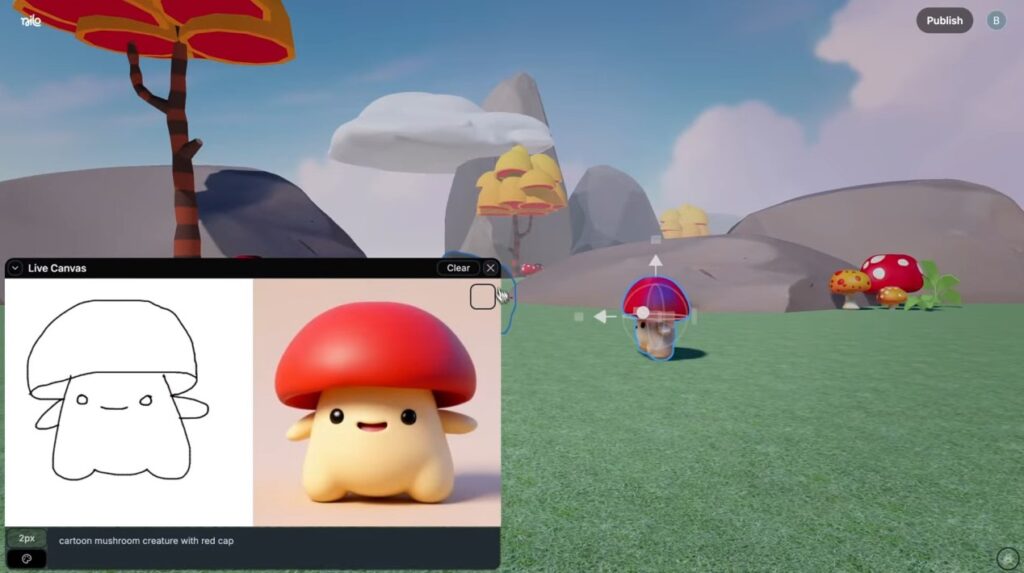
Nilo’s browser-based tool allows users to generate worlds, characters, animations, and even code from text, images, or voice prompts. With support across desktop, mobile, Discord, and Telegram, the platform removes the steep technical barriers of traditional engines. The company describes its mission as “creation at the speed of culture”—a phrase that chief executive officer and founder Nuno Leiria says captures how quickly players want to remix and interact with digital content.
“A few months ago, I was pitching Nilo at an event between A16Z and Supercell,” Leiria said in an email interview. “I took a photo of Otto Söderlund, Supercell’s AI lead, with my phone, which automatically turned Otto into a 3D model in a few seconds. I then animated Otto’s 3D model, and he was running, jumping, and dancing in front of everyone—it was hilarious. Imagine being able to create an interactive experience as soon as the latest Ghibli trend or Coldplay Jumbotron event happens, and then instantly sharing it with a link. That’s the magic.”
Now, instead of a brand needing to hire a studio to build a prototype of a game world or app just to see if it’s viable, anyone can prompt Nilo and instantly have something playable to test the waters. This could also make capitalizing on trends far easier and faster before cultural focus shifts.
Lowering barriers for Gen Alpha creators
Nilo is targeting the generation raised on Roblox, Minecraft, and Fortnite Creative, where social play and user-generated content often overlap. But unlike those platforms, Nilo was designed from the ground up to be AI-native and immediately intuitive for anyone.
“Platforms like Roblox have done an incredible job introducing aspiring creators to user-generated content, but the actual tools they offer have an incredibly steep learning curve,” Leiria said. “Creating anything meaningful in Roblox means spending countless hours in Roblox Studio and tools like Blender. Aspiring creators must learn coding, 3D modeling, animation, and more, all just to build one experience.”
Nilo, by contrast, is designed to feel more like play than work. “Instead of being challenging and tedious, creating in Nilo is as fun as playing a game with friends. It’s like playing digital Legos,” Leiria said. “Nilo was built to be accessible. It works on any browser or mobile device, and games and worlds can be shared with just a link.”
The company calls its platform an “Iron Man suit for game development.” Developers still supply the creativity and passion, but Nilo helps them execute faster and more efficiently by automating the most complex steps.
The $4 million seed round reflects growing confidence in the model. Supercell and a16z speedrun led the raise, joined by a roster of investors and angels from across gaming, AI, and creative tech. While Leiria says he can’t speak directly for them, he pointed to four likely factors for their interest: “An extremely ambitious vision and market size, a world-class team, our rapid technical execution, and the very enthusiastic response from our early users. Joy can’t be faked.”
Some observers might wonder if simplifying creation risks making the tool feel like a toy, rather than an actual tool capable of professional output. Leiria said the opposite is true because it lowers the barrier to entry for eager, creative young minds.
“Normally you’d have to learn and use different tools with different settings to create 3D models, rig them, and animate them. With Nilo that’s just a few clicks or voice prompts,” Leiria said. “With the complex parts out of the way, we can surface more detailed operations progressively, as needed. That ensures aspiring builders can get started immediately, while creative professionals will eventually be able to realize their more complex visions.”
Nilo’s team includes veterans from Fortnite, Twitch, Adobe, and VRChat—backgrounds that shape its design philosophy. “We know how to bring high-quality, console-level performance into the browser. At the same time, we’ve lived through what makes communities thrive and creators feel empowered,” Leiria said. “We’re not just building a game development tool, we’re applying the design thinking of games themselves, so that Nilo feels less like software and more like play.”
That combination of accessibility, speed, and social collaboration is what investors likely are hoping will make Nilo resonate with Gen Alpha and beyond. The company is launching a closed Early Access program this month, with community members invited to join its Discord as “Founding Builders” and visit the company’s website for more details.