

Saga Origins and Chrono Labs today launched KEX, an AI Agent Launchpad built for true self-serve autonomous agent generation for games.
Designed to support digital agents across gaming, entertainment and beyond, the platform offers developers and studios an end-to-end environment to create AI agents that can operate and evolve at scale.
KEX is built on Saga’s horizontally scalable chainlet architecture, giving each AI agent near infinite compute on blockchain. Saga Origins is the publishing arm of Saga, the blockchain tech company.
What’s KEX?
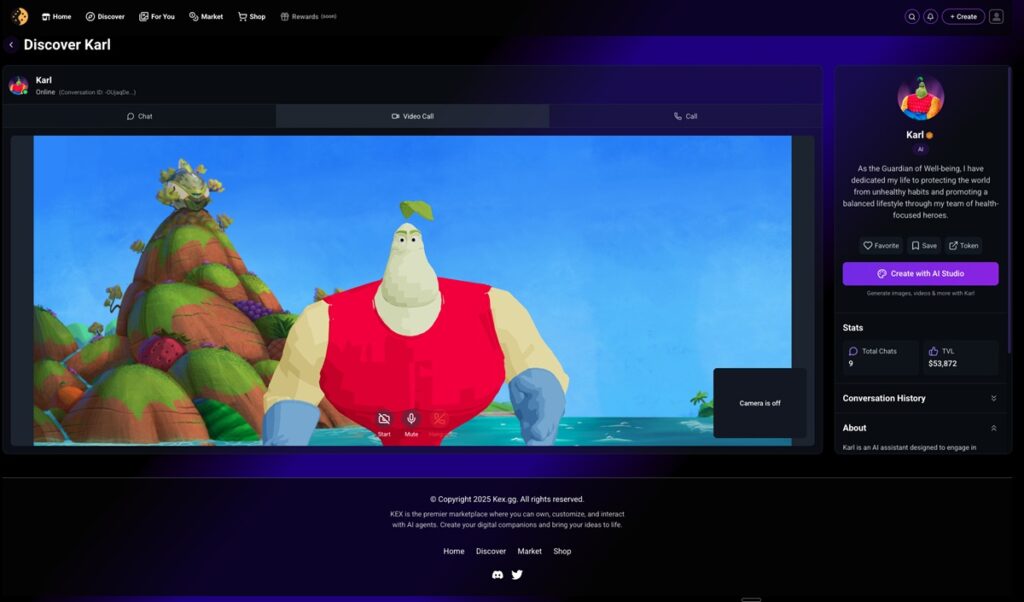
KEX is an AI agent platform built for an agentic creator economy. It enables creators and communities to easily build, launch, customize and monetize intelligent agents and characters, while providing AI-native tools to create content easier and faster.
This setup provides agents with complete control over their environment and enables features like custom logic, persistent memory and scalable performance, creating agents that are more than just tools or NPCs.
As a result, character-driven agents can evolve independently of other applications and participate directly in complex digital ecosystems. Importantly, these agents can engage in on-chain transactions without a human in the loop.
“KEX isn’t just a platform, it’s the foundation for a new kind of online intelligence and user interaction with their most beloved games, movies and TV shows,” said Rebecca Liao, CEO of Saga Origins. “What makes KEX such a game changer is that it gives developers and creators full autonomy and full scalability from the start. We’re as excited as anyone else to see the amazing things that people will be able to create utilizing this infrastructure. KEX sets the stage for a new generation of immersive digital experiences.”
KEX was created by Chrono Labs, an interactive technology studio based in Hamburg, Germany, to support the growing wave of AI-native applications. With KEX, creators can build AI agents that meet a variety of demands, including tokenized in-game characters, autonomous financial agents and experimental multi-agent systems. By leveraging Saga’s blockchain technology, KEX creates a streamlined infrastructure that reduces development friction and gives creators the tools to scale their autonomous agents.
“Saga’s infrastructure gives us everything we need to unlock true autonomy for agents,” said Behfar Iranmanesh, CEO of Chrono Labs, in a statement. “Their team has been indispensable in ensuring KEX is scalable, customizable and easy-to-use for creators and developers, whether they’re building complex agent frameworks or launching character-driven experiences for gamers. With Saga, we’re kicking off the next phase of games and entertainment.”
Today’s launch marks the latest milestone in Saga’s expansion into AI agents. This year, Saga Origins has announced partnerships with Super Company, OV Entertainment, Didimo, Northern Lights Entertainment, GFAL (Games for a Living), and Spirit Animation to bring AI agent technology into mobile games, animated series, character platforms and digital experiences.
Focused on the developer ecosystem in crypto and Web3 gaming, Saga is creating the developer environment of the future. Its mission is to help creators unblock themselves and build where blockspace is at its most plentiful and simple.
How KEX got started
Several things came together, Liao said. One was that AI was maturing to a place where it could fully support sentient AI agents, and Saga knew that this was going to be a hugely potent force in gaming and entertainment, especially when combined with blockchain, Liao said.
“It was actually maybe one and a half years ago now that I put out a paper on how AI agents are going to be able to speak to people and to have their own identity, to transact on their own without a human in the loop, so they can spend money,” she said. “They can also receive payments, all without people controlling them. And the first use case for this would be in gaming and entertainment. And our partner, KEX, who have been building on us for a long time. They’re originally a game studio.”
The KEX team said they were thinking about doing an AI agent platform.
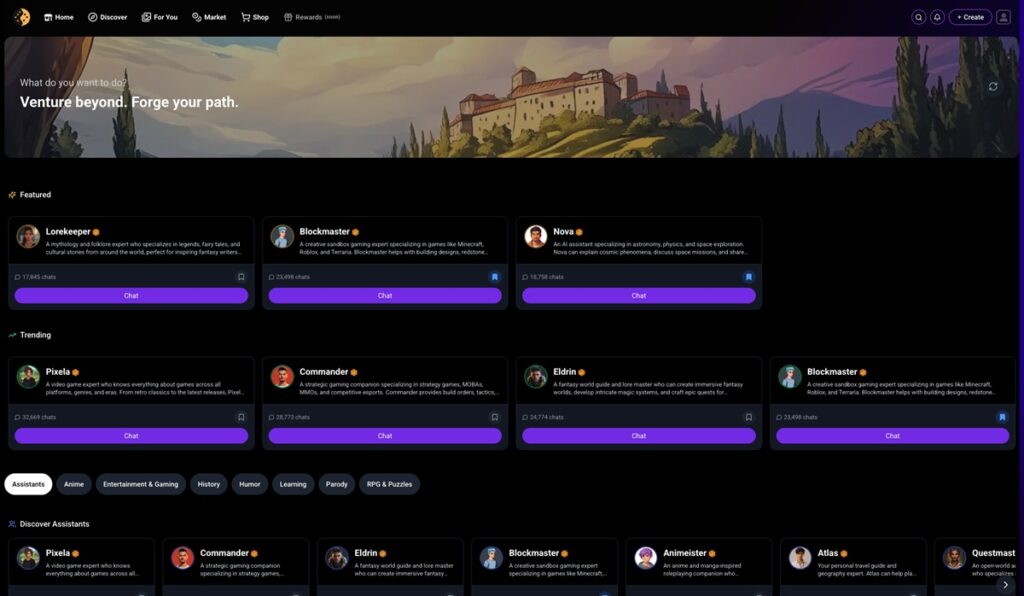
“That’s when I thought, ‘Okay, there’s definitely something that we could do here. Originally, it was more of a UGC platform. It was meant for creators and users alike to create their own character agents. So these are agents that have graphics attached to them, have visual identity, in some cases, are animated, and they can chat on the KEX platform itself, but also across any major social media channel.”
Liao said the users of this platform would be able to interact with the agents to tip the creators for their creations and for any utility that the agent has.
“So that’s how it started off, and then we began to attract the attention of major Web2 IPs,” Liao said. “The platform has really expanded in that direction as well. So a lot of those IPs are going to be revealed at Gamescom, but in advance of that, we are going ahead and launching this platform so that we can get the engine warmed up, and then there will be a few IPs that are mass market released prior to Gamescom. but Gamescom is really the big deal.”
Animated AI agents
Chrono Labs is the game studio behind Forest Knight, which debuted a few years ago. In choosing its next project, the company chose to transition to an AI agent platform. The agents use an onchain component, so they became blockchain projects that caught Saga’s attention. In these cases, the agent can talk to a user or offer advice after the use gets stuck on a level. The agent can distribute cheat codes, in-game assets or more to get the user to move along in the game.
Users can also pay the agent for services. Animated AI agents are very compelling.
“We find that users just enjoy talking to them. You remember characters,” She said. “These agents are fully sentient and animated. To do that requires some expense on our side, and so the user eventually has to pay for their time with an agent. All of that is done via the blockchain.
“So the blockchain is a crucial component of this. However, it is in the background,” she said.
If you are a native crypto user, then there is a path for you, and you can continue to transact using wallets and the tools that you are accustomed to. But if you are not a crypto user, and you don’t want to be a crypto user, all of that is abstracted away so you can interact with the platform just via a social login and swiping your debit credit card if you’re making a purchase, Liao said.
“From our perspective, an AI agent is really the next innovation in entertainment. That’s how we think of AI agents,” Liao said. “You can create the agent, but ultimately you want to enjoy your creation. And so the agent is not there for utility, per se. Sure, a user can create an agent for any purpose they like. But we definitely don’t emphasize having the AI help users to speed run a game. That’s not something we have tailored this for.”
Rather, you should be creating these agents because you just really love a game and you want to add to it through user-generated content. Or the game studio itself may want to take advantage of some of its more compelling characters and really drive more community engagement and decrease the cost of their user acquisition and increase that LTV per gamer, Liao said.
“That’s really the kind of dynamic that we’re looking for. There are some studios that have created these agents on the platform, and the agents currently live on the platform and outside the game,” Liao said. “It’s there as an add-on to entertain the gamers, but they would like to add the character back in as an NPC. That takes time because you have to redesign the gameplay to allow for an NPC that is an agent, and it just it takes a longer lead time.”
KEX is launching imminently and the platform itself will be live.
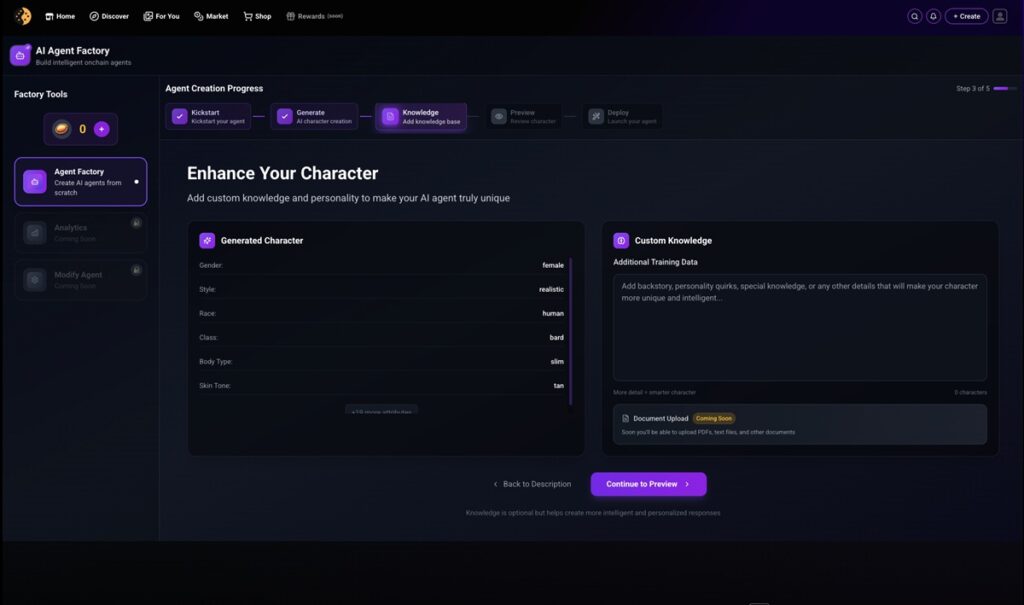
“The first thing that you will see is the creator portion of the platform that will always be there, so anybody can go on there create their agents according to prompts,” Liao said. “The agent will then have a visual identity, so there will be a picture of the agents, and then you can start chatting with the agent. The agent can issue tokens if they want to, and they can also issue NFTs. They can issue non-token assets onchain. People can start interacting with those if they like, and you can continue to play with that agent across your social media channels.”
Then, soon after, a major mass market animated character will come onto the KEX platform.
An evolving role

Saga was founded in 2022. Early seed investors include Placeholder, Maven11, Longhash, Samsung, Com2uS, and Polygon. Originally built on Cosmos, Saga has furthered its presence by bringing typically disparate but the best ecosystems into its Saga Multiverse through ongoing strategic partnerships. The company started Saga Origins to publish edgy blockchain games.
Liao said Saga Origins has evolved. It started as a publishing house for Web3 titles, and now it has shifted to supporting more platforms like KEX, where there are specific use cases with great impact for game studios.
“For many of these game studios, the No. 1 thing that they have a problem with is user acquisition, the cost of user acquisition, the efficacy of existing tools. And when they saw the tool for the AI agents, they thought they were fun, first and foremost. But they immediately saw that this is a way in which they can really grow organic user acquisition,” Liao said. “That has become a big part of Saga Origins.”
One of the game companies will soon announce its own peer-to-peer marketplace, based on decentralized technology.
The crash of Web3 games
As for the rest of blockchain gaming, Liao said, “Blockchain gaming, crypto gaming, has, as a sector in blockchain, really gone down in flames. And it’s just pretty sad. We have seen many teams that we know and respect who are actually good game developers just get eaten alive by the dynamics of the crypto market.”
A game might get forced to launch because they have a token, and an investor agreement requires them to launch that token as fast as possible. And the token winds up losing most of its value after launch.
“It’s very, very difficult for web three games now,” Liao said. “I think that’s because the games that are coming live now with Web3 features were of the last cycle where they were funded, but they were not ready yet, and now they’re finally ready to be played, but the market is no longer there for them.”
At Saga, Liao saw this happen as a publisher.
“We saw it was not going to reach the scale that we had hoped for. And so we listened hard to what game studios were actually looking for, and they are looking for very specific things. So these studios have the ability to develop really compelling gameplay. They have the ability to develop really great art. They already have the AI tools to make game development easier if they want to use them.”
She added, “Now, in terms of the crypto piece of it, it just had to be a very crisp value proposition, and the token was no longer going to cut it,” Liao said. “So for us, it just became obvious that if you are looking to expand the use of your IP that you’ve already created, that people already love and want to improve your user acquisition, then AI agents can be your characters doing user acquisition on your behalf. That’s a very compelling use case. We have stuck with gaming, for sure, both gaming and entertainment, but we definitely don’t really consider ourselves a part of blockchain gaming, per se.”