
Virtuix, a developer of full-body virtual reality systems, today announced that it is going public in a “micro-cap” initial public offering (IPO).
The company’s Class A ordinary shares will start trading today on the Global Market tier of The Nasdaq Stock Market LLC under the ticker symbol “VTIX.” It will be a test of whether the stock market still believes in the dream of VR, particularly after Meta laid off 10% of the employees in its Reality Labs division recently and closed a few VR game studios.
In addition to the $11 million raised by shareholders selling shares to Chicago Venture Partners, Virtuix has access to $50 million in an equity line of credit. That investment comes in the form of a PIPE (Private Investment in Public Equity). It’s not a lot of money as far as IPOs go, and so it fits in a category of a micro-cap IPO. On top of that, there isn’t an allotment of shares that are being sold to the public at this time.
Asked what is enabling the company to get enough attention from investors to go public, the company’s founder said it’s the growth rate. [Update: Virtuix shares closed at $24.39 a share, up 21% today].
“We’re growing. We launched Omni One, which is our third-generation product, and we reported 138% year-over-year growth. We’re ready to scale, and going public gives us access to capital and the public markets to fund our growth and really take the company to the next level,” said Jan Goetgeluk, CEO of Virtuix, in an exclusive interview with GamesBeat.
For the six months ended September 30, 2025, the company reported net sales of $2 million, or 138% year-over-year growth, with a net loss of $4.1 million for the six months. For the six months a year earlier, the net loss was net loss was $10.1 million, so a 60% improvement in the bottom line. That $10.1 million did include a one-time non-cash expense of $4 million, so adjusted for that, net loss was approximately $6 million (or improving about 35% in the latest period). Revenue in fiscal year ended March 31, 2025, was $3.6 million.
Founded in 2013 and headquartered in Austin, Texas, Virtuix pioneers technology that enables physical movement in AI-generated environments, whether fictional game worlds or photorealistic replicas of the real world, created by AI-driven 3D reconstruction techniques like Gaussian splatting.
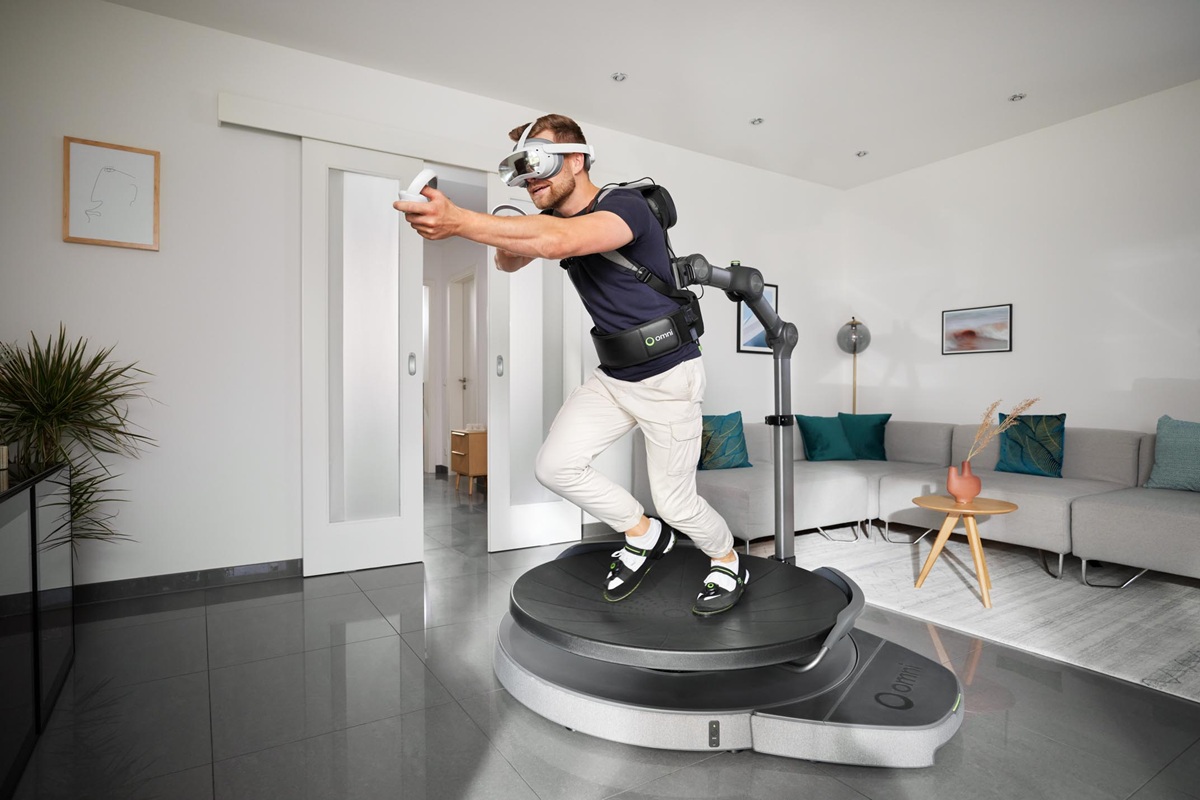
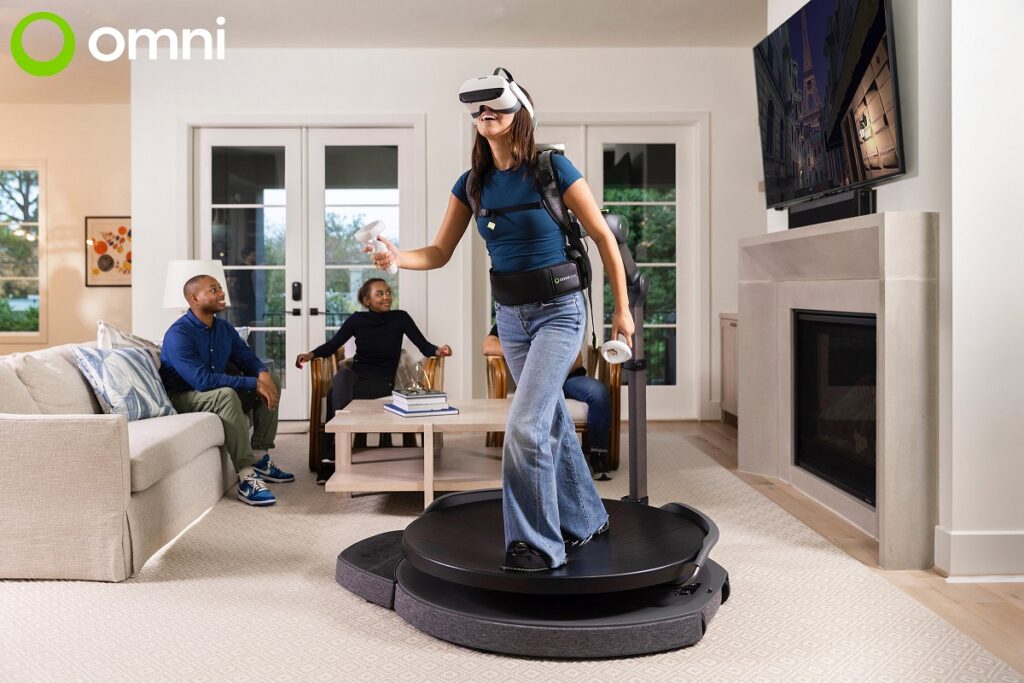
The company designs and manufactures “Omni,” the premier brand of omnidirectional treadmills that enable users to walk, run, crouch, and jump in 360 degrees inside virtual environments.
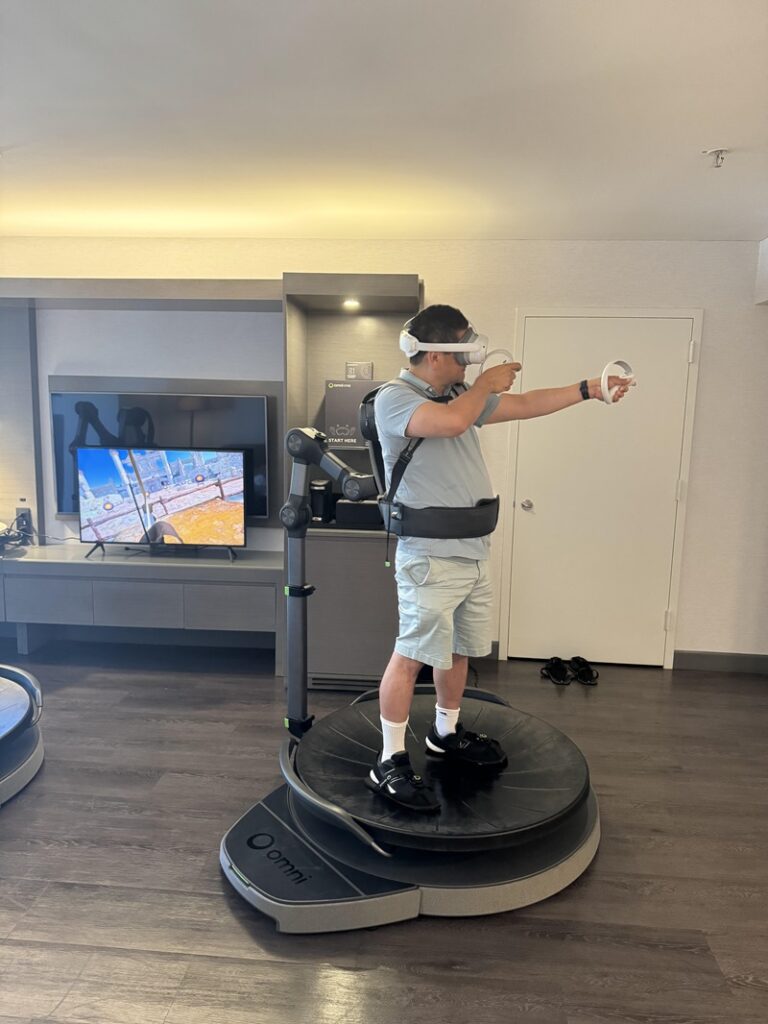
Virtuix founder and CEO Jan Goetgeluk began developing the original Omni treadmill in 2011, motivated by a desire to walk naturally in virtual worlds rather than pushing buttons on a controller. Goetgeluk said in our interview that he is encouraged by new developments like Gaussian splatting, which allows developers to take point clouds of a 3D space and use the data to quickly reproduce a 3D space in VR. The costs of Gaussian splatts could lower the cost of production for VR, he said.
Goetgeluk said the company is ready to scale sales and marketing.
On top of that, he said, “We’re developing a new product around the Gaussian splatting, which is kind of an AI-driven 3D reconstruction technique that allows us to very quickly turn 360 degree video footage into virtual environments. We can create these photorealistic virtual worlds very quickly from camera footage, and that’s a game changer. It used to take many months to make VR environments, especially high-fidelity, photorealistic ones. That’s very, very costly. So now, with these new 3D reconstruction techniques, like as in Gaussian splatting, it takes hours.”
Goetgeluk believes these techniques can drive the market for the VR tech forward in industrial training, defense, simulaiton and other applications. Accordingly, he noted he is not selling any of his own stock in the IPO.
In the VR is not dead category, Owlchemy announced this week that players for its Job Simulator and Dimensional Shift games have installed the games six million times, logged 2.5 million hours, played 6.1 million shifts, and completed 20 million+ tasks.
Origins
You could say that the VR market has always had its ups and downs ever since the big VR bubble kicked off around 2016. The troubles for VR today pale in comparison.
“There was some disappointing news recently from Meta,” Goetgeluk said. “They closed some studios and laid off 10% of the workforce there, but they still kept 90% of the workforce working on VR. So the industry, the VR industry, continues to get massive investments from Meta, Apple, Google, with Android XR and so on. The market has matured in the sense that the technology is now already in a good state, but the big players continue to invest and keep driving that market adoption.”
He noted that adoption of VR keeps steadily growing for the new medium, and it’s becoming a more mature part of the entertainment space, with growth also happening in enterprise applications. A decade ago, going public was probably unthinkable, but Goetgeluk has been patient as he started the company a dozen years ago.
Goetgeluk launched a Kickstarter for the product in June 2013 that raised over $1.1 million, making it one of the most successful campaigns of its time. Virtuix has since raised $50 million from high-profile investors, including Mark Cuban, venture funds including Maveron and Scout Ventures, and through equity crowdfunding.
With its diversified product portfolio spanning consumer, enterprise, and defense markets, Virtuix is positioned for rapid growth. The company recently launched Omni One, its next-generation gaming system for the home that enables players to burn calories while gaming.
Revenue for the six months ended September 30, 2025, grew 138% year-over-year. To date, Virtuix has brought three generations of products to market, generating over $20 million in sales. However, the company is not profitable, Goetgeluk said.
“We’re not profitable yet. We’re investing in our growth as well as in new markets and new products,” he said.
That net loss is one of the things, alongside the Meta layoffs, that could spook investors. But Goetgeluk said that he is encouraged that 55% of the company’s customers for the Omni One are new to VR.
“They probably never thought of buying a VR headset. This is their first VR purchase. So the majority of our customers are not your typical VR people who are VR enthusiasts. For a lot of people, VR with just a headset is not compelling enough, but our experience where you walk around, run around inside games, that’s what I want,” Goetgeluk said. “In a sense, we’re expanding the market for VR with our product. It’s gaming. At the same time, an appealing aspect of it is the ability to burn calories and be active while gaming. So a lot of our customers do buy our products for that purpose. They’re getting their steps in. One user lost 40 pounds in four months. And so it’s more than, it’s more than VR gaming.”
On top of that, his company is expanding beyond VR games into training as well. And he believes the unique selling point of Virtuix is that it enables people to get off the couch and walk or even run inside their VR games, thereby improving their health.
In conjunction with the Nasdaq listing, Virtuix secured an $11 million investment from Chicago Venture Partners and a $50 million equity line of credit, dependent on certain conditions. Use of proceeds will include scaling sales and marketing of Omni One, with production capacity already in place to produce 3,000 units per month, representing $100 million in annual revenue potential.
“We’re only getting started,” said Jan Goetgeluk, Virtuix’s founder and CEO. “In a world where AI-powered 3D reconstruction techniques can rapidly generate photorealistic virtual environments, the missing piece is the ability to move through those worlds naturally. We pioneered the technology to make that possible.”
He added, “Going public provides us with access to capital to fund our growth and develop new products like Virtual Terrain Walk, our training system for the defense sector. Looking ahead, we believe our ‘dual-use’ strategy of supplementing high-volume consumer sales with high-margin defense contracts positions us for achieving continued growth and creating long-term value for our shareholders,” Goetgeluk said.
Scout Ventures, an early-stage venture capital firm that invests in frontier technologies, invested in Virtuix’s first seed round and three additional rounds. Brad Harrison, Scout Ventures’ founder and managing partner, commented on the debut: “Virtuix’s technology offers a unique solution to enable physical movement within virtual worlds. It is a key piece of VR that has been missing. I am proud to be an early investor in Virtuix and congratulate the entire team on joining the Nasdaq.”
Virtuix has released a new video showcasing how Gaussian splatting rapidly turns 360-degree camera footage into photorealistic 3D digital environments, revolutionizing applications like virtual tourism, industrial training, and mission planning for defense and law enforcement. Watch the video here.

Maxim Group LLC acted as exclusive financial advisor to the company in connection with this direct listing. Winston & Strawn LLP acted as counsel to the company.
Virtuix has launched a dedicated Investor Relations section on its website at https://investors.virtuix.com, featuring SEC filings, governance information, investor presentations, and an IR calendar.
Virtuix is a leading manufacturer of full-body virtual reality systems for consumer, enterprise, and defense markets. The team has about 45 people in Austin, Texas.
The company’s premier portfolio of “Omni” omni-directional treadmills enables players to walk and run in 360 degrees inside video games and other virtual reality applications. With a commitment to innovation, Virtuix continues to push the boundaries of XR and AI, delivering immersive experiences to users worldwide.
I have watched Virtuix from the beginning and it was a pleasure to use it again at CES 2026 a couple of weeks ago. There, the company showed off its Omni One in partnership with VR headset maker Pimax.
“It’s an exciting time,” Goetgeluk said. “Blood, sweat and tears. But we’re only getting started. We’re only getting started.”