
Tripo AI, a global artificial intelligence company building AI 3D foundation models and world models, today announced the completion of its Series A+ and Series A++ financing rounds, raising nearly $200 million in total.
The aim is to lower the barrier to entry for artists in creative work, not replacement, the company’s chief scientist, Yanpei Cao, said in an interview with GamesBeat. At GDC, CEO Simon Song showed the company’s 3D generation models and vibe coding tools, with results showing in seconds.
The new capital will be used to expand Tripo AI’s AI 3D and world model research teams, accelerate core algorithm development, strengthen data and infrastructure systems, and broaden the company’s global product and ecosystem presence.
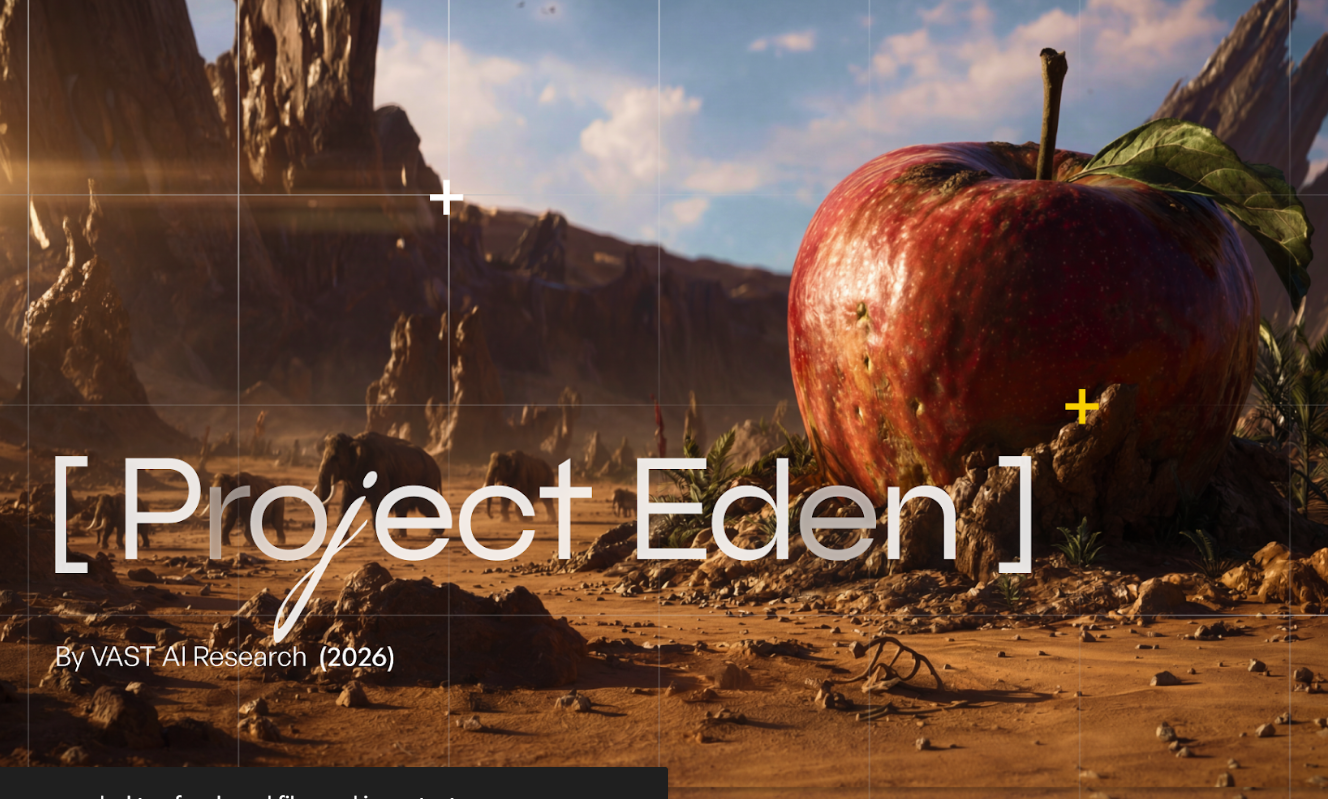
Alongside the financing, Tripo AI introduced Project Eden, a world model research initiative designed to support persistent, reusable, and multiplayer interactive environments. Project Eden represents Tripo AI’s next step toward enabling creators, developers, and researchers to create, modify, and enter interactive worlds that can persist over time.
Project Eden: From Generating Views to Maintaining Worlds

Cao said in an interview that the company’s AI tools are meant to augment game creators and artists, not replace them.
“We give them the tools to do what they do best,” he said in an interview with GamesBeat.
He said there is a misconception in the industry now where companies show off video generation models and call them world models. They’re not, he said, as they rely on pixel context to remember them. The models hallucinate from the ground up to keep the video going. Project Eden comes from the game engine approach, rendering a 3D state, and it knows the state of a game world and then a generative model renders them based on it. So it solves critical bottlenecks in world models today like environment persistence, he said.
It’s not AI slop in that respect, and it relies on a deterministic view. If you throw a brick at a window in a model, it would shatter the window, based on the laws of physics. After further development, Project Eden could be used for physical simulation and game development.
Large language models predict the next word. Video models render the next frame. A world model must go further: it must maintain and update the state of an environment as it changes in response to user actions, agent behavior, and time.
Project Eden is Tripo AI’s research initiative for building persistent world models through a decoupled architecture that separates world state from visual rendering.
The first layer is the Structured State Layer, which maintains the underlying 3D world state, including scene geometry, object identity, attributes, and event logic. This layer allows the world to exist independently of any single camera view.
The second layer is the State-to-Observation Interface, which converts the underlying world state into semantic and geometric conditions for rendering from different viewpoints. Because each view is derived from the same underlying state, the system is designed to support consistency across perspectives.
The third layer is the Generative Rendering Layer, which uses the state-derived conditions to produce detailed visual output in real time, supporting immersive and interactive user experiences.
By decoupling state transition from visual rendering, Project Eden is designed to unlock three core capabilities:
1. Long-horizon environmental persistence
Worlds can maintain consistent state across viewpoint changes, user exits, and extended exploration.
2. Reusable and editable worlds
Users and agents can modify the underlying world state, allowing changes to persist and be observed by others who enter the same environment later.
3. Concurrent multiplayer interaction
A shared world state can support multiple human users and AI agents interacting at the same time, with each participant receiving a separate rendered view while contributing to the same evolving environment.
Project Eden is positioned as a foundational engine for next-generation interactive content creation and as a simulation base for embodied AI research, multi-agent evaluation, and interactive world generation.
Tripo AI’s research on world models remains ongoing. The company is continuing to advance complex scene simulation, physical dynamics, free-viewpoint exploration, object-level interaction, real-time rendering performance, and state transition models that allow worlds to update in response to user and agent actions.
Advancing AI 3D Foundation Models
The company started in 2023, and it began work on Project Eden in late 2025, Cao said.
Over the past three years, Tripo AI has developed a series of 3D generation models designed to make high-quality spatial content faster and more accessible. Its latest model releases, Tripo H3.1 and Tripo P1.0, launched in March 2026, continued that trajectory.
Tripo H3.1 is designed to generate detailed geometry with high structural precision. Tripo P1.0 is designed to produce production-ready meshes within seconds.
These advances provide a technical foundation for moving 3D assets beyond being merely viewable. Tripo AI’s goal is to make generated 3D content usable, editable, interactive, and ultimately evolvable inside persistent worlds.
Tripo AI has also introduced new capabilities in Tripo Studio to support professional 3D workflows.
Native 8K AI Textures
Tripo AI’s 8K texture capability is designed to help generated 3D assets remain visually sharp under close inspection and across viewing distances.
High-resolution textures have traditionally required specialized production workflows. Tripo AI is working to make high-quality texture generation more accessible to individual creators, small studios, and professional teams building assets for pipelines including Unreal Engine, Unity, and Blender.
Intelligent Part Segmentation V2
In May 2025, Tripo AI introduced intelligent part segmentation in Tripo Studio Beta, enabling AI-generated 3D assets to be automatically separated into components for downstream workflows.
Tripo AI is now introducing Intelligent Part Segmentation V2, powered by an upgraded multimodal 3D structural understanding model.
The new version adds a 2D pre-segmentation preview before 3D segmentation, allowing users to inspect the expected result before committing. It also supports three levels of granularity:
• Low, 3 to 6 parts: for 3D printing, concept presentation, and workflows focused on main structure.
• Medium, 6 to 15 parts: for common assembly needs in game development and film production.
• High, 15+ parts: for detailed modules, mechanical structures, and highly segmented assets.
For 3D printing workflows, the feature can be combined with Tripo AI’s Quick Cap capability to support a workflow from generation to segmentation, capping, and printing.
Building an Open-Source AI 3D Ecosystem
Tripo AI views open source as a key part of building shared spatial infrastructure for creators, researchers, and developers.
In March 2024, Tripo AI and Stability AI jointly open-sourced TripoSR, a single-image 3D generation model.
In March 2025, Tripo AI launched the second season of its open-source initiative, releasing eight projects including TripoSG, TripoSF, UniRig, and HoloPart. These projects covered multiple parts of the AI 3D technical stack, from foundation models to functional components.
Tripo AI has now completed the third season of its open-source initiative, focused on dynamic interactive content, new representation methods, and real-world applications.
• TripoSplat, open-sourced by Tsinghua University, introduces a density control method for 3D Gaussian representation. Its learnable probabilistic sampling mechanism allows models to allocate compute resources dynamically across devices and application scenarios.
• AniGen, open-sourced with the University of Hong Kong, enables generation of animatable 3D assets from a single image. Within a unified model, it generates geometry, texture, skeleton, and skinning.
• SkinTokens, open-sourced with Tsinghua University, converts skinning weights into token form, enabling skeleton and skinning generation within the same autoregressive framework.
• LegoACE supports text and image inputs and autoregressively generates physically buildable LEGO models block by block.
Across its open-source initiatives, Tripo AI has released projects covering multiple areas of the AI 3D technical stack. By continuing to open core technologies to researchers and developers, Tripo AI aims to make advanced 3D creation tools accessible to a broader community.
The company has more than 100 people across China. Project Eden is in an early stage but it will be useful for developers perhaps next year.