
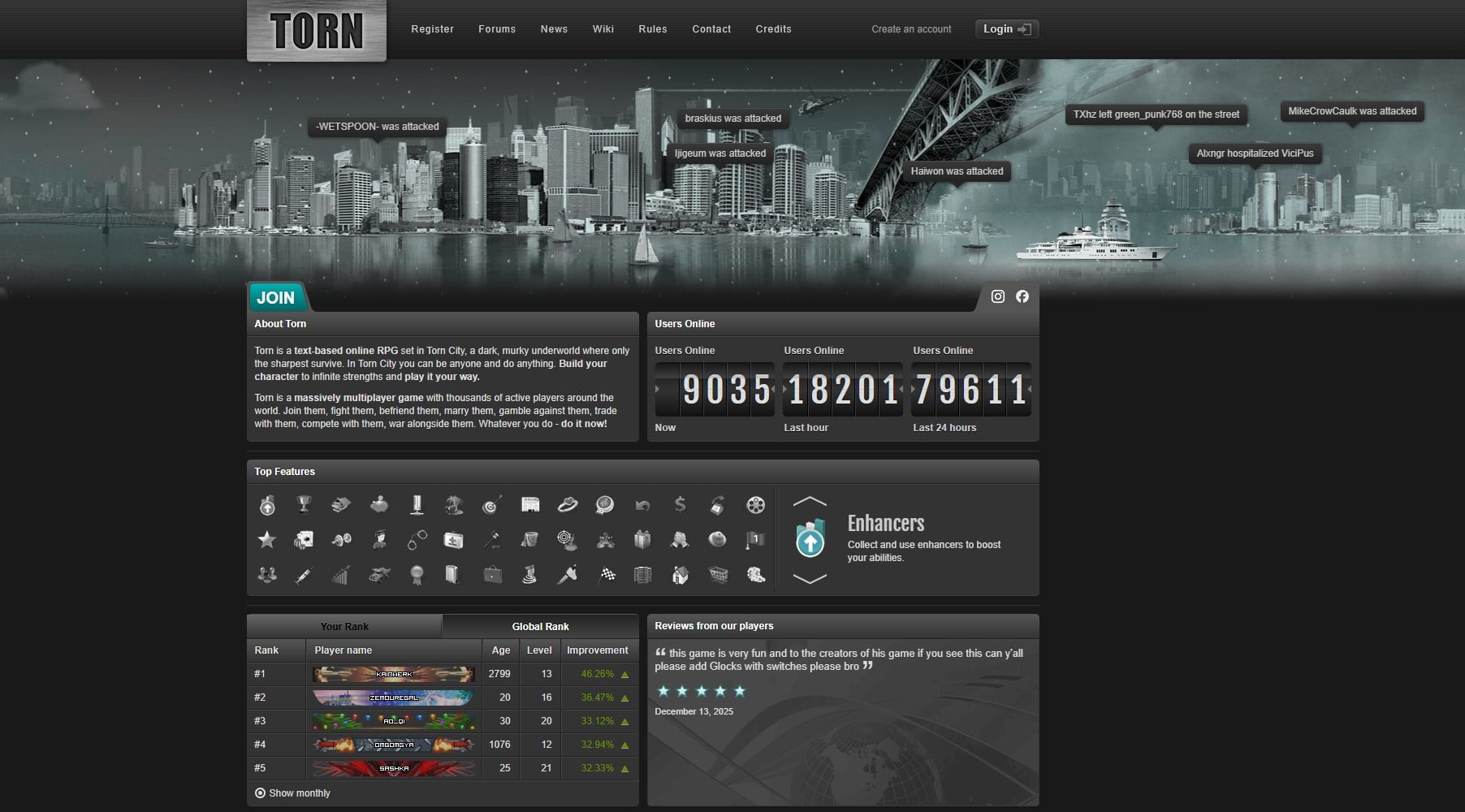
For more than two decades, Torn has quietly existed outside most modern gaming conversations, even as it has built one of the most persistent and player-driven virtual worlds still running today.
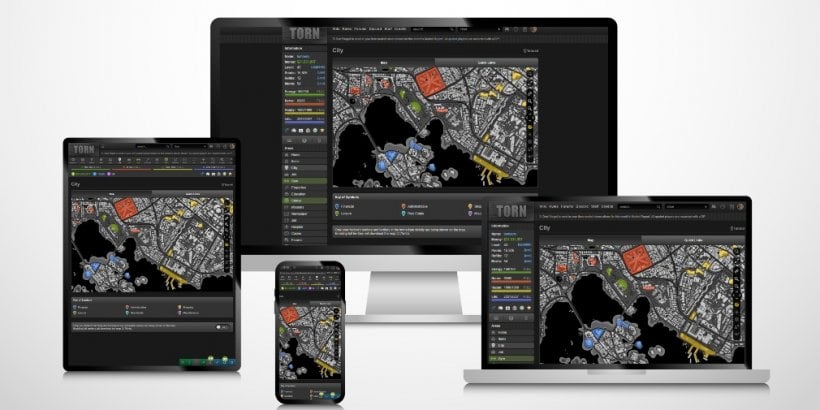
Launched over 20 years ago and playable entirely through a web browser or mobile app, Torn has grown into a living virtual crime MMO roleplay simulator with tens of thousands of daily active players, a fully player-controlled economy, and a history that never resets.
In an industry dominated by seasonal wipes, live service churn, and graphical arms races, Torn’s endurance feels almost anachronistic, and is increasingly rare. Having a massive wiki certainly helps for a game like this, as well.
At a glance, Torn’s low-fi presentation can make it easy to overlook, but its design philosophy is anything but simple. The game drops players into a ruthless city where nearly every system, be it money, items, power, or even influence, is shaped by human decisions rather than scripted outcomes.
Wars between factions can last weeks, financial empires rise and collapse through player speculation, and reputations forged years ago still matter today. There are no shortcuts to success, no pay-to-win escapes, and no safety nets once a mistake ripples through the community.
What makes Torn especially notable is how it has achieved this longevity without traditional growth tactics. The game has never relied on major marketing pushes, influencer campaigns, or aggressive monetization. Instead, it has expanded deliberately, supported by a globally distributed team of roughly 40 developers and managers who have operated fully remote since the project’s inception.
That slow, controlled growth has allowed Torn’s community culture, which is equal parts cooperation, rivalry, and social drama, to mature without being diluted.
After surpassing its 21st anniversary, Torn’s creators are still focused less on reinvention and more on preservation: maintaining economic stability, nurturing community trust, and ensuring that every new feature adds depth rather than noise.
In an era where most online games struggle to stay relevant for even five years, Torn offers a compelling counterexample as a reminder that persistence, restraint, and player agency can be just as powerful as spectacle.
To learn more about why Torn has sustained so much popularity over multiple decades, GamesBeat conducted an exclusive email interview with Joe Chedburn, founder and managing director at Torn LTD. We’ve included a lightly edited version of the Q&A below.
GamesBeat: How many people are working on Torn full-time and where is the studio based?
Joe Chedburn: There are currently around 40 people working full-time on Torn, spread all around the world. Most are front-end and back-end developers, alongside engineers, writers, UX designers, graphic artists, and managers. We have teams based in the UK, US, Ukraine, and Thailand, as well as individuals scattered across Europe. In 21 years, we’ve never had a physical office—and we’ve never felt the need for one.
GamesBeat: Can you just start by giving me the elevator pitch on the game in a way that a modern gamer will understand? What is it and how does it work?
Chedburn: Torn is a massively multiplayer online crime game you can play through any browser or our free mobile app, where you build power and wealth inside a living city of over 100,000 monthly players. You can commit illegal activities like arson, scams, and corpse disposal, build your character into a Rambo-style war machine, or focus on business and investment if you want to go legit. Every dollar in Torn moves through a player-driven economy where markets rise and fall based on what people actually buy, sell, and steal. And all this happens against a backdrop of constant gang warfare, with thousands of factions competing for control in wars that often drag in the entire city.
The best thing about our world is it never resets, so every victory, loss, and humiliation becomes part of Torn City’s decades-long lore. If you’re expecting a button-mashing experience and a quick dopamine fix, this ain’t it. You can still play casually, dipping in when it suits you, or you can treat Torn like a career and claw your way to the top. Either way, you can’t buy success here, with every player limited by their replenishable resource bars and their ability to cooperate with strangers and weirdos from all over the world.
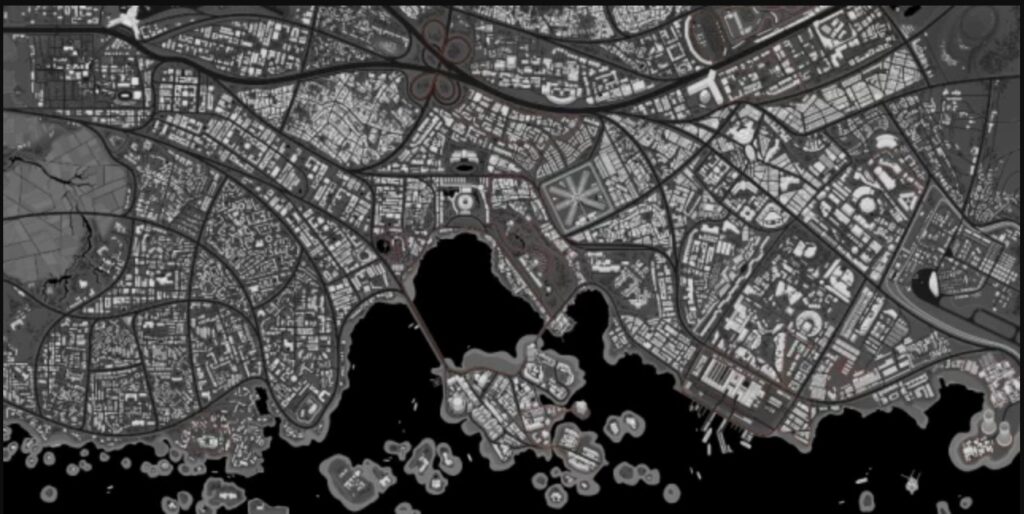
Torn is basically a low-fi, old-school crime simulator with a social media platform stitched to its back. Every decision has real human consequences you’ll have to navigate to survive. There’s no hand-holding and no 155GB updates to download, since we’re text-based and our graphics are minimalist. Just a living, breathing world of crime and consequences. So if you can’t be arsed waiting for GTA to be released, come take a look at its nasty cousin.
GamesBeat: Torn has achieved remarkable success without major marketing campaigns or major external support. What do you attribute this to, and how have you managed to sustain player interest over two decades?
Chedburn: Torn has seen consistent and methodical growth thanks to its staying power. Once a player begins exploring the considerable depth of the game we’ve constructed over the last two decades, and starts engaging with the rest of the community within it, it’s more than likely they’ll stick around for good. Our retention figures are genuinely quite incredible for a free-to-play game.
In the past, I’ve consciously held back on advertising. I’ve been comfortable with its steady rate of growth that’s prevented our servers from becoming too overwhelmed, our loyal and vibrant community from becoming diluted, and our team from expanding faster than we could sustainably manage. In hindsight, I think this controlled expansion has greatly benefitted us as Torn has matured.
It’s only since the start of last year that we’ve really begun actively investing in rapidly optimizing our infrastructure and expanding our playerbase through advertising. It just feels like now is the time for us to safely attempt this, but we’ll still be keeping the rate controlled.
GamesBeat: Torn is known for its complex player-driven economy and high degree of player freedom. Can you discuss the design decisions behind these features and how they contribute to the game’s longevity?
Chedburn: It might sound a little corny, but I’ve always said, “We give the players the tools to build their own game.” It’s a philosophy that still guides the game’s direction today. The core of Torn’s gameplay has always revolved around its community—the drama and the situations they create, both individually and together. Torn’s success depends on the thousands of diverse, fascinating characters who inhabit it, shaping an experience that’s not just entertaining, but also deeply meaningful for everyone involved.
It’s not the addictive or satisfying gameplay that I’m most proud of, it’s all of the fascinating ways in which players interact with each other through Torn’s mechanics, meaningfully affecting others for better or worse, resulting in unique bonds or fierce rivalries. These are things you rarely see in other games, especially 3D worlds, where a player’s actions are limited depending on where they’re standing at that current moment.
GamesBeat: With around 80,000 active daily players, TORN has a fiercely loyal fanbase. What strategies have you employed to retain players and foster a sense of community within the game?
Chedburn: Player retention in Torn has always been rooted in the strength of its community. We’ve spent over two decades refining the processes used by a dedicated volunteer staff team, led by an experienced and passionate community manager, who work tirelessly to nurture a positive and engaging environment every single day.
We’re always present and approachable. Any player can reach out directly to management if they wish, and they’ll get a genuine response. That accessibility keeps us grounded alongside the community, and I wouldn’t ever want Torn to grow to a point where that no longer feels possible.
As developers, we take community feedback incredibly seriously. We’re quick to acknowledge and respond to even the smallest rumblings, and I’d like to think players understand the reasoning behind all of our decisions, even if they don’t always agree with them. That open, responsive relationship has kept Torn’s community loyal and invested after all these years. Players can sense our genuine passion and dedication, and I think that makes their connection to Torn all the more meaningful.
GamesBeat: Can you walk us through the process of updating and expanding the game world, and how you balance new content with existing player expectations?
Chedburn: Now that Torn has grown to a substantial size, every new addition, no matter how small, is carefully considered to ensure it adds genuine depth rather than just diluting the existing pool of content. Pushing out update after update is an easy way to make players happy in the short term, but with Torn, everything we do is built for the long term—with the goal of keeping every past addition relevant, so the game only ever improves over time.
So, while we aren’t releasing content as quickly as players might like, I hope they understand that this slower pace isn’t necessarily a bad thing. We’re making sure that whatever we add is a net positive for Torn as a whole, because for a game that already has twenty years of content behind it, it’s counterintuitive, but that outcome is actually quite difficult to guarantee.
GamesBeat: How do you design and manage the economic systems to ensure they remain engaging and challenging for players?
Chedburn: The economy is the beating heart of Torn, and it’s far more fragile than most realize. Game mechanics can literally create value out of thin air in an instant, and the rate of that creation, across all faucets, must be carefully monitored and controlled. I’m confident hyperinflation has been the single biggest killer of text-based games and persistent browser-based games (PBBGs) throughout their history.
We’re constantly working to balance player income sources against the threat of inflation. I know how important it is for players to be able to generate meaningful wealth within reasonable timeframes, and nobody must ever feel forced into pay-to-win.
We do this by harnessing terabytes of logs, we have achieved complete awareness of value flowing to and from every faucet and sink in Torn, and even between every individual player. We have total visibility at our fingertips going back over ten years now, we just need to make sure we’re looking in the right places. Governments could only dream of having this level of oversight in the real world.
GamesBeat: Running a game for 21 years comes with its share of challenges. What have been some of the most significant challenges you’ve faced, and what lessons have you learned along the way?
Chedburn: It’s a heavy burden, but after 21 years I’ve naturally adapted to the role’s demands. Every crisis has made me stronger and more capable. Over the last two decades, our team has also grown enormously in both size and experience, so whatever comes our way, I’m never facing it alone.
There’s nothing quite like the stress of being woken up in the middle of the night to resolve a crisis. That used to happen a lot back when Torn was being hammered by relentless DDoS attacks in 2017 and 2018. When you’re the one being held personally responsible for the outages, with thousands of people depending on you, the pressure can be immense. It reached a point where I developed an anxiety disorder that lasted for years.
Fortunately, things are very different these days. Our infrastructure is far more capable, and we have engineers covering every timezone, so it’s rare that I’m ever woken up. With the help of one of our players, that particular case even led to the attacker’s arrest, giving us some much-needed closure.
Finding solutions to complex problems that don’t have a perfect answer has been one of my biggest ongoing challenges. For example, we’ve spent years trying to balance legitimate script usage through our public API against the threat of illegal scraping directly from Torn. API scripting keeps everyone on a fair and transparent playing field, while scraping—often impossible to detect—can create unfair advantages for those willing to break the rules. Some players would like us to reduce the API’s capabilities. and I completely understand why, but doing so would only encourage more of the hidden, exploitative behavior we’re trying to prevent.
Another long-running challenge has been discouraging tedious, unfun forms of min-maxing that some players feel forced into to stay competitive at the top level. Some of these problems are so complex, with so many nuances, that they’ve taken us years to solve, involving endless discussions and countless iterations of attempted fixes.
Torn’s my baby! I care deeply about it, and the incredible community that’s grown around it. I’ve poured my heart and soul into the game, which I feel is the very least I can do, given how much time and passion so many players have invested, and how important it is to them.
GamesBeat: How important is player feedback in shaping the direction of TORN, and can you give us some examples of how player suggestions have influenced game development?
Chedburn: While players definitely shape Torn’s direction indirectly, we can rarely rely on them to tell us specifically what to do. There are simply too many differing opinions, knee-jerk reactions, and suggestions that are either short-sighted or self-serving. In a game like Torn, many players naturally advocate for changes that benefit themselves or their bank balance, rather than changes that truly improve the game’s longevity, or things that create genuine fun, unique interaction, and long-term engagement.
This realization led to the creation of The Committee, which is a group of carefully selected players with varying levels of experience and different playstyles. These individuals are often trusted with insider information and tasked with making unbiased decisions on behalf of the wider player base. Within our private forum, we discuss ongoing issues, player concerns, and upcoming features that need feedback before release.
The Committee has proved invaluable over the years. It’s far easier to discuss complex topics behind closed doors with a tight-knit group of smart, passionate, and experienced players from all corners of Torn—people who genuinely want the best for the game, can keep emotion out of it, and, most importantly, can stay on topic!
GamesBeat: Now that the 21st anniversary has passed, what plans do you have for the game’s future?
Chedburn: We’ll keep doing what we’re doing! Improving and expanding Torn’s gameplay in a sustainable way that results in greater meaningfulness and depth. As our player base continues to grow, our team will continue to grow with them, and Torn will only ever continue to improve over time, year after year.
As with every year, we celebrate Torn’s anniversary by looking back on iconic members of the community throughout our history, those who have helped to meaningfully shape Torn in one way or another, by launching special collectible keepsakes. Each keepsake released every year, honours one player across six categories: Altruists, Reprobates, Legends, Pioneers, Architects and Elders.
It reminds everyone, including myself and the team, that Torn is all about the community—it’s the people that make the game what it is.