
The New Guys, a new audience-risk and narrative-reception consultancy for the video game industry recently launched with aim of helping game makers recognize risks and avoid making audiences mad.
Founded by Matt Braynard and Joey Snyder-Kloos, The New Guys helps publishers, studios, and investors identify avoidable creative and commercial risks before games are revealed, marketed, or released. It’s a small team without lots of game making experience, but when we talked, we had an interesting conversation that revealed the delicate balance that game publishers and developers have to walk when weighing the risks of offending audiences.
The firm focuses on how players, influencers, creators, reviewers, and online communities are likely to respond to a game’s narrative, characters, dialogue, visual presentation, marketing copy, and broader audience positioning.
“Game companies already spend heavily on QA, localization, user research, and marketing,” said Braynard. “But too many projects still reach the public with obvious audience-reception problems that could have been identified earlier. Our job is to help publishers spot those issues before they become controversies, bad word-of-mouth, or commercial drag.”
The New Guys offers confidential services, including:
● Rapid Audience-Risk Screens for trailers, store pages, scripts, characters, quests, and
reveal materials.
● Narrative & Market-Fit Audits for games in development.
● Executive Outside-Voice Briefings to help publishers and studios resolve sensitive
creative concerns.
● Launch War Room Monitoring for reveals, betas, demos, and release windows.
● Greenlight & Transaction Risk Memos for publishers or investors evaluating whether
to sign, fund, acquire, or continue supporting a title.
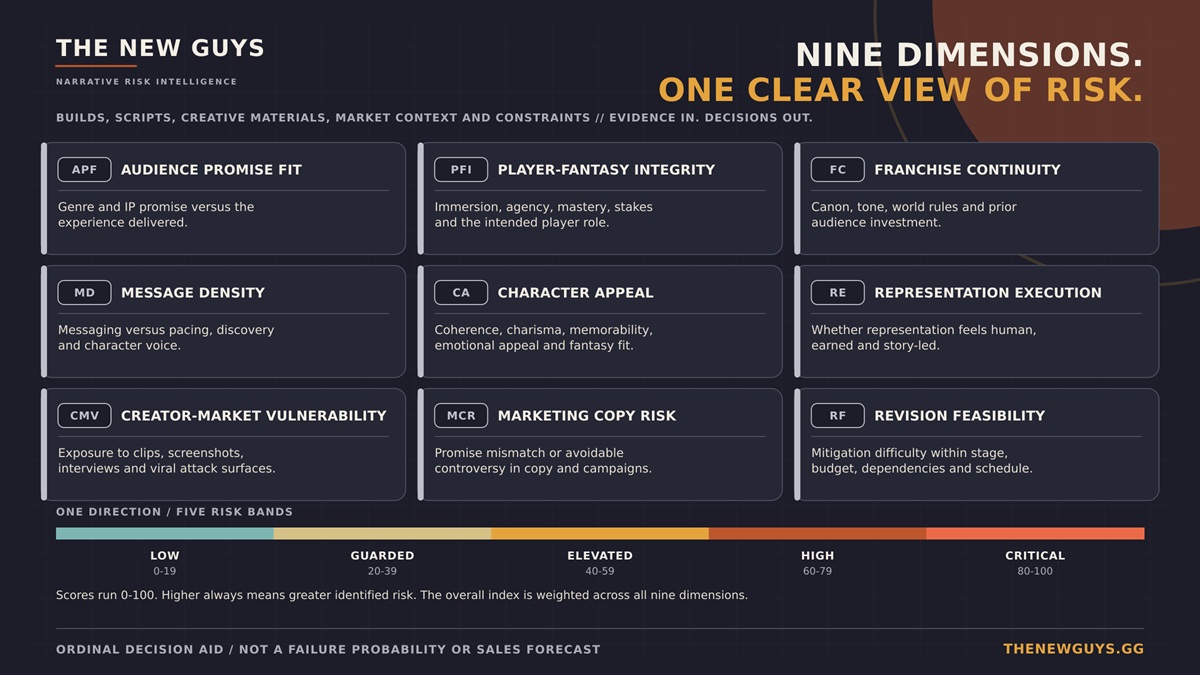
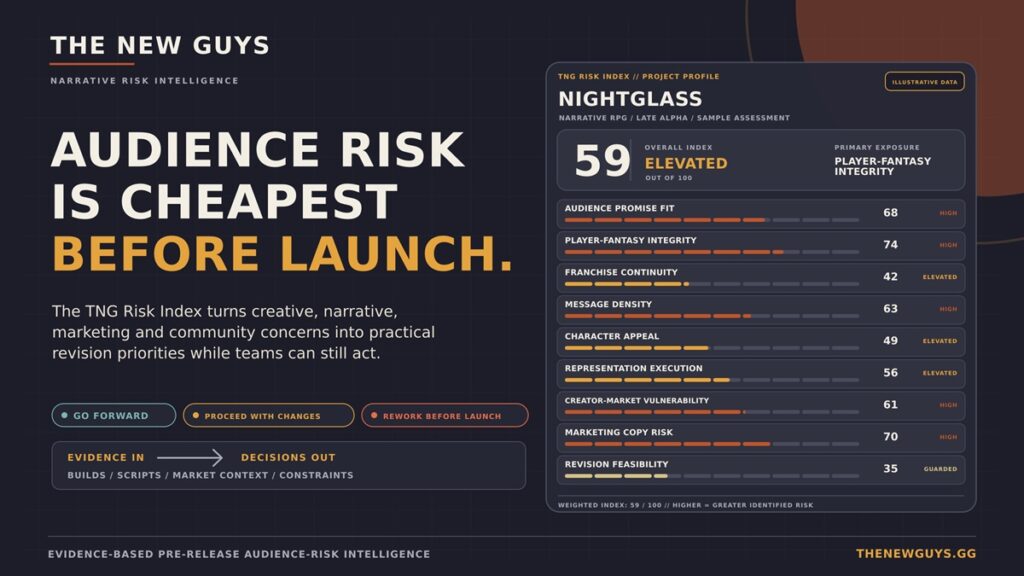
The company’s methodology, the TNG Audience Risk Index, evaluates games across factors such as player-fantasy integrity, franchise expectation fit, message density, character appeal, representation execution, creator-market vulnerability, community expectation mismatch, regional market fit, and revision feasibility.
“The goal is not to flatten creativity or tell studios what they are allowed to make,” said Snyder-Kloos. “The goal is to help teams understand how their actual audience may interpret creative choices. Sometimes the problem is writing. Sometimes it is marketing. Sometimes it is a character, a trailer, a line of dialogue, or an interview that gives players the wrong signal. We help identify those issues early and offer practical alternatives.”
The New Guys is especially focused on two areas of the market: Western publishers managing studio relationships and global developers, particularly Asian publishers and studios seeking stronger alignment with North American and European player expectations.
The firm’s work is confidential, commercially focused, and designed for decision-makers
responsible for publishing strategy, portfolio risk, external development, franchise management, marketing, community, and greenlight decisions.
The New Guys is now accepting private briefings with publishers, studios, investors, and
industry partners.
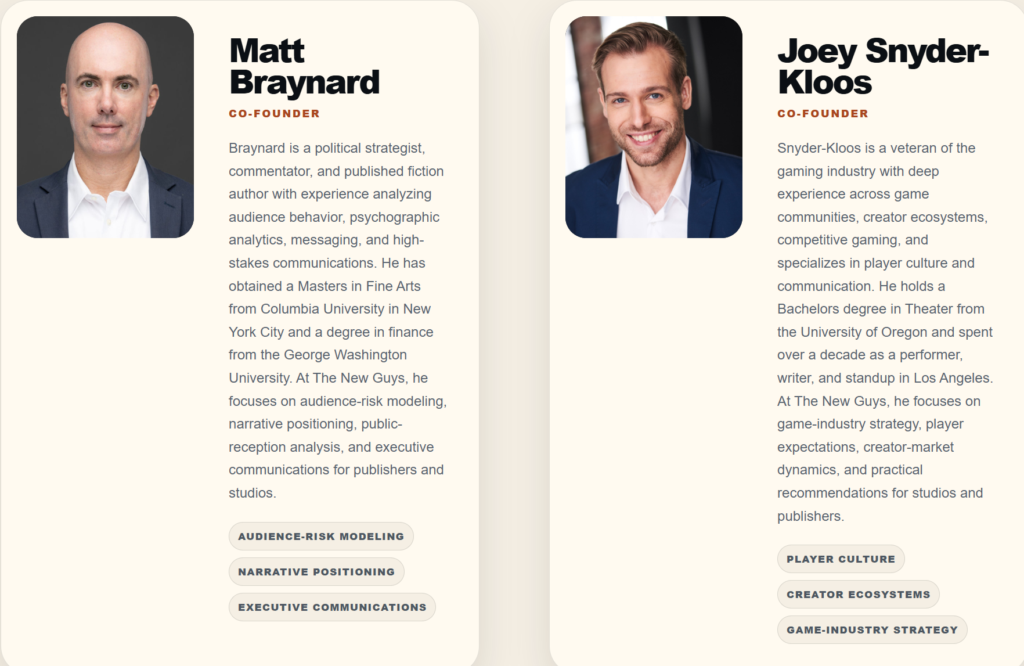
Braynard is a political strategist, commentator, and published fiction author with experience analyzing audience behavior, psychographic analytics, messaging, and high-stakes communications. He has obtained a Masters in Fine Arts from Columbia University in New York City and a degree in finance from the George Washington University. At The New Guys, he focuses on audience-risk modeling, narrative positioning, public-reception analysis, and executive communications for publishers and studios.
Snyder-Kloos is a veteran of the gaming industry with deep experience across game
communities, creator ecosystems, competitive gaming, and specializes in player culture and communication. He worked as a community engagement manager on a variety of games. At The New Guys, he focuses on game-industry strategy, player expectations, creator-market dynamics, and practical recommendations for studios and publishers. His job is to keep a pulse on the gaming community and gaming culture.
The Highguard example
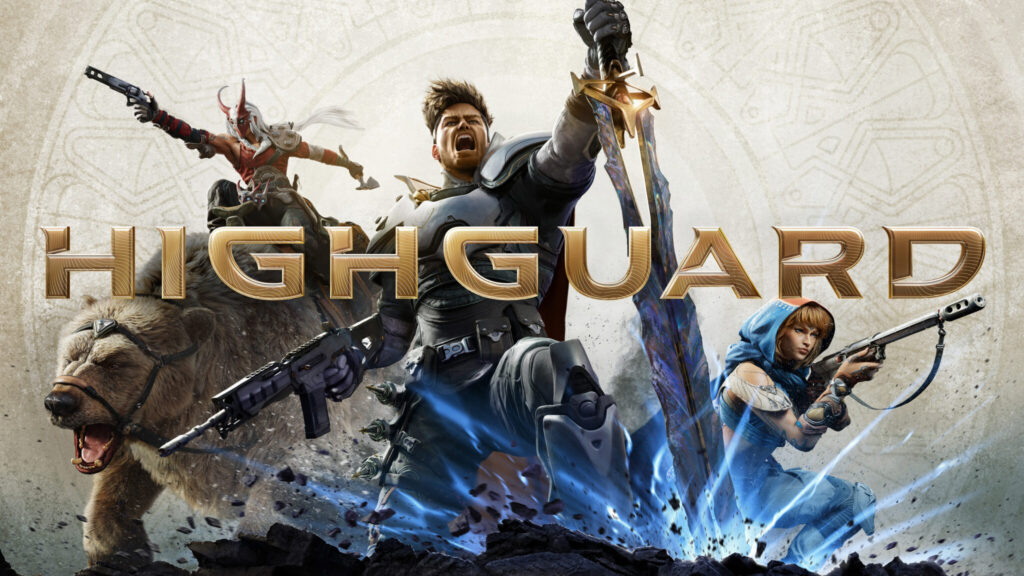
One of the most recent failures to read the audience came with the launch of Highguard, the fantasy multiplayer game made by part of a team that built Respawn Entertainment’s Apex Legends.
Wildlight’s Highguard had a surprise reveal at The Game Awards 2026 event, where it was the “one more thing” that closed the show. The devs announced they would launch the game a month later, even though no one had heard of it and the company didn’t do a large beta test.
Apex Legends did the same thing at reached 50 million players within its first 30 days, making it one of the fast-growing free-to-play games ever.
Highguard got severe backlash, as fans were upset that it was considered so important that it was the finale of The Game Awards show. More than two million players tried it out, but it only reached a peak on launch day of 97,249 players. Player counts crashed, but the developers didn’t help by saying that players were not giving the game a chance, as they played for a few minutes and didn’t even get through the game’s 10-minute opening cut scene. With even greater criticism following the launch, the game shut down its servers on March 12.
“Our involvement or engagement with a publisher would probably have come a few steps before that phase because when you’ve got folks beta testing stuff, it is going to [leak] out, right?” said Braynard. “The question is, do you have a health meter? Is the level too hard or is it slowed down at certain places? Those are real gameplay questions, and that’s the right environment” to address problems — before players see them.
Braynard added, “We’re here to help avoid problems, and we work with them before the betas, before content locks, and we have a a very precise index risk assessment where we look across nine different things that aren’t necessarily directly related to specifics of gameplay but avoiding the kinds of problems that some games have had.”
The consultants ask if the game is meeting audience expectations for what they can get elsewhere in this genre of game? If it’s attached to a franchise, is it working within the established canon and the legendary characters? Is it breaking some rules that would make the audience upset? Are the characters appealing? Is the message density too much so that it’s getting in the way of gameplay? Is representation in the game legitimate? Does it feel real and natural, or is it tokenized?
“All of those kinds of things are what we’re evaluating, and we’re giving a really clear, concise method of determining where the potential risk is,” said Braynard. “Our job is not to come and tell you, ‘Hey, don’t do this. Don’t have this type of person, but we’re going to make sure that our client has their eyes wide open about what kind of risk they’re undertaking, unless they can make a revision. We’re also advising them on revisions, and how reasonable is it for them to be able to make the revisions to avoid these problems.”
The problems aren’t isolated to games like Highguard. There have been quite a few other titles that have suffered badly because of problems that The New Guys believe could have been avoided.
Snyder-Kloos, “It’s not just Highguard. Highguard was particularly notorious because one of the lead devs came out and basically penned an open letter to the community. If I could have given them advice, it would have been, ‘I appreciate your honesty, but what you’re showing here is you are showing your hand in a way that is going to make them resent you.”
The shock for the dev was like coming out of a cave and realizing they were not in touch with the audience.
Other examples and interpretations of risks
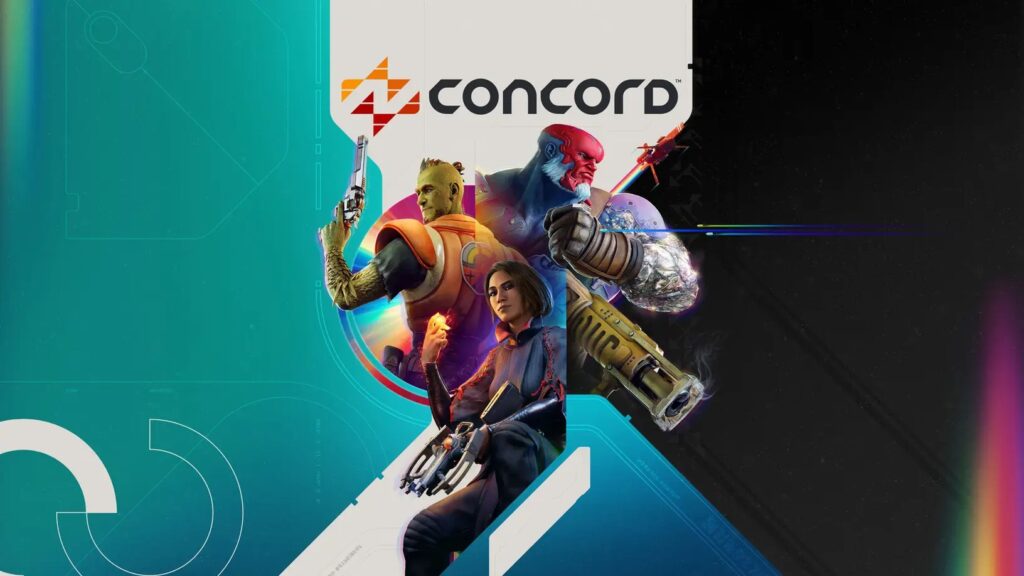
Other examples include Sony’s Concord, Ubisoft’s Skull & Bones, and Red Thread Games’ Dustborn.
It’s not just a politically charged point of view that The New Guys has to warn game devs about.
“Regardless of where you fall along the cultural spectrum, everybody wants their game to do well, and everybody wants their audience to like their game. I can’t imagine a game company that says, ‘No, the goal here is to make everybody angry,'” said Snyder-Kloos.
The New Guys sat down and figured out how a game company could assemble a marketing package that winds up upsetting players.
“We thought, don’t they have folks to come in and say, ‘Now hold on a second, we know what you’re doing. We just want you to be aware of the risks. If you take this risk, it’s not a surprise because that fellow from Highguard, he seemed genuinely shocked, you know, and that’s why I said I didn’t doubt his sincerity,'” said Snyder-Kloos.
Developers may move so fast that no one ever stops the train and asks whether they’re running big risks of getting pilloried by the very people who are the target customers, Braynard said. Braynard said his approach is to screen content quickly or do an in-depth audit.
As a third party, The New Guys can come in without risk and call a spade a spade. Others inside a company might find they can’t make a political argument or objection to politics in a game without risking their own careers. So people inside companies tend to stay silent.
“We’re The New Guys, and what we’re doing is being that third party that can come in and speak to the studio that might be going off track in a way that could be financially devastating,” Braynard said. “We’re a consultant. We can we walk in the door, speak a truth, we can walk out, we’re gone.”
While this might be a publisher’s duty for a developer, the publisher might not want to anger the developer, as it could lose an important partner. If The New Guys does its job, then it could perhaps head off a social media meme problem that destroys a franchise, Braynard said.
A long background for risk-analysis consulting
N’Gai Croal, a former Newsweek game and entertainment journalist, created a company called Hit Detection in 2009 to do something similar. He hired former game journalists and analysts to do mock reviews and make publishers and developers aware of problems before any reveals. But Hit Detection’s main role was assessing whether games were good or not. Kate Edwards, CEO of Geogrify, is also a consultant who looks at cultural insensitivities or geopolitics that developers might not be familiar with. The New Guys’ intention is to help make a financial case for either going forward or changing a game, based on the perceived risks.
“Our intention mainly is to provide that early warning system before too much time and capital is invested and before it’s too late to make a real change,” Snyder-Kloos said.
The New Guys believe the problems get worse when you cross borders while making games. Asian game companies have long eyed the West (a big economic trend in gaming), but they’re often unaware of all the cultural sensitivities involved in understanding the market. (Anyone remember “All your base are belong to us.”).
“We’re expecting to be at Gamescom. There’s some Korean developers we’re interested in talking to that they have some interesting titles coming up that could potentially benefit potentially benefit from our help. So those are sort of the two markets that we’re looking for,” he said.
“We help publishers spot the moment where players might feel lectured or baited or disrespected, and try to give them practical ways to fix those problems before launch,” Braynard said. “We want to be the folks that a develop a publisher calls before a game becomes a discourse disaster.”
While The New Guys tries to be neutral, it has to anticipate how gamers on the left or right side of a political spectrum might react. But they do believe that games should focus on fun, rather than an agenda or messaging that cold get in the way of that fun. They noted the controversy around Sweet Baby, a consulting firm that enabled diversity perspectives in games. It was criticized for bringing a “woke agenda” into games and was attacked by the likes of Elon Musk.
The New Guys recognizes some players might like that and others might not, but players who focus on gameplay could be angered by “signaling” and prefer apolitical approaches instead, Snyder-Kloos said. Whatever the politics of a game, overt or not, the goal is not to be surprised by reactions from gamers.
“Our goal is to provide a clear apolitical assessment of listen. Here are the risk factors associated with this. It is up to you, of course. At the end, what risks you’re willing to tolerate?” Snyder-Kloos said. “We’re not going to say there is something wrong with your idealogy. We’re going to say, based on our projections, the risk index here means you could take a $100 million title and crater it into a $20 million title that could result in the studio getting completely shut down.”
Rather, the ultimate metric ought to be fun, which can be a very subjective thing.
Braynard said, “Someone once said books and bullets have a destiny of their own. And once you’ve released a game, you can no longer shepherd people’s interpretations. They draw their own interpretations of it. It’s out of your control for them to conclude what you were trying to do, what the meaning is. That’s what makes our business unique.”
Political risks?
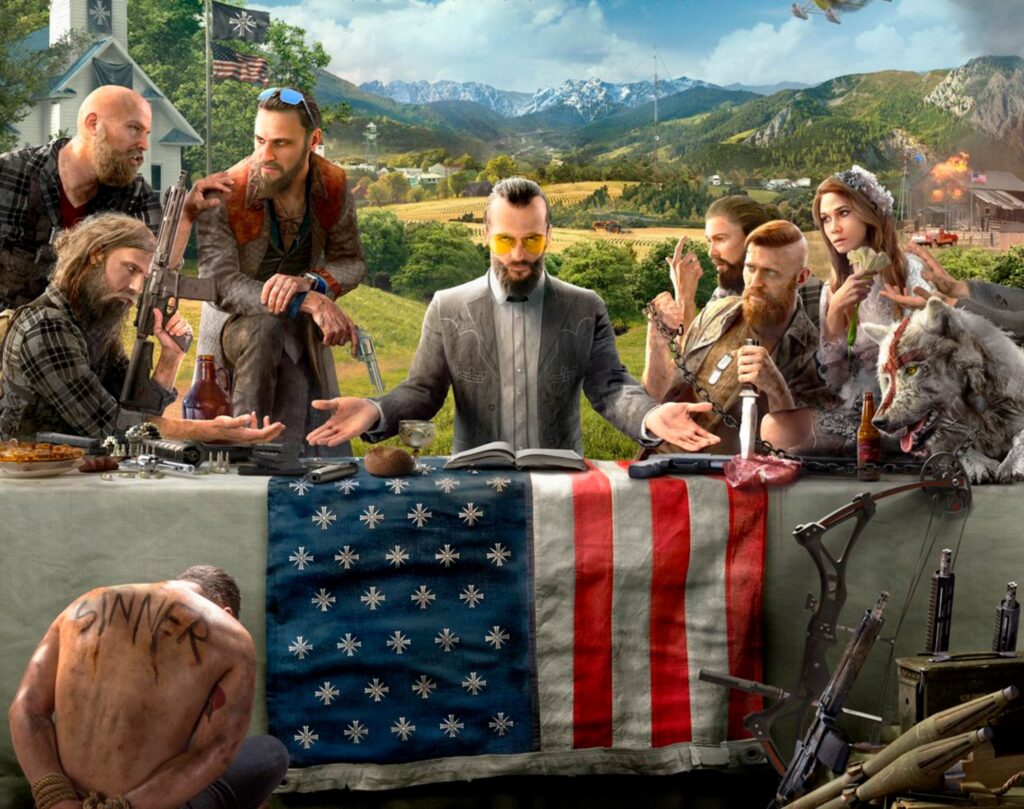
There are games where developers said the games were not political. But they touched on themes and realities that seem ripped from political headlines. Those kinds of games include Far Cry 5 (with white supremacist militias in Idaho), Wolfenstein (with references to the rise of the KKK in the United States) and more. In these cases, some gamers were offended that the game developers ultimately said the games were not political, when they seemed obviously so. Game companies didn’t want to admit the games had a political slant, since they would lose the audiences that felt like their political side was unfairly depicted.
“It’s funny that you mention that because you’re describing what I think used to happen. I think it was common sense for video game companies to take that approach, which was even if you are making something that may be political, you’re careful to present it not overtly” in a biased way, Snyder-Kloos said.
Some companies push for the controversy as they see the message as inseparable from the fun. Other companies tend to stay away from politics because they want to focus on the fun.
Braynard said that some players might be pro diversity, but they might react poorly to bad examples of “representation execution,” or tokenizing. Game developers might think they’re doing good by including diverse characters, but if those characters are stereotypical or one dimensional, then they can risk offending gamers who are sensitive to representation execution and the result could be harm to the bottom line.
He pointed to the use of diverse characters in House of The Dragon, where there’s a reason behind the diversity for House Targaryen’s characters, as they are tend to share common traits like silver hair. By contrast, fans took exception to the presence of diverse characters in Rings of Power, the Amazon show based on J.R.R. Tolkien’s works, where no explanation was given for the diversity of characters. Audiences tend to react poorly when they’re being fed things that are “good for the audience,” rather than something that is authentic to the lore of the game, Snyder-Kloos said.
In all of this kind of cultural or political debate, Braynard said, “We’re not telling anybody what to do. The keyword is risk. We’re just saying what the risks are and that you are aware of it.”
And with games, regardless of your ideology or background, you can enjoy them, he said.
Examples of the feedback that The New Guys give
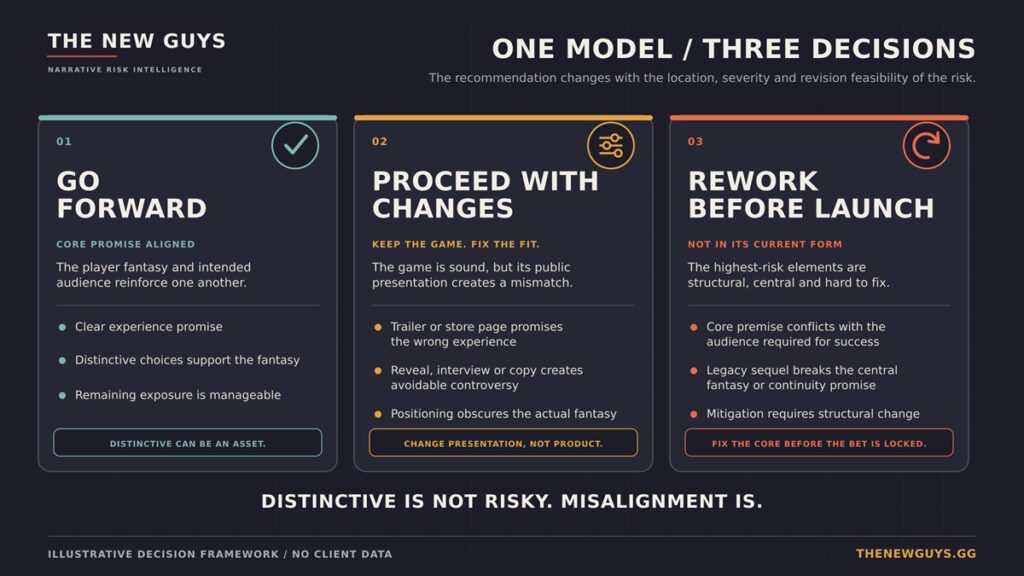
In follow up, The New Guys provided more details on their approach.
We wouldn’t ask whether a game is unusual or too quirky. We’d ask whether it delivers the fantasy it’s promising to its intended audience, where any reception risk is concentrated, how likely that risk is to affect creators, communities, and sales, and whether it can be corrected without compromising the game.
Clair Obscur is a good example of a game we’d recommend moving forward with. Its unusual setting isn’t a liability because the visual identity, characters, combat, and emotional tone all reinforce a coherent player promise. It’s distinctive, but it doesn’t appear confused about whom it’s for or what experience it’s offering.
The risks would increase if, for example, the publisher marketed it as a conventional mass-market action game. That would be positioning and expectation problems, not reasons to abandon the game itself.
Our recommendations generally fall into three categories:
1. Go forward. The core player fantasy and intended audience are aligned, and any remaining risks are limited, audience-specific, or readily manageable.
2. Go forward with changes. The game itself is sound, but a trailer, store page, character introduction, line of dialogue, interview, creator strategy, or marketing copy is creating an avoidable mismatch. In that case, we’d identify the specific issue and suggest changing the presentation before the public sees it.
3. Do not go forward in the current form. The highest-risk elements are central to the product, conflict with the expectations of the audience required for commercial success, and can’t be corrected without big changes.
An established-franchise sequel provides a useful example of the third category. A creative choice that might be perfectly viable in a new IP can become highly risky if it undermines the central fantasy or character expectations that brought the franchise’s audience to the table. If the problem is one trailer or a few lines of dialogue, that’s fixable. If the conflict is built into the protagonist, premise, and overall treatment of the legacy audience, we would advise a more serious rework.