
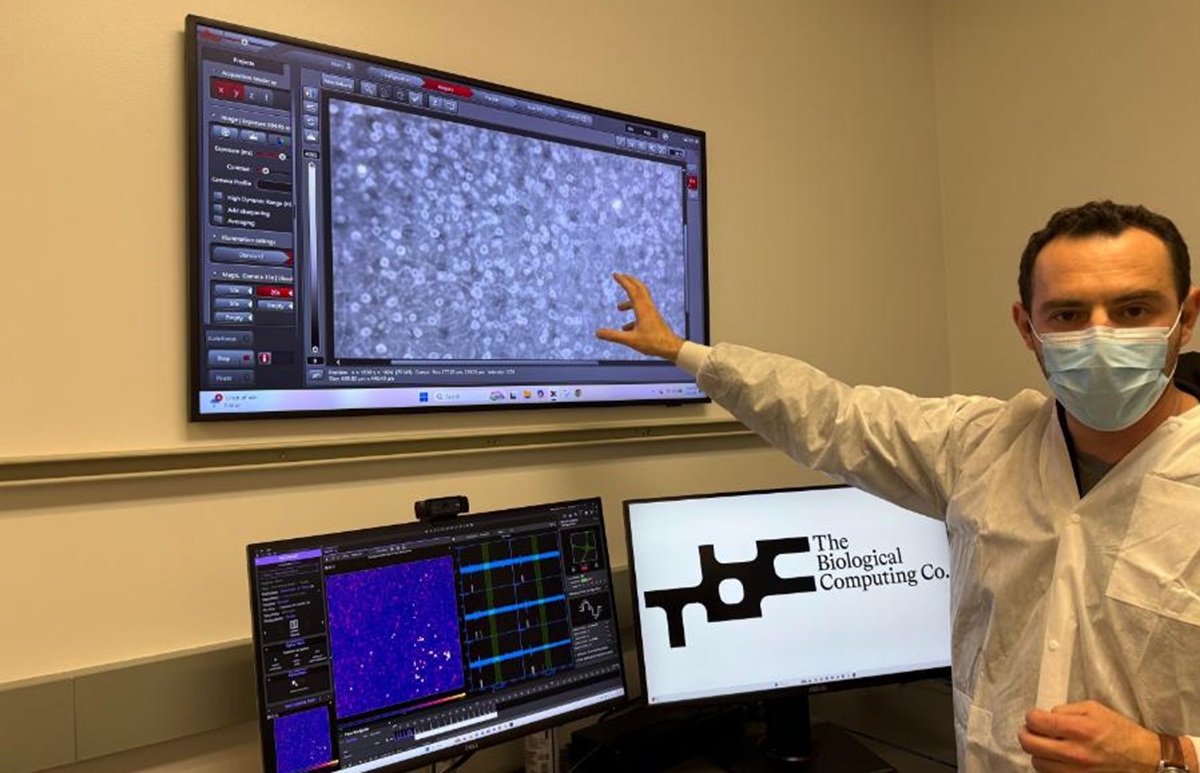
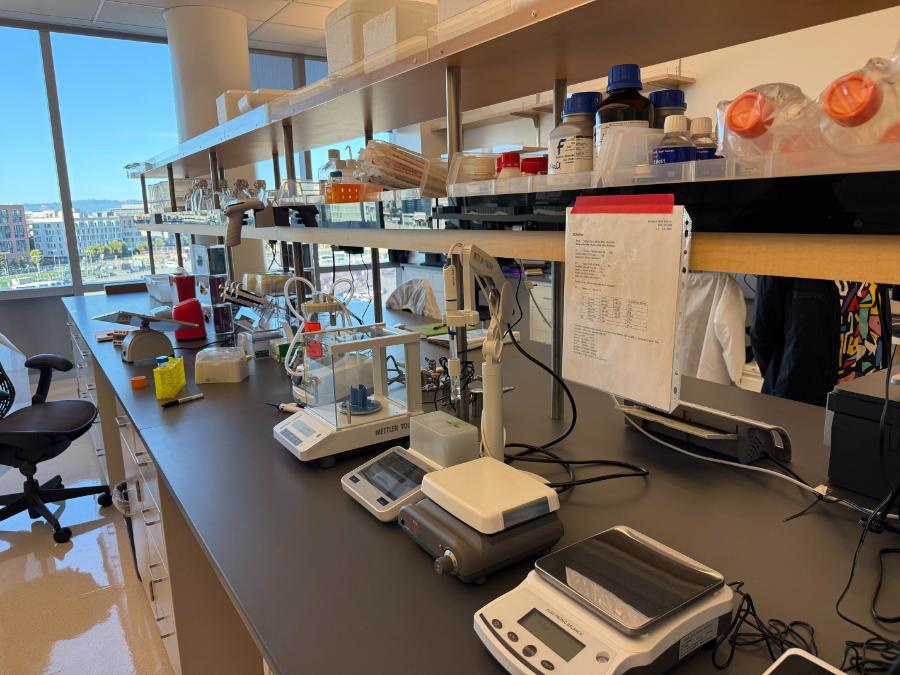
In a “wet lab” in San Francisco, The Biological Computing Co. is growing computers from brain cells.
It is creating a new class of compute that integrates living neurons with modern AI, becoming the first to deploy applied biological computing for computer vision, generative video, and AI infrastructure.
We’ll address whether the brain cells are living or not as well as the company’s views of the ethical way to do this. And we’ll delve into its aim of saving the planet from inefficient computing that could run us out of energy. It’s a long story, but I find it fascinating.
The company known as TBC recently came out of stealth in February after decades of gestation and announced a $25 million seed round led by Primary Ventures. We joined a small group of journalists who got a full briefing and toured the lab in San Francisco.
Formerly known as Biological Black Box (BBB), The Biological Computing Company connects living neurons with modern AI to make frontier models more stable, scalable, and efficient.
The plan in a nutshell
The company’s neural-based solution integrates directly with foundation models to improve performance while reducing compute cost, reflecting a belief that the future of high-performance computing will increasingly incorporate real biology. It comes from the natural advantage that living neurons have in creating “algorithms” with their natural functions of connecting and networking and learning.
“The takeaway is that this is happening now. This is not a science project. Biological computing is here,” said Jon Pomeraniec, cofounder of TBC, in an interview with GamesBeat. “We are the only people in the world to commercialize it in a very meaningful way. I think that’s the big picture. We are taking real neurons, which you’ll see from start to finish. We use real neurons as products to make models better, faster and cheaper. That’s that’s the big picture.”
The perfect storm driving low-power biocomputing
TBC was founded at the intersection of three global forces: breakthroughs in neuroscience, growing constraints of today’s AI systems, and an accelerating climate and energy crisis.
Today’s dominant architectures rely heavily on brute-force scaling and repeated optimization cycles. I’ll call this “dry” computing, because it’s based on silicon-based chips and electronic hardware. These approaches — embodied in the graphics processing units (GPUs) that are responsible for Nvidia’s $4.92 trillion valuation — have become increasingly expensive and difficult to sustain as systems move beyond static training, exposing the need for new computing paradigms that prioritize efficiency, stability, and reliability.
“The pinnacle of performant compute will closely resemble the brain in more ways than we can imagine,” said Scott Belsky, partner at A24 and previous chief of strategy at Adobe, in a statement. “TBC is pursuing a north star that I believe is the most promising direction to explore the future of computing.”
Naveen Rao, managing editor at Neurotech Futures, was on the lab tour with me. He’s a Forbes contributor and market analyst operating a global neurotech business ecosystem after spending two decades across digital health, federal policy, and patient advocacy. I asked him what promise he sees in TBC.
“It represents an important direction of applied research methods in neuroscience, wherein labiratory methods are focusing on driving real world business value rather than academic value vis a vis publishing papers or unlocking grants,” Rao said.
From living neurons to deployable AI
TBC’s neuroscience and engineering team encodes real-world data (e.g., images, video) into living neurons, then decodes neural activity into richer representations mapped onto state-of-the-art AI models through modular adapters.
In parallel, TBC’s Algorithm Discovery platform applies biologically derived principles to inform new AI system design beyond transformers, creating a compute layer that strengthens existing architectures rather than replacing them.
“Having worked at the intersection of neuroscience and AI, what excites me about TBC is that they’re not just borrowing metaphors – they’re using living neuronal cultures to discover learning rules for the next generation of AI,” noted Tim Gardner, cofounder of Neuralink, in a statement.
Origins
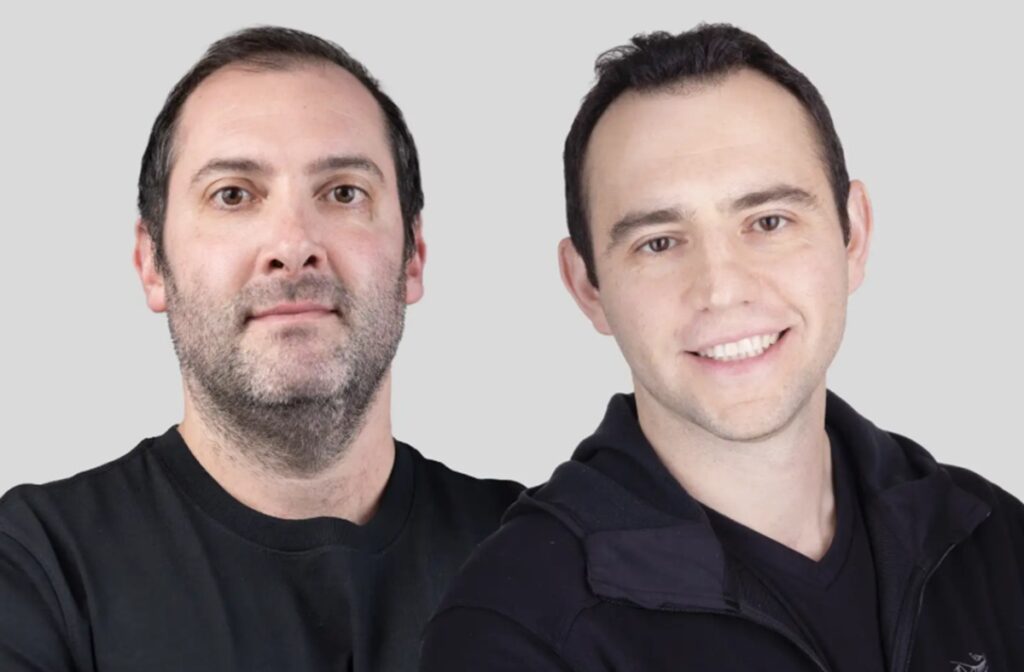
KsendzovskyBelieving that better computers require a revolution in computing itself, TBC cofounders Alex Ksendzovsky and Pomeraniec were both established neurosurgeons and neuroscientists.
They believed they could establish a new computing category where biological networks complement silicon to unlock new performance and efficiency capabilities across modern AI systems – demonstrating scalable quality gains that are critical for real-world products operating under tight energy constraints.
“I’ve been growing neurons on electrodes for about 20 years, since about 2005 and that’s that’s really when this concept, at least in my mind, came around,” said Ksendzovsky in an interview with GamesBeat.
I met him and Pomeraniec again at the company’s headquarters. Asked why they didn’t keep doing surgery on brain patients, Ksendovsky said that during a professional career as a brain surgeon, they might be able to do 3,500 surgeries related to things like treating Parkinson’s disease or epilepsy.
But if they succeed with biological computing, Ksendovsky believes they could help far more people — and perhaps keep the world’s data centers from consuming too much energy to the point of endangering the planet.
The founders assembled a team of 23 neurosurgeon-scientists, biologists, and engineers with expertise in neuroscience, machine learning, computer vision, and AI. Their job at TBC is to engineer the future of biocompute, and they’ve raised more than $25 million to pull this off. (They plan to raise more).
“Using the real brain for computing is paradoxically the most elusive yet the most obvious idea in the field of computer science,” said Ksendzovsky.
“We’re at the ground level of paradigm shift, of what comes next, after language, after silicon,” Pomeraniec added. “We’re building infrastructure to understand and interact with the world in a fundamentally new way.”
At the time Ksendzovsky was in college, working in a lab at Georgia Tech, he was one of the first people to grow neurons on electrodes to study learning and memory, or the underlying mechanisms of the brain.
He went to his adviser with questions. About this time, he could keep a neuron alive for a day, and he could connect maybe 420 neurons at a time.
“Why don’t we use this clump of cells in a dish to understand and predict the stock market so we can all be rich? That was in 2005 and [the adviser] didn’t like the idea. He thought that it wasn’t possible at the time, and he sent me on to do something else,” Ksendzovsky said.
He added, “I wasn’t happy with him. Now, looking back, I think he was 100% correct because at the time, we did not have the technology to do what I was hoping to do, or more broadly, to use these brain cells for computational purposes.”
But the idea never left Ksendzovsky’s brain. He got a doctorate in neurophysiology and ended up becoming a neurosurgeon. He did post-doctorate research where he would implant electrodes in patient brains and record the data from that.
“And ultimately, I had the realization in 2022 that this idea that we had 20 years ago is now possible. This is the convergence of three independent fields, but it’s also very clear we need more efficient compute,” Ksendzovsky said.
How it works
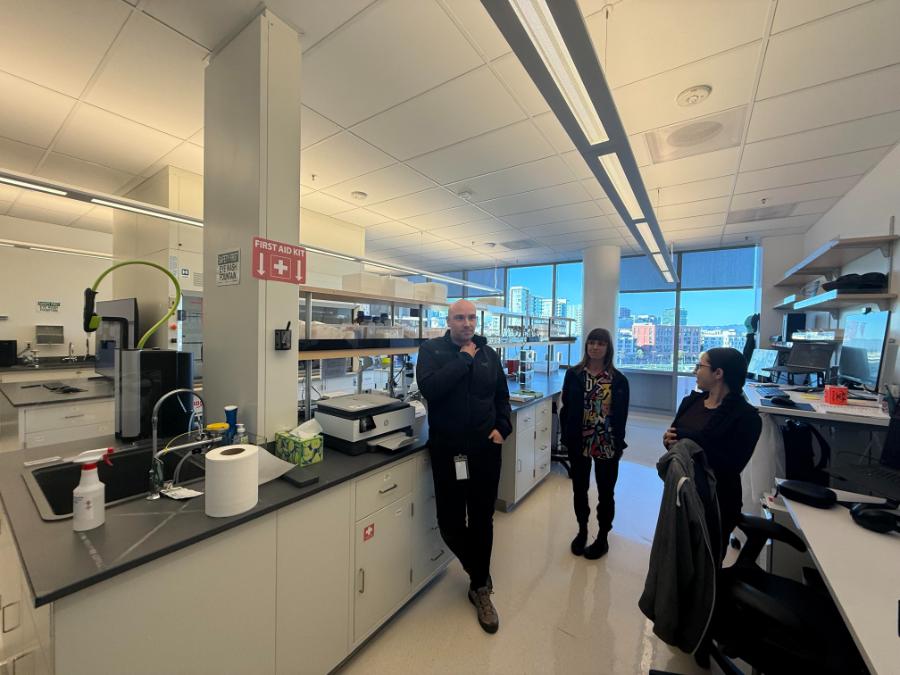
TBC is harnessing evolutionary intelligence to redefine computing at its wet lab. The platform integrates living neurons with advanced AI, creating frontier models that are more stable, scalable, and dramatically more efficient for applications including AI processing and real-time adaptive learning.
As for keeping the brain cells alive, Ksendzovsky said the cells live in a media that provides sugar, proteins and other nutrients necessary for them to stay alive. They create waste, like all cells do, and TBC changes the solution every few days. The company has a lot of rat brain cells in the lab dishes, but there are also human cells as well. While the cells are alive, they are not living beings, Ksendovsky said.
These lab protocols have been around for many years. The team can keep them alive for six months to a year plus, at this point, very easily. They stay alive. They also live in an incubator that maintains the perfect temperature and the right carbon dioxide mixture.
When you look at the computer displays in the laboratory, you can see a kind of heat map that shows the spikes in activities in the brain cells. Those are the electrical signals firing through the neurons in the dish. The researchers interface with them through electrodes, where something that looks like a chip interfaces with a wet petri dish.
“We are the ones that are creating the language to encode information. We are the ones that are saying, a picture of my face, a video, for example, is represented to the neurons in a certain way, the electrical currents. That’s why we need the electrodes,” Ksendzovsky said. “The electrodes are also essential because they let us interface directly with the neurons. When we present an input, like an image of a face, the neurons generate measurable responses. We can then capture those signals, model them mathematically, and use that to develop new algorithms or enhance existing ones.”
He said that what he observed in the last 20 years was that biology, and the ability to keep brain cells alive for a long time, has advanced. The team has has extended lifespan of cells in a dish to more than a year, in some cases.
Now the team can keep 4,096 electrodes into 100,000 brain cells, keeping them alive and connected to electrodes. With the electrodes, the team can monitor the activity — the brain waves, so to speak — and understand what the neurons are doing based on electrical activity. And the team can understand what the activity going on among the neurons in the dish means.
“Those tools weren’t really available 20 years ago, but now, through companies like Neuralink and brain computer interface literature, we can now do that,” Ksendzovsky said. “That was the genesis of TBC.”
Visiting the wet lab in San Francisco
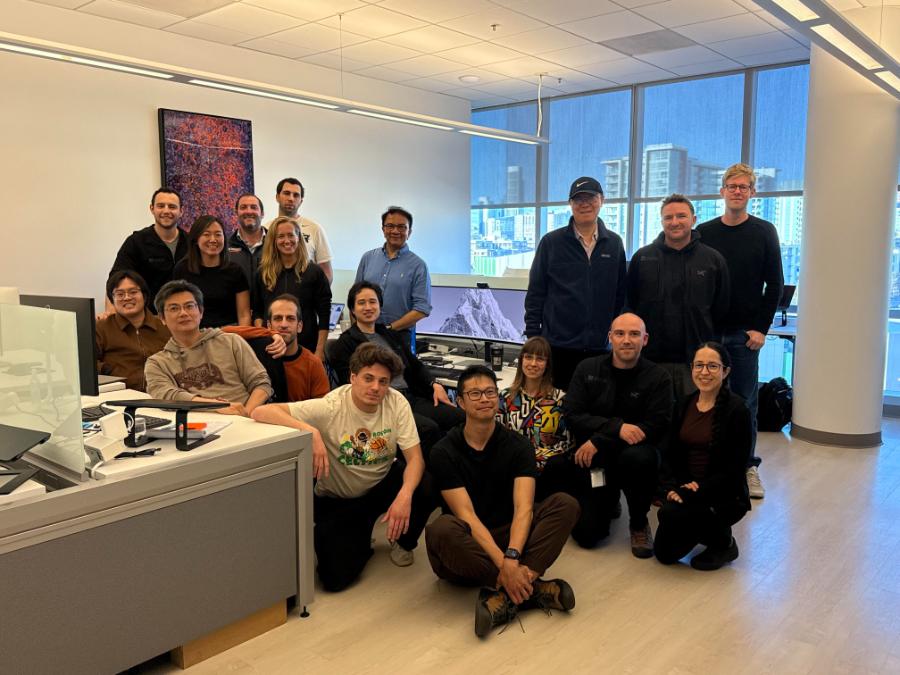
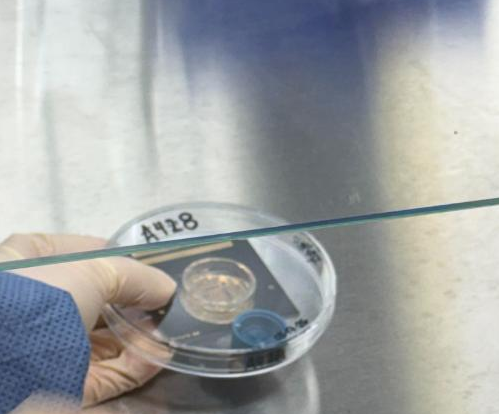
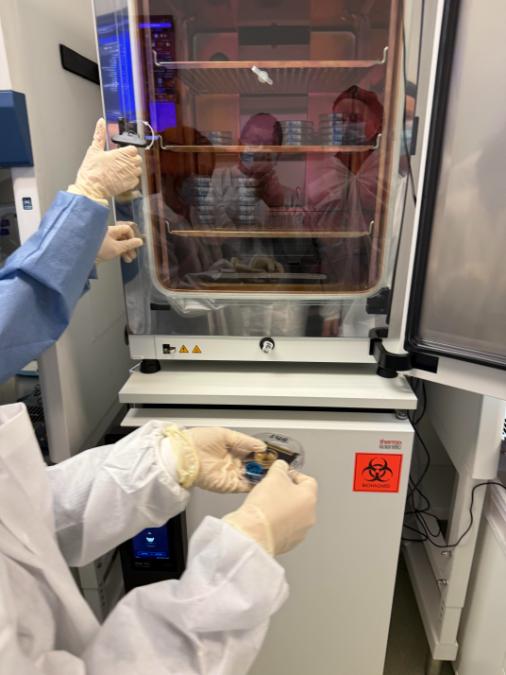
Like I said, we visited the lab. Pomeraniec and Ksendzovsky gave out electronic chips with dishes attached to them that could make systems that connect the brain cells or rat cells with chips.
The main product is called the multi electrode array, and this is where the team grows and maintains brain cells. Pointing to a dish that was on a machine that could read the data coming from electrodes, Ksendzovsky said, “These brain cells are alive, and we’ll show you them, and they maintain and represent their information in a very complex and dynamic way. This is what we’ve been studying for a long time. And over the last 20 years, there’s been kind of this explosion of neuroscience, in terms of understanding what brain signals mean in terms of how many electrodes are on this, which is important to encode information and keeping these cells alive.”
He said, “The products that we’re creating is actually software. We are now performing what’s called real-time compute.”
He said that real-time compute is the next stage — five to 10 years from now, where we encode information, take the neural response and use that in inference for AI processing.
Ksendzovsky said, “What we are doing is we’re taking information, sending it to the distribution neurons. We’re able to take the way neurons represent that information, model it mathematically, and then build algorithms from that. So for all the products that we’re creating, this is what we call our algorithm discovery platform. All the products we’re creating are adapters, fine tuning methods, learning rules that plug into diffusion based transformers, for example, to improve benchmarks.”
If you don’t quite get it, Ksendzovsky encourages you to read the company’s blog posts because it is building these models in the open.
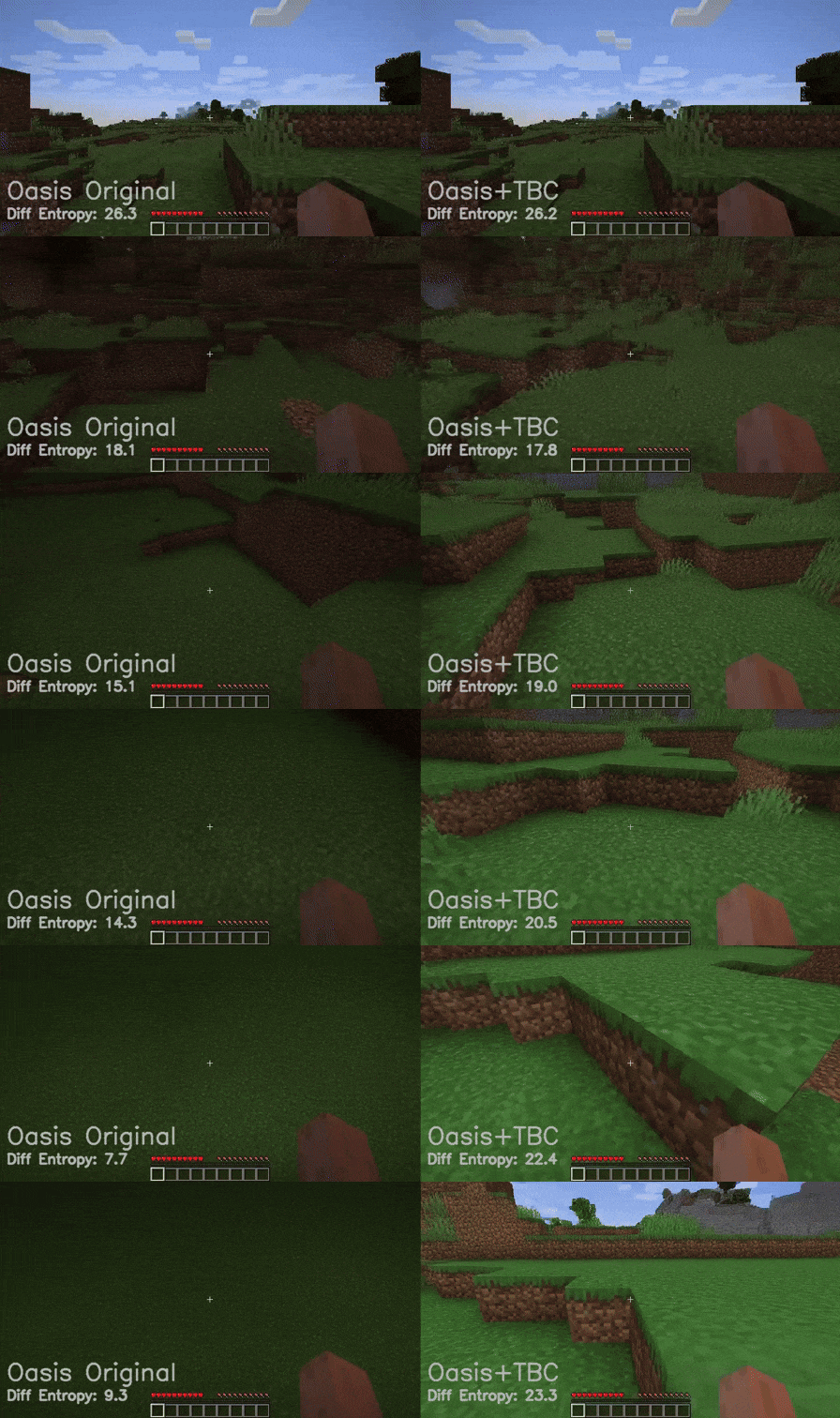
“Just by looking at the way these brain cells represent images and videos, we can double the rollout of the video generation model, the state of the art model like Oasis, using a similar concept. We can take an algorithm that reconstructs an image, for example, and we can improve the clarity or the resolution of it,” Ksendzovsky said. “We can take the way a single pixel or single electrode represents information, gather a learning rule from it, and actually apply that towards the problem of continual learning in AI.”
He added, “There’s a lot that we can gather from this small group of neurons. We can model [this biological network] and then create novel algorithms and augment current algorithms. And the way this is productized is with our commercial partners who have bottlenecks. They can’t generate enough video, for example, or it takes too much compute to create an interactive world model. Or they’re running into issues, which is something we’re working on now, like object permanence.”
Ksendzovsky said, “We’re the only company in the world that is not only taking neuroscience principles and applying them towards creating novel algorithms, but we’re empirically deriving them from [observing] neurons. That’s what differentiates us from IBM, for example, that is taking neuroscience principles and trying to make hardware from it. [Unlike] other companies that are taking neuroscience principles and trying to mimic them algorithmically, we’re the ones that are actually doing this empirically.”
One writer asked Ksendzovsky why the human brain would have an algorithms in it to discover. And why would there be any encoding information?
Ksendzovsky said the brain encodes information a very special way, and it’s very different than how current algorithms and current silicon based chips encode information.
One of the major differences is the brain learns, while silicon computers don’t really do that. And the way neurons are connected to each other can change, whereas silicon is rigid, he said.
“It represents information a much more complex way. So it’s a fully parallelized network. And so even though there’s differences, we can pick up on and model that into algorithmic tech,” Ksendzovsky said.
He pointed back to something from many decades ago: the McCulloch-Pitts neuron and its model of the brain, where a synapse was like a silicon transistor, or switch. Over time, from the 1950s until the 1980s, this model was used to mimic biology and how computers could remember things. Then, when neural networks were accelerated by GPUs in the 2000s, “AI processing became very non biological,” said Ksendzovsky.
“That’s when, from the leap from the 1980s to about now, we found ourselves with ChatGPT 5. We found ourselves with these models that are very capable, but it’s insane to me that they’re using massive amounts of energy,” Ksendzovsky said. “What’s even more insane is this: think about this idea of all the world’s data up until five years ago. To me, that concept wasn’t even real. Now, we’ve actually used all the world’s data to train these models The concept of data centers in space, right? Sounds ridiculous. A year ago, it was new. Now, it’s a real product, right? People are trying to do it.”
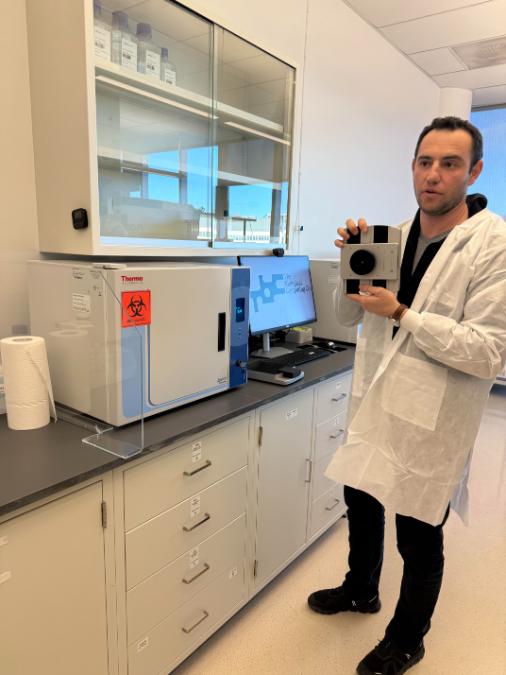
Ksendzovsky said, “The bottom line, since the late 80s to now, algorithms became very non-biological and they became extremely inefficient. The hardware followed inefficiency, even though the hardware seems like it’s making amazing advances in AI processing.
Meanwhile, the biological version of computing gained ground.
“This is where neuroscience started to flourish. So companies like Neuralink sit on the backbone of a ton of research in terms of people sticking electrodes in all kinds of brains and recording from them and understanding what those signals mean,” Ksendzovsky said. “We learned more about neuroscience. We’ve learned more about how single neurons interact. That brought us to 2026 again, and this is where John and I have been working in for a long time. Now we can take some of those principles and apply it towards novel algorithms.”
Asked about extracting algorithms from brains, Ksendzovsky said, “We interpret the way cells represent information, and we build an algorithm from there, if that makes sense.”
I asked a follow-up question. “As tech writers, everybody has always described neural networks more as brain like, right? And what you’re saying is they’re not at all brain-like?”
Ksendzovsky said the early neurons described as transistors were brain-like in their roots. But the term neural network now has diverged from biology and it’s a different kind neural network, he said.
Then the founders introduced their employees one by one. The team came from roles at Meta, MIT AI Labs, Apple, UnitedHealth, UC San Diego, the Max Planck Institute for Brain Research, UCL, Johns Hopkins University, Stanford University and more. The team has roots in AI, neuroscience and biology as part of a multidisciplinary approach.
They are working on tools like MEAs, or multi-electrode arrays,where the biology mixes with the computing. They use cells from rat brains and from human stem cells.
In a surgical area of the lab, Marisol, one of the biology experts, has been developing cortical cultures, the wet part where the cortical neurons in rats are put into a solution, given nutrients, and then preserved while operating various brain functions. These are recorded through the electrodes and translated into understanding related to those functions. The biologists figure out how to recognize things like vision processing.
In the lab, the team characterizes the electronic messages coming in from the rat or human cells.
“The goal is how do we optimize our cultures? How do we optimize the system to the point where we’re, first of all, constantly reproducible and we’re attracting algorithms that are optimal for our use cases down the road, right?” he said.
The rat neurons have been used for a long time, and so they are well understood.
“We also have organoids as well, for example, and that’s a three dimensional structure that recapitulates the brain. So we are doing experiments of organoids also. The bottom line is this is like the front end of our pipeline,” Ksendzovsky said. “Everything has to be perfect here, because all data flows through the biology. But after, after it reaches algorithm form, it’s got to be optimized.”
The team is trying to figure out that part. The team takes a skin cell that gets reprogrammed into stem cell.
“From there, there, you can create any kind of cell lineage you like. And obviously, for us, we create neurons. The interesting part about stem cells or IPS-derived neurons is you can actually keep going further than that and create different neural subtypes,” he said.
The team isn’t taking the visual cortex from the rat brain. Rather, it is taking the cells of the frontal cortex and he added, “Most of the brain cells that we use for our algorithm development are actually prefrontal area, motor sensory region.”
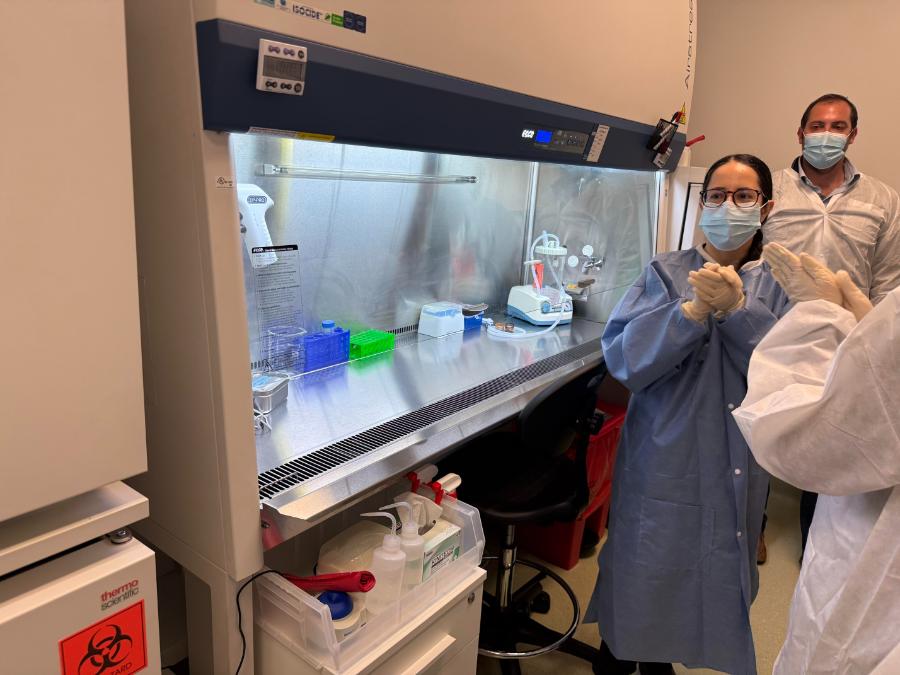
The team does the delicate work in a small clean room in the lab. At that point, we had to put on some frocks and pants and masks and moved into the room. On the ground was a sticky part that could take the dust off of our feet as we walked into the clean room. That reduces contamination.
This was where they asked us to take the chip-based electrodes with the dish attached to them out of our pockets. These electrodes are key to getting information out of the cells and sending electrical signals into the cells.
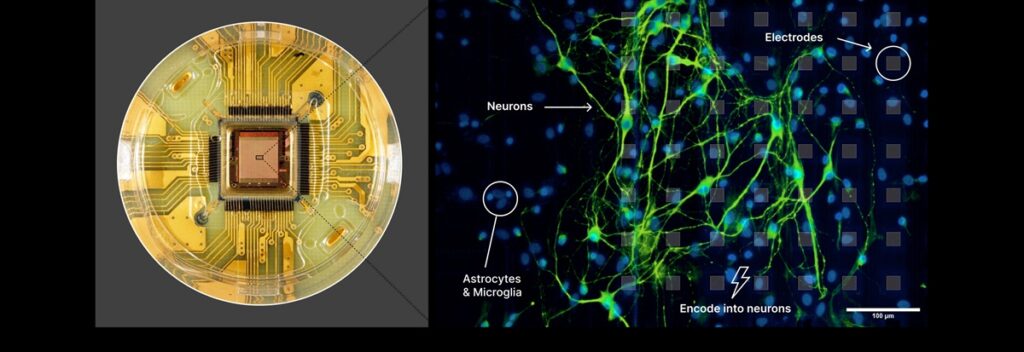
“The way information is flowing through your brains right now, as you’re looking at me, listening to me talk, your retina, your cochlea, is converting the senses that are defining the world around you, into electrical signals. Those electrical signals are propagating through your brain, allowing you to create the concepts or the things that you’re seeing in front of you and the concepts that you’re hearing. Right?” Ksendzovsky said.
He added, “We have this culture, or this group of neurons on this dish, and because it doesn’t have senses, we have to have a way of incorporating encoding information into it, and that’s where this interface of electrodes is extremely important. So the way we encode information, which I’ll show you all here, is by creating electrical stimulation patterns from data of the outside world and sending it into the dish.”
The liquid inside the dish is the “media.” It’s what the cell gets its nourishment from. It’s a manual process to switch the media out a couple of times a week to get rid of waste. So there’s a preamplifier that allows the team to record data from all 4,096 electrodes. It’s also the stimulator control that allows the team to send a stimulation pattern into the dish. It maintains a heat around 37 degrees.
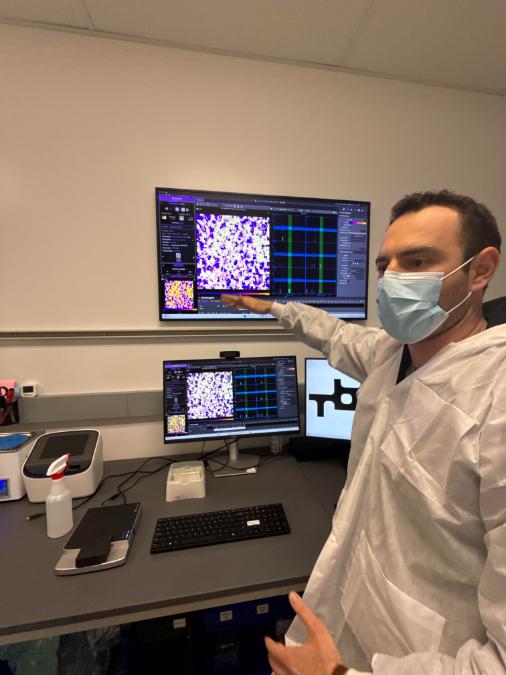
A single pixel on a display that is connected to the electrodes represents a single electrode on the dish of 4,096 electrodes. The heat map on the screen represents is actual recorded voltage traces. The brain cells communicate through electrical current, so as electricity runs through a neuron, it changes the ions around it, and that’s what the team can record and that’s how the team can understand what the neurons are doing.
There’s a 64 x 64 grid of the contacts represented the actual array of brain cells. The heat map represents amplitude of spikes. And so when neurons communicate with each other, they have what’s called an action catch, or a spike. And you can see the fluctuations of colors suggesting neurons are communicating with one another.
Pointing at the screen, Ksendzovsky said, “Okay, this is baseline activity. We have not perturbed it. We have not done anything to it, right? The neurons just continue to communicate. And they’re always talking to one another, as mentioned earlier. What makes this special? The neuron that fires on this side of dish will send information through long range connections the other part of the dish, and every single neuron is connected across a maximum of two synapses to every single other neuron. So this is the fully parellelized nature of a biological network.”
The team can see the signals created by each electrode on the screen with the grid. It can see how the neurons communicate with each other.
Ksendzovsky said, “This is why we’re able to start the company now, or four years ago versus 20 years ago when we originally had this idea. The signal to noise ratio is incredible with these multi electric arrays, so we can distinguish very easily what’s real neural activity versus noise.”
He added, “You can see the difference in amplitude, right? We can capture a lot of signals, like I said, 20,000 hertz, and we actually have computational tools to analyze this data and do something with it, like create algorithms.”
Ksendzovsky said, “When we first started the company, we asked very simple questions, the fundamental questions like, ‘Can you take information from this outside world, send it into addition neurons? And how do you do that?'”
The team started to do this spatially. And so what that means is the team traces an image.
Showing us the screen, he sends the current into the biological network, and then records the response.
The most important part is you see that it’s on a timer, and you see that this image recapitulates what we actually wanted to send into the dish. The important part is not the actual moment itself. It’s what happens right afterwards, what happens about 100 milliseconds afterwards, when the screen lights up, Ksendzovsky said.
The data from the computer and the electrodes shows up in the wet world of the dish, where the neurons show activity that it knows what has been sent into it. The team figures out the rules of how the neurons behave and it communicates with them.
And while the team is training the cells to recognize the company’s logo, it’s not quite learning yet.
“What we’re doing here is leveraging the fact that you have a massive dimensionality increase that happens in terms of it within the biological network,” Ksendzovsky said. “We’re studying that, leveraging that to improve AI systems downstream, just like you asked, though they’re also learning, right? The biology can learn. That’s one of the big distinguishing factors between biological networks and fartificial neurons, right?”
It can train a dish of neurons to recognize the difference between the company logo and a biohazard logo.
“We can train a classifier right, and then, as it turns out in our blog, the classifier, once trained on neural representation, is actually more accurate than a classifier that’s trained. This is in this data set on just the images themselves. So that was when John and I left and decided to leave our careers as neurosurgeons to do this,” Ksendzovsky said.
He added, “That was the first time anyone’s actually applied biological compute towards a real world use case.”
He also showed how the algorithms created by the brain cells can solve problems better. For instance, in a demo set in Minecraft, the brain cells outperformed a standard solution by enabling AI-generated video sustain itself longer.
I asked if they needed an entire brain to learn, just like neural networks need to train on all the world’s data to become intelligent. Ksendzovsky said they don’t need that. They just need about 100,000 cells. Or they may flex it up to 300,000 to 500,000, but they don’t need an entire brain to learn. That’s about 2.5 trillion parameters, he said.
The dishes have no blood, but they have nutrients like acids and glucose and they create waste. They have oxygen flow.
“They’re 100% alive,” he said.
He showed us the electrical activity up close. We could see the electrical signals propagating through the cells.
“This is what neurons are connected to, the synapses in between them. This is what determines the connectivity to biological network. It is what determines what we see in this world. That determines who we are, determines how these neurons process information. This is what we’re able to study. This is where we’re able to mathematically model, and this is also we’re able to modify. So when you’re learning, as you guys are standing in this room, the connections between your individual neurons are constantly changing, right? So again, we have a protocol that allows us to do this, and that’s we’re learning,” Ksendzovsky said.
He added, “The last thing I want to say, and we kind of go over there, is kind of going back to, ‘How is that single pixel represented across neurons that live at that electrode and then across all other electrodes? And can we create a mathematical model to recapitulate that?'”
And he aid, “From that mathematical model, what we can do is we created a what we call an adapter, which is an additional layer that allowed us to incorporate that transformer and increase the rollout. And so I’ll show you that result in a second. Again. This is our algorithm discovery platform. This is our how we empirically derive neuroscience principles and apply them towards many customer segments. And I think I can probably say this foundation model, labs, cybersecurity, data curation, all of these are potential customers and again, once we sign a contract that we’ll talk to you guys about it, but that’s where we can apply our technology.”
On the same journey
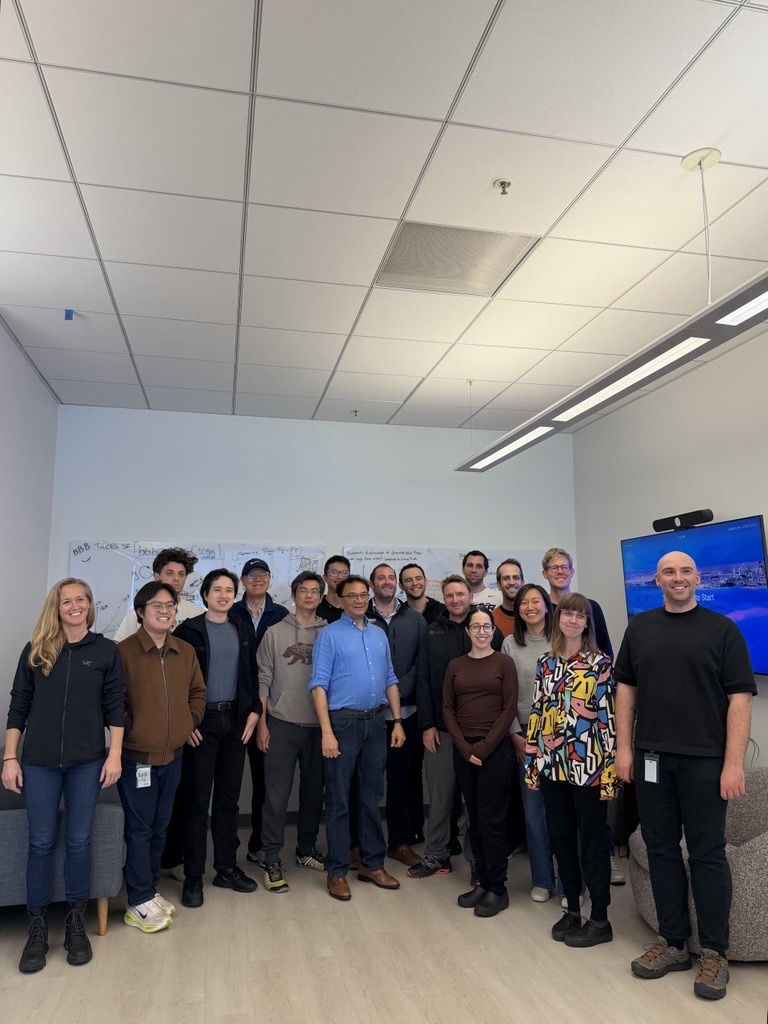
Ksendzovsky and Pomeraniec have worked together for a long time.
“He was the clear partner for me on this and we realized the technology is available, and that’s when we started the company,” said Ksendzovsky. That was around the time where it became very clear that energy demands for compute are unrealistic. And, you know, we’re seeing kind of the limitations now, three years later, also drawing on the hypothesis, or the idea, that the brain is massively more energy efficient in terms of how compute.”
They thought they could take these neuroscience principles, as they’re empirically derived neurons, and apply them towards creating better algorithms.
“I’m also a neurosurgeon, neuroscientist, on a very non traditional path to get here, which I think is actually reflective of the company and the narrative that we’re that we’re building,” Pomeraniec said. “I started on Wall Street. I was an economist. I was working for an investment bank. I totally rerouted. Went into neuroscience. Met Alex along the way. For the past 16 years, we’ve been doing everything together. We were in the trenches as residents together. Best personal friends. He signed all my wedding documents, and he’s the godfather for my children.”
This is the second company they’re building together. The first time was NeuroRPM, a digital health company building a “mobile health and data analytics platform to optimize clinical care for sufferers of neurodegenerative diseases.”
“So it really runs deep,” said Pomeraniec. “And I think you know what kind of binds us and this company is that we truly believe that when you bring the smartest people from all these different disciplines, from computational neuroscience, biology, machine learning, ethics, product — truly amazing things are possible.”
He added, “We’re really, really, really swinging for the fences here. And we’ve taken this big win and true approach, which is to say, when this is true, when we’ve actually successfully brought this to the world, the world’s gonna look a lot different in a very meaningful and positive way.”
And he said, “The last thing I’ll say is people ask us. They say, ‘How did you go from being neurosurgeons to doing this company building? Why did you quit your careers?’ You know, we like to say that we didn’t quit clinical medicine or academic medicine. We’ve evolved. It’s really taken us all these sort of diverse in depth experiences to be able to get to this point. And you know, we’re just happy to be here.”
I mentioned to them in our interview that it reminded me of Jeff Hawkins and Donna Dubinsky, the creators of mobile tech companies Palm and Handspring, on how they worked. Hawkins was interested in making brain-like computers at Intel. But he veered into designing energy-efficient devices like laptops and later the Palm Pilot.
After he was successful, he quit that work and started Numenta, to go back to his original dream of making an electronic brain. Dubinsky joined him as cofounder. And they went, and Hawkins dove so deep into neuroscience that he wrote two books on the brain.
But while there are things that Numenta does to improve software algorithms, TBC was created because it didn’t go far enough in modeling or mimicking the brain. I noted that the difference was that this brain-like work was “wet.”
“100% right,” said Ksendzovsky. “This idea of mimicking how he brain works, mimicking biology to create algorithms, that’s not new. There are neural chips out there that, in fact, like the McCulloch-Pitts (M-P) neuron, proposed in 1943 by Warren McCulloch and Walter Pitts. (It was the first mathematical model of a biological neuron, and it uses binary inputs and a threshold function to determine firing, acting as a logical switch to perform boolean functions like AND, OR, and NOT). It mimicked how we understood neurons function in 1950s.”
He said that if you look across the arc of the history of AI, there was this kind of inflection point in the late 80s with back propagation, where at least on the software side, non biological algorithms and architectures started to produce very nice results. That was the beginning of neural networks, and then, over decades, those neural networks funcitoned better with the massive parallel processing of Nvidia’s graphics processing units (GPUs).
“We found ourselves in this time now where you have very capable AI systems, ChatGPT,” Ksendzovsky said. “But they’re massively energy inefficient.”
He said, “What we’re saying is this. Wrap your mind around the fact that you need all of the world’s data to train these things. It’s insane, right?” Like, the fact that this is where we’ve gotten right, our position is that we’ve gotten here because we’ve become very non biological.”
This is what the non-biological view of computing has achieved for us, Ksendzovsky said.
But with the 1980s, another inflection point happened and it also took a long time to cook.
“In neuroscience, we started to really understand how individual neurons communicate with one another, how clusters of neurons, how the actual brain works, the structure of circuitry, the tools to actually be able to record from the brain, and make sense of these voltage traces and signals,” Ksendzovsky said.
Now there’s a body of literature. And Ksendzovsky said there is this massive disconnect between how AI systems that were supposed to be biologically based work and how we understand how the brain works today.
“So what we said as a company, ‘We’re going to go back to this idea where we’re going to, mimic the biology.’ We’re going to build or improve AI systems that more closely reflect that. But rather than just drawing through literature, we have this dish of neurons that allows us to empirically derive those principles,” Ksendzovsky said.
Now The Biological Computing Company is developing products, and they can easily plug into software systems today.
The team has figured out how neurons represent an image. And that allows the team to build a software adapter or an additional layer to a diffusion transformer for video generation. That leads to the efficient computing that the company can show today.
“Once this is true, the world is going to look very different. I agree with that sentiment, and we’re building towards that North Star. But the world already looks different with what we can build. We are already building products,” Ksendzovsky said. “We already have technical partners. We can already build tools from additional neurons that can improve video generation.”
“We’re already doing this. This isn’t like a pipe dream,” Ksendzovsky said.
In the wet dishes, every neuron is next to every other neuron.
“There’s millions and millions of synapses. And so it’s a little hard to compare the computational power of our neurons in a dish to like silicon computer,” he said.
Research has been done on the function of inputs and outputs of a single neuron and what causes the neuron to fire. The researchers are tackling questions.
Can you build a deep learning network, mimicking what happens in the brain? Can all these inputs and all these variables lead to this neuron firing? Can we predict it with a deep network? Looking at the parameters of the network, the team got a count. And it multiplied the amount of cells across the average dish of wet neurons that TBC makes.
“It turned out to be about 2.5 trillion parameters. Now, compare that to ChatGPT 5. A single dish of 100,000 neurons is presumably as powerful as some of the best models we have now, and that’s like a fraction of of what we can do,” Ksendzovsky said. “And so from a scale perspective — and just to be clear, we’re building software that mimics how the dish of neurons processes information. From a scale perspective, we can scale very quickly.”
He said the 4,096 electrodes give a ton of insight into that biological network.
“There are no issues of scale from that perspective,” he said.
I noted that the efficiency must mean that there is less brute force in this approach than other kinds of computing.
“We’re hoping that’s what we’re solving for. Something the brain does very well is you’re able to be trained on very few data pieces, right?” Ksendzovsky said. “It doesn’t take you more than one video of a cheetah eating somebody to know to stay away from cheetahs. You don’t need 100,000 representations of that. Your brain’s able to take context in, and be able to build that around into that concept. So for sure, we’re helping to solve for that as well.”
The roadmap
The company is now actively looking for more partners of video generation. It started on data that was focused on computer vision, like classification tasks.
It has computing proceeding on interactive role models and video generation for video games and for simulated worlds.
Ksendzovsky said that one of the interesting problems that video generation has is object permanence, like having an object staying in space and maintaining its position there, or the physical relationship of objects as they move in relationship to one another.
Tim Sweeney, CEO of Epic Games, noticed this when Google Deepmind’s Gemini 3 world model generated video game worlds. He saw that when you moved through a generated world, you could see lots of fine realistic details. But when you turned around and tried to go see them again, they were gone. That was a problem with object permanence.
Ksendzovsky said that a lot of these issues that video generation models have, the brain has already figured out. For example, if we’re in virtual space now, and you interact with me, I’d know what to do.
“If I throw something at you, you’d be able to swat it away, right? It’s not because your brain has memorized all of the utility physics. It’s because you have context for the size of the object. You know what friction air has on it, velocity and acceleration, right? You have an intuitive sense for that,” Ksendzovsky said. “All of that information is encoded in a single neuron to neuron interaction.”
The interesting thing is that the next milestones is helping to solve some of those problems for collaborators and customers.
“It’s what we call our algorithm discovery platform. We take state of the art models, we benchmark them, understand and build them, just like we did with Oasis in Minecraft. We then go into the dish design, very carefully craft experiments that will get at some of those problems. And then we mathematically model the neuroscience principles to help help us solve those problems,” Ksendzovsky said.
Then they can augment those state of the art algorithms, and benchmark them. That’s the next step to improve tasks like video rollout, object permanence, physical representations of objects in video generation as applied to video gaming, simulated worlds for robotics, advertisements and more, Ksendzovsky said.
Making products
Pomeraniec said emphasized that the company is productizing and commercializing right now.
“In addition, what’s so exciting about what we have and what we’re doing? We very much think of it as a discovery platform, like we’re not necessarily inventing products. We’re discovering them. And what I mean by that is, we have access to the perfect computer that’s already been built and architected over 500 million years of evolution. We don’t have to rebuild that. It is way beyond what Silicon can possibly do,” Pomeraniec said.
The question is, “How do you speak to it? How do you communicate with it, and how do you apply it in a meaningful way? The cool thing is that the more we do, and the more that we develop that language, which is really the kind of the secret sauce what we’re doing, we’re finding new and other meaningful ways to apply it.”
He added, “And so we have this beautiful platform that that is very rich, and we learn from it, and then we can apply many products from it. So that’s the neat and challenging thing. We’re not a video generation company, right? We’re making huge meaningful gains along the way, but there’s just so much possibility of what we can do. And this very excited about that.”
I thought about how William Gibson, the author who coined “cyberspace,” wrote a short story called Johnny Mnemonic. He plugged chips into his brain to make him smarter. I thought that maybe we got the idea backwards, and that we should have been plugging brain cells into our brains.
The ethical way to do this?
I asked what was the ethical way to do this.
Ksendzovsky replied, “I just want to be very clear about our position on this. The neurons, the brain cells that we’re growing in a dish, they are nowhere near the structural requirements, the total amount necessary, the conditions necessary to create anything like we experience. Experience as sentience, or anything like that.”
He added, “We are very clear about this, and we are watching this and studying this understanding very clearly. From that perspective, a lot of people ask this question, from that perspective. We have worked very closely with ethicists. We’re functioning like a lot of the standard biotech organizations from that role.”
It’s not about creating life, he said.
“We’re accessing super fundamental aspects of neuronal compute just how neurons interact with one another. In order to have life, for sentience, consciousness, things that we experience as humans, or even a version of that, how animals experience it, there needs to be the perfect conditions, the exact structure, and we have none of that in our dish, and that’s intentional,” Ksendzovsky said.
So the aim is to be ethical and not create another living being, but to focus on what the computational ability is for these cells. It’s different from the brain computer interface tech that Neuralink created. Researchers have used electrodes to stimulate parts of the brain to treat Parkinson’s Disease and epilepsy for a long time — again, with very different technology. Those technologies have helped life the knowledge around the brain and what brainwaves really mean.
“I think it paved the way for something like this, but it’s a completely different technology,” he said.
TBC said that they’ve taken an ethical approach to using living cells, with a focus on computing functions only, with no intention to build a full brain. I bounced this off Rao.
“I think it will and should pass muster,” Rao said. “I believe very deeply that ‘neuroethicists’ have failed modern neuroscience by focusing on recursive internal philosophies of hypothetical harms (‘does this neuron ‘feel”) rather than external social and economic analysis against practices and applications that are active in the market (‘could this tech bring improvements over widespread status quo practices? What are ongoing problems this could improve upon?’). So I am probably the wrong person to ask!”
How to not melt down the planet
The process is not expensive, they said. The dishes may cost $200 but they can be reused many times. The real expense is more in the talent of the team, which includes a number of world-class experts in AI, biology and engineering.
“The biology part is miniscule, and you can do what GPUs do, but a lot more efficiently and faster,” Ksendzovsky said.
One of the best things about working with real brain cells is that the experimentation enables the discovery of new ways to communicate and compute. The concepts can be tested in an empirical way and that can show the way to the best results.
“That’s the position we’re taking. We have these neuroscience principles that can be applied to software or to hardware, and we create experiments with neurons to then prove whether that principle is important,” Ksendzovsky said. “And then you can build software or hardware. So I think where we plug in with our discovery platform right now we’re driving towards algorithm discovery, but we can certainly use this for the next generation of neuromorphic chips, which can be designed more like how real neurons interact and structurally work with one another.”
Ksendzovsky said the team is able to scale massively, as it has hundreds of dishes now and could scale up to thousands.
“What we’re getting at is that in five, 10 or 15 years, we will have real-time biological compute, which is actually using the neurons themselves as part of the inference loop,” Ksendzovsky said.
The products that TBC is creating now are laying the foundational layer for real time biological compute, which is the North Star.
The competition
There is competition out there in biological computing. But the main targets are the chipmakers like Nvidia, Intel, AMD and Cerebras, which are all working on technologies that consumer a lot of energy.
Rao said other “wet” competitors include Cortical Labs and FinalSpark.
“I won’t comment on more vs less promising approaches as this is all early days, but I think short term success will have more to do with the companies’ go to market factors, business models, partnership strategy, than technical differentiators,” Rao said. “There is room for many winners at this stage, too. Finally, I expect many competitors to emerge in the next 3 years and beyond.”
I asked Rao about the “wet” vs dry approach of hardware chip makers like Nvidia, AMD, Cerebras and more.
“I am not a technical expert on AI, but from my historical understanding of today’s ‘neural networks’ based on ancient neuroscience theory from the 19th century, I believe the comparison with hardware is apples to oranges,” Rao said. “We need ‘both sides’ to improve efficiency, but the biological/neural computing plays carry a fundamentally different premise: that naturally occurring biological efficiency can be decoded and leveraged to rightsize energy outlays of status quo/legacy computing processes constraining our energy grid powering today’s AI surge. The hardware approach strikes me as iterative on status quo methods, so just more of the same underlying mechanisms.”
Inspirations and aspirations
As for inspirations, it wasn’t so much science fiction that crystallized the thinking. Rather, it was a combination of naivete about how big the task was but also the confluence of neuroscience and how AI computing became so inefficient to the point where it’s going to consume a lot of the resources of the Earth in high-energy data centers. President Donald Trump was asking chip companies and data centers to provide their own form of energy.
“This is just something that is so obvious that it has to exist. We’re just seeing the ramifications of it not existing,” Ksendzovsky said. “The data center demand right now, it’s just so astounding that you can see all the consequences of power inefficiency and what it means for the whole planet now.”
For hyperscalers, he said they can try to figure out how to create their own energy, or pay for their own energy, “or they can invest in a partnership with us and try to figure out how to make it much more efficient.”
He added, “That’s a much smaller lift in my mind.”
Back to one of the key questions. Is this worth their time, when they could be using their training to save lives?
“We’re making computing applications better, faster, cheaper, now and in the future. In the dream state, we’re unlocking use cases that cannot be solved in silicon. One of the downstream applications of that could be health, it could be med tech,” Ksendzovsky said.
He added, “I see it from the opposite perspective. It’s like you’re solving problems probably today that cannot be solved with the gold standard of actual human brain data, like, from deep brain probes. That takes forever, and to build a company that can then unlock that data takes forever and is hundreds of millions of dollars. You’re seeing it all around. We know how how the brain works, but it’s not how AI systems work, per se.”
How would he know that he’s changing the world and doing something that has demonstrable impact?
Ksendzovsky said, “Let’s stipulate you’re going to change the world. I think it’s efficiency. So reducing the amount of power needed to perform a task. That’s, again, what we’re showing now. So customers, using using us can have more parameters, for example.
A customer works with you, and then they come up with a model. We have a much more powerful model, and hopefully less time.
If TBC fulfills it’s promise, the significance could be big.
Rao said, “It will really depends on specific adoption and performance demonstration opportunities – the key will be showing rather than extrapolating claims. I don’t want to speculate too much here as this approach remains unproven at scale. But in terms of impact, here is what I would hope to see in the next 12 months: a large data center pilots this technology and runs a real world study of head to head or pre-post energy consumption.”
The results are starting to shown now. The company is working with a firm named Odyssey in video generation. In cybersecurity, more efficient tech is rolling out for some of the conversations. How many watts does it take? How much is the cost? That’s the kind of conversation that we’re already engaged in.”
“Our immediate impact there is helping world models. A lot of companies now are working on language models and training with brute force and tools,” Ksendzovsky said.
He said that this opening up of the company’s ambitions is an opportunity to educate more people about the journey the company has been and how much more work has to be done.
There’s a billion-fold difference in how much energy is required for infromaton to pass through a brain synapse than through a transistor, and TBC is talking about partnership terms with companies who believe in the energy efficiency. The firm intends to be monetizing as soon as possible.
“That’s our ceiling, a billion-fold,” he said. “We’re starting to show that we can improve and reduce inference costs. And so in partnering with inference providers, for example, they will use the TBC enhanced model, and the price per token is lower.”