
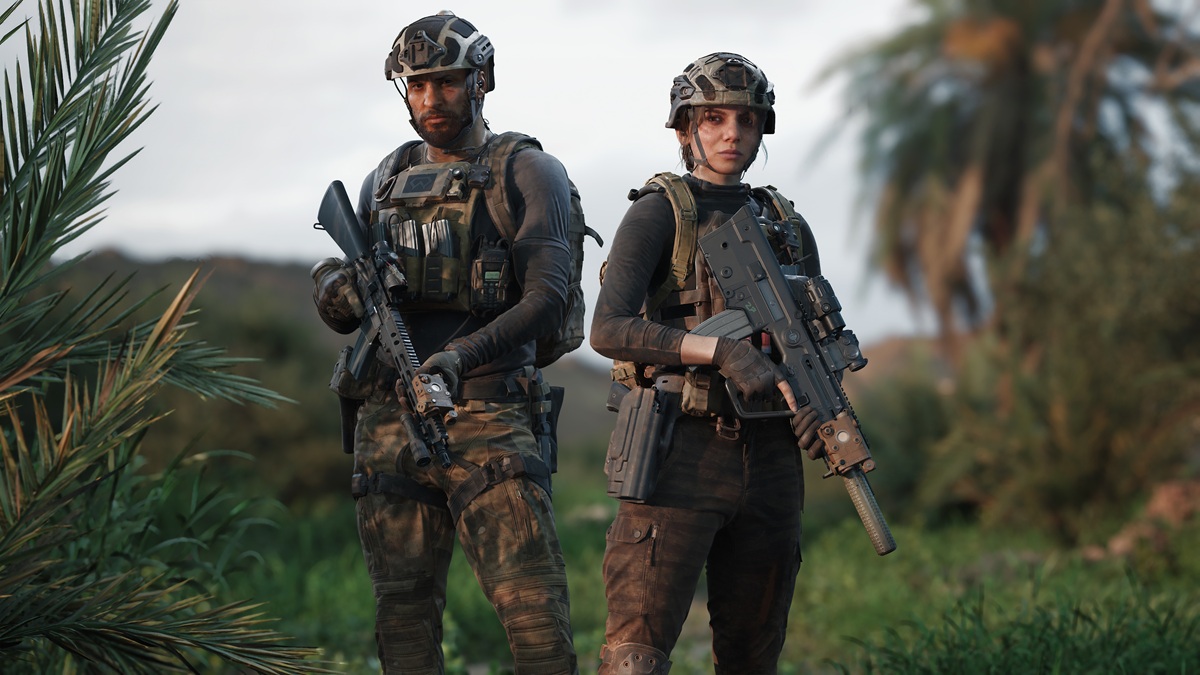
That’s No Moon Entertainment revealed a deep look at its independent triple-A game under development: Crossfire, a new single-player version of the popular multiplayer franchise owned by South Korea’s Smilegate.
It’s a narrative-driven single-player tactical action-adventure, based on modern military combat but inspired by a turning point in human history that is based on science fiction.
During the Summer Game Fest livestream, That’s No Moon Entertainment, founded in Los Angeles by veterans of some of the industry’s most recognizable and acclaimed creative teams, revealed their debut project, Crossfire.
The game is developed in collaboration with Smilegate, creators of the blockbuster Crossfire modern combat shooter franchise. Designed as a premium single-player experience, Crossfire is a third-person tactical action-adventure game that combines a resonant cinematic thriller with grounded, innovative stealth combat.
That’s No Moon’s debut project immerses players in the story of Layla Qassem (Claudia Doumit – Amazon’s Emmy-nominated series The Boys) and Delroy Cross (Ricky Whittle – Starz television series – American Gods), two enemy operators who must forge a fraught alliance to survive a lethal existential threat. One of the interesting choices the team made is that you don’t play as both operators; rather, you only play as Layla and not as Cross.
“I’m looking at it through the lens of that Delroy and Layla are both the protagonists of our story, and Layla is the player character. She’s the player protagonist. So they are both protagonists,” said Taylor Kurosaki, chief creative officer, in a press briefing. “I’ll imagine myself as the player here, I’m rooting for them to succeed, I’m rooting for them to survive, and I know that if their fraught alliance doesn’t hold, then they won’t succeed. So, in that way, and through that lens, Delroy is as much a protagonist as Layla is of this story, but Leila gets the special role as player protagonist.”
You can see the trailer here. Smilegate invested in That’s No Moon and injected $100 million into it. That’s pretty amazing, but Crossfire has an enormous audience, as its registered players in 80 countries have surpassed 1.1 billion players and its concurrent players has topped eight million.
And yet That’s No Moon is providing a cinematic narrative that can elevate Crossfire’s experience, raising it to something epic. At least that’s the bet at That’s No Moon, and we’ll see how it all turns out. For this moment, it’s quite encouraging to see something as ambitious as this title while others shave back their dreams.
Pushing the medium forward, Crossfire introduces Adaptive Cover, a genre-reinventing cover system that dynamically adjusts the player’s stance to respond to the terrain and enemy positions around them. The player-character will intuitively maintain cover, delivering an unprecedented tense and realistic experience. With Adaptive Cover, players will be able to use the terrain to outthink and outmaneuver highly lethal enemies.
“With every game we work on, we try to do something that has never been done before, so we designed Adaptive Cover to bring a level of detail and grounded realism that is unlike anything else. It requires tactical thinking and has removed the constraints placed on our designers and artists,” said game director Jacob Minkoff, who is also cofounder of That’s No Moon. “This sense of realism connects the design and the narrative, delivering the tension of a cinematic thriller.”
That’s No Moon’s core DNA is expressed by thoroughly connecting narrative and design, allowing the player to connect to the characters through both cinematics and gameplay. This ethos is at the heart of Crossfire, an experience that showcases genre-reinventing gameplay and industry-leading performance capture technology to bring its story to life.
“We created this studio with the goal of delivering world-class single-player experiences; it’s what many of us have built our entire careers on,” said Taylor Kurosaki, chief creative officer at That’s No Moon. “With Crossfire, we hope to show the world that our team has a rare combination of pedigree and vision to do just that.”
“Crossfire has been loved by over a billion players around the world for nearly two decades, and this project represents a major evolution of the franchise into a premium cinematic single-player experience,” said Simon Cheong, CGO at Smilegate, in a statement. “Together with That’s No Moon, we are building a bold new vision for the Crossfire universe that we believe will resonate with both longtime fans and entirely new global audiences alike.”
Crossfire is slated for future release on PlayStation 5, Xbox Series X|S, and PC for Steam and via Epic Games Store. This title is a Smilegate IP developed by That’s No Moon Entertainment. Publishing responsibilities are managed by Smilegate for console platforms and by Team K1 for PC.
A studio that focuses on unique gameplay
Crossfire is a single-player tactical action-adventure, where two opposing operators face tactical combat in a fragile alliance with an enemy you have no choice but to trust.
With tense and innovative gameplay that provides unprecedented cover-based combat and stealth mechanics, together with their ally, players must utilize the richly detailed terrain to outsmart an overwhelming threat.
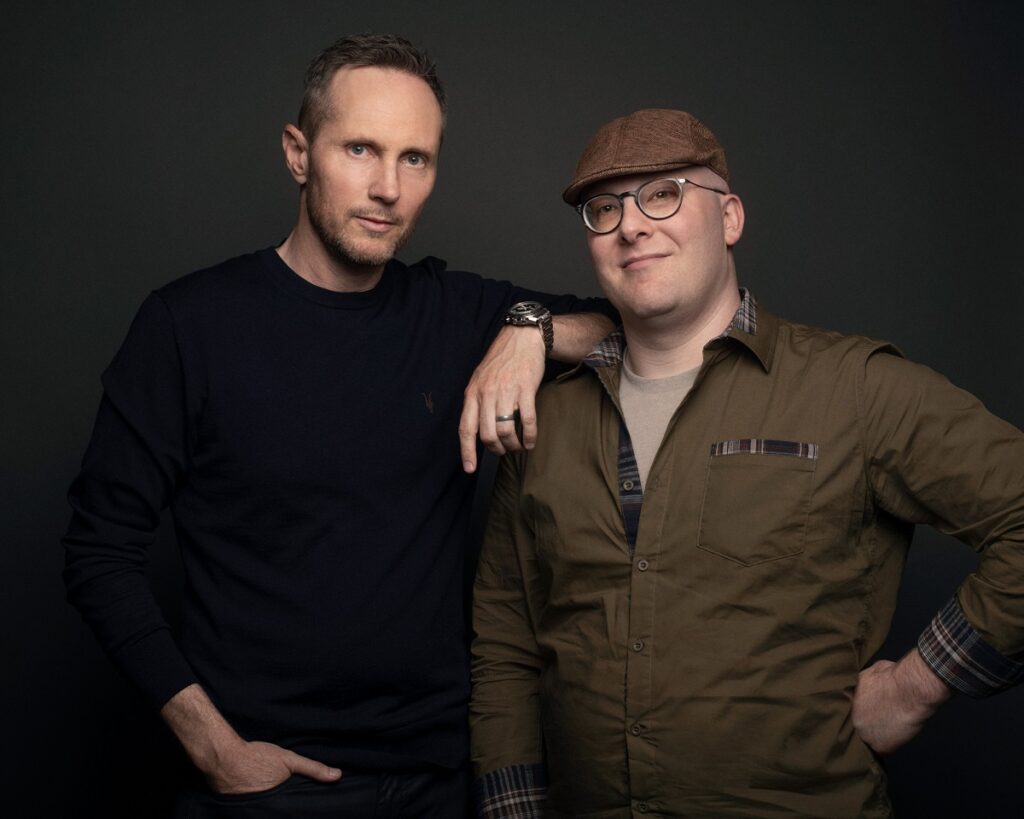
Kurosaki and Minkoff, who started That’s No Moon Entertainment in 2021, walked us through a demo of the gameplay in a press briefing.
Minkoff said the team was very deliberate and intentional about how it built its team of developers and storytellers.
“The vision we had for the studio is directly connected to the vision for the game, so we think it’s important to at least touch on that slightly,” Minkoff said.
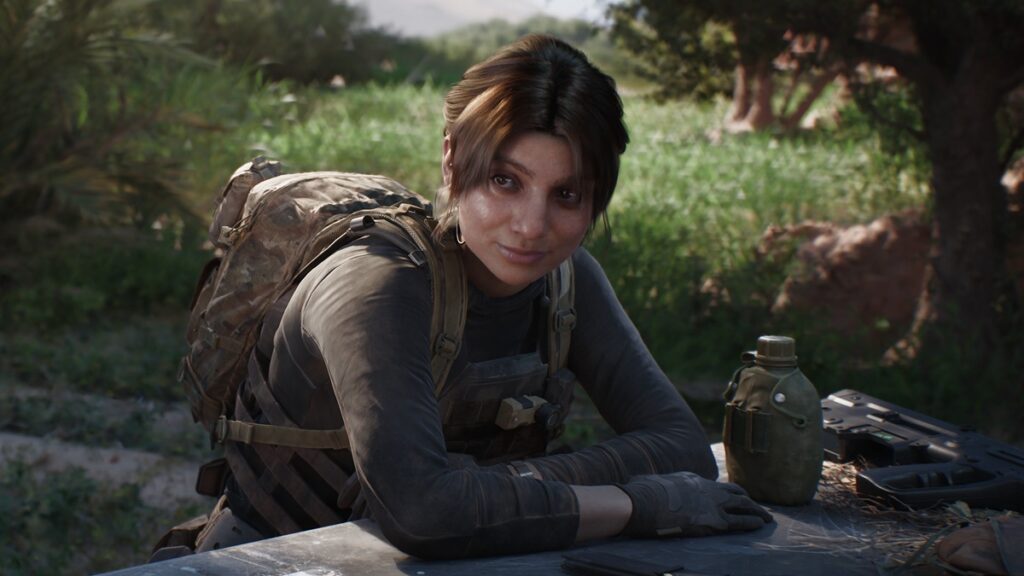
The team saw there was a crowded market and they focused on innovation to push the medium forward, Minkoff said.
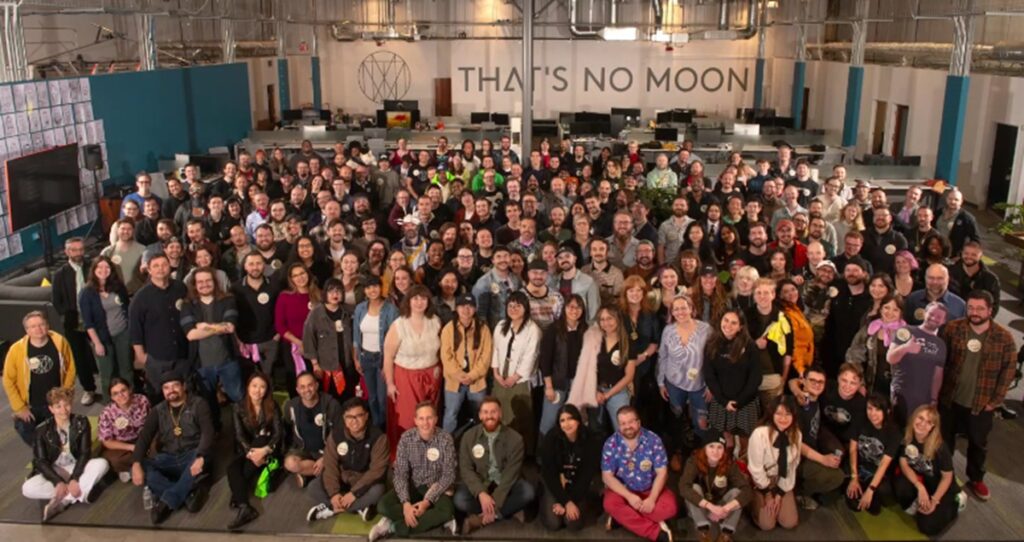
“This team you’re seeing there was purpose built from the earliest moments of our studio to make the game that we’re going to show you today,” Kurosaki said. “So what that meant is we got to hire the specialists, the subject matter experts to build this, and that was an amazing opportunity. It’s a bunch of veterans who come from all over the industry, worked on games that you all know and love, and a lot of newcomers. That mix of experience and new ideas, and the idea sharing, has been a really, really cool mix.”
The team is globally distributed, though it’s based in Los Angeles. Minkoff and Kurosaki started working together at Naughty Dog on Uncharted 2.
“We’ve been working together for a very long time. Jake and I started working together making Uncharted Two, so we’ve been partners over 18 years now. We spent our entire careers making these kind of tentpole narratively driven games, and at every, in every iteration of what we’ve made, we believe and we hold dear our North Star, which is this inseparable connection between narrative and design,” Kurosaki said.
He added, “I’m more on the narrative side, but Jake is definitely no slouch, and you know Jake’s more on the design side. I worked on some games as a designer way back when, but the point is that we both value both disciplines, and we know that these games only succeed when each of them is in service of the other, and they are developed holistically to form this experience that you play.”
Pillar talk

The game is a character-driven narrative created by “massive story nerds,” Kurosaki said.
“We love the power of storytelling, and we especially, obviously, love the power of interactive storytelling, where you can have a level of empathy with the character you’re playing as that is unlike any other medium,” Kurosaki said.
By focusing on narrative and high quality immersion, the team feels players can feel part of the world. The tech creates a sandbox for players, and it allows deeper, more subtle stories that can push the medium forward.
“We’ve been inspired by those that have come before us, and we want to again push the medium forward, innovate, so that we can keep advancing games, it’s really, really important to us,” Kurosaki said. “These games take a long time to make, and so you only have so many at bats, and you want to leave the industry forever changed, as you move forward from from what you’re working on.”
The team didn’t want to focus on a multiplayer or live ops game, even though that has been more fashionable for startup studios.
“This is a single player narratively driven game in the grand tradition of the games that we love very deeply, and represent our most formative and memorable experiences in gaming. Additionally, this is not a choose your own adventure, so to speak. There is a tremendous amount of agency that our players have within the game, and Jake’s going to get into that in great detail, but we also believe in the power of authored storytelling,” Kurosaki said.
The game is a tactical action adventure that is comprised of grounded combat, with very high lethality. The high lethality requires a stealth forward approach, so that you don’t die, and then the second pillar of that is this deep cinematic storytelling with relatable characters,” Kurosaki said. “Nuanced characters, not cardboard cutout altogether good or altogether evil mustache twirling villains. Again, flawed human beings that remind you of people you know, and ideally probably remind you of yourself.”
The plot and the characters
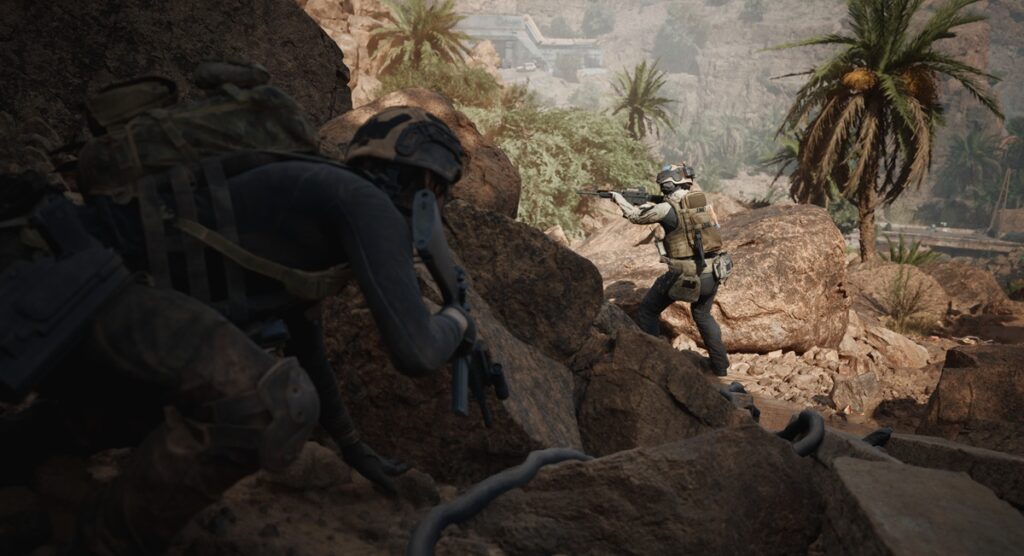
There is a sci-fi element to the story, but it is also grounded in the world we already live in. Sadly, we’ll hear about that angle later. The game is built on Unreal Engine 5, allowing the startup to get the work done in a shorter time.
Layla Kasem is a mercenary and her philosophy would be that she wants progress and change at any cost. She sees the world as an inequitable place, and she wants to make it more equitable, which means attacking the institutions that exist.
“And sure, I love that ideology. Yes, I want the world to keep getting better, but if that ideology is taken to its logical extreme, that’s not good. If that ideology is taken to its logical extreme, it means chaos, it means anarchy. So there’s a good version of it, and then there’s a dipping into potentially a bad version of it, and playing opposite Layla is the character Delroy Cross. He’s ideologically opposed to her,” Kurosaki said.
Cross believes in protecting the status quo and meaning that he values stability, and that is also a noble ideology.
“We want the world to be predictable. We want things. I left something there and it’s still there, or this building is still standing. So, again, it’s a noble ideology, but when it’s taken to its logical extreme, it really ensures that the haves remain the haves and the have nots remain the have nots,” Kurosaki said. “So these two valid in the right way ideologies are going to be put on full display as Layla and Delroy get forced together — not with someone with a gun to their head — they are compelled to work together based on this existential threat, this sci-fi element.”
“That pushes them together and through their time together in order to succeed, they are going to learn that the narrative of the other is valid, so they will learn empathy together,” Kurosaki said.
Gameplay storytelling
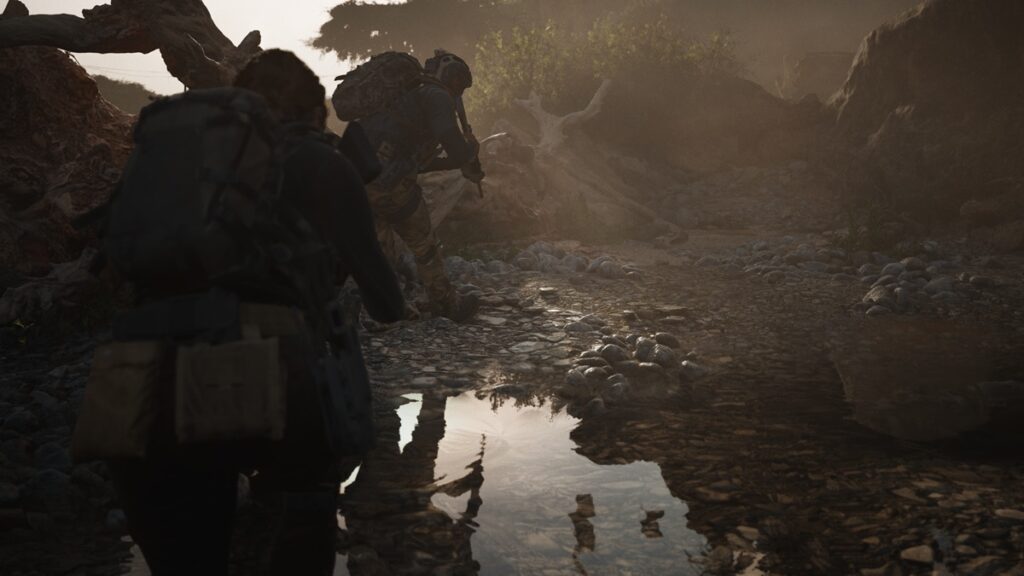
These two operators have to move through the world together in a way that they feel the tension about their differences.
“Taylor was talking about the pressure that’s placed on them that makes these two operators from opposing sides of a conflict ideologically opposed work together. The player has to feel that same pressure. What we always say is that you need to make sure, that the player’s emotional state is in parity with the protagonist that they are playing as,” Minkoff said.
Given the existential threat and the lethality of the enemy force, they have to work together.
“The gameplay is all about combining this cinematic storytelling with genre reinventing cover and traversal that rewards tactical thinking and experimentation when you are working against this overwhelming lethal enemy force,” Minkoff said.
Here’s where the team came up with an innovation. Minkoff noted that we’re still stuck in the Gears of War stage of third-person cover-based shooters, where you hide behind rectangular blocks to avoid getting shot. That’s a couple of decades of games with boxy shapes in combat spaces. When you see them, you realize a combat scene is about to happen.
The problem is this creates a binary state for cover, he said.
“If I’m in cover, then I’m taking a low stance. If I’m out of cover, then I’m taking a high stance, and if I’m in cover, I’m protected. If I’m out of cover, I’m not protected. This really limits art, and it telegraphs to the player that this is a combat space,” Minkoff said. “We made these choices 20 years ago collectively as an industry, because we couldn’t push that many polygons, and we had limited processing power, limited animation systems. But what it results in is these very, very stair-stepped environments.”
This limits artists and the kind of environments they can create. There are basic art tropes like your crawling height, your cover height, your mantle height and so on. So you see a bunch of crates everywhere, including flanking crates.
“Because you’ve gotten used to the patterns, I think that there’s been a decline in third person cover-based shooters,” Minkoff said. “Twenty years ago, you got like surprised and delighted when an enemy entered a space and slammed into cover and aimed over the top of it.”
This is where the team came up with adaptive cover, using Unreal Engine 5, with its Nanite infinite polygon materials and Lumen lighting. Those are game-changing technologies, Minkoff said.
“We realized we could make these incredibly complex organic environments,” Minkoff said.
The team sent the artists out to scan a bunch of environments. They used photogrammetry. Now the soldiers can take cover in arbitrary stances against complex organic cover of arbitrary shape, and the team came up with new AI systems, physics systems, player interface systems, animation systems — all to make movement feel more realistic among realistic cover.
Minkoff said he dressed up and went to a park near his house and started crawling around in the environment.
“A space like this is illegal in video games. You are not allowed to build a space like this because we don’t have those systems to interact with it, but we started looking at it and saying, well, here’s how a human being actually interacts with it. Here’s how you move over it and climb around it, and you can imagine pulling the trigger to aim down sights, and here’s how you would aim over it, and here’s how you get back into cover,” Minkoff said.
So they gave the player the ability to navigate the environment, and they used it to demo Layla moving around in an area around rocky terrain with lots of enemies around and Delroy tries to draw enemies away from her.
“We developed a new technology, which is our big innovation, called Adaptive Cover. What Adaptive Cover does is the player enters cover mode, they deflect their stick, and the character takes the appropriate stance given the context of the environment around them, and the line of sight of enemies. What we’re doing here is we are intersecting the enemy visual frustum, their line of sight with this elliptical semi solid, the red shape around the player, and we are creating the green safety volume with that intersection,” Minkoff said.
It’s simple. If you’re inside the bubble, you’re not visible. But if part of you is sticking outside of it, the enemy can see you. It’s what soldiers call defilade, when something is blocking the line of sight to you. Minkoff showed a demo that proved the tech exists and it makes a difference in gameplay.
The Crossfire name
If you knew That’s No Moon Entertainment got its funding from Smilegate, you would not be surprised that the team is making a Crossfire game. But while people love the gameplay of the multiplayer title, they don’t really know its backstory. It’s a valuable IP without much story, and giving it story is where Minkoff and Kurosaki came in.
“What was really amazing is Crossfire has the themes that really align with our vision of how we see the world and the kind of games we like to make,” Kurosaki said.
Because there’s no right or wrong side in Crossfire, it’s easier to sympathize with both sides and see shades of good in the bad side.
“Delroy Cross and Layla are these ideologically opposed different operators who are forced to work together to overcome this existential threat, so the other great thing about working on this and working with our partners at Smilegate is they’ve been so supportive of us and they have let us make the best game of our careers,” Kurosaki said. “They have not micromanaged us, they recognize that we are the subject matter experts, and they all they want to do is enable us to make something meaningful, something special, something that is pushing the medium forward.”
The cover system allows for more realistic combat. You don’t charge in like Rambo against a superior armed enemy. You use stealth, break line of sight, reposition, flank and pop up again, fire, run away and do it again. The action is slower, but the strategy is more cerebral. In its pre-alpha state, it looked pretty good.
In the gameplay demo, Cross has a suit that makes him nearly invisible, and so he flanks enemies and draws them off of Layla, who is visible. She uses the cover system to stay out of sight of the guards. Cross holds down the enemies as she escapes and crawls to the other side and then ambushes a guard from an unexpected direction.
Roadhouse banter
The two protagonists don’t necessarily trust each other, but their banter breaks the ice. One of them quotes Roadhouse, and the other asks if they mean the 1989 Patrick Swayze film or the “shitty remake.”
It’s a small bit of humor but it gets the heroes on their path to trusting each other.
I asked about Roadhouse.
Kurosaki replied, “Who doesn’t love Roadhouse? Well, you know, I mean, honestly, though, by the nature of the fact that Delroy and Layla are compelled to be together, they have a chance to learn that they have more in common than they thought, and that, to us, is like the center heart of this game.”
He added, “We can be intellectual and talk about, well, I see the world this way, and then you see the world that way. We’re oil and water, but at the at the heart of it they have a lot in common, and them having the chance to discover what they have in common and share those moments together — that is again the emotional core of the story. So, even questionable taste in 80s movies is something that people can share.”
The summary of pillars
The game focuses on four pillars. First is the notion of tactical freedom with grounded combat. It’s that innovative gameplay in the form of adaptive cover. You have to constantly analyze the space around you.
It also allows for a level of immersion and kind of visceral combat that wouldn’t be possible otherwise, said Sebasteann Barradas, senior communications manager at That’s No Moon.
Then there’s the nature of the fragile alliance between Layla and Delroy, that idea that they’re ideologically opposed, but because of the existential threat, the pressure that is being placed on them, both in narrative and in gameplay, that the player is feeling, and that the characters are feeling, that ultimately comes together with the cinematic intensity.
“It’s the wrapper of the entire experience. It’s this prestige thriller that’s grounded, is tense, is intelligent. Every frame has been meticulously crafted by our team of developers, and we’re incredibly excited now to have been able to share it all with you,” Barradas said.
We asked who the enemy was and it is an existential threat, but that’s an answer for another time, the company said. All we know is there is a sci-fi element.
Someone asked if you can play as Cross. Kurosaki said you are always playing as Layla, and he said it was conviction.
“We believe that again this power of empathy with characters, the interactive medium, and narrative storytelling in single-player games like this, we want you to walk a mile in someone else’s shoes, and this person’s shoes, who’s having not a great day, not a day like she expected, is Layla,” Kurosaki said.
As to the parts of the Crossfire IP that are coming into the game, Minkoff said there are two factions from the original IP that are part of the game.
“Taylor and I were very inspired by the world of Crossfire and the fact that the way those factions are set up in that world, is that neither of them is right or wrong. They are both equally right and equally wrong. They both have perspectives that you can empathize with, but also see how, when taken to an extreme, they can go bad,” Minkoff said.
He added, “It allows us to create the flawed, grounded characters that we’ve always wanted to make. We’ve never wanted to make games where there’s pure, obvious, evil, mustache-twirling villain. We want to make games that feel like they’re more about real people, and the Crossfire IP fundamentally is built that way and gives us the opportunity to do it.”
There are also boss-type encounters, pacing, escalation and other nods to the gameplay of the original IP.
“The pacing of them is all driven by the emotional story we want to tell about Layla and Delroy, and that’s why we believe in the curated single player experience as a medium,” Minkoff said.
Asked about Delroy’s role, Kurosaki said said he impacts the gameplay significantly because he draws enemies toward him, and fires and rushes in o does a finishing move for you.
“He is a willful protagonist in his own right, and if he, as an NPC, was not there, I think these combats would be basically impossible to pass,” Kurosaki said. “This is a stealth-forward game. Stealth as an enemy awareness state divided into the enemy’s knowledge about each individual character.”
“The enemies can be aware of your buddy Delroy, but not aware of you, the player, and therefore they will be firing at him, hunting him down, but perhaps you haven’t been seen, so that gives you the opportunity to break line of sight, reposition, flank, get in a hit and run action with the foes, because of the way that he is drawing fire,” Kurosaki said.
The stealth combat makes it more realistic overall.
“In real life, there is no such thing as Rambo. This is a thing we’ve learned over and over from our military advisors throughout the years on multiple projects, is that two soldiers against an overwhelming force of enemies,” Minkoff said.
He added, “That’s why guerilla tactics exist in real life, and that’s how this game has been tuned because adaptive cover and the terrain we’ve given you is all about using the environment to your advantage to overcome that overwhelming force.”
Kurosaki said, “What I feel when I play the game is it’s not like choosing one or the other that that they seamlessly blend one into another. You will be in a firefight, and then you will quickly break line of sight, reposition, get the drop on someone, so you can actively regain stealth in the midst of a combat. It’s really both happening simultaneously.”