

Sparxity, a leader in sparse-native computing, announced a new funding round that brings total funding to date to $90 million.
The funding will accelerate the development of the Dresden, Germany-based company’s specialized chips for fine-grained dynamic sparsity, targeting up to 44 times faster AI inference in ultra-sparse models, bringing greater energy efficiency by computing only what matters.
The round was led by ICM HPQC Fund and joined by investors such as Lockheed Martin Ventures, GlobalFoundries, GS Futures, Cloudberry Ventures, TGFS, and the EIC Fund. The financing also includes angel investments from AI leaders Richard Socher (Recursive Superintelligence) and Nancy Xu (Salesforce-acquired Moonhub), alongside continued support from Atlantic and Silicon Catalyst.
“Our work with PEER demonstrated the potential of dynamic sparsity, activating only a fraction of the compute across millions of fine-grained experts,” said Xu Owen He, former Google DeepMind researcher and Sparxity strategic advisor, in a statement. “Yet today’s hardware limits how far we can take these approaches. Co-designing AI models, distillation pipelines, and hardware around sparsity unlock a new level of computing efficiency.”
Sparxity builds full-stack systems around a simple principle: compute only what matters. Its approach addresses rising AI infrastructure costs and energy consumption. The funding follows the sparse-native startup quadrupling its revenue between 2024 and 2025 with continued momentum in 2026.
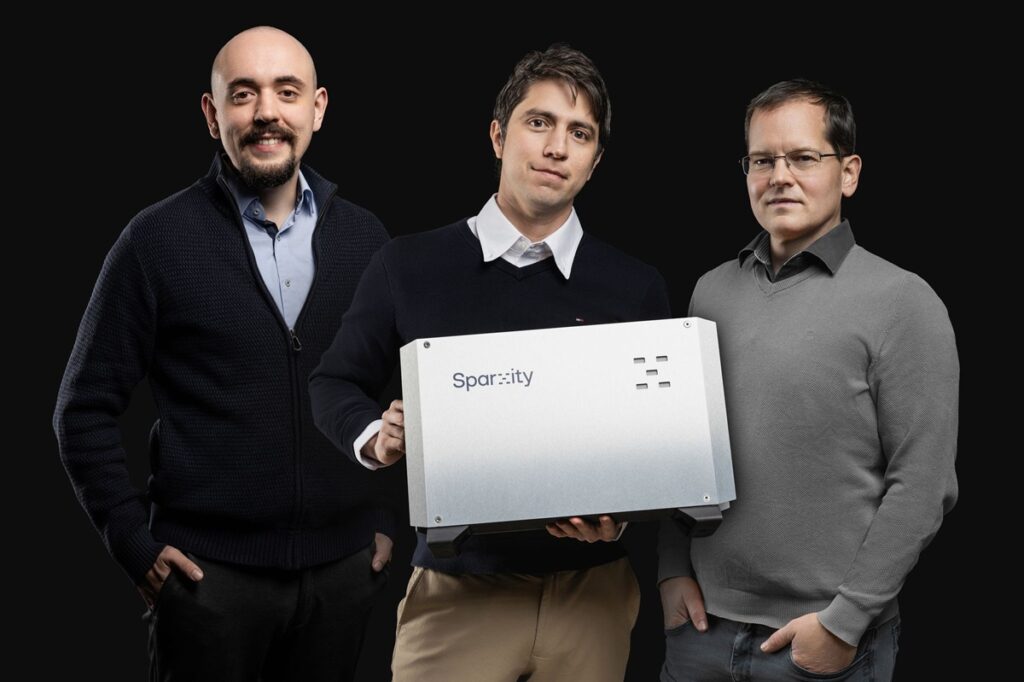
Sparxity said it has created a robust value proposition around sparse-native computing with tremendous traction. To date, the company’s foundation include three tapeouts, more than 70,000 chips produced and 12 racks deployed. Sparxity currently has more than 30 customers worldwide, including some of the globe’s largest supercomputing facilities.
“The next era of AI will be defined not just by how much computing power we can deliver, but by how intelligently and efficiently we use it,” said Sparxity CEO Hector Gonzalez, in a statement. “This financing is a powerful validation of our vision for sparse-native computing and the complementary positioning of our systems. With the backing of leading, strategic investors, we’re accelerating the transition from dense, energy-intensive architectures to heterogeneous datacenters with dedicated silicon for ultra-sparse workloads to unlock greater AI performance and lower costs.”
Sparse computing reduces unnecessary operations and data movement. Sparxity’s current systems bring this approach to HPC and AI, with reported results, including 10× faster sparse solvers, 18× lower energy use for event-based machine learning and 20× shorter runtimes for optimization problems on selected workloads.
Its next-generation chip technology is being designed specifically for dynamic sparsity in AI inference. For model developers, this offers finer-grained sparse architectures. For operators, the goal is higher throughput and lower energy and infrastructure costs.
“Sparxity has a unique complementary positioning at the infrastructure stack. Its architecture is grounded in first principles, addressing the inevitable shift toward sparse activation and the structural limitations of conventional hardware,” said Matthew Gould of ICM HPQC Fund, in a statement. “Sparxity has demonstrated the ability to manufacture its technology and deploy systems with major customers. We are pleased to lead this financing as the team builds on that track record to address next-generation AI inference.”
The funding follows two major announcements by Sparxity. The first was a multi-million-dollar deployment of its sparse-native computing systems at the Jülich Supercomputing Centre (JSC), part of Forschungszentrum Jülich and home to Europe’s first exascale supercomputer.
The second was a major partnership with Deutsche Telekom to bring Sparxity’s sparse-native technology into T-Systems‘ data center infrastructure. This partnership marks a significant step toward deploying energy-efficient, sparse-native AI computing at industrial scale.
“We are looking forward to having Sparxity on board in our AI factory soon. The German company scores particularly well with its energy-efficient use of AI computing power,” said Ferri Abolhassan, CEO of T-Systems, in a statement.
The company also recently introduced Sparxity (formerly SpiNNcloud) as its new identity, reflecting its broader commitment to sparse computing.