
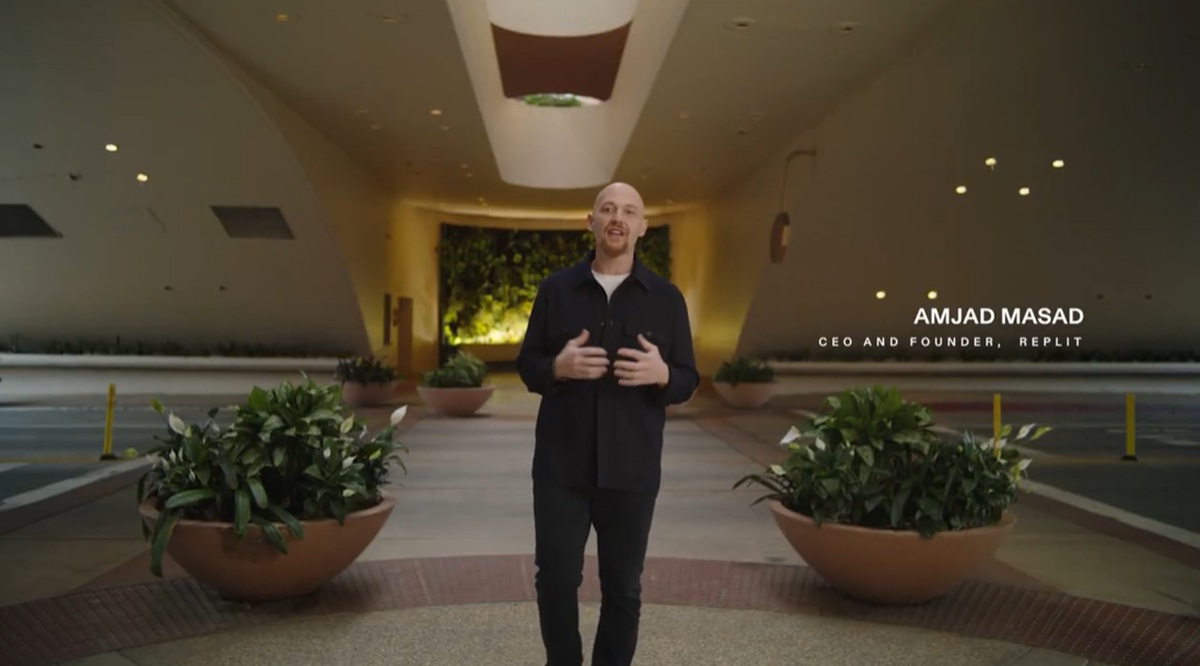
Replit has introduced Agent 4, an evolution of its platform designed to treat software development as creative work.
The platform is built on four pillars intended to synchronize imagination with implementation. Some people may see this kind of work as replacing human programmers. But the company sees its tech as freeing programmers to be more creative.
Core Functionalities of Agent 4 include:
- Integrated Design and Development: Agent 4 merges design and development into a single environment. Users can generate multiple design directions, iterate on specific UI elements like buttons, and integrate complex assets—such as 3D globe animations—directly into their working applications. Changes are immediately reflected in the live app.
- Parallel Processing: The platform moves away from sequential development. It allows multiple agents to work on separate project tasks simultaneously in the background. When tasks are complex, the system breaks them into smaller pieces, resolves them, and merges them safely.
- Creative Collaboration: Teams can collaborate in a shared workspace, moving beyond simple conversation management. The system provides visibility into what is in progress, who submitted a request, and what has been completed, while allowing users to review and approve tasks before they are applied to the main application.
- Unified Production: Users can build diverse outputs, including web apps, mobile apps, pitch decks, and promotional videos, within one platform. The system maintains consistent context and design across all these formats.
Impact and Availability
Agent 4 is available to all users starting today. Agent 4: is built for creativity.
The system is designed to allow users to build up to 10 times faster, leaving more time for creative decision-making, such as direction, taste, and judgment.
With Agent 3, the company pushed autonomy forward. Agent could run for hours independently—self-testing, fixing issues, and driving builds ahead on its own. At the time, it set a new bar for autonomous vibe-coding agents and showed what was possible when software could move without constant oversight, the company said.
That breakthrough unlocked something important: once the mechanics of building can run independently, the next frontier is creative control.
With Agent 4, we’re building on that foundation by putting human creativity at the center of the process. It introduces a set of interconnected innovations designed to keep you fully in creative flow – while the Agent handles the tedious but necessary work in the background.
What makes this possible is that it’s the complete environment where software is built, run, and shipped. That full-stack context allows Agent 4 to handle both the complex and the tedious, so you can focus on what’s uniquely human: creativity.
Design iteration is the most frequent kind of change—and often the slowest. In many teams today, design and development happen in different environments. That separation can sometimes create extra coordination overhead, especially when small visual changes need to be reflected across both design and code.
With Agent 4, Replit is dramatically speeding up design iteration by removing that friction. Design and code now live in the same environment. You can explore ideas, generate variants, and refine details inside your design board—without disrupting your working app or breaking your flow.
When you land on a design works, you can bring that into your app and integrate them into production code. You can explore freely while it builds in the background, then move forward with confidence.
The result is faster iteration, fewer surprises, and designs that don’t just look good in isolation—they translate cleanly into the real product.
To make that possible, Agent 4 introduces a set of focused improvements:
- Design while the Agent builds
You can now work on one part of your app while the Agent builds another. Design is no longer a separate mode, it’s something you can do continuously, at any point in the build process.
- Faster design exploration with an infinite canvas & multiple UI variants
Sometimes you don’t want the answer—you want options that you can compare, refine the strongest one, and move forward. Agent 4 introduces a canvas that allows free-form **design exploration and lightweight flows for generating and managing UI variants directly in context, so you can explore and iterate on real UI without leaving your app.
- More precise and reliable design controls
The company said it is providing more precise design controls like multi-select, hover/active state editing, responsive overrides, hover-to-preview interactions and easy undo etc. to enable you to make much more precise design changes directly in the UI, and those changes are applied straight to production code.
At some point, the only way to free up more time for strategic and creative work is to go faster on execution. Projects often feel slow because everything happens one step at a time. You wait for one thing to finish before starting the next, even when the work could move in parallel.
Agent 4 frees up more time for creativity by enabling parallel work—multiple agents working at the same time, each focused on a different part of the project. It’s the difference between one person tackling a checklist alone and a small team dividing the work and moving together.
There are two ways Agent 4 speeds things up:
Working on multiple tasks in parallel. Independent tasks can run in parallel, with progress visible and coordinated. Once the tasks are done, they can be merged into the main project. When changes conflict, Agent 4 uses specialized sub-agents to resolve them.
Breaking up big tasks automatically. For larger jobs, Agent 4 can split a single task into smaller pieces, work on them simultaneously with sub-agents, and recombine the results—shortening long-running tasks without sacrificing quality.
Because Replit powers your full environment—projects, files, and execution—it can coordinate this work safely. The result is faster iteration, less waiting, and more momentum, without losing control of your project. That’s performance you can feel.