
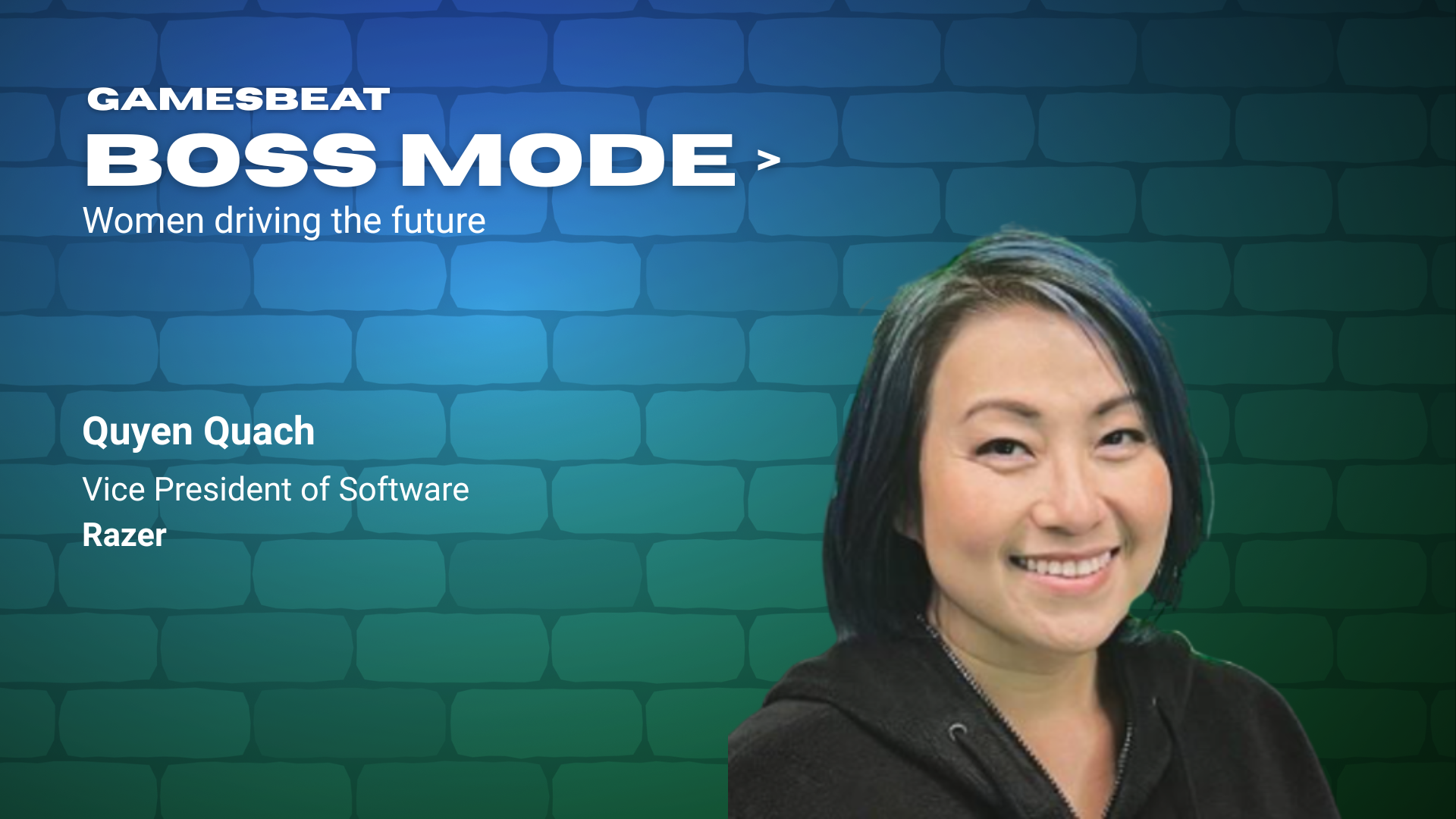
Not chosen by title. Chosen by impact. BOSS Mode is a new GamesBeat series highlighting the women leading change across gaming and every industry it touches. This isn’t a moment. This is a movement. New chapter. New era. Welcome to BOSS Mode.
In this BOSS Mode series, we often speak about mentorship and the case for creating new opportunities for the next generation of female workers in the games industry. But perhaps it’s also worth talking about why that’s important, even for those who don’t necessarily see it as part of their mandate.
To that end, I got the chance to speak this week with Quyen Quach, the vice president of software at Razer, about this topic. Quach has worked at Razer since 2018, with a focus on their future strategy as VP of Software. She’s worked on such familiar Razer products as Chroma, Synapse and Cortex as well as the Razer ID ecosystem.
During the discussion, Quach and I talked about our gaming history, what it’s like being the only woman in the room, and why that’s no longer acceptable or even viable. Below is an edited transcript of our interview.
GamesBeat: Do you want to start with giving me an overview of what you do at Razer, and your story?
Quach: I am VP of software at Razer, and that covers a ton of things. Our cloud infrastructure, our big data AI, software that’s used to run the hardware, that adds additional cool functionality to our hardware like Synapse and Chroma. We have a Chroma ecosystem which is a cool immersive lighting effect for gamers, and we have over 300 games connected to it.
So it’s a really cool place to play if you like tech and games! I’ve worked here for seven-and-a-half years. I’ve been in the tech industry for almost 30 years, so it’s been a long time. I’ve always loved tech. I love science. I love video games. I’m just a girl that always wanted to work in the video game industry and make cool stuff! So I feel lucky to be able to do what I love.
GamesBeat: Can you tell me more about your background in tech and video games?
Quach: My video game story started when I was a little girl, playing Zelda on the NES. I remember when I finished that game, that was the moment that I thought, “I want to make video games.” At that time, I didn’t know what a software developer was, but that’s what I became.
When I went to school for software development, there were very few women in the industry. I distinctly remember, in one of my classes –Electrical Engineering 101 — there were over 100 students and exactly three women. We saw each other from across the room, then went down to the front of the auditorium to meet each other after class.
That’s been most of my life, really, realizing suddenly that I’m the only woman in the room, or that there are very few women doing this. What can we do to make sure there are more opportunities like this for women? It’s not like they’re not interested. Sometimes they just haven’t had the opportunity or the right catalyst.
GamesBeat: What’s the biggest way that you think the games industry has changed from when you started to now?
Quach: The industry has definitely broadened with a much broader audience. It started with the early adopters — you had to be able to do afford the technology, or to go to the arcades to play. Now we have free-to-play games everywhere, available for anybody, anytime. We also have more diverse content that’s available, not just for different interests and backgrounds, but also different regions.
GamesBeat: Starting from the perspective of having been one of only three women in your class, how do you think the industry has changed for women — especially those just starting out in the industry?
Quach: I think we’ve come a long way. We definitely have a lot further to go. The female employees in tech, from the staff I’ve seen, are not really representative of the industry of customers that we have out there. There’s still a gap in representation. But I’m definitely no longer the only woman in the room, even when I’m in executive meetings. So that’s really great to see!
GamesBeat: You mentioned that one of the things you were passionate about was creating more opportunities for women. How do you think you can do that?
Quach: Visibility and have more conversations and creating awareness. Sometimes we’re just so busy working, we’re not conscious. I’ll do that sometimes — all of a sudden, I look up and realize I’m the only woman present. Explaining the importance of it, also.
Then, sometimes I have speaking opportunities, or the opportunity to mentor or sponsor women. I really enjoy those moments. I spoke at a company event a couple of years ago about how having more diverse teams is not just a social responsibility, but also a business imperative.
When I mentor women, I remind them to speak up because it’s not just your personal opinion — you’re representing a customer base!
When we’re creating products, we need to make sure we’re including women in the room from the very start, at the design stage, all the way to when we’re marketing them, so that we’re creating better products for all of the customers out there. You’re missing out on certain points of views when you don’t have a diverse team, whether that’s in the technology you’re creating, or the marketing campaigns that you’re running.
So you need women in the room to speak up. When I mentor women that I worth with or within my teams, I remind them to speak up because it’s not just your personal opinion that you’re presenting. You’re representing a customer base that others may not be thinking of at that moment. It’s okay to have that opinion!
GamesBeat: Do you have any advice or insights that you would give to a woman you’re mentoring? What would you tell a woman who’s just entering the industry?
Quach: I think one insight that I’ve mentioned to my mentees the most — because it was the most surprising for me — is from Lean In. I avoided reading that book for many years because so many people told me I should read it and that it sounded like me. I thought, “No, that’s not me. I’m not a ‘lean-in.'”
Honestly, I never sought to be a leader. I actually was a gamer that wanted to work on cool tech, that wanted to be a mom. I thought I was just going to be a software engineer my whole life. That’s all I wanted to do, and then to go home, raise a family and play games. Then somehow I got here, and I thought, “No, Lean In is not me.”
Then I finally read the book and one part stood out to me: Men apply for jobs when they feel 60% qualified, but women apply only when they feel 100% qualified. Then I thought, “Oh my god, that is me and so many people that I know.” Just having the awareness of that and having those conversations makes people realize that we’re holding ourselves back.
Be proud of who you are! Be proud of how different you are and the things that you have and just go for it! I know that’s been quoted a lot, but a lot of women still find it surprising even when I reference it now. A lot of women that I’ve met have to be reminded throughout their lives to represent themselves, promote themselves and their own skills and be confident of that.
GamesBeat: You said you didn’t really set out to be a leader, but now that you’re in a leadership position, how do you lead with impact?
Quach: There are a couple of different ways to define that, but I will go with how I impact my organization. Caring my organization and the people that work for me and their opportunities, no matter what their gender or background, trying to find their strengths has been really fun. It started out first as trying to figurer out how to best utilize the team.
At the end of my life, I’m going to remember the differences I made in somebody’s life, rather than the millions of dollars that I helped some company make.
It’s like playing a video game and figuring out which character should be the mage, which one should be the tank — assessing and organizing the team. Then I realized that it was also helping people find that in themselves. Most people actually didn’t realize their strengths in themselves, and having those conversations, you can become the catalyst to accelerate what hey can do in their career.
There’s a self-realization that comes with it, but there’s also a benefit for the team, organization or company, because then that person can do so much more. That’s part of the mentoring that I do. It’s easier for me to do within my own organization because I work with them and see them every day.
I’ve had so many moments with my people that I feel so proud of. I think, at the end of my life, those are the moments that I’m going to remember: The differences I made in somebody’s life and those moments working together, rather than the millions of dollars that I helped some company make.
GamesBeat: What do you think is your Boss Move, that defined your career?
Quach: It’s not one moment in particular, but it’s something that I want to share, because I think it would help other women, or anyone really — it’s a Boss Move in that way: Don’t let anyone else define what your job is. Make sure you’re really clear on what the goals and mission are.
You can define your career. You have control. Think through how to achieve the goals you’ve been set in your own style. I’ve gotten feedback as I’ve shifted into more leadership roles that I should lead in certain ways. “Be more like a man. Be tougher. Yell at people.” I didn’t want to. I wanted to do things my way. When you take initiative, you define your own path and people start to see you as a leader because you’re not a follower.
GamesBeat: And what would your boss music be?
Quach: Can I give you two answers?
GamesBeat: Yes, of course.
Quach: The song that I listen to a lot right now is “Golden” [from K-Pop Demon Hunters]. The song, the story behind it, the words, that motivates me.
But the two video games that I listen to the sounds from a lot — all the sounds on my phone, my ringtones — are the original NES Zelda and the original Metroid. The original Metroid is one of those really memorable moments for me as a female gamer, to realize at the very end of the game that you were playing a woman the whole time!