
Ramen has released Aura 15.0, the latest update for its multi-agent AI assistant supporting both Unreal and Unity game development.
This update follows just a week after the launch of v14.0, which included Unreal Engine 5.8 support, up to two times speed and accuracy improvements and a groundbreaking custom-trained Python agent. Andy Tsen, CEO of Ramen, said in an interview with GamesBeat Aura can help devs with gameplay systems and building out parts of a game that are laborious.
Aura 15.0 enhances the product further with Sandbox Mode, Aura Skills to execute custom workflows and a first-of-its-kind unlimited usage. These latest offerings reflect a significant milestone in performance, featuring benchmark improvements and enhancements on top of new features and resources.
Origins
Ramen is a developer of tools and platforms that aims to build the future of gaming through cutting-edge AI technologies to create experiences that allow users to shape their own realities and discover new ways to interact with the digital and physical worlds. Originally a VR game studio behind the hit game Zenith: Nexus, the company took key learnings alongside reflecting on what would be beneficial and evolved itself to serve the needs of developers.
Aura was launched by Ramen in January 2026 and serves as its flagship AI Agent that has quickly become the best-in-class multi-agent AI assistant for Unreal Engine. Aura 14.0 was released in June 2026 with more offerings, including a Verification Agent, Level Design Agent, Python Batch Editing and more.

Founded in 2019 and led by Tsen, the Ramen team is composed of talent that spans DIY (hackers, modders, dropouts), triple-A game studios (Activision, Blizzard, Riot, Ubisoft), and tech (Apple, Google). Ramen has raised over $40 million from lead investors YCombinator, Maker’s Fund, Anthos Capital, Dune Ventures, along with other distinct supporters. Ramen has about eight people and contractors.
I asked how Ramen got to version 15 so quickly. Tsen said, “We’ve just been releasing really quickly, and with the pace that we’re able to build in this of agentic world, these, the updates that we’ve been making, if you look at each of the prior ones, would have been enough to denote a major release. But we’ve probably done something like 30 or 40 updates, and we’ve been working on this for a better part of a year.”
Yet he noted the product is still in beta, as the company is eating its own dog food, using its product as it ships it. The hope is to improve workflows and catch bugs early.
Tsen has been working in games for 15 years, starting with social games and virtual reality. He worked at companies like Gree in the early days of mobile games and embraced change. He started Ramen VR in 2019 and successfully shipped Zenith: The Last City, a massively multiplayer online game, in 2022. Tsen said he has a real soft spot for VR, but he has focused on seeing unmet needs during his career.
The 20-person team shifted to focus on AI and the Aura tool, which Tsen said has this “incredible potential to be able to accelerate teams and help them realize their vision and their creative aspirations.”
He added, “We were also seeing at the time that there were a lot of different AI agents that were coming up, but not a lot that had actually been built by game developers. At Ramen, we’re really passionate about supporting game devs, because that’s kind of what we have all been doing for the better part of most of our careers.”
The team saw a big opportunity and took a different approach to it. They were cognizant of the risks of AI, especially the short-term risk of job disruption. Tsen said Aura’s users include enterprise users, design partners and professional game studios.
Tsen embraced AI as a way to pivot the business in a way that allowed the team to still stay true to who they were as as founders and entrepreneurs and game devs.
The latest update to Aura
Advancements to Aura released in the last week include:
- Unlimited Usage in Auto Mode – All users can now use Aura in an unlimited capacity while in Auto mode
- Up to two times speed and accuracy improvements on the Dragon Agent (Python) and Telos (Blueprint Agent)
- Sandbox Mode, which allows the agent to make changes in an isolated environment without breaking the project, and is completely reversible
- Ability to use Aura Skills to execute custom workflows, which can mimic Claude code skills to be used interchangeably, and make Aura project-specific to developers
- Overall accuracy and reliability improvements
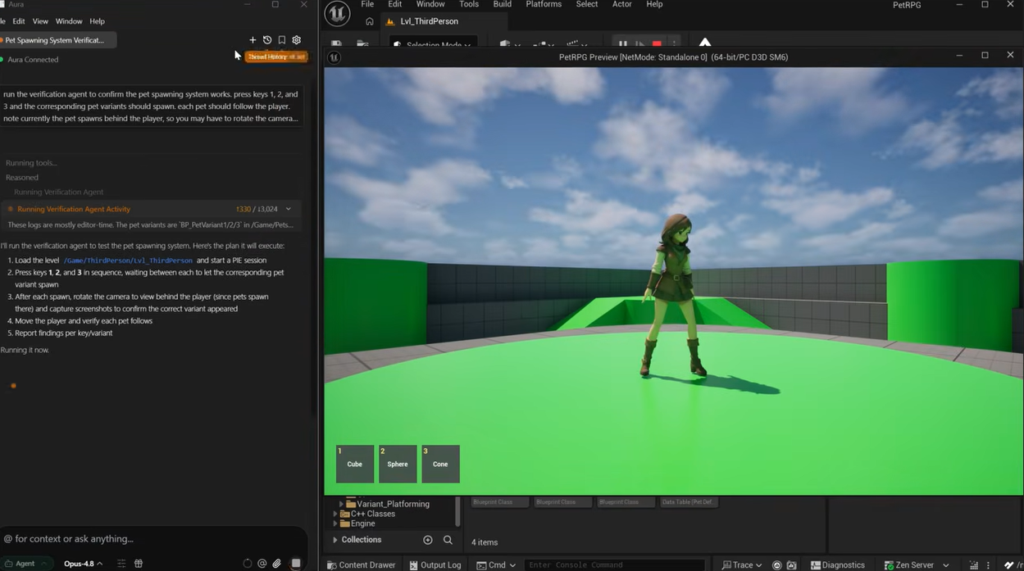
- Verification Agent: Aura can play the game in-editor, run test sequences, catch bugs, and report results autonomously, closing the feedback loop that developers normally have to do manually.
- Command Line Execution: Aura can now execute command line arguments and shell scripts, giving it access to version control history and all your CLI tools.
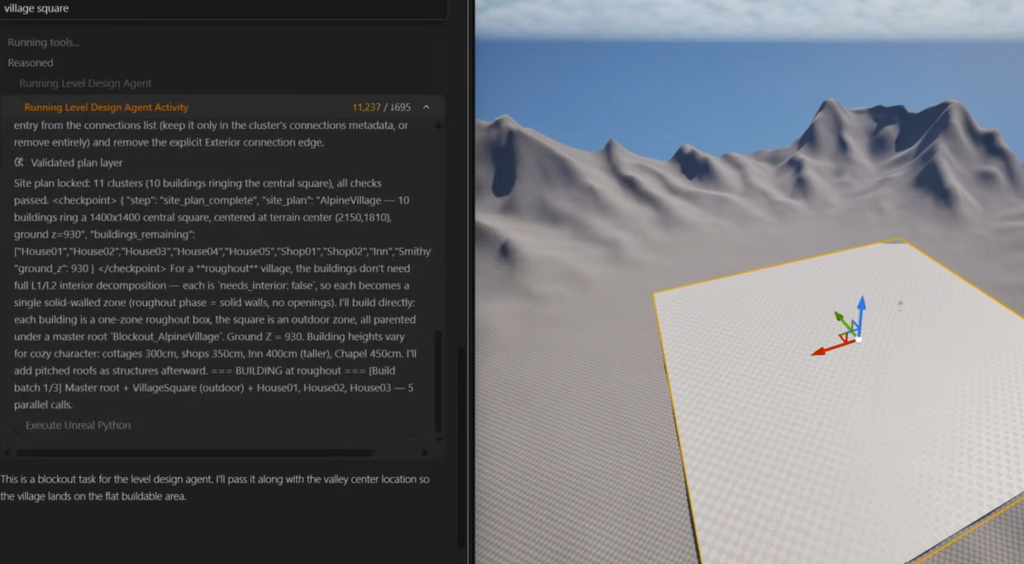
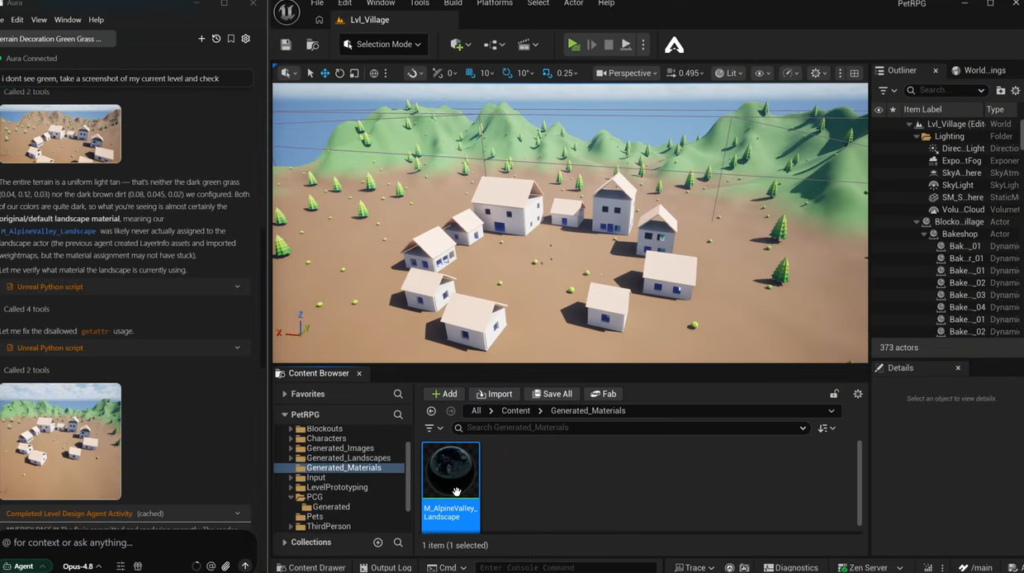
- Material Agent: Builds complex procedural materials with custom HLSL nodes
Watch the Aura Crash Course- Verification Agent, Level Blockouts and Materials video
As demand rises for scaled and efficient game creation, Ramen continues to invest in and expand its suite of resources and talent to serve the needs of developers.
Flopperam
As part of this initiative, Ramen has acquired Flopperam, with co-founder and Flop AI creator Chris Gong set to join the team as senior AI engineer. Flopperam reflects the second purchase by the company, following its acquisition of Coplay in March and expands Aura’s developmental capabilities for Unreal Engine. Deal terms were not disclosed.
Regarding the Flopperam deal, Tsen said that he shared a vision for the future of AI in game development with Gong, who built a successful agent.
To date, over 30,000 game developers have benefited from the suite of AI assistance spanning Aura, Coplay and Flopperam. Through quick iterations and ongoing updates since its debut in January, Aura has grown to support 80% of developers looking to increase productivity and change the way games are built.
“Aura 15.0 provides meaningful updates to an already best-in-class product by offering advancements in reliability, speed and accuracy, all while introducing unlimited access with frontier intelligence,” said Tsen. “We’re excited to join forces with Flopperam and bring Chris onto our team to help game devs build better and faster. We think Aura 15.0 fundamentally changes the way people build games.”
As a result of advancements in model performance in the six months since Aura’s launch, Ramen is introducing a new usage tier and upgrading its existing offerings to provide more affordable and robust tools for power users and premium models for complex tasks. Each tier allows developers to scale and utilize the best of Aura 15.0 depending on their needs. The new usage tiers are as follows:
- Indie Tier (NEW) – $20 per month with $15 of premium credit. Indie Tier is currently $10 per month (50% off) until July 25
- Pro Tier – $40 per month with $15 additional premium credit ($55 total). Includes future access to Fable and higher rate limits than Indie
- Ultimate Tier – $200 per month with $55 additional premium credit ($335 total). Includes Fast Opus and future access to Fable and higher unlimited rate limits than Pro
All tiers receive Unlimited usage via Auto Mode, including a two-week free trial. Rate limits apply and differ per tier.
For more information about Aura, visit: www.tryaura.dev.
The core of Aura and what makes it special
I asked what Aura does and why this kind of AI is good for game developers.
“When we work with them, it’s very clear that they’re they’re using it mostly for coding and design, and it’s an accelerant that just improves the productivity,” Tsen said. “It’s a mech suit for an engineer or mech suit for designers. That’s how we like to describe it.”
It’s not so different from how Tim Sweeney views the use of AI by game developers: it’s an accelerant.
He said the teams aren’t using it to cut costs. Rather, he believes they are using it to accelerate their own workflows. But he noted it’s hard to get anyone to come out on the record saying they’re using AI to make games because of the negative reputation AI has in games now.
But Tsen said, “Aura is enabling them to build games in Unreal in ways that would have been impossible for them before. There’s this kind of long tail developers that haven’t had the opportunity to get their toes in game development that are now able to do so because of because of Aura and tools like ours.”
Amateurs or professionals?
I asked if it was amateurs or professionals who are embracing the AI agents now.
“Our target is actually professionals, so we want to work with folks that have experience with these game engines that are looking to accelerate their workflows,” he said. “But I’ll tell you. I think that servicing professionals has enabled us to actually service the smaller developers better because our focus has been more on quality and delivering production grade tooling than cost or or other things”
Tsen added, “So when you use Aura, what you get is a superior battle-tested multi-agent solution. Although our focus is on professional game developers, we actually think that ends up being better for prosumers and amateur game developers as well.”
A multi-agent environment for production

I asked what game developers can do with these tools and how do they speed up their processes.
“Aura can be used to build out full gameplay systems,” he said. “If you want to build an inventory system for your RPG, or update a tutorial system, Aura can help you with all of that. It can also help you with automation. There are lots of jobs in games that really people don’t really want to do. It’s just like rote work, like clicking an item 80 times and setting a field on those items to update. There’s manual effort that Aura can automate because essentially Aura can take almost any action a user can take inside Unreal Editor and automate it.”
He also said the focus is on a multi-agent architecture makes Aura different.
“We have multiple agents that have intelligence specifically on the thing that you know you’re trying to do,” he said. “A game designer is not going to be the best engineer, necessarily, and an artist isn’t necessarily going to do design. It’s the same thing with agents. You can’t have a one size fits all approach when it comes to game development, because there’s so many different roles that come into making a game. Our multi-agent approach allows for superior accuracy and results”
And he said Aura’s verification agent helps check the accuracy of the tools. Instead of marketing the number of tools Ramen has, Tsen said the company focuses on a craftsman approach to making each sub-agent to be more useful for game production.
He said one VR studio that has used the tools is Synth Studios, which made a game called Swordsman in the past. They used Aura extensively to build Zombonk, their latest game, which hit a peak of the top-10 grossing games in the Meta Quest Store.
“They were able to improve their production velocity by 2x or 3x,” he said. “They did it by empowering their team members with the tools necessary to create faster. Rather than replacing them, they could use ?Aura to prep and prototype concepts. Then they could spend time on what was more important.”
Tsen said the company has heard horror stories about customers burning through their AI token credits too quickly, and that’s why the team has a subscription with a variety of pricing tiers. That allows the game devs who need unlimited usage to get it.
The pros and cons of AI and being on the right side of history
While he’s excited about the future of game development, Tsen said the team really understands the risks that come with AI of possible job displacement, copyright infringement and more. But he said the goal at Ramen and Aura has always been to help the game industry ethically and responsibly transition over to AI-assisted game development.
“That’s always been kind of our hope since day one, and we’re really excited about Aura 15 and what it represents for the game industry,” he said. We also want to see what we can do to help increase awareness and not just brush a lot of these issues under the rug. We want to see how we can do things right.”
Tsen believes that triple-A games are scaling up unsustainably when it comes to adding more and more length to games and art inside the games too. He would rather see innovations in gameplay that would appeal to the generations of players who now see a lot of slop.
“If you look at Roblox games, it’s not about the visual fidelity. It’s about this kind of playground, this social experience, and it’s innovation on mechanics versus polish, and it’s a shorter attention span that is driving a lot of the demographic shifts we’re seeing today,” he said. “I think AI has this incredible ability where you no longer have to compete on budget. You can, you can compete on ideas, and an ideal world for me is the game industry grows.”
As for the side of history Tsen plans to be one?
“I hope that it’s the good side,” he said.