
Rambus, a chip intellectual property provider, announced its complete DDR5 9600 Client Memory Module Chipset for AI PCs at a time when memory is scarce.
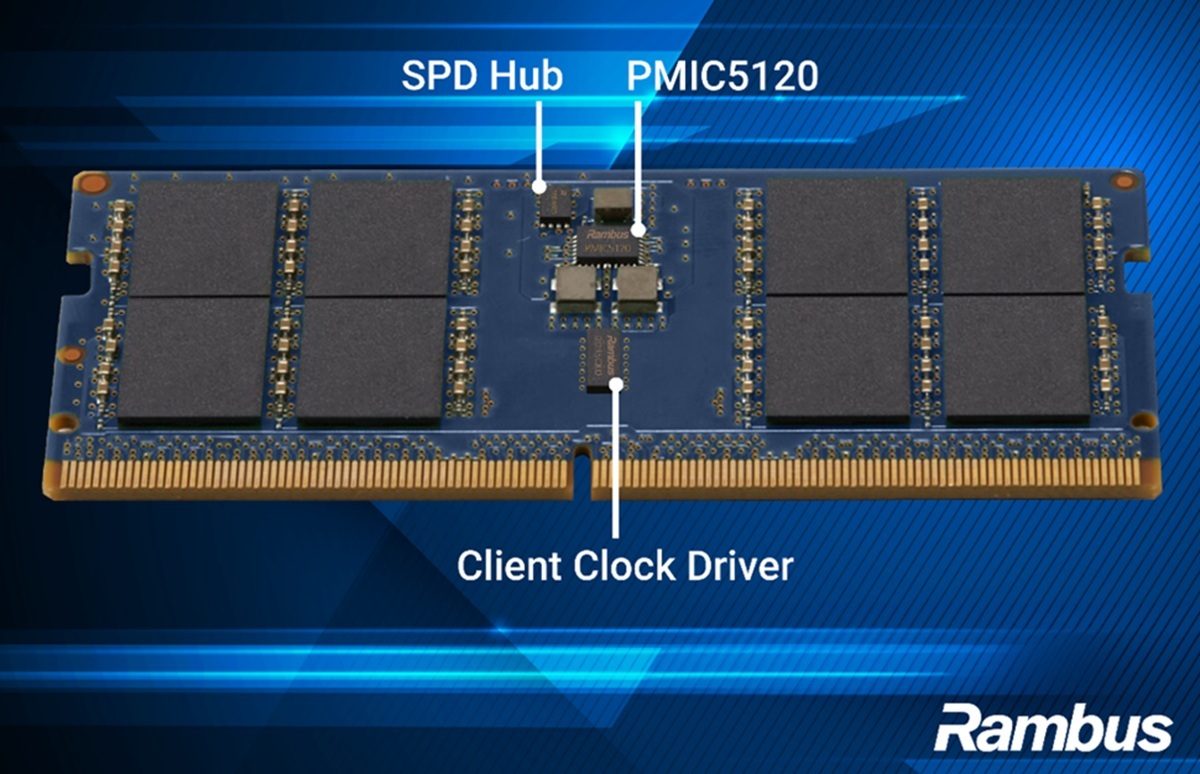
The chipset is targeted at high-performance CUDIMM, CQDIMM and CSODIMM modules in future generation AI PCs. The chipset includes the new Gen2 Client Clock Driver (CKD02), delivering breakthrough performance with support for PC memory module operation of up to 9600 MT/s, Power Management IC (PMIC5120) and Serial Presence Detect Hub (SPD Hub).
With the rise of agentic AI, PCs now plan, execute, and adapt workflows in real time. These workloads require persistent context, concurrent processing, and continuous data movement between the processor and system memory requiring significant increases in both bandwidth and capacity. At the same time, scaling DDR5 memory beyond 6400 MT/s introduces new technical challenges, including signal degradation, clock jitter, and timing instability, the company said.
To address these challenges, the industry is transitioning to clocked memory modules, including CUDIMM and CQDIMM for desktops and CSODIMM for laptops, which incorporate an on-module client clock driver (CKD) to condition and redistribute the clock signal.
I asked Rambus how this could help the memory chip shortage. John Eble, VP of Product Marketing, Memory Interface Chips at Rambus said in reply, “The memory manufacturers have talked about how HBM requires 3-4 times the capacity per bit vs. DDR5. The very high demand from AI for HBM memory has created a supply-constrained environment for the memory industry, and industry analysts are projecting that situation persists through 2027 since it takes time to bring on new fab capacity. For the PC market, available supply will likely be directed to the high-end, high-performance segments. And it’s these segments that our new DDR5 Client Chipset serves enabling new levels of bandwidth and capacity. Further, we are working closely with ecosystem partners and suppliers to ensure our memory interface chips will not be a bottleneck as additional DRAM capacity comes on line and more memory is available to the PC market.”
The new Rambus DDR5 9600 Client Chipset provides a complete solution for clocked DDR5 modules operating from 8000 to 9600 MT/s. Designed for performance and scalability, the chipset supports next-generation AI PCs, notebooks, and workstations.
By addressing signal integrity, power delivery, and system coordination at the module level, Rambus simplifies the design and deployment of high-performance memory module solutions.
“Agentic workloads are fundamentally more memory-hungry, driving the need for higher memory bandwidth, greater capacity, and improved efficiency in AI-enabled PCs,” said
Rami Sethi, SVP and general manager of Memory Interface Chips at Rambus, in a statement. “Our DDR5 9600 Client Chipset, featuring the Gen2 Client Clock Driver, delivers the performance foundation needed to enable this new era of intelligent, high-performance
client systems for AI-driven productivity, next-generation gaming and professional
content creation.”
“As AI-driven workloads become increasingly pervasive across client devices, memory
subsystem innovation will be key to unlocking their full potential,” said Jeff Janukowicz,
an analyst and research vice president at IDC., in a statement. “To meet growing performance demands, the industry is transitioning to clocked memory architectures such as CUDIMM and CSODIMM, which are designed to address signal integrity and timing challenges at higher data rates. Complete chipset solutions that deliver stable, high-speed operation will play a critical
role in accelerating the adoption of next-generation AI PCs.”
The Rambus DDR5 9600 Client Chipset supporting high-bandwidth, high-capacity,
clocked client memory modules and includes:
Gen2 Client Clock Driver retimes, conditions and distributes the clock sent from
the processor to the DRAM devices on the DIMM
PMIC5120 efficiently steps down the system voltage supply to the voltage levels
needed to power the DRAM and all other active chips on the module
SPD Hub enables communication of module identification, configuration, and
telemetry