
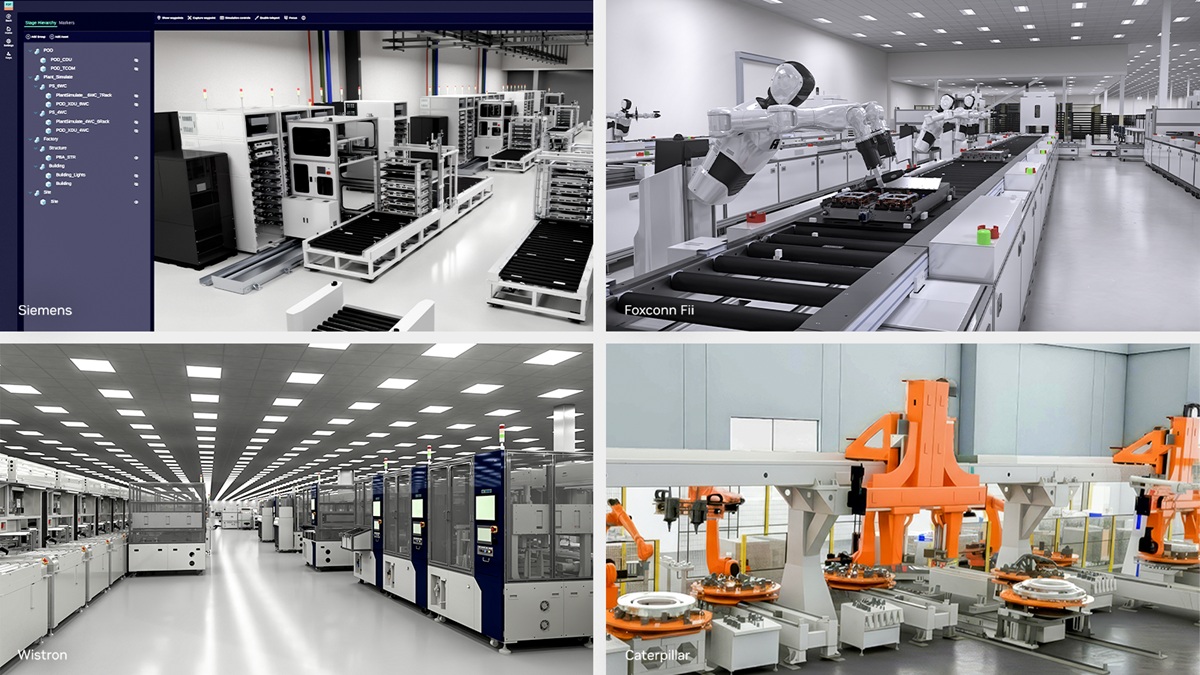
Nvidia announced that top U.S. manufacturers and robotics companies are using its Omniverse technology to build smart factories and advanced robots that can work alongside humans.
These AI-powered systems are designed to help solve labor shortages and boost productivity, marking a new wave of industrial innovation. According to Nvidia’s CEO, Jensen Huang, this effort is turning traditional factories into intelligent machines, helping make American manufacturing more competitive and resilient.
Nvidia said the nation’s leading manufacturers, industrial software developers and robotics companies are using Nvidia Omniverse — a kind of metaverse for engineers — to build robotic factories and new autonomous collaborative robots to help overcome labor shortages and drive American reindustrialization.
“AI is transforming the world’s factories into intelligent thinking machines — the engines
of a new industrial revolution,” said Huang, in a statement. “Together with American’s manufacturing leaders, we’re building physical AI, Omniverse digital twins and collaborative robots that will drive productivity, resilience and competitiveness across the U.S. industrial base.”
Nvidia is pretty savvy in staging its GTC event in the nation’s capital. It’s clear that big companies need to stay on the good side of Donald Trump, who has been very transactional in cutting deals. By helping politicians and allies in the government understand tech, Nvidia can stay on the good side of government controls. Axios called the San Jose version of Nvidia GTC the “Super Bowl of AI.” The new DC edition is an attempt to impress those who hold political power that empowering the tech industry is a way to make the nation and its economy more competitive in the world.
An Nvidia spokesperson said in a message to GamesBeat, “We’re in the early innings of the AI industrial revolution—intelligence is becoming a new kind of infrastructure. This is America’s moment to decide who will lead and set the global standard. During GTC DC, we will continue engaging the U.S. government to inform on our technologies, and most critically, to underscore Nvidia’s commitment to helping America win the global AI race by boosting U.S. manufacturing, building critical infrastructure, and reindustrializing the country for the AI era.”
The operating system for the industrial AI era
Nvidia announced that it is expanding its “Mega” Nvidia Omniverse Blueprint for
simulating robot fleets to include technologies for designing and simulating factory digital
twins. Nvidia’s AI Blueprints are like ready-made recipes for building smart AI tools, so developers don’t have to start from scratch.
Siemens is the first company to develop digital twin software that supports the Mega
Omniverse Blueprint. Currently in beta testing, the new industrial technology stack will be
part of the Siemens Xcelerator platform.
It will help engineers design and operate large scale digital twins of factories that bring together realistic 3D models with live operational data. Built for the AI era, this technology stack enables comprehensive simulation, optimization and real-time performance monitoring that can help design smarter and more efficient factories, products and data centers.
FANUC and Foxconn Fii are among the first robot manufacturers to support 3D, OpenUSD based digital twins of their robots to make it easy for manufacturers to drag and drop equipment into their digital twins.
In his Nvidia GTC Washington, D.C., keynote address, Huang showcased how Foxconn is
using the new Omniverse technologies to design, simulate and optimize its new 242,287
square-foot facility in Houston, Texas, for manufacturing Nvidia AI infrastructure systems.
America’s leaders build AI-driven factories to accelerate manufacturing
In 2025, $1.2 trillion in investments toward building out U.S. production capacity was announced — led by electronics providers, pharmaceutical companies and semiconductor
manufacturers.
The nation’s leading companies are relying on applications from independent software vendors and Omniverse libraries to build robotic factories that can power this wave of industrialization, using physical AI and simulation to accelerate manufacturing.
Belden has implemented Accenture’s Physical AI Orchestrator, which combines Nvidia
Omniverse libraries, the Nvidia Metropolis platform and agentic AI from Accenture, to
create virtual safety fences for instant hazardous zone monitoring and real-time quality
inspection systems in factories and warehouses.
Caterpillar is applying Omniverse to build digital twins of its factories and supply chains,
for use in advanced manufacturing capabilities such as predictive maintenance and dynamic scheduling, Nvidia NIM microservices to drive workflow automation and predict and optimize factory maintenance, and Nvidia cuOpt software to optimize supply chain performance.
Lucid Motors is using Omniverse to build digital twins of its factories for real-time factory
planning and optimization, as well as to train AI-driven robotics systems. Toyota is using
idealworks’ iw.sim technology, which integrates capabilities from the Mega Omniverse
Blueprint, to create digital twins of its Georgetown, Kentucky, facility and explore complex
automation scenarios.
TSMC is using Omniverse to accelerate fab design and construction, as well as the Nvidia
Isaac platform for the development of robotics for specific operations at its Phoenix, Arizona, facility to significantly enhance manufacturing productivity.
Wistron is using a suite of Nvidia AI and Omniverse technologies to implement a rigorous digital testing and validation process for the systems it assembles in its Fort Worth, Texas, facility.
Leading robot developers assemble America’s new robotic workforce
Robotics companies are using Nvidia’s three-computer architecture to build and deploy
advanced fleets of robots that will play a critical role in bridging skills gaps, enhancing
worker productivity and improving safety across industries.
Figure and Nvidia announced a collaboration to accelerate next‑generation humanoid robotics. Using Nvidia accelerated computing to build its Helix vision language action model and the Isaac platform for simulation and training, Figure is rapidly building the world’s most advanced, large‑scale humanoid fleet capable of everything from household chores to industrial support.
Agility Robotics’ general-purpose humanoid, Digit, uses the Nvidia Isaac Lab framework to refine whole-body control through millions of reinforcement learning scenarios, which
accelerate enhancements to its skillsets such as step recovery from environmental
disturbances, often needed in highly dynamic areas like manufacturing and logistics
facilities.
Digit is powered by the Nvidia Jetson AGX Thor module, enabling real-time perception, navigation and autonomous decision-making.
Amazon Robotics is using Omniverse libraries and frameworks to shorten the development of Amazon’s various manipulation systems and mobile robots, which run on the Nvidia Jetson robotics platform, from years to months. Thanks to simulation training, Amazon’s recently announced BlueJay multi-arm manipulator for picking, stowing, and consolidating, moved from concept to production in just over a year.
Skild AI is building a general-purpose robotics foundation model that spans legged,
wheeled and humanoid robots, using Isaac Lab for locomotion and dexterous manipulation tasks training and Nvidia Cosmos world foundation models for generating training datasets.
FieldAI is training cross-embodied robot brains for monitoring and inspection in construction and oil and gas environments, using Isaac Lab for reinforcement learning and
Nvidia Isaac Sim for synthetic data generation and software-in-the-loop validation.
AI infrastructure accelerates industrial digitalization
Nvidia provides edge solutions and works with leading cloud service providers to offer broad access to the powerful AI and simulation infrastructure needed to accelerate manufacturing in America.
Nvidia IGX Thor, an Nvidia Blackwell-powered, enterprise-ready platform designed to power the next generation of industrial and medical edge AI applications, is being adopted
by industry leaders including Diligent Robotics, EndoQuest Robotics, Hitachi Rail, Joby
Aviation, Maven and SETI Institute.
Google Cloud announced that its new G4 instances powered by Nvidia RTX PRO 6000
Blackwell Server Edition GPUs are now available, while Microsoft will soon offer these
GPUs both in Microsoft Azure public cloud and at the edge with Azure Local distributed
infrastructure.