
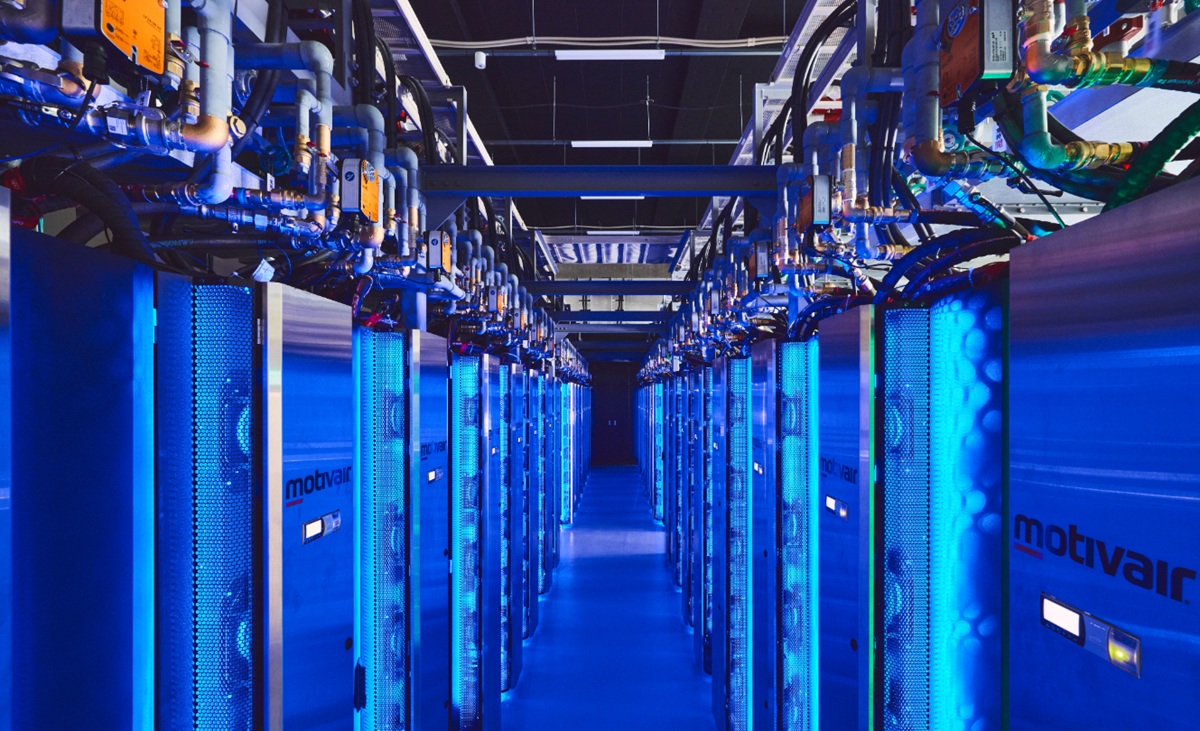
Nvidia announced the opening of the Global Research and Development Center for Business by Quantum-AI Technology (G-QuAT), which hosts ABCI-Q — the world’s largest research supercomputer dedicated to quantum computing.
Quantum processors promise to augment AI supercomputers in solving some of the world’s most complex challenges, spanning industries including healthcare, energy and finance. By enabling quantum-GPU computing at an unprecedented scale, ABCI-Q marks a profound leap toward realizing practical, accelerated quantum systems, Nvidia said.
Delivered by Japan’s National Institute of Advanced Industrial Science and Technology (AIST), the ABCI-Q supercomputer features 2,020 Nvidia H100 graphics processing units (GPUs) interconnected by the Nvidia Quantum-2 InfiniBand networking platform.
The system is integrated with Nvidia CUDA-Q, an open-source hybrid computing platform for orchestrating the hardware and software needed to run useful, massive-scale quantum computing applications.
“Seamlessly coupling quantum hardware with AI supercomputing will accelerate realizing the promise of quantum computing for all,” said Tim Costa, senior director of computer-aided engineering, quantum and CUDA-X™ at Nvidia, in a statement. “Nvidia’s collaboration with AIST will catalyze progress in areas like quantum error correction and applications development — crucial for building useful, accelerated quantum supercomputers.”
ABCI-Q’s AI supercomputing is integrated with a superconducting qubit processor by Fujitsu, a neutral atom quantum processor by QuEra and a photonic processor by OptQC — enabling hybrid quantum-GPU workloads across multiple qubit modalities.
“ABCI-Q will enable researchers in Japan to explore the core challenges quantum computing technologies face and speed the path to practical use cases,” said Masahiro Horibe, deputy director of G-QuAT and AIST. “The Nvidia accelerated computing platform in ABCI-Q will empower scientists to experiment with the stepping-stone systems needed to advance quantum computing.”