
Nvidia announced it will boost 6G development by open-sourcing its Aerial software for building AI-native 5G and 6G networks.
Nvidia Aerial software will soon be released as open source, making it available on a variety of Nvidia platforms, including on Nvidia DGX Spark.
With open-source software and a powerful and accessible supercomputer to run it all, AI-RAN and wireless researchers can go from rapid prototyping to product development in hours versus months or years.
That means next-generation AI-native mobile networks can be built at the pace of AI for
open, widespread collaboration, unlike previous generations where innovation was
constrained by access to licensed software and proprietary hardware.
Rewriting the wireless playbook with open source
Open source is reshaping industries by breaking down barriers to innovation and
accelerating collaboration, enabling breakthroughs that would be impossible under closed, proprietary systems.
Nvidia is a leading contributor to open source, including for the telecom industry. Previously open-sourced Nvidia Sionna software has already surpassed 200,000 downloads and 500 citations.
Now, Nvidia is open sourcing its Aerial software, including Aerial CUDA-Accelerated RAN,
Aerial Omniverse Digital Twin (AODT) and the new Aerial Framework.
These resources — previously limited to a small group — are expected to be available on GitHub under Apache 2.0 licensing starting this December, with AODT release in March 2026, empowering developers to build full-stack, AI-native 5G and 6G RAN solutions. They
can experiment and build AI-native network solutions without restrictions, accelerating the transition from research to real-world deployment.
Dion Harris, senior director of HPC and AI Infrastructure Solutions, said in a press briefing that Nvidia Aerial RAN will be the “foundation of AI native 5g and 6g.”
The upcoming Aerial open-source release is packed with capabilities, including:
● Aerial Framework for converting Python code into high-performance CUDA code to
run on Nvidia Aerial RAN computer platforms.
● AI-powered neural models, such as advanced channel estimation for significantly
improving wireless performance.
● A dApp framework to provide third-party applications with access to real-time
physical layer data through secure application programming interfaces. Developers
can deploy AI-powered dApp algorithms that can modify RAN behavior in real time.
● Customizable pipelines with modules that developers can selectively modify or
replace with their own code to build full-stack RAN software.
Such features have enabled the first made-in-America AI-native wireless stack, showcasing
early 6G applications including spectrum agility and integrated sensing and communications.
This move expands access to powerful CUDA-accelerated wireless software and boosts the global movement toward AI-native 5G and 6G solutions. It opens doors to developers
beyond the telecom industry, making it easy for them to build new applications for mobile
networks, including agentic and physical AI applications that need mission-critical
performance.
This shift amplifies U.S. leadership in open source and fundamentally rewrites the way the
telecom industry innovates — sparking knowledge-sharing and an implementation-first
approach at a global scale.
DGX Spark: The desktop supercomputer for wireless R&D
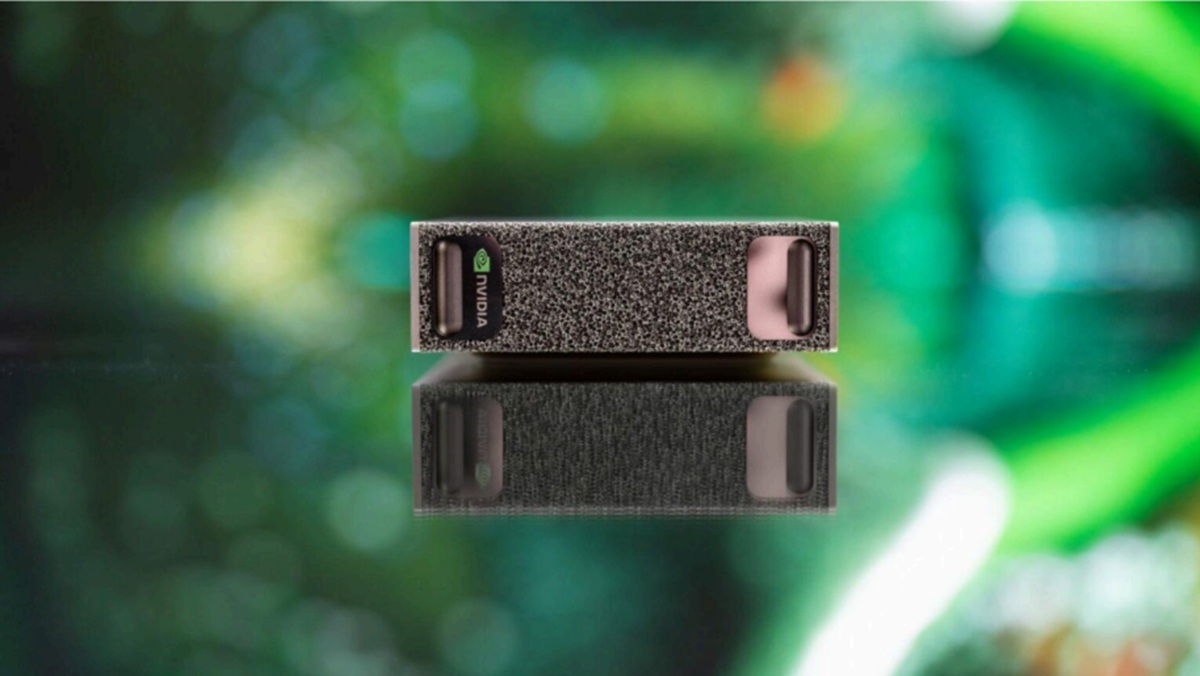
Nvidia DGX Spark, the world’s smallest AI supercomputer, is now available for AI-native 5G
and 6G research. It delivers the performance to run NVIDIA Aerial or Sionna software in a
cost-effective small footprint. Whether procured through manufacturers or accessed via
Nvidia DGX Cloud, DGX Spark empowers teams to prototype complete wireless networks
and continuously train and refine their AI models using real-world data gathered across
diverse radio environments.
The Nvidia Sionna Research Kit now supports DGX Spark, in addition to Nvidia Jetson
AGX Orin, offering an AI-native 6G lab in a box for rapid prototyping. It brings together
every component, from user equipment and antennas to radio systems and core networks, that developers need to research and validate AI/ML algorithms’ performance over the air — and to do so in one afternoon, from unboxing to setting a live 5G network.
Researchers can test their algorithms anywhere with the ultraportable kit, instead of being confined to a lab.
The Nvidia Aerial Testbed now supports DGX Spark in addition to Nvidia GH200 Grace
Hopper Superchips, enabling over-the-air testing of CUDA-accelerated, full-stack 5G and
6G networks. Designed to accelerate commercial product development, it provides
seamless integration between network digital twin and live deployment.
Dell Technologies is introducing Dell Pro Max with GB10, a DGX Spark-based system designed to empower researchers and developers across a wide range of AI applications,
including the demanding needs of global telecom research. The platform delivers proven
performance for handling intensive 5G and 6G workloads, offering a stable and powerful
environment for testing, simulation and validation while enabling researchers to tackle the
complex challenges of 6G.
Collaborators building AI-native 6G on Nvidia
The Nvidia AI Aerial portfolio — spanning accelerated computing platforms, software
libraries and tools — gives developers the means to build, train, simulate and deploy
full-stack AI-native RAN systems faster than ever.
Thousands of wireless innovators around the world are already tapping into the Nvidia AI
Aerial portfolio for research and development, including leading U.S. institutions
Northeastern University, Virginia Tech, Arizona State University and DeepSig, and
researchers from WINSLab and LIDS at MIT, who are working on AI-driven breakthroughs
that will define 6G technology and shape global standards.
“With Nvidia’s open-source Aerial software and DGX Spark, developers can create
modular, software-defined wireless systems and experiment freely — from labs to live
environments,” said Alex Jinsung Choi, chairman of the AI-RAN Alliance, in a statement. “This is a critical enabler for fueling AI-RAN innovations that boost spectrum efficiency, enhance network performance and power new AI applications — at a pace the industry has never experienced.”