
Nvidia said scientific supercomputing centers are adopting Nvidia NVQLink, a universal interconnect for linking quantum processors with Nvidia’s AI processors.
Tapping the low-latency, high-throughput interconnect, more than a dozen supercomputing centers and national research institutions across Asia and Europe
are joining U.S. facilities in advancing their ability to research, develop and harness
the integration of quantum and classical hardware.
“In the future, supercomputers will be quantum-GPU systems — combining the unique strengths of each: the quantum computer’s ability to simulate nature and the GPU’s programmability and massive parallelism,” said Jensen Huang, CEO of Nvidia, in a statement. “NVQLink with CUDA-Q is the gateway to that future — uniting quantum and GPU computing into a single, coherent system to push the frontier of what’s computable and unlocking new scientific discoveries.”
Nvidia’s Blackwell chips are being integrated now with quantum processors. The next-generation AI chips coming are code-named Rubin, and Nvidia leaders said in a press briefing that Feynman will becoming after that. All of them will be running the CUDA stack. Nvidia is aiming to deliver 10 times higher resiliency and five times longer application runtime without interruption, using Nvidia photonic switch systems.

By uniting quantum processors with Nvidia accelerated computing, NVQLink’s open system architecture overcomes control and error-correction challenges and enables the development of hybrid quantum-classical applications. It delivers 40 petaflops of AI performance at FP4 precision with a GPU-QPU throughput of 400 Gb/s and a latency of less than four microseconds.
NVQLink allows the coupling of quantum processors and GPUs via tight integration with quantum control systems and GPU supercomputing within the Nvidia CUDA Q software platform. NVQLink was designed in collaboration with quantum processor and controller builders, as well as supercomputing centers across the world, including in Asia, such as:
● Japan’s Global Research and Development Center for Business by Quantum
AI technology (G-QuAT) at the National Institute of Advanced Industrial
Science and Technology (AIST)
● Korea Institute of Science and Technology Information (KISTI)
● Taiwan’s National Center for High-Performance Computing (NCHC)
● Singapore’s National Quantum Computing Hub (including A*STAR IHPC, CQT
and NSCC Singapore centers)
● Australia’s Pawsey Supercomputing Research Centre
Europe and the Middle East are also embracing quantum computing research with
supercomputing and quantum technology centers supporting NVQLink, including:
● CINECA, Italy
● DCAI, operator of Denmark’s AI Supercomputer
● The Czech Republic’s IT4Innovations National Supercomputing Center (IT4I)
● Germany’s Jülich Supercomputing Centre (JSC)
● Poland’s Poznań Supercomputing and Networking Center (PCSS)
● Technology Innovation Institute (TII), UAE
● Saudi Arabia’s King Abdullah University of Science and Technology (KAUST)
They join the U.S. national laboratories that recently announced integration with
NVQLink technology for cutting-edge research, including:
● Brookhaven National Laboratory
● Fermi National Accelerator Laboratory
● Lawrence Berkeley National Laboratory
● Los Alamos National Laboratory
● MIT Lincoln Laboratory
● National Energy Research Scientific Computing Center
● Oak Ridge National Laboratory
● Pacific Northwest National Laboratory
● Sandia National Laboratories
Real-world hybrid quantum-classical applications

Quantinuum recently announced that its latest Helios QPU, and future generations of its quantum processors, will be integrated with Nvidia GPUs through NVQLink and will draw on the power of Nvidia CUDA-Q to orchestrate quantum error correction.
NVQLink and CUDA-Q allowed the deployment of quantum error-correction techniques to successfully protect the delicate quantum information within the Helios QPU from noise, or unwanted disturbances that cause errors in quantum systems.
This demonstration is the world’s first real-time use of a scalable decoder for a class of quantum error-correction codes known as qLDPC codes. The Quantinuum team demonstrated active error correction and decoding with a decoder implementation that achieved a reaction time of 67 microseconds, exceeding Helios’ two-millisecond requirement by 32x. Key to achieving this result was NVQLink’s ability to provide a flexible and configurable decoder capable of massive parallelism.
The microsecond latencies and extremely high throughput provided by NVQLink are made accessible to developers through real-time application programming interfaces in Nvidia CUDA-Q. This lets scientists and developers easily build and test approaches to quantum error correction and quantum-GPU applications within a single programming environment.
In addition, NVQLink’s use of Ethernet allows researchers to easily scale the classical compute they draw on as quantum processors and applications expand.
Nvidia’s deal with Japan’s RIKEN national research institute
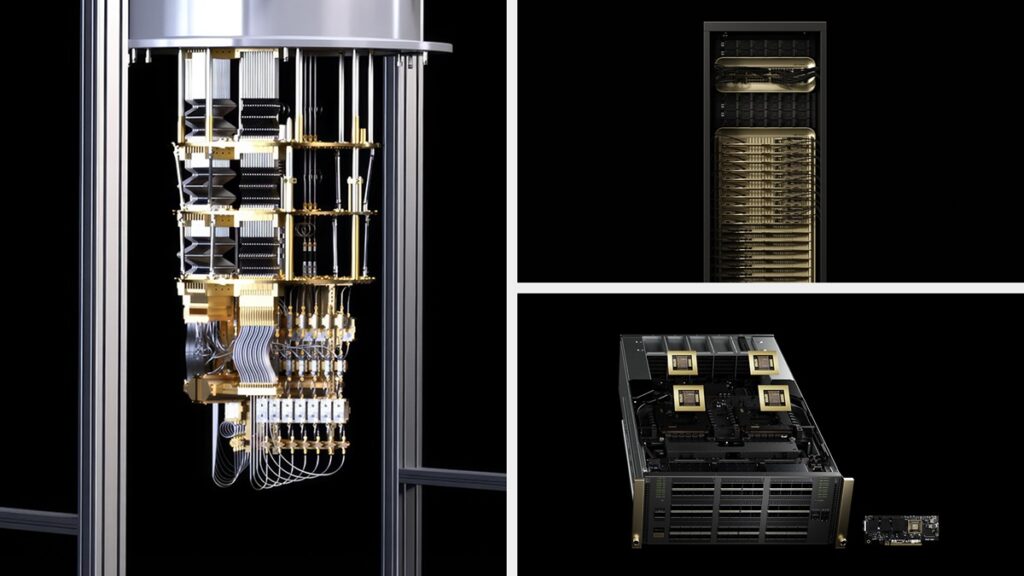
Nvidia also announced that RIKEN, Japan’s leading national research institute, is integrating Nvidia GB200 NVL4 systems with two new supercomputers in Japan — one built for AI for science and the other for quantum computing.
The first system will deploy 1,600 Nvidia Blackwell GPUs, using the GB200 NVL4 platform and interconnected by NVIDIA Quantum-X800 InfiniBand networking, as part of RIKEN’s AI for science initiative. The system will advance research in areas such as life sciences, materials science, climate and weather forecasting, manufacturing and laboratory automations.
The second system, dedicated to quantum computing, will feature 540 Nvidia Blackwell GPUs — also using the GB200 NVL4 platform and interconnected by NVIDIA Quantum-X800 InfiniBand networking — to accelerate research in quantum algorithms, hybrid simulation and quantum-classical computing methods.
“RIKEN has long been one of the world’s great scientific institutions, and today it
stands at the forefront of a new era in computing,” said Ian Buck, vice president of
hyperscale and high-performance computing (HPC) at Nvidia, in a statement. “Together, we’re helping Japan build the foundation for sovereign innovation that will drive breakthroughs to solve the world’s most complex scientific and industrial challenges.”
“Integrating the Nvidia GB200 NVL4 accelerated computing platform with our next-generation supercomputers represents a pivotal advancement for Japan’s science infrastructure,” said Satoshi Matsuoka, director of the RIKEN Center for Computational Science. “Our partnership will create one of the world’s leading unified platforms for AI, quantum and high-performance computing, allowing researchers to unlock and accelerate discoveries in fields ranging from basic sciences to industrial applications for businesses and society.”