
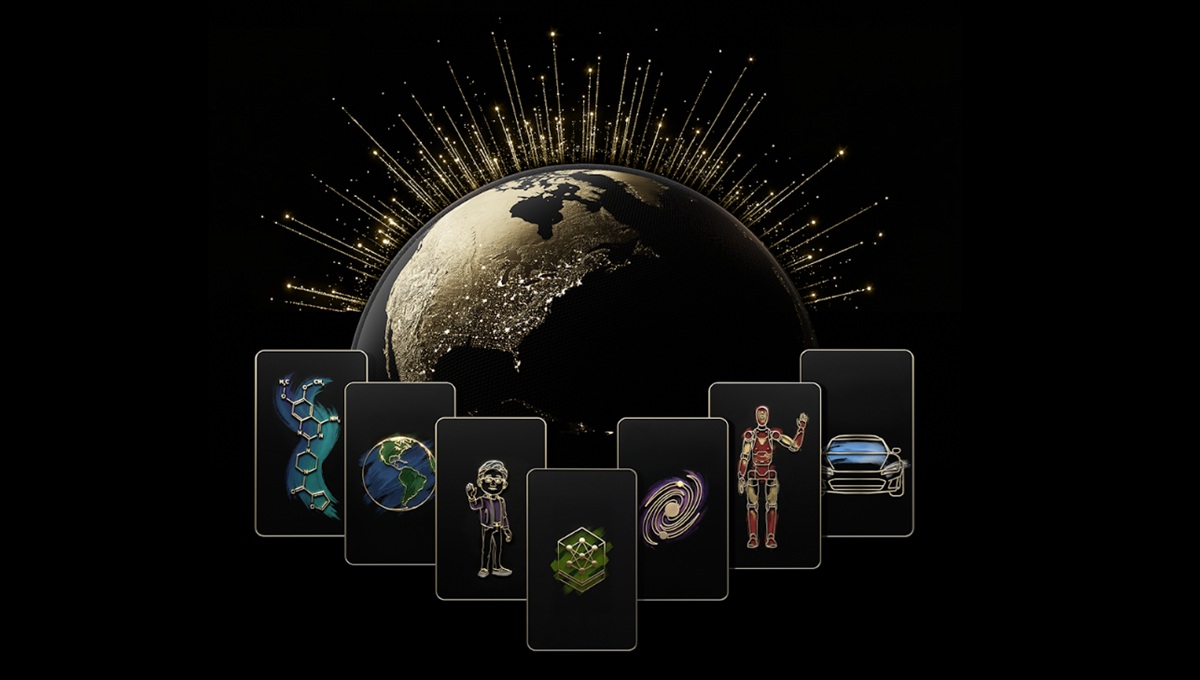
Nvidia announced it is expanding its open model families to power the next wave of agentic, physical and healthcare AI.
Nvidia said it is introducing new models that enable developers and scientists to build intelligent systems that can reason and act across digital and real-world environments.
Open models are essential to advancing innovation at global scale. Nvidia’s expanding
portfolio — including Nvidia Nemotron for agentic systems, Nvidia Cosmos for
physical AI, Nvidia Alpamayo for autonomous vehicles, Nvidia Isaac GR00T for robotics
and Nvidia BioNeMo for biomedical research — contributes advanced models and
frameworks to unlock new capabilities across industries.
Nvidia announced the news during the GTC keynote by CEO Jensen Huang at the company’s GTC event on Monday in San Jose, California.
“Open source AI has become a global force for innovation,” said Kari Briski, vice president
of generative AI software at Nvidia, in a statemet. “From biology and scientific discovery to robotics and autonomous machines, Nvidia open model families extend intelligence beyond language, enabling developers worldwide to build intelligent agents and power breakthroughs across digital and physical industries.”
Nvidia Nemotron 3 Ultra, Omni and VoiceChat Models power AI agents
The Nvidia Nemotron family is expanding with omni-understanding models across
language, vision, voice and safety, extending multimodal intelligence to help developers
build specialized, agentic AI.
Nvidia Nemotron 3 omni-understanding multimodal models power AI agents, delivering
natural conversations, complex reasoning and advanced visual capabilities.
● Nemotron 3 Ultra delivers frontier-level intelligence with 5x throughput efficiency
with the NVFP4 format on the Nvidia Blackwell platform to power AI-native applications such as coding assistants, search and complex workflow automation.
● Nemotron 3 Omni integrates audio, vision and language understanding, allowing AI
agents to extract insights from videos and documents with high efficiency and accuracy.
● Nemotron 3 VoiceChat supports real-time conversations in which AI listens and responds simultaneously. The model combines automatic speech recognition, large
language model processing and text-to-speech capabilities in a single system.
● Nemotron safety models and retrieval pipeline strengthen trustworthy multimodal
systems by detecting unsafe content across text and images, while an agentic retrieval pipeline improves the relevance and accuracy of outputs.
LangChain has integrated Nvidia Nemotron models and other Agent Toolkit software into
its agent development platform, enabling businesses to build, deploy and monitor intelligent AI assistants that can automate complex tasks at enterprise scale.
Leading companies including Automation Anywhere, CodeRabbit, CrowdStrike, Cursor,
Factory, Distyl, Genspark, Perplexity and ServiceNow are deploying Nvidia Nemotron
models to power advanced agentic applications.
Edison Scientific is using Nvidia Nemotron as an integral component of Kosmos, an autonomous AI scientist used by more than 50,000 researchers that performs hundreds of research tasks in parallel, compressing months of research into a day.
AI developers worldwide are using Nemotron models data and frameworks to build
sovereign models that serve billions of people in their native languages and align with local cultures and values. These include AI Singapore, Bielik.ai, Linagora, Soofi, Stockmark,
Trillion Labs, Viettel and YTL AI Labs.
Nvidia has also released Nemotron-Personas, a collection of privacy-preserving, fully
synthetic datasets grounded in local census and demographic data. The France dataset,
developed in collaboration with Pleias, is available today, joining existing datasets for the
U.S., Japan, India, Brazil and Singapore.
New open models advance physical AI reasoning
Nvidia is accelerating the development of autonomous systems with new foundation
models and simulation tools designed to help robots and vehicles perceive, reason and act in the physical world. These include:
● Nvidia Cosmos 3, the first world foundation model to unify synthetic world generation, physical AI reasoning and action simulation, is expected to come soon, helping physical AI operate in complex environments.
● Nvidia Isaac GR00T N1.7, an open reasoning vision language action (VLA) model purpose-built for humanoids, is now commercially viable for real-world deployment.
● Nvidia Alpamayo 1.5, a reasoning VLA model, supercharges autonomous vehicles reasoning with navigation guidance, prompt conditioning, flexible multi-camera support and configurable camera parameters.
During his GTC keynote, Nvidia’s Huang also previewed GR00T N2, a next-generation robot foundation model based on DreamZero research. Built on a new world action model architecture, the model helps robots succeed at new tasks in new environments more than twice as often as leading VLA models. Slated to be available by the end of the year, GR00T N2 currently ranks No. 1 on MolmoSpaces and RoboArena for generalist robot policies.
HCLTech, Johnson & Johnson MedTech, Milestone Systems, mimic robotics, Skild AI, Tulip,
and The Toyota Research Institute are using Nvidia Cosmos to accelerate physical AI
training and video analytics. Humanoid, LG Electronics, Neura and Noble Machines are
adopting Nvidia Isaac GR00T N1.7 to scale humanoid robot deployment.
Open models accelerate healthcare and life sciences research
Nvidia is advancing AI-driven discovery in healthcare and life sciences with open,
multimodal foundation models and datasets that accelerate biomedical research, drug
discovery, medical imaging and understanding of scientific literature.
Nvidia BioNeMo is expanding as an open AI development platform for healthcare and life
sciences, enabling researchers to model, design and simulate biological systems at scale.
Proteina-Complexa is a generative model for protein binder design that accelerates
structure-based drug discovery and therapeutic development. Novo Nordisk, Viva Biotech
and Manifold Bio are using Proteina-Complexa to design proteins that bind to a target
protein, and have experimentally tested the generated designs.
Nvidia has collaborated with EMBL’s European Bioinformatics Institute, Google DeepMind
and Seoul National University to massively expand the AlphaFold Protein Structure Database — calculating about 30 million protein complex predictions and adding 1.7 million high-confidence predictions to the AlphaFold database — to speed the discovery of new drug targets and disease biology.
Availability
Select Nvidia open models, data and frameworks are available on GitHub and Hugging
Face, a range of cloud, inference and AI infrastructure platforms, and build.nvidia.com.
Many of the models are also available as Nvidia NIM microservices for secure, scalable
deployment on any NVIDIA-accelerated infrastructure, from the edge to the cloud.