
Vibe coding is making it easier for kids to make games — but could prevent them from developing a deeper understanding of game creation.
A research report by the University of Macau and Federal Institute of Technology in Zurich shows that AI coding tools are helping kids build games faster, but that these tools are short-circuiting the learning process behind game development. The authors of the report plan to share their findings during a presentation at the 2026 Association for Computing Machinery conference in Barcelona on April 16.
During the AI vibe coding study, researchers observed Chinese students between the ages of 7 and 11 using AI coding tools to build projects — including an AI game coding tool called Stax — then analyzed their output, recording the entire creative process from start to finish. The study found that the majority of students’ activity involved testing or debugging their prototypes, with students rarely visiting their code, treating game creation more like playtesting than programming.
Many of the participants in the study chose to generate full scripts rather than building their logic piece-by-piece, according to Kanye Wang, a researcher at the University of Macau, in a written interview with GamesBeat. When something broke, students would simply regenerate their scripts or give up on their approach altogether rather than tracing through the code to find the specific problem.
“That pattern — ‘does it run?’ replacing ‘how does it work?’ — is the thing worth watching,” Wang said. “If it becomes the default mode, students end up with a kind of surface familiarity with games without really internalizing how things like event handling, state or condition logic actually function under the hood.”
Wang said he doesn’t believe AI coding tools inherently enforce a surface-level understanding of game development, but that these tools often implicitly assume users have expert-level game creation knowledge, which can force novice game makers to lean too heavily on AI assistance.
“With the right kind of scaffolding — asking students to explain what the code does, compare different implementations, or make manual edits — the same tools could push understanding deeper rather than bypass it,” he told GamesBeat.
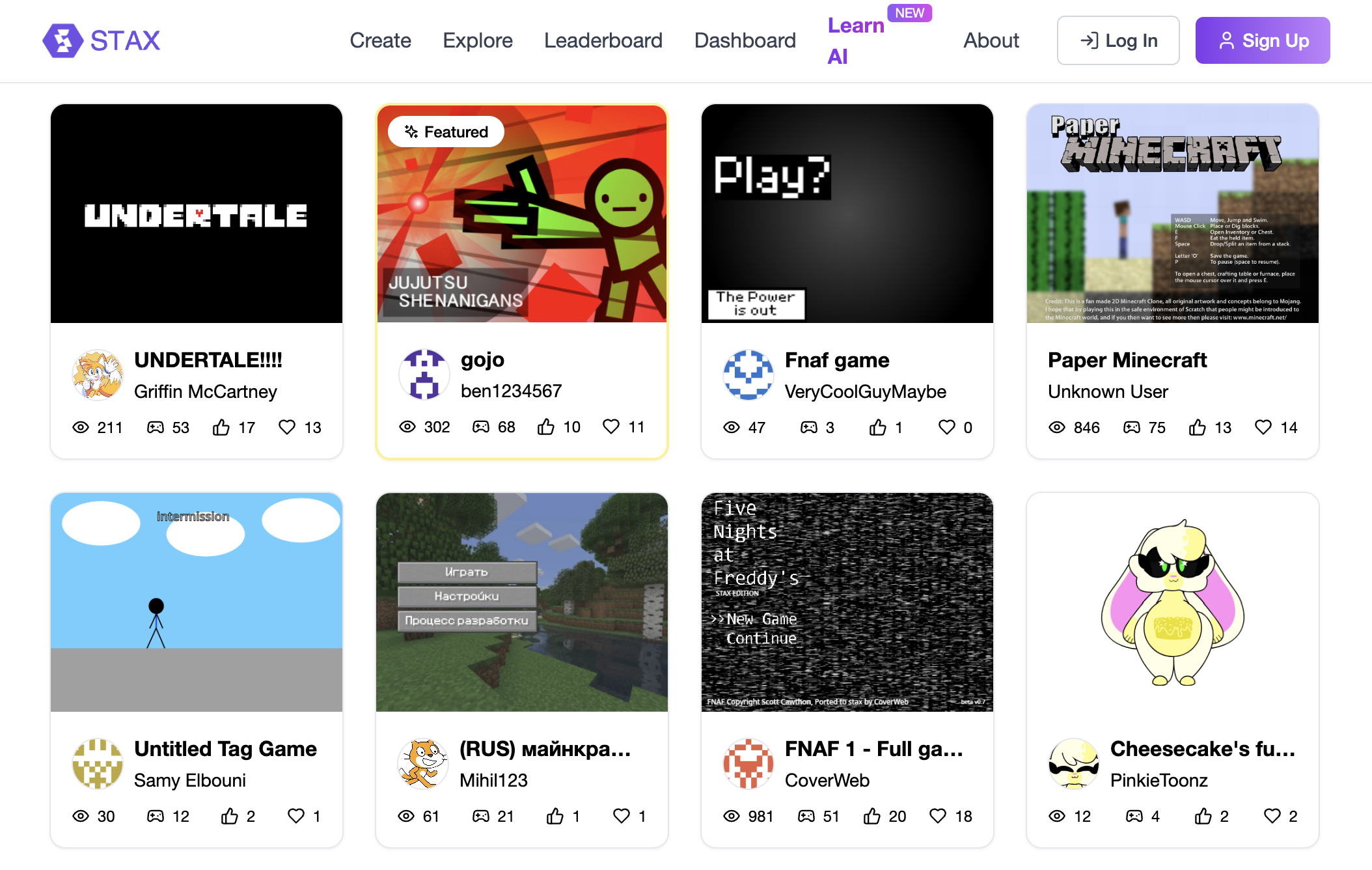
As game developers’ use of AI coding tools increases, AI vibe coding is entering the educational side of game making. Stax, a tool built by the company Polylabs, is one of the first dedicated game development vibe coding tools intended for children in an educational setting. Polylabs co-founder and CEO Ping He is already applying Wang’s and other researchers’ findings to future development of Stax, with plans to run larger-scale studies to inform the project.
“Designing AI ‘vibe coding’ and gamified learning for children is fundamentally different from building productivity tools for adults; it requires a delicate balance of play and genuine learning,” He said in an interview with GamesBeat. “A practical consideration for Stax is that it sits right at the intersection of gaming and computational education. Depending on the end user — whether it’s a school prioritizing a strict curriculum or a student exploring freely at home — our feature set needs to adapt.”
In addition to the University of Macau and Federal Institute of Technology in Zurich’s AI vibe coding study, Polylabs also recently collaborated with North Carolina State University on a study exploring the effects of chatbots and other AI tools on children’s learning in classroom settings. The study revealed middle-school teachers’ mixed perceptions of AI, with strong benefits like building prompting skills and self confidence — but potential drawbacks including a decline in critical thinking among learners.
“Teachers are more interested in seeing that their students know the fundamentals and coding logic, but are just using AI as an assistant, not over-relying on AI,” said Bahare Riahi, a researcher at NCSU, in an interview with GamesBeat. “Over-reliance on AI is one of the biggest concerns for teachers.”