
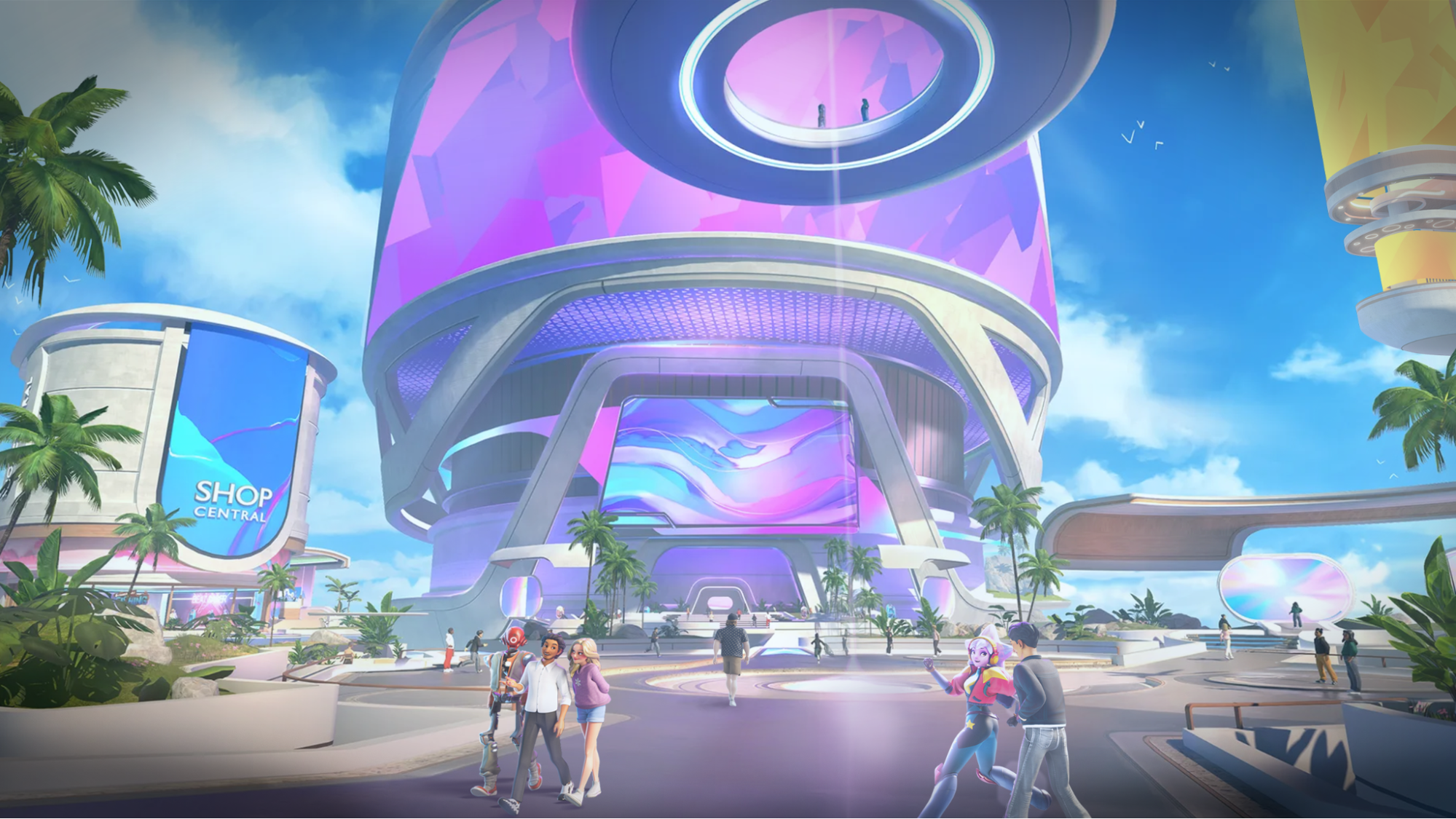
After struggling for years to find purchase in virtual reality, Meta’s Horizon Worlds platform is making a quiet comeback after pivoting to a mobile-focused user experience in early 2025.
Meta launched Horizon Worlds in December 2021, at the peak of the metaverse hype wave sparked by the company’s October 2021 rebrand from “Facebook” to “Meta.” Like Roblox and Fortnite, Horizon Worlds is a user-generated content (UGC) platform, giving users the ability to build, share and monetize custom-designed virtual worlds. Unlike other UGC platforms, which users primarily access via PCs, consoles or mobile devices, Horizon Worlds launched as a virtual reality platform. Until September 2023, when Horizon Worlds opened up early access to mobile and web browser users, the only way to access experiences on the platform was via Meta Quest VR headsets.
For years, the VR user experience that set Horizon Worlds apart also held it back. VR devices have not yet significantly penetrated the U.S. market, with overall headset sales actually declining by 10 percent year-over-year between 2023 and 2024, according to a December 2024 Omdia report. As VR languished, so did Horizon Worlds; in 2022, most users spent less than a month on the platform before giving it up, according to a Wall Street Journal report.
The pivot to mobile
As 2024 came to an end, the builders of Horizon Worlds realized they would need to separate Horizon Worlds from its VR focus if they wanted to successfully scale the platform. In November 2024, the company began an intentional push to improve the mobile user experience in Horizon Worlds, with the aim of making mobile the platform’s primary entry point. In early 2025, Horizon Worlds enabled game development for mobile-only users, allowing developers to design their games without regard for the VR experience. And on December 4, Bloomberg News reported Meta’s plans to cut its metaverse budget by up to 30 percent in the coming year, the latest signal of the company’s decreasing focus on VR.
“The long-term goal is to get a billion people connected, and if you just pragmatically look at the math for how that will be achieved in the next few years, it cannot only rely on VR devices being sold and hitting that penetration,” said Meta senior director of product management Sean Liu in an interview with GamesBeat. “If you look at the numbers, you’re like, ‘hey, you have to have a mobile story here.’”
So far, Horizon Worlds’ mobile pivot appears to be paying off. Monthly active users in Horizon’s mobile-first worlds have grown by four times over the past year, per a September Meta blog post, with in-world purchases in Horizon Worlds up by 280 percent in 2025, according to numbers shared by a Meta representative.
“At the beginning of the year, we probably had less than a dozen truly built-for-mobile worlds,” Liu said. “And now, we have 5,000 of them.”
Meta’s ongoing updates to Horizon Worlds are not limited to the platform’s mobile expansions. In February, the company announced a $50 million fund for creators in Horizon Worlds, with plans to disburse all of the funds to participating creators by the end of 2025 in the form of commissions, contest prizes and engagement payouts. The company invited a group of user-generated content creators from both Horizon Worlds and other platforms to attend its Meta Connect conference in September 2025, resulting in the event’s highest-ever UGC creator presence.
“It was creators from Roblox, Fortnite, Minecraft — even some creators inside of Meta already,” said Fortnite creator and developer Matthew “Immature Gamer” Zanazzo, who attended the conference on Meta’s invitation. “And it was a good presence, a good turnout. I think there were at least 50 to 100 creators.”
A creator renaissance
UGC creators have responded positively to Meta’s efforts to woo them over to Horizon Worlds. Over the past year, experienced creators and creator studios the cut their teeth building virtual worlds inside other platforms have started to put more time and money into developing Horizon Worlds experiences, from the Roblox-focused studio Sawhorse Productions to the Fortnite-native creator studio Creators Corp. Sawhorse co-founder and head of interactive Nic Hill said that he has observed a steady traffic increase inside his company’s Horizon Worlds experiences, although he declined to share specific numbers and Horizon Worlds does not publish user traffic numbers.
“A third or half of the world has a Meta account, right? So, strategically, if they can achieve that, — get Horizon in front of all those people, get them playing, get accounts built and growing — then, all of a sudden, you’ve got a big platform that’s bigger than Roblox,” Hill said in an interview with GamesBeat.
Creators Corp. has taken an even bigger step into Horizon Worlds, with the studio’s founder and CEO Margot Rodde estimating that her company had dedicated 70 percent of its time and resources to Horizon Worlds development in 2025. What sets Horizon apart for Rodde, whose studio started out in Unreal Editor for Fortnite, is that she believes Creators Corp. has received more direct support from Meta in 2025, both through the platform’s creator fund and the help of a dedicated internal team.
“We’re able to provide valuable feedback on a number of different things — not just purely the game or the development part of it, but also how they might have to approach early IP partnerships or brand integrations or influencer partnerships, and so on,” Rodde said in an interview with GamesBeat. “Being able to exchange ideas and just brainstorm with them is really interesting, and it’s very encouraging for us.”
Rodde’s interest in Horizon Worlds was also motivated in part by her frustration with Epic Games’ approach to Fortnite developer relations. Although Epic Games has been gradually implementing new creator discovery and monetization tools — including the introduction of in-game item sales, which Epic announced in September for a December 2025 launch and recently delayed to launch on January 9 — Rodde told GamesBeat that she believed Epic’s interest in creators’ feedback had declined since the early days of Unreal Editor for Fortnite, in contrast with Meta’s growing interest in UGC creators.
“I’m not mad at Epic for not doing that with us,” she said. “It took us a little bit of time to get used to the platform and get our head around it, and by that time, they were not seeking that kind of feedback anymore — which I think is a mistake for them.”
Beyond Horizon Worlds’ influx of creators and creator studios, UGC creators who have been on the platform since its VR era are also benefiting from its mobile comeback, with prominent Horizon Worlds creator Eugene “Emorgul” Morgulis reporting an increase in traffic to his experiences in 2025, though he declined to share specific numbers. In addition to his own creations, Morgulis has also taken on more work with studios like Sawhorse as they push into Horizon Worlds.
“There’s room for a lot of different experiences on Horizon, and if these professionally developed studio ones bring people in, they will spread out and find other stuff,” Morgulis said in an interview with GamesBeat. “The more studios — the more people — that come in, the more creators like me can partner with those studios to make some really fun, quirky, cool experiences.”
And once players are inside one of Morgulis’ worlds, they keep coming back. To keep players engaged, Morgulis maintains an active Discord server that he uses to collect player feedback, runs polls about the new content players desire most and operates competitive leagues in worlds like “Element Battling,” which the creator said “is loosely, but legally, inspired by ‘Avatar: The Last Airbender.’”
“They’ve formed their own friendships, their own communities here,” Morgulis said. “Like, they are on season two of a league with 30 teams fighting it out.”
The brand question
Horizon Worlds’ mobile push has succeeded in bringing more players and creators onto the platform, but a key puzzle piece is still largely absent from the equation: brands and advertisers. Platforms like Fortnite and Roblox have developed robust brand–creator ecosystems, with advertisers paying creators to build custom-branded virtual worlds or integrate brands into their pre-existing experiences.
Some advertisers have dipped their toes into Horizon Worlds in 2025 — in April, the film production company Blumhouse launched its “Blumhouse Horrorverse” on the platform to promote films like “M3GAN and “The Purge, and McDonald’s launched a “McDonaldland” experience on Horizon Worlds in August — but for the most part, major brands have not yet opened up their purse strings to the Horizon Worlds advertising opportunity.
Liu, the Meta executive, acknowledged that brands are “a big part of the equation” for UGC platforms and acknowledged that building a larger brand presence on Horizon Worlds is one of Meta’s long-term goals for Horizon Worlds, though he flagged the growing number of entertainment IP activations on the platform, including both Blumhouse’s “Horrorverse” and a world launched by NBC Universal to promote “The Office” in September.
“A lot of brands still view us, certainly, as a lot more nascent — but we’re trying to expand that brand portfolio,” he said.
Although Meta’s reported four times growth in monthly mobile user activity in 2025 is encouraging — and the aforementioned 5,000-mobile-world statistic is a meaningful data point — Horizon Worlds has not yet reached the proven scale necessary to convince more brands to dip their toes into the platform. Advertisers want to see concrete numbers showing the scale and reach of media opportunities, and Meta has not publicly released these types of figures for Horizon Worlds since February 2022, when the company announced that the platform’s monthly user base was roughly 300,000.
If Meta wants to get advertisers to bite on Horizon Worlds, the company will need to play the long game, continuing to build goodwill with creators — and fill the platform with more content — to spark organic user growth.
“While Horizon is seeing a resurgence with creators and their fans, brands tend to move a little slower. Before jumping in, there typically needs to be signs of steady audience scale, clear and ownable opportunities for brands and proven measurement,” said Sami Barnett, the senior director of gaming at the advertising agency The Marketing Arm. “Horizon could definitely get there, it’s just earlier in the curve when compared to more established UGC platforms like Roblox or Fortnite.”